
 Today, I am pleased to welcome Sylvia Barbara Soberton to my blog to discuss one of the women featured in her latest book, “Ladies-in-Waiting: Women Who Served Anne Boleyn.”
In 1533, Anne Boleyn had seven maids of honour and one mother of maids, Mrs. Marshall, who supervised them on the Queen’s behalf. Apart from Mary Howard, Margery Horsman, and Jane Ashley, the maids who served Anne in 1532, there was Mary Zouche, Mary Shelton, Margaret Gamage, and Elizabeth Holland. Howard and Shelton were Anne Boleyn’s first cousins, and Holland was mistress of the Queen’s uncle, the Duke of Norfolk. Margaret Gamage was the first cousin of Jane Boleyn; only Mary Zouche was not related to Anne Boleyn.
Hans Holbein’s sketch inscribed “M Souch” depicts an exceptionally good-looking young woman dressed in highly flattering French fashions, revealing her blonde hair and décolletage. It is often suggested that the sitter may be Anne Gainsford, who married George Zouche in the 1530s, but Anne Gainsford rarely appears in the court records, whereas Mary Zouche is mentioned often. This “M Souch” was most likely Mary Zouche, daughter of John Zouche, eighth Baron Zouche of Harringworth, and his first wife Dorothy Capell. At some point during the late 1520s, she wrote a letter to her cousin, John Arundel, imploring him to help her and her sister to find employment at court as maids to either Katharine of Aragon or Princess Mary. She may have served one of them, but in 1533 she was Anne Boleyn’s maid, attending the Queen’s coronation.
After Anne’s execution in 1536, Mistress Zouche went on to serve as maid of honour to Jane Seymour. She became one of this Queen’s favourite ladies, receiving jewellery, including beads and girdles. Zouche was still unmarried in 1542 when she was granted an annuity of £10 “in consideration of her services to the King and the late Queen Jane.”
 Description:
The aspects of Anne Boleyn’s life and death are fiercely debated by historians, yet her ladies-in-waiting remain an understudied topic. Much emphasis is usually put on Anne’s relationships with the men in her life: her suitors, her royal husband, her father and brother, and her putative lovers, who were executed on 17 May 1536. By concentrating on a previously neglected area of Anne Boleyn’s female household, this book seeks to identify the women who served Anne and investigate what roles ladies-in-waiting played in this Queen’s household.
 The story of Anne Boleyn and her rise and fall has been told throughout the centuries in numerous ways. With tales of this memorable monarch came rumors of what happened inside her court and the women who served her during her reign. We tend to look at her life through the lens of the men who interacted with Anne Boleyn at court, but what about the women who knew her? Stories of ladies-in-waiting selling the queen out and secret romances ran rampant throughout the centuries, but how much truth is in these tales? Sylvia Barbara Soberton explores these questions in her latest book, “Ladies-in-Waiting: Women Who Served Anne Boleyn.”
 In any dynasty, those closest to the throne are the most at risk of dealing with suspicions and conspiracies. Those who were not next in line for the throne were seen as threats, especially those whose bloodline was a bit stronger than those who sat on the throne. The Tudor dynasty’s biggest threat was the few Plantagenets who still lived at court. The family that had the most Plantagenet blood in their veins and poised the most significant threat was the Pole family. However, one woman who was very close to Henry VIII and his family married a man who had Plantagenet blood in his veins. Her name was Gertrude Courtenay, the Marchioness of Exeter, and her story is finally getting the light it deserves in Sylvia Barbara Soberton’s latest book, “The Forgotten Tudor Women: Gertrude Courtenay: Wife and Mother of the Last Plantagenets.”
 Today, I am pleased to welcome Sylvia Barbara Soberton back to discuss another forgotten Tudor woman, Gertrude Courtenay, who is the subject of her latest book, “The Forgotten Tudor Women: Gertrude Courtenay. Wife and Mother of the last Plantagenets”.
 About the Book
 The story of the Tudor dynasty has been told from many different angles. Each monarch has been explored through lenses like social and political history numerous times. However, there is a new approach that is coming into the forefront of historical research and that is the focus on the medical history of the Tudors. Each Tudor monarch, from Henry VII to Elizabeth I, had some sort of bout with illness that would drastically alter the course of their reigns and the future of the dynasty. In Sylvia Barbara Soberton’s latest book, “Medical Downfall of the Tudors: Sex, Reproduction and Succession”, she explores the more intimate aspects of this turbulent dynasty to discover the truth about why they fell.
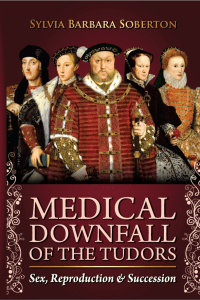 Today, I would like to welcome Sylvia Barbara Soberton to my blog as part of the book tour to promote her latest book, “Medical Downfall of the Tudors”, which is available now.
 Adventures of a Tudor Nerd