
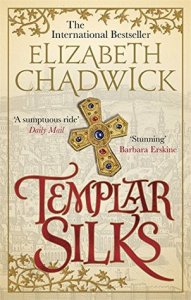
One of the greatest knights in English history is lying on his deathbed. As his loved ones stay near his bedside, William Marshal remembers his time in the Outremer, where he is to perform a final duty to his lord. William and his companions soon realize that the Holy Land is more treacherous than they could ever imagine, and the most dangerous person for William is the concubine Paschia de Riveri. Elizabeth Chadwick concludes her William Marshal series with novel six in the series, “Templar Silks.”
I have enjoyed the previous novels that I have read by Elizabeth Chadwick, and I wanted to read more from her. I saw this book at a used book store, and I wanted to read it, even though I had not read the previous five books in the series.
We begin this final adventure with William Marshal in the year 1219. William is on death’s door and has asked his squire, Jean D’ Earley, to retrieve his burial silks from Wales. These were not just any burial silks, but the ones that he was given by the Templars when he was in Jerusalem. To understand why William went to Jerusalem, Chadwick goes back to 1183, when William was in the service of the Young King Harry, the son of Henry II and Alienor of Aquitaine. Harry decides that they would raid Rocamadour to pay for their endeavours, but this would be one of the last decisions he would ever make. On his deathbed, Harry asked William and his men to take his cloak to Jerusalem so that he could be forgiven for his sins of robbing the church.
William agrees, and so he, his brother Ancel, and a handful of others make their way to Jerusalem. Once they make it into the Outremer, they soon realize that they are in the midst of a fight for the throne. King Baldwin IV of Jerusalem is dying, and there is a fight within his court for the throne, primarily from Baldwin’s sister Sybilla and her husband Guy de Lusignan, William’s mortal enemy. To top it all off, William falls in love with the concubine of Heraclius, Paschia de Riveri. William and his men must survive the politics of the Outremer to return home to his beloved England.
Overall, I thoroughly enjoyed this novel, despite not having read the previous books in the series. Now, I want to read the rest of the series to see William Marhsal’s life through Chadwick’s eyes. If you have read the previous books in the William Marshal series, I would recommend that you read the final book in the series, “Templar Silks” by Elizabeth Chadwick.
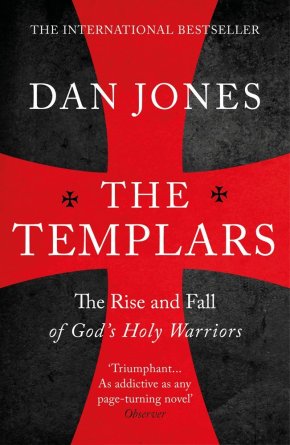 The Crusades were a series of wars between Christian and Muslim warriors for the right to control the Holy Lands of the Middle East. Many men on both sides earned legacies that would surpass their earthly bodies during bloody battles. It created many bands of knights that would last for generations, such as the Hospitallers and the Teutonic Knights. The Templars were the most famous of these knight groups, who may have lasted only for less than two hundred years, but whose legacy would turn into myth. Dan Jones has taken on the arduous task of discerning fact from fiction about the Templars in his book, “The Templars: The Rise and Fall of God’s Holy Warriors.”
 Adventures of a Tudor Nerd