
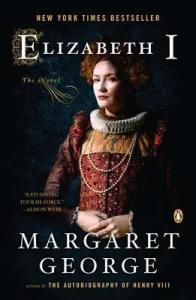
 The stories of queens have been told in numerous ways for centuries, but one of the most famous queens in human history is the Virgin Queen, Elizabeth I. The daughter of Anne Boleyn and Henry VIII who famously decided not to marry any man and instead devout her entire life to serve England’s people. That does not mean she was subservient to others she demanded respect and adoration from her subjects. Most stories of Elizabeth I begin in her golden years, but what could a novel about the queen’s silver years tell us about her personality, her reign, and the people who choose to follow or rebel against the famous queen? Margaret George gives her readers an innovative look at the titular queen in her novel, “Elizabeth I.”
This is only the second novel I have read written by Margaret George, the first being the brilliant “The Autobiography of Henry VIII.” I knew that she had written a novel about Elizabeth I, but I had not had the chance to read it until I saw it at a used bookstore. It was an instant buy for me even before I read the description, but the blurb made me even more intrigued.
George does not begin with Elizabeth’s coronation in 1558, like many novels about Elizabeth, but in the year 1588, which was arguably the queen’s most difficult challenge, fending off the Spanish Armada. To start at this most pivotal moment in Elizabeth’s reign is a bold choice that pays off because it sets the tone for the rest of the novel. Nothing is stable for the queen even after victory is won. Shortly after the Armada is defeated, the love of Elizabeth’s life, Robert Dudley Earl of Leicester dies. It is a huge loss for the queen, but she is not the only one who loves Leicester. He leaves behind his wife and cousin to the queen, Lettice Knollys, however, the two women cannot share their grief as the queen banished her cousin from court after she heard about the marriage.
The only one who can connect the two women at this point is Lettice’s son the Earl of Essex, who desires to be a great man, so he becomes a favorite of Queen Elizabeth. The arrogant young up-starter soon finds out that court is not all that he dreamed it would be and that to be a great man, he has to follow every rule of his monarch, which goes as well as you would imagine. What I appreciate about this novel is that George does not gloss over Elizabeth’s reign and instead chooses to show how muddy the political landscape was during the late Elizabethan age. We also get to see events that are not often featured in other novels about the Elizabethan age, such as Roanoke, Grace O’Malley, the return of the Armada, diplomats from farther countries, and the connection between Lettice Knollys and William Shakespeare. She fought every second of every day to keep her crown because she never knew who was the threat and when they would strike next until her dying breath.
I think this novel does an excellent job of showing George’s readers what Elizabeth I was like further into her reign. It balanced both the harsh reality of the Tudor court with plenty of intrigue with Elizabeth the person who had her heart broken on more than one occasion and had to be harsh to fight for what she loved, the English people. If you want an unforgettable portrayal of the Virgin Queen and her court towards the end of her reign, I highly recommend you read, “Elizabeth I” by Margaret George.
 Henry VIII is one of the most notorious kings who ever ruled England. He had six wives, two of which were executed, three legitimate children who would change England forever, and he decided to break from Rome and create his own church. Henry was such a larger than life figure, yet when it comes to historical fiction, he tends to play a smaller part in books about his six wives and is often portrayed as a villain. Henry doesn’t get to have his own voice, in historical fiction, on some of the most important parts in his life, so Margaret George decided to give him one in her book, “The Autobiography of Henry VIII: With Notes by His Fool, Will Somers,” to explain what could have been going on in his mind during these pivotal moments.
 Adventures of a Tudor Nerd