
 August 22, 1485, marked the end of the Plantagenet Dynasty with the death of King Richard III at the Battle of Bosworth Field. The man who succeeded him as King of England after his death was young Henry Tudor, whose dynasty would live in infamy in English history, thought that he was done fighting on the battlefield for his right to rule. This was only the beginning of a decades-long war against those who claimed to be lingering shadows of the past. They claimed to be the Princes in the Tower, whose disappearances in 1483 left to doubt and confusion on what happened to them and gave those who despised this new dynasty opportunity to exploit a young king’s fear of being overthrown. The young men who made this king who won his way to the throne on a battlefield quake in his boots are known today as “the Pretenders”, but who were they? In Nathen Amin’s much-anticipated book, “Henry VII and the Tudor Pretenders: Simnel, Warbeck, and Warwick”, he traces the origins of each pretender to show what type of threat that they posed to the first Tudor king.
I would like to thank Amberley Publishing for sending me a copy of this book. When Nathen Amin announced that he was writing this particular book, I was instantly interested in reading it. I thoroughly enjoyed his “ The House of Beaufort”, so I wanted to see how he would approach the enigmas of the pretenders. I was not disappointed as this was a historically riveting masterpiece.
To understand why the pretenders were able to gain supporters, Amin takes his readers to the Tower where the two sons of King Edward IV disappeared under mysterious circumstances. Since neither King Richard III nor King Henry VII could answer if the princes were either alive or dead, we have been left with Schrodinger’s cat-like situation. This proved to be a mistake on Henry VII’s part as it allowed young men with relatively obscure origins to take advantage and try to overthrow the king and his family. Two of the most famous pretenders were Lambert Simnel and Perkin Warbeck, who had help near and far to try to end the Tudor dynasty before it really began. However, there were others including the tragic tale of Edward, Earl of Warwick, whose only crime was to be born of Yorkist royal blood.
There have been other books that have touched on the topic of the pretenders, but what Amin has done in this particular book is nothing short of remarkable. By acting as a historian/detective, Amin dived deep into the archives to follow the path that these men took from obscurity to prominent threats to the crown. Along the way, Amin kept Henry VII and his actions central to the narrative to show a different side to the first Tudor king that many might not have anticipated.
To write such a definitive and thought-provoking nonfiction book on such shadowy figures like the pretenders is no easy feat. Amin created an outstanding narrative that balances scrupulous attention to details with a coherent and engaging writing style to bring the complex story of Henry VII and the pretenders to life for the modern age. If you love learning about new aspects of the Tudor dynasty, “Henry VII and the Tudor Pretenders: Simnel, Warbeck, and Warwick” by Nathen Amin is the book for you. This is easily my favorite book Nathen Amin has written thus far.
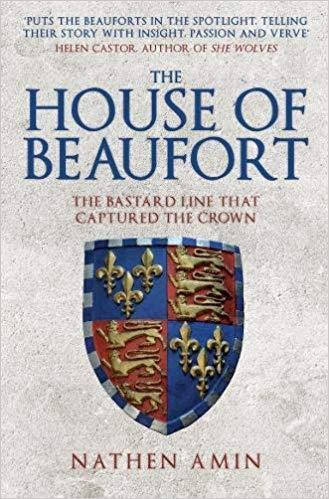 The houses of York, Lancaster, the Nevilles, the Howards, the Mowbrays, the Percys, and the Tudors are often recognized as the families involved in the Wars of the Roses. However, there was one more house that was just as important as the others; the Beauforts. The Beauforts were the sons and daughters of John of Gaunt, Duke of Lancaster and his mistress Katherine Swynford. They were considered bastards since they were born out of wedlock, yet they were connected to the house of Lancaster and rose to power by their own right. They would help change not only English history but the history of Europe forever. The Beauforts made a huge impact during the Hundred Years War and the Wars of the Roses, yet many people only recognize Margaret Beaufort and Edmund Beaufort 2nd Duke of Somerset. The Beauforts don’t get much attention. Nathen Amin, the founder of The Henry Tudor Society, wanted to tell the story of this remarkable family. It is in his book “The House of Beaufort: The Bastard Line that Captured the Crown”, that the Beauforts are given the attention that they rightfully deserve.
  Adventures of a Tudor Nerd