
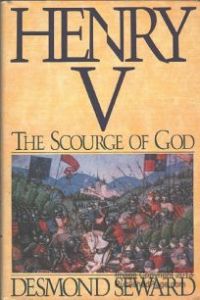
 In English history, there have been some legendary warrior kings, but none have captured the imagination of the general public quite like Henry V. He was the King who won a great victory at Agincourt, almost captured France, but died young and never got to see his son become king of both England and France, albeit for a short time. For the English, Henry V was seen as a hero to the nation, but is his legacy much darker? Desmond Seward dives into the archives to find a much more ruthless king for his biography, “Henry V: The Scourge of God.”
I found this book in a used bookstore after I read the most recent biography of Henry V by Dan Jones. I have heard of Desmond Seward, but I have only read one of his books before this one. I decided to see how a biography that’s almost 40 years old stands up today and how it compares to the narrative-driven biographies that are being published right now.
As Seward states in his introduction, many historians who have come before him have only focused on English sources. What Seward tries to do is show a different, darker side of the titular king, the side that the French saw when he was attacking them relentlessly. To begin with, Seward looks into how Henry of Bolingbroke, Henry’s father, became Henry IV. Since his father was a usurper, his control over the throne hung by a thread, so paranoia passed on from father to son. Henry V learned how to become a military leader through his expeditions in Wales to face off against Owain Glyndwr.
When his father died, Henry V became King of England, and he immediately set his sights on France. During this period of medieval history, the Hundred Years’ War was in full swing, and Henry V wanted to do whatever it took to destroy the French. He is most known for his victory over the French at the Battle of Agincourt, but he also took cities like Caen, Rouen, Paris, and Meaux. Henry V would be named the heir of King Charles VI of France, as well as gain a bride named Catherine of Valois, through the Treaty of Troyes. Henry V’s legacy seemed secure, but alas, he died young, and his dream of a united kingdom of France and England failed to prosper under his son, Henry VI.
While I do think that it is important to read older biographies to understand how our perceptions about historical figures have changed over time, I found this one a bit dry and overtly negative. It wasn’t as balanced as I hoped it would be. I think if you want to attempt reading this, take what Seward is saying with a grain of salt and balance it with a more contemporary biography to get a better picture of who the true King Henry V was. If you want to study more about Henry V, you might want to give “Henry V: The Scourge of God” by Desmond Seward a try.
 Adventures of a Tudor Nerd