
 When we think about the men who surrounded King Henry VIII, a few names come to mind. Cranmer, More, Wolsey, and Wroithesley are just a few, but the man who is synonymous with the infamous king’s reign is Thomas Cromwell. The man who helped Henry get his divorce from Katherine of Aragon saw both the rise and fall of Anne Boleyn. He also assisted in the dissolution of the monasteries and brought reform to England with the break from the Roman Catholic Church. To modern audiences, it feels as if we know everything that there was to know about Thomas Cromwell’s public life, but what was he like in his private life when his friends and family surrounded him? Caroline Angus gives her readers an insight into Cromwell’s personal life in her latest book, “The Private Life of Thomas Cromwell.”
Thank you, Pen and Sword Books and Net Galley, for sending me a copy of this book. I love finding new perspectives about historical figures, like Thomas Cromwell, so when I heard that Caroline Angus was writing this book, I was delighted. I wanted to see what new information this book could provide about Thomas Cromwell’s life.
Angus begins her new nonfiction book on Cromwell by showing the origins of the Cromwell family and how Thomas went from the son of a blacksmith to his journeys in Italy, especially in Florence. It is impressive to see how Thomas’ influential friends from Florence would help shape how he conducted business later on in life as one of King Henry VIII’s top counselors. Thomas must have been a polymath to achieve the astronomical rise to power that we see him go through that landed him in the workforce of Thomas Wolsey.
Under Thomas Wolsey, Thomas Cromwell’s private and public life became insanely busy as he gained the king’s respect. He would be the principal architect for the dissolution of monasteries and helped Henry VIII gain his divorce from Katherine of Aragon to marry Anne Boleyn. As Cromwell became a player in Tudor politics, he married Elizabeth Williams and had several children. As Cromwell’s family grew, so did Thomas’ roles at the court of Henry VIII. He was the king’s number one advisor and was asked to perform the most difficult tasks, like bringing the downfall of Anne Boleyn and breaking England from the Roman Catholic Church. In a way, Thomas Cromwell was the Tudor equivalent of Alexander Hamilton.
I enjoyed this book because we see Cromwell as a human being, not just some lofty historical figure. He was a man who climbed the social ladder with his talents and his connections throughout England and Europe. With every title and every bill passed, Cromwell gained new enemies, who would lead to Thomas Cromwell’s downfall after the disastrous marriage between Henry VIII and Anna of Cleves. His fall was so dramatically quick that even Henry VIII regretted killing Thomas Cromwell.
Angus’s passion for comprehensively telling Cromwell’s story for scholars and students of Tudor history shines through this book. Her research is meticulous as she balances Thomas’ public life and private life to tell the whole story of the legendary man. If you are interested in understanding the life of Henry VIII’s most faithful servant and trusted advisor, I recommend reading “The Private Life of Thomas Cromwell” by Caroline Angus.
 When we think of famous artists in the 15th and 16th centuries, we focus on the great European masters. Michelangelo, Leonardo da Vinci, and Albrecht Durer tend to come immediately to mind. However, one man from Augsburg, Germany, revolutionized how we viewed the Tudor dynasty through portraiture: Hans Holbein the Younger. Many are familiar with his famous works of art and how they influenced how the Tudors have been perceived for centuries, but the man behind the masterpieces has been overlooked. His story and how art was understood in the 16th century is told in Franny Moyle’s latest biography, “The King’s Painter: The Life of Hans Holbein.”
 One of the most popular Tudor historical fiction series in recent memory has revolved around the enigmatic Thomas Cromwell. Of course, I am talking about the famous
 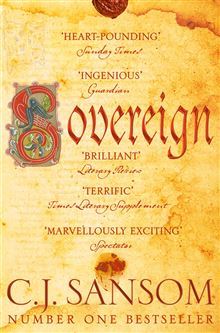 When one thinks about a royal Progress, we often think about the glitz and glam of the royal family traversing the entire country at a leisurely rate to inspire awe for their subjects. However, the Progress of 1541, when Henry VIII and his fifth wife Catherine Howard traveled to the hostile northern part of England, was anything but a casual visit. It was very political as Henry was trying to make the North submit to him after the Pilgrimage of Grace while at the same time he was waiting for a meeting with King James V of Scotland. It is the city of York and during this important Progress that C.J. Sansom shapes his latest adventure with his hunchback lawyer and part-time detective, Matthew Shardlake, in book three of the delightful Shardlake series, “Sovereign”.
 The story of the reign of King Henry VIII has been told mainly through his numerous marriages and through the lives of his children. Although his immediate family was a big part of his legacy, there is much more to his story than his tempestuous relationships. There were also his legal, religious, and military exploits. The ones who were with Henry when he made these decisions were the men who were loyal to him, his counselors and companions. Their tales are often told separately, until now. Tracy Borman has decided to masterfully combine their tales to explore the life of their infamous king in her latest biography, “Henry VIII and the Men Who Made Him”.
  Adventures of a Tudor Nerd