 Today, I am pleased to welcome Paul Walker, the author of “State of Treason” Book one of the William Constable Spy Thriller series, to my blog as part of his book tour with The Coffee Pot Book Club. Paul Walker will be discussing one of his characters, John Foxe.
One of the delights in writing historical fiction is discovering real characters from the past, translating bare facts recorded about them into thoughts and actions, then weaving these into your story. When I started researching the reign of Elizabeth I for State of Treason, the first book in the William Constable series, I came across Doctor John Foxe. Until then, I knew little about Foxe; having only a vague notion of him as an author and scholar in the sixteenth century. Delving deeper, it soon became apparent that Foxe was a celebrated figure and his Book of Martyrs was a bestseller in its time, second only to the Bible, and an important tool of Protestant propaganda.
Foxe was born around the year 1516 in Lincolnshire to a prosperous yeoman family and entered Oxford University when he was 18. He became a supporter of Martin Luther and was active in condemning the practice of selling pardons by the Catholic Church. While at Oxford he witnessed the burning of William Crowbridge for his role in publishing the Bible in English. During the reign of Henry VIII, he was critical of the church and when Mary came to the throne he fled to Europe with his wife where he befriended several continental Protestant scholars. It was in Basel that he wrote and published the first edition of his Book of Martyrs in Latin.
The full title runs to a long paragraph and could be considered a work of flash fiction itself. The book contains many gruesome illustrations of the executions of Protestant martyrs. This, and an understanding that Foxe was fiercely anti-Catholic, gave the initial impression of a stern, unbending religious fanatic. I was surprised, therefore, when I came upon an engraving, which, to my mind, showed a thoughtful and gentleman. In particular, he had a kind twinkle in his eyes. Reading more, I discovered he had a benign and forgiving nature and abhorred cruelty, even for those whose views he strongly opposed. He favoured the use of logical and theological arguments rather than maltreatment and execution to persuade those of different faiths.
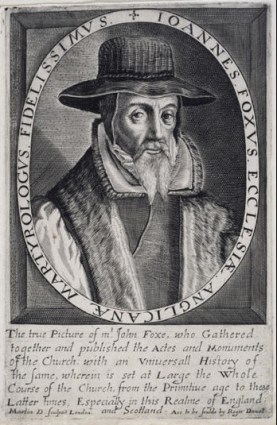
An instance that demonstrates his compassion and humour was when he advised against the execution of an Anabaptist, Joan Boucher, in the reign of Edward VI. Boucher was examined by a man named James Rogers, who insisted she should die by burning. Instead of burning, Foxe pleaded, “at least let another kind of death be chosen, answering better to the mildness of the Gospel.” When Rogers answered that in his opinion burning alive was gentler than many other forms of execution, Foxe said to Rogers, “… maybe the day will come when you yourself will have your hands full of the same gentle burning.”
In 1559, with Elizabeth on the throne, Foxe returned to England where he continued his scholarly work. I decided to incorporate Foxe as a character in State of Treason, which is set in London in 1578. The protagonist is William Constable, a fictitious physician, and scholar of mathematics and astronomy. Foxe’s faith becomes a foil for Constable’s man of science and logic. Together they form an unlikely friendship and formidable partnership in the fight to protect the English state against foreign and domestic intrigue.
Four editions of his Book of Martyrs were printed in Foxe’s lifetime with the fourth published in 1583 and derived works were published after his death. The first English edition was published in 1563 and contained 1,700 pages and 1.5 million words. These statistics were surpassed by the fourth edition which was four times the length of the Bible and described as the most physically imposing, complicated, and technically demanding book of its era.
Francis Walsingham, William Cecil, and other Protestant statesmen decided that Foxe’s Book of Martyrs could be used in the anti-Catholic propaganda campaign deployed against Mary, Queen of Scots, and her supporters. A copy was placed in almost every church and wealthy household and it was required onboard all ships that sailed to the New Lands or fought against Spain. It has been argued that it was one of the most influential books in the English language. Despite its renown and popularity, it is said that Foxe never earned a penny from any of the editions. He was an unworldly man who largely depended on the benevolence of wealthy patrons.
John Foxe died peacefully at his home in Grub Street, London in 1587.
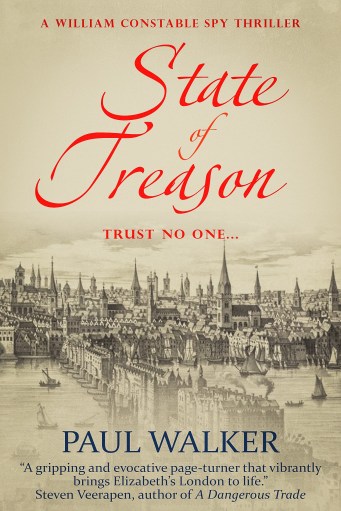
London, 1578
William Constable is a scholar of mathematics, astrology, and practices as a physician. He receives an unexpected summons to the Queen’s spymaster, Sir Francis Walsingham in the middle of the night. He fears for his life when he spies the tortured body of an old friend in the palace precincts.
His meeting with Walsingham takes an unexpected turn when he is charged to assist a renowned Puritan, John Foxe, in uncovering the secrets of a mysterious cabinet containing an astrological chart and coded message. Together, these claim Elizabeth has a hidden, illegitimate child (an “unknowing maid”) who will be declared to the masses and serve as the focus for an invasion.
Constable is swept up in the chase to uncover the identity of the plotters, unaware that he is also under suspicion. He schemes to gain the confidence of the adventurer John Hawkins and a rich merchant. Pressured into taking a role as court physician to pick up unguarded comments from nobles and others, he has become a reluctant intelligencer for Walsingham.
Do the stars and cipher speak true, or is there some other malign intent in the complex web of scheming?
Constable must race to unravel the threads of political manoeuvring for power before a new-found love and perhaps his own life is forfeit.
Amazon
Audio: Amazon UK • Amazon US

Paul Walker
Paul is married and lives in a village 30 miles north of London. Having worked in universities and run his own business, he is now a full-time writer of fiction and part-time director of an education trust. His writing in a garden shed is regularly disrupted by children and a growing number of grandchildren and dogs.
Paul writes historical fiction. He inherited his love of British history and historical fiction from his mother, who was an avid member of Richard III Society. The William Constable series of historical thrillers is based around real characters and events in the late sixteenth century. The first three books in the series are State of Treason; A Necessary Killing; and The Queen’s Devil. He promises more will follow.
Social Media Links:
Website • Twitter • Facebook

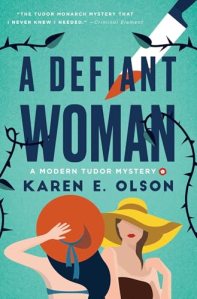 Have you ever wondered what the Tudors might be like in the modern day? What kind of life would they live, and would they all survive? What if King Henry VIII were a billionaire and most of his wives were still alive, including Anne Boleyn? Anne Boleyn is living but is in hiding from the rest of the Tudor clan and is separated from her daughter. When her daughter is kidnapped, Anne has to come back to her old life and team up with Henry’s latest wife to save her daughter. Can they save Anne’s daughter before it’s too late? Karen E. Olson brings the Tudors to the modern age in her latest novel, “A Defiant Woman.”
 When we think of Elizabethan England, we tend to think of the Golden Age of England. A time of discoveries and for the arts to flourish under the Virgin Queen, Elizabeth I. However, there is a darker side. It was also a time of espionage, fears of invasions from other countries, and the hatred between Catholics and Protestants. The dangers of the Elizabethan underworld have reached the queen, as there is an attempt on her life. Can Jack, the son of a crime boss, change his life and find the culprit before they find him, or will he be betrayed by those he calls his friends? Amie McNee explores the seedy underworld of Elizabethan England in her novel, “To Kill a Queen.”
 For centuries, the brave knights of Camelot and the Crusaders have searched for the Holy Grail. The cup that Jesus of Nazareth used during his Last Supper is rumored to be a vessel that can grant eternal life or miraculous healing powers. It can be a cup, plate, or stone, but in all stories, the Grail guardians and those searching for it are predominately male. But what if the guardians were male and female and the ones searching for it were predominately female? Alais from 11th-century France and Alice Tanner visiting France in 2007 share a connection that is centuries deep and it all started with a ring, a book, and an image of a labyrinth. How are these two connected to the labyrinth and the Grail and can they protect it from those who want to use it for their dark purposes? Kate Mosse weaves the tale of the Grail and the two women connected by fate in her novel, “Labyrinth.”
 Adventures of a Tudor Nerd