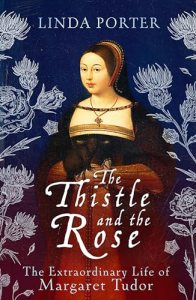
Book Review: “The Thistle and The Rose: The Extraordinary Life of Margaret Tudor” by Linda Porter

The Tudors have been an area of fascination for historians and history nerds alike for centuries. The attention tends to focus on either Henry VIII and his six wives or his daughter, Elizabeth I, but we need to remember that they were not the only Tudors. In fact, we should remember that Henry VIII had siblings, Arthur, Margaret, and Mary. While Arthur and Mary tend to get more attention due to their proximity to Henry VIII and his marital life, Margaret Tudor had her own eventful life as Queen of Scotland and the mother of King James V. Linda Porter tells Margaret’s story in her latest biography, “The Thistle and the Rose: The Extraordinary Life of Margaret Tudor.”

I had heard that Porter was writing a new biography about Margaret Tudor, so I knew I wanted to read it. I have read a few books about Margaret Tudor, but they have been relatively short, so I wanted to see what new information Porter would include in this book.

Margaret Tudor was the second child of King Henry VII and Queen Elizabeth of York. As such, she was destined to marry a foreign prince and create a strong alliance for the brand-new Tudor dynasty. Since her brother Arthur was betrothed to Catherine of Aragon, Margaret’s parents chose a match with Scotland and King James IV, who was twice the age of Margaret. As Queen of Scotland, Margaret did her best to bridge the gap between England and Scotland, deal with her husband’s mistresses and illegitimate children, and be a mother to her son, King James V.

Everything changed when James IV died at the Battle of Flodden. Margaret was now a widow and regent for the young King James V. To protect her family, Margaret decided to marry Archibald Douglas, 6th Earl of Angus, which turned out to be a trainwreck. Although Archibald did give Margaret her daughter, Margaret Douglas, he was stealing from Margaret’s own properties, which was a jerk move. Margaret wanted a divorce, but her dear brother Henry VIII was against the idea. A bit hypocritical, especially since he would divorce Catherine of Aragon a few years later. Eventually, Margaret would divorce Archibald and marry a third time to Henry Stewart, Lord Methven.

Throughout history, Margaret Tudor has been viewed negatively because she married Archibald so quickly, but Porter showed that Margaret should be applauded for how she survived during difficult circumstances. She fought for herself and her children, even if it meant that she was at odds with her husbands or her brother. Through her letters, we see how Margaret was a diplomat trying to make peace between England and Scotland.

Porter does an excellent job telling Margaret’s story in a respectful manner. This book is extremely well researched and easy to read. If you are a Tudor fan and you want to learn more about Henry VIII’s sister Margaret Tudor, I highly recommend you read “The Thistle and the Rose: The Extraordinary Life of Margaret Tudor” by Linda Porter.

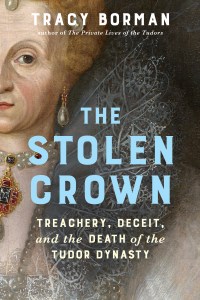
Book Review: “The Stolen Crown: Treachery, Deceit and the Death of the Tudor Dynasty” by Tracy Borman

It is March 1603, and the Virgin Queen is dying. She has no children to inherit her throne directly, so she must choose a successor. She chooses the son of Mary Queen of Scots, the queen who had been executed a few years before. James VI of Scotland will become James I of England, but was it as easy as William Camden makes it in his account? What does a recent discovery about Camden’s original manuscript of Annales tell us about James’ succession to the throne of England? Tracy explores the messy conflict to find an heir to the English throne in her latest book, “The Stolen Crown: Treachery, Deceit and the Death of the Tudor Dynasty.”

I would like to thank Grove Atlantic and Net Galley for sending me a copy of this book. I have been a fan of Tracy Borman’s books for a few years now because of how she is able to present new information about stories from the past that I already know and give them a fresh look. When I heard that James might have stolen the crown from Elizabeth I, that thought intrigued me so much that I knew I wanted to read this book.

So how did the Stuarts come into power, and why did Elizabeth have James as her successor? To understand that question, we have to explore briefly the origins of the Tudor dynasty and how Elizabeth I came to the throne. After we are firmly established in the reign of Elizabeth I, Borman goes through why Elizabeth needed to elect a successor and the nominees. Those up for Elizabeth’s throne were: James VI, Arbella Stuart, Lady Katherine Grey, Mary Grey, and Henry Hastings, Earl of Huntingdon. We get to see how Elizabeth handled each of her potential choices as the next ruler of England, but the two that are highlighted significantly in this book are Arbella Stuart, the daughter of Charles Stuart, 5th Earl of Lennox, and Elizabeth Cavendish, and the man who would become King James VI of Scotland.

Borman shows her readers the complex relationship between Elizabeth and James, a tumultuous relationship, especially after the death of James’ mother, Mary Queen of Scots. It was not the most cordial relationship that has been shown in history, including the Annales written by William Camden. However, due to extraordinary research that was revealed in 2023, it was shown that Camden’s writing had serious revisions to paint James in a better light during the fight for succession. In fact, there were attempts on Elizabeth’s life that James knew about, including one incident where he might have been directly involved. Just because James became King of England after Elizabeth’s death does not mean that he had an easier time in England. In fact, the Stuarts lasted less than a hundred years before the monarchy was dissolved with the execution of James’s son Charles I in 1649.

This is another spectacular book by Borman, one that changed how I viewed the relationship between Elizabeth and James in the final years. It reads like a political thriller and offers a deeper appreciation for Elizabeth’s fight for the English throne, while also highlighting how the Stuarts employed similar tactics to the Tudors in securing their right to rule England. Suppose you want an extremely well-researched book that provides great insight into the end of Elizabeth’s reign and provides new information about this period. In that case, I highly recommend you read “The Stolen Crown: Treachery, Deceit and the Death of the Tudor Dynasty” by Tracy Borman.

Book Review: “Bring Up the Bodies” by Hilary Mantel

The year is 1535, and Henry VIII is growing bored with his current wife, Anne Boleyn. His eyes are wandering yet again, and this time his sights are set on Jane Seymour. Anne Boleyn had failed to give him his desired son, so Henry decided that it was only fitting for his right-hand man, Thomas Cromwell, to take down a queen. It’s Cromwell’s biggest challenge yet, but it could also become Cromwell’s defining moment. Hilary Mantel explores the pivotal months that pitted Cromwell against the Boleyns in her second book in the Wolf Hall trilogy, called “Bring Up the Bodies.”

Although the first book in the series, “Wolf Hall,” was a challenging read, I still wanted to continue reading the series. We all know Thomas Cromwell’s story, but since I started the Mantel retelling of his life, I wanted to see how she will handle the fall of Anne Boleyn.

We pick up where we left off in the first book, at Wolf Hall in 1535, where Henry VIII meets Jane Seymour and her family. The King is tired of Anne Boleyn, even though she is pregnant with what is hopefully Henry’s heir. Once they get back from Wolf Hall, rumors begin to spread about Anne’s infidelity while Cromwell is working on the dissolution of the monasteries. Anne has alienated so many people at court that they wonder if it’s time for a change and if perhaps Henry will take back Katherine of Aragon.

But it is too little too late. Katherine of Aragon will pass away without seeing her daughter, Mary. Anne believes that she is safe; however, fortune’s wheel is always turning. A jousting accident will rock the court and change the trajectory of Anne’s life forever. After Anne suffers a miscarriage, Henry decides now is the time to send in Cromwell to bring down the queen. We get the opportunity to see the downfall of Anne Boleyn and the men around her through the eyes of the man who brought about her fall from grace and her untimely death.

I enjoyed this novel more than Wolf Hall because there was that sense of drama and danger. We see Cromwell at his most impactful moment, but we also see that he is not some monster, but a human who was following orders. Mantel’s writing style may still be a bit difficult, but I felt this one was easier to follow along with than the first book. I cannot wait to see how Mantel will finish this trilogy. If you want to continue the Wolf Hall trilogy and see how the Cromwell/ Boleyn feud ends, I highly recommend you read “Bring Up the Bodies” by Hilary Mantel.

Poetry: Elizabeth of England by Agatha Christie

My mom is a fan of Agatha Christie and a collector. She was recently reading one of Christie’s lesser-known books, “Star Over Bethlehem: Poems and Holiday Stories,” when she found a poem about Elizabeth I. I thought it was just neat to see a crime writer write a poem about Queen Elizabeth I.

Elizabeth of England

I am Mistress of England- the Seas I hold!
I have gambled, and won, alone….
I have freed my land from the power of Spain,
I have gathered in gold from the Spanish Main
With the help of my mariners bold.

But never a child of my flesh and blood,
When I shall be dead and gone,
Oh! never a King of the Tudor blood
Shall sit upon England’s throne….

I have saved my land from the dreaded foe,
My fleet will be known to fame,
And many a ship has sailed to the West
In Gloriana’s name!

I was menanced by Spain before I was born
In the months, oh! mother most dear,
When my father defied those powers twain,
The curse of the Church and the might of Spain,
To keep the oath he had sworn!

And Katharine, raging, invoked her God,
And appealed both far and near,
And fostered the plan of leer and of nod
Which brought you down to the bier….

So is it written in ages past
With a woman’s smile as bait,
A King shall risk his very soul
And change a nation’s fate….
Did you never fear, oh! mother of mine,
When you played on a King’s desire,
When first of queenly rank you dreamed,
And subtly plotted and boldly schemed
To further your high design?
Did you never dread that the hand which crowned
Could cast you down in the mire,
That a love so swift might be swiftly drowned,
And a King might love-and tire?

Oh! red were your lips as you smiled in his face,
And red was your hair as fire!
And red was the band around your neck
As you met your doom so dire….

An Oath I swore!-and the Pride of Spain
Is driftwood along my coast!
I was not too royal to scheme and to smile,
To pay with a promise-and daily awhile-
Till I changed my mind again….

Your blood, oh! mother, which gave me might,
(Not that of the Tudor host,)
And a woman’s game that was played aright
Is Elizabeth Tudor’s boast.

‘Tis perilous work to trifle with France…
To jest with Spain may be death…
But I played my part with a woman’s guile
And never a catch in my breath!

I have hated most women- but one above all,
(No matter her rank or name,)
Fair was her face, and her frame spread wide
When in France she dwelt as a royal bride
Ere she sailed to her fate and fall.

The lure of her beauty drew all mankind
Like a moth to the candle flame…
They brought me the warrant to sign…and I signed
With a flourish my royal name!

(But oh! to think that when I am gone
And laid in my grace so low,
The Crown which rests on my royal head
Shall adorn a Stewart’s false brow!)

She had fostered a plan to seize my throne,
Conspiring with Rome and Spain,
She had aimed at my life, so they said- what then?
It was never fear that drove my pen!

(Who have never a child of my own…)
But the jealous rage that naught can slake
Of a woman who loved in vain…
And she shall die for her beauty’s sake!
Who has loved- and been loved again!

(There are gallants thronging around my throne,
And many a maiden fair,
But the maids who come to Elizabeth’s court
Must coif Saint Catherine’s hair!)

I am Queen of England! I rule unafraid!
(But never a son of my own…)
I have gowns in plenty, and jewels rare,
With many a wench to tire my hair,
And they call me a painted jade!

But many a ship in Elizabeth’s name
Shall open up seas unknown….
And I shall share in my Children’s fame
Who have never a child of my own….

Source

Christie, Agatha. 2011. Star over Bethlehem. Harper Collins.

Book Review: “To Kill a Queen” by Amie McNee

When we think of Elizabethan England, we tend to think of the Golden Age of England. A time of discoveries and for the arts to flourish under the Virgin Queen, Elizabeth I. However, there is a darker side. It was also a time of espionage, fears of invasions from other countries, and the hatred between Catholics and Protestants. The dangers of the Elizabethan underworld have reached the queen, as there is an attempt on her life. Can Jack, the son of a crime boss, change his life and find the culprit before they find him, or will he be betrayed by those he calls his friends? Amie McNee explores the seedy underworld of Elizabethan England in her novel, “To Kill a Queen.”

I would like to thank Crooked Lane Books and Net Galley for sending me a copy of this novel. I am a sucker for a good historical mystery, and if it is set in Tudor England, even better. I read the premise of this novel and decided to give McNee a try.

The year is 1579, and Queen Elizabeth I is entertaining her final suitor, the Duke of Anjou. The city is all abuzz with rumors of wedding bells. Everyone except Jack, a young coroner apprentice, who is the son of a crime boss. Jack is helping the Justice of the Peace, Ben, and his mentor, coroner Damian, try to solve a case of a wife beaten to death by her husband. It is a pretty open and shut case, so Jack was surprised to receive another case so soon. A soldier died protecting the queen from an assassin. Now, Jack, Ben, and Damian must find the assassin before it’s too late.

It seems like your typical murder case set in a period setting, but that’s where McNee mixes things up. We get to meet Jack’s father, Axe, the crime boss, and we find out that Jack is not their real identity. Not many know Jack’s true identity, except for his lover Jenny and Damian. Jack’s friend Harry is a common resident of Bedlam, but he is now out, and Jack has to take care of him. When associates close to Jack end up being killed, there is a sense of urgency that Jack has to find the murderer before they find Jack. There are a lot of twists and turns, and the reveal of the whodunnit was shocking, but the conclusion of the book did not fit well with the tone of the rest of the book.

Overall, it was a decent novel, even though it felt more Oliver Twist than Tudor. It was nice to see the typical Tudors step to the side so that we can focus on other stories in Elizabethan London. If you want a detective novel with an unlikely protagonist, filled with twists and turns, and set during the Tudor age, I recommend you read “To Kill a Queen” by Amie McNee.

Book Review: “Shades of Yellow” by Wendy J. Dunn

Have you ever wondered what it might be like for a historical fiction writer during their writing process? How do they balance both their own lives and the lives of their characters? While we can read author interviews to find out what goes on in an author’s mind, why not take a fun twist of a historical fiction author writing about a historical fiction writer writing her first historical fiction novel? Meet Lucy Ellis, a new writer who is writing her first novel about the death of Amy Robsart while recovering from cancer and going through a divorce. Can Lucy finish her novel about Amy Robsart before her life and her health come crashing down? Wendy J. Dunn tells the tale of two women betrayed in her latest novel, “Shades of Yellow.”

I would like to thank Wendy J. Dunn and The Coffee Pot Book Club for sending me a copy of this novel. I am a fan of Dunn’s writing style, especially when it comes to her novels, so when I heard she was writing a new novel, I knew I wanted to read it before I knew the premise. The idea of a novel about writing a historical fiction novel was very intriguing, and to throw in the story of Amy Robsart in the mix adds to the complexity of this idea, which I love.

We begin with Lucy Ellis about to leave Australia for a research trip to England. Her mother does not want her to go because Lucy’s doctor found something concerning. Lucy is a survivor of breast cancer and is on the verge of a divorce from her husband, Ben, and she is nearing her 30th birthday. Life is hitting her hard, but along the way, she found a historical figure that she resonates with: Amy Robsart. She wants to tell the story of what really happened to Amy in her first novel, so she has to do research in England to make it more authentic.

Once in England, Lucy meets up with her aunt Jo, her cousin Max, and her grandpa, who is a blind author. We get to see her novel-writing process and bits of the novel while Lucy deals with a whole host of family drama. While the main focus of this book is Lucy’s story, sprinkled within are flashes of Amy’s life, how she felt about her husband Robert Dudley, and her rival in love, Elizabeth I. It is by studying Amy’s life that Lucy learns how to embrace life’s challenges and realize that she has people around her who love her. 

It takes a lot of skill to write not just one novel, but a novel within a novel, but Dunn nails it perfectly. I would love to read the finished novel about Amy Robsart one day. This novel takes the aspects of a dual timeline novel and flips it on its head in such an innovative way. If you want a contemporary novel about healing between two women centuries apart and their strengths to keep fighting when life throws so many obstacles their way, I highly recommend you read “Shades of Yellow” by Wendy J. Dunn. 

Blurb: 

During her battle with illness, Lucy Ellis found solace in writing a novel about the mysterious death of Amy Robsart, the first wife of Robert Dudley, the man who came close to marrying Elizabeth I. As Lucy delves into Amy’s story, she also navigates the aftermath of her own experience that brought her close to death and the collapse of her marriage. 

After taking leave from her teaching job to complete her novel, Lucy falls ill again. Fearing she will die before she finishes her book, she flees to England to solve the mystery of Amy Robsart’s death. 

Can she find the strength to confront her past, forgive the man who broke her heart, and take control of her own destiny?

Who better to write about a betrayed woman than a woman betrayed

Buy Link: 

Universal Buy Link: https://books2read.com/u/mqPGgd  

This title is available to read on #KindleUnlimited. 

Author Bio

WENDY J. DUNN is a multi-award-winning Australian writer fascinated by Tudor history – so much so she was not surprised to discover a family connection to the Tudors, not long after the publication of Dear Heart, How Like You This, her first Anne Boleyn novel, which narrated the Anne Boleyn story through the eyes of Sir Thomas Wyatt, the elder.  

Her family tree reveals the intriguing fact that one of her ancestral families – possibly over three generations – had purchased land from both the Boleyn and Wyatt families to build up their holdings. It seems very likely Wendy’s ancestors knew the Wyatts and Boleyns personally. 

Wendy gained her PhD in 2014 and tutors in writing at Swinburne University of Technology, Australia. She loves walking in the footsteps of the historical people she gives voice to in her books.  

Author Links

Website: http://www.wendyjdunn.com/ 

Newsletter: https://wendyjdunn.substack.com/ 

Facebook:  https://www.facebook.com/authorwendyjdunn 

Instagram: https://www.instagram.com/wendyjdunnauthor/  

Threads: https://www.threads.com/@wendyjdunnauthor  

Bluesky: https://bsky.app/profile/wendyjdunn.bsky.social  

Book Bub: https://www.bookbub.com/profile/wendy-j-dunn  

TikTok: https://www.tiktok.com/@wendyjdunn  

Amazon Author Page: https://www.amazon.com/stores/Wendy-J.-Dunn/author/B004FRTZFA  

Goodreads: https://www.goodreads.com/author/show/197156.Wendy_J_Dunn 

LinkedIn: https://www.linkedin.com/in/dr-wendy-dunn-6358181a  

Book Review: “Great Harry’s Navy: How Henry VIII Gave England Sea Power” by Geoffrey Moorhouse

One would assume that, since England is an island nation, its navy has been its strength since its foundation. That, however, was not always the case. While there were naval battles during the Middle Ages, it was not a navy like we know today. The concept of the Royal Navy was founded during the time of the Tudors, especially under the reign of Henry VIII. So, how did Henry VIII turn a navy from 7 ships to over fifty ships that could stand with other European navies? Geoffrey Moorhouse examines the creation of the English navy in his book, “Great Harry’s Navy: How Henry VIII Gave England Sea Power.”

This particular title was a used bookstore find for me. I saw that it was about the Tudors, and an aspect that I am not super familiar with. I don’t read a lot of nautically-based books, especially nonfiction, so I decided to go on a whim and try it out.

Moorhouse recognizes that this is a highly specialized book, so before delving into the history, he includes an extensive glossary at the beginning of the book to assist those unfamiliar with nautical terminology. He then dives into the origins of the English navy pre-Henry VII, and we can see that Henry VII did not leave his son, Henry VIII, many ships. However, Henry VIII had such a passion for ships that he got to work right away making shipbuilding centers and making sure that the right men were in the positions of power to make his navy superior to those in Europe. Moorhouse goes into minute detail to show how the Tudor navy rose, fell, and rose again to create a foundation that Henry’s children, Edward VI, Mary I, and Elizabeth I would build upon to create a sea superpower.

I am a fan of challenging books and discovering new topics in history. I wanted to learn more about naval history, presented in an easy-to-follow writing style. While Moorhouse does attempt to do this, his exuberant nerdy side for naval history comes out, and it felt like he was having a conversation with experts, not novices. It was one of those books that took me a long time to read because there was so much information that I was trying to digest as a novice.

I think this book is definitely written for a specific group of people, and they are those who love nautical history and learning about the Tudors. For novices, like myself, it may be quite a trial to read. If you are in the latter category and you want to read this, take your time and take notes if need be. I think this is a book that could be a great resource for historical fiction authors and just those who want a different approach to the Tudors. If that is you, “Great Harry’s Navy: How Henry VIII Gave England Sea Power” by Geoffrey Moorhouse might be a book to add to your collection.

Book Review: “Dark Renaissance: The Dangerous Times and Fatal Genius of Shakespeare’s Greatest Rival” by Stephen Greenblatt

Sixteenth-century England was a time of great change. There were religious changes as the crown passed from one member of the Tudor family to another. Wars and illnesses like the plague and the sweating sickness were rampant. However, this was also a time of an explosion of the arts, particularly of the theatre. We see men like William Shakespeare and Ben Jonson rise from obscurity to write plays that would propel them to become phenomena. There was a third playwright who should be included in this list. He was the son of a cobbler who was educated at Cambridge University. A brilliant man who wrote groundbreaking plays while he was a spy for her majesty Queen Elizabeth I, his cause of death when he was only in his twenties would remain a mystery for centuries. Christopher (Kit) Marlowe’s story is told in Stephen Greenblatt’s latest book, “Dark Renaissance: The Dangerous Times and Fatal Genius of Shakespeare’s Greatest Rival.”

I would like to thank W. W. Norton & Company and Net Galley for sending me a copy of this book. I will be honest. Although I do spend a lot of time studying the 16th century, I don’t read a lot of plays by Shakespeare or Marlowe. So, when I saw this book and its premise, it piqued my curiosity. I knew that Marlowe was a famous playwright, he was a spy, and that he died young, but that’s all I knew before reading this book. I wanted to know more about Kit Marlowe and his world.

Christopher Kit Marlowe was the son of John Marlowe, an immigrant shoemaker, and his wife, Katherine Arthur. As their only son, it was believed that Kit would become a cobbler, but he had different skills that were more academically inclined. The cobbler’s son would study the classical writers of Ancient Greece and Rome, while learning Latin and debating theology. Kit would find himself at Cambridge University, and he paid for his education on a scholarship. While the main focus of these chapters is Marlowe, Greenblatt does show the lives of the scholars and fellow students who would shape Marlowe’s writings and his path in life.

Just as Marlowe was about to complete his Master of the Arts degree, his attendance dropped, and he was seen in Rheims in France. He was beginning to establish connections to the Elizabethan spy network with William Cecil, Lord Burghley, and Sir Francis Walsingham. This is the stage of life where we not only see Marlowe get in trouble with the law, but we also get to see Marlowe become a playwright who would rival Shakespeare himself. Greenblatt takes his time to analyze Marlowe’s works, including Tamburlaine the Great, Edward II, The Jew of Malta, and Doctor Faustus. Finally, Greenblatt examines Marlowe’s death on May 30, 1593, and who might have been responsible for his murder.

I found this book extremely informative, not only when it comes to the life of Christopher Kit Marlowe, but also the worlds of Elizabethan higher education, the theatrical community, the divides on religious beliefs, and the spy world. Marlowe is one of those figures who challenged what it meant to be a playwright through his rather controversial works, which inspired others like William Shakespeare. If you want a book about a playwright with a tragic end who doesn’t get a lot of attention, I highly recommend you read “Dark Renaissance: The Dangerous Times and Fatal Genius of Shakespeare’s Greatest Rival” by Stephen Greenblatt.

Book Review: “Mistress of Dartington Hall” by Rosemary Griggs

One of the greatest threats to England during the reign of Elizabeth I was the Spanish Armada, under the orders of King Philip II of Spain. In the year 1587, the Spanish ships were spotted off the coast of Devon. Fear grips the country, but one woman is up to the task of keeping her beloved Dartington Hall and its inhabitants from harm. Roberda Chapernowne knows what it means to fight for those she loves and is willing to do it again while her husband, Gawen, is away in Ireland fighting for the Queen after he almost divorced Roberda. Roberda’s life turns upside down when Gawen returns home. Can they rekindle their relationship, or will they fall into despair and ruin? Rosemary Griggs concludes Roberda and Gawen Chapernowne’s stories in her latest novel, “Mistress of Dartington Hall.”

I would like to thank Troubador Publishing and Net Galley for sending me a copy of this novel. I have enjoyed Griggs’ previous novels, so when I saw that she had another novel coming out to end Roberda Chapernowne’s story, I knew I had to read it to see how Roberda’s story ended.

We are thrust straight into the action with this novel. It’s 1587, and rumors of Spanish ships have been spotted off the English coast. Fear grips the inhabitants of Dartington Hall, but the mistress of the house, Roberda Chapernowne, is ready to take control of the situation. She has been in charge for the last three years, following her husband, Gawen, who left her and his family to fight in Ireland for Queen Elizabeth I. Now, Gawen has returned home, which makes things extremely awkward as Gawen tried to divorce Roberda. Now, he is back and wants to reconcile their relationship, but Roberda’s faithful maid Clotilde, who has stood by her side every step of the way, is hesitant.

Gawen and Roberda reconcile while raising their children while dealing with the threat of a Spanish invasion. Unfortunately, their brief return to normalcy is dashed when Gawen is injured while hunting and dies, leaving Roberda to take care of the children and the estate. But being a widow who has mostly daughters and only one son is difficult. We see how Roberda deals with her children’s inheritances, her family in France, and a budding romance for Roberda.

I found this an enjoyable conclusion to Roberda Chapernowne’s story. I liked how this book series and this novel in particular focused on lesser-known figures in the Tudor age, instead of the typical royals. If you are a fan of the previous novels in this series, I recommend you read “Mistress of Dartington Hall” by Rosemary Griggs.

Book Review: “Thomas More: A Life” by Joanne Paul

The year is 1535, and an educated scholar, father, writer, and the former Chancellor of England marches to his demise. His crime was staying silent on an issue that the King deemed extremely important: the idea that the King of England should be the Supreme Head of the Church of England, not the Pope. As a Catholic, Sir Thomas More does not agree with this decree and must die. How did one of the most prominent Tudor scholars of his age fall so quickly? Joanne Paul explores the rise and dramatic fall of this infamous Tudor figure in her latest biography, “Thomas More: A Life.”

Joanne Paul is slowly becoming one of my favorite nonfiction writers. Her debut, “The House of Dudley,” was spectacular, and when I heard that she was writing a biography about Thomas More, I knew I wanted to read it. I know the basic information about Thomas More’s life and his books about the Wars of the Roses and Utopia, but I wanted a book that gives more details about his life.

Thomas More was the son of the lawyer John More and his wife Agnes, born in 1478. A child of the Wars of the Roses, the shifting sands of the political landscape of his youth will prepare him for the tumultuous Tudor court of his adulthood. While he recalls the reign of King Richard III in his book about the period, it should be noted that he was a boy during the king’s reign. 

Thomas became a scholar who specialized in Humanism and created a community of like-minded scholars and artists, including men like Desiderius Erasmus. Thomas More would marry twice, to Jane Colt, the mother of his children, Margaret, Elizabeth, Cecily, and John, and Alice Harpur. He would ensure that all his children received a proper Humanist education, and his children, especially Margaret, were praised for their scholarly abilities. He would begin to write like he was running out of time and create one of his most famous works about politics, Utopia, as well as go toe to toe against Martin Luther himself. 

 More would continue his academic pursuits, even when he captured the attention of King Henry VIII, who would appoint him Chancellor of England. While a great honor, Thomas did not agree with the King on the Great Matter as he believed Queen Katherine of Aragon was the rightful wife of King Henry VIII. He would persecute those whom he deemed as heretics as a devout Catholic man, and it was ultimately his faith that would lead to his earthly doom. When Henry VIII decided that he wanted his people to swear an oath that Henry VIII was the Supreme Head of the Church of England instead of the Pope. As a devout Catholic, Thomas More’s silence was deafening, and he was condemned as a traitor to the crown, destined to be executed.

Even though Thomas More was a controversial figure of the Tudor era for Ricardians and Protestants alike, we in the modern age can learn a lot from his life and apply it to our own time. Paul does it again, as this is a stunning biography of a man who was a scholar and an outspoken Catholic in a time when the King’s power was becoming dangerous.  The way she weaves the historical facts, including More’s numerous pieces of writing, with a narrative that is easy to follow is astounding. Truly, this is the definitive biography on Sir Thomas More. If you want a fabulous biography on such an infamous figure of the Tudor age, I highly recommend you read “Thomas More: A Life” by Joanne Paul.