
 Today, I am pleased to welcome Rozsa Gaston to my blog to share a spotlight for her book series “The Anne Boleyn Chronicles” and her latest novel, “The Queen’s Maid.” I would like to thank Rozsa Gaston and The Coffee Pot Book Club for allowing me to participate in this blog tour.
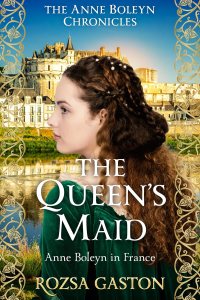 Blurb:
The Tudor series continues! For fans of Philippa Gregory, Elizabeth Chadwick, Carol McGrath, and Anne O’Brien.
A new adventure begins for Anne…
France, 1514
After an enlightening period of training as a lady’s maid at Margaret of Austria’s court, Anne Boleyn has been sent to France.
She arrives at the Palace of Tournelles, home of ageing King Louis and his new English wife, Mary Tudor, sister of King Henry VIII. As Anne speaks French, her main role is to serve as translator for Queen Mary.
Anne’s sister Mary is also at the French court, and Anne soon learns that not everyone is pleased about the union between the French king and his young queen.
The king’s cousin-in-law, Louise of Savoy, is desperate for Queen Mary not to fall pregnant, so that her son, Francis, will ascend the throne.
And with Louise and the English queen pulling Anne in two different directions, it will not be possible to appease everyone.
Can Anne successfully navigate the familial politics at the French royal court? Will she make her mark as one of the queen’s maids?
Or could her divided loyalties prove to be her undoing…?
THE QUEEN’S MAID is a thoroughly researched, fascinating historical novel set during the 16th century in Europe. It is the second book in the Anne Boleyn Chronicles series.
‘Wonderfully detailed and entirely enjoyable. This is a young Anne in whom I absolutely believe, and who does much to explain the woman she’d become.’ – Sarah Gristwood, author of Game of Queens.
THE ANNE BOLEYN CHRONICLES SERIES:
Book One: Maid of Honour
Book Two: The Queen’s Maid
Book Three: Queen of Diamonds
Buy Links:
Universal Buy Links:
Book 1: https://getbook.at/MaidOfHonour
Book 2: https://getbook.at/TheQueensMaid
Book 3: https://getbook.at/QueenOfDiamondsAB
Series Buy Links:
Amazon US: https://www.amazon.com/dp/B0FNQHK66N
Amazon UK: https://www.amazon.co.uk/dp/B0FNQHK66N
This series is available to read on #KindleUnlimited.
 Author Bio:
Rozsa Gaston is a historical fiction author who writes books on women who reach for what they want out of life.
She is the author of Maid of Honour: Anne Boleyn at Margaret of Austria’s Court, 𝗚𝗿𝗮𝗻𝗱 𝗣𝗿𝗶𝘇𝗲 𝗪𝗶𝗻𝗻𝗲𝗿 of the 𝟮𝟬𝟮𝟰 𝗖𝗛𝗔𝗨𝗖𝗘𝗥 𝗕𝗼𝗼𝗸 𝗔𝘄𝗮𝗿𝗱 for Early Historical Fiction, The Queen’s Maid: Anne Boleyn in France, Queen of Diamonds: The French Royal Court, Margaret of Austria, 𝗙𝗶𝗿𝘀𝘁 𝗣𝗹𝗮𝗰𝗲 𝗪𝗶𝗻𝗻𝗲𝗿 of the 𝟮𝟬𝟮𝟯 𝗖𝗛𝗔𝗨𝗖𝗘𝗥 𝗕𝗼𝗼𝗸 𝗔𝘄𝗮𝗿𝗱 for Early Historical Fiction, the four-book Anne of Brittany Series: Anne and Charles; Anne and Louis, 𝗚𝗲𝗻𝗲𝗿𝗮𝗹 𝗙𝗶𝗰𝘁𝗶𝗼𝗻 𝗪𝗶𝗻𝗻𝗲𝗿 of the 𝟮𝟬𝟭𝟴 𝗣𝗨𝗕𝗟𝗜𝗦𝗛𝗘𝗥𝗦 𝗪𝗘𝗘𝗞𝗟𝗬 𝗕𝗼𝗼𝗸𝗟𝗶𝗳𝗲 𝗣𝗿𝗶𝘇𝗲; Anne and Louis: Rulers and Lovers; and Anne and Louis Forever Bound, 𝗙𝗶𝗿𝘀𝘁 𝗣𝗹𝗮𝗰𝗲 𝗪𝗶𝗻𝗻𝗲𝗿 of the 𝟮𝟬𝟮𝟮 𝗖𝗛𝗔𝗨𝗖𝗘𝗥 𝗕𝗼𝗼𝗸 𝗔𝘄𝗮𝗿𝗱 for Early Historical Fiction.
Other works include Sense of Touch, Marguerite and Gaston, The Least Foolish Woman in France, Paris Adieu, and Budapest Romance.
Gaston studied European history at Yale and received her master’s degree in international affairs from Columbia. She worked at Institutional Investor, WR Capital, and as a columnist for The Westchester Guardian before becoming a novelist.
She is currently working on Book Four of The Anne Boleyn Chronicles, covering Anne Boleyn’s time at the 1520 Field of Cloth of Gold. She lives in Bronxville, New York, with her family.
Her motto? History matters.
Author Links:
Website: www.rozsagaston.com
Twitter / X: https://x.com/RozsaGaston
Facebook: https://www.facebook.com/rozsa.gaston/
Instagram: https://www.instagram.com/rozsagastonauthor/
Book Bub: https://www.bookbub.com/profile/rozsa-gaston
TikTok: https://www.tiktok.com/@rozsagastonbooks
Amazon Author Page: https://www.amazon.com/stores/Rozsa-Gaston/author/B0084F8MJE
Goodreads: https://www.goodreads.com/author/show/5391292.Rozsa_Gaston
 Today, I am pleased to welcome Janet Wertman to my blog as part of the blog tour for her latest novel,
  Blurb:
 Author Bio
 I am pleased to welcome Wendy J. Dunn to my blog today to share a snippet from her novel “The Duty of Daughters” as part of the blog tour for her omnibus “Falling Pomegranate Seeds Duology.” I would like to thank Wendy J. Dunn and The Coffee Pot Book Club for allowing me to be part of this blog tour.
 Blurb:
 Author Bio:
  Throughout history, the true defining feature of a good queen was whether or not she could give birth to a male heir and a spare to keep the dynasty going. No dynasty relied heavily on the pregnancy of a queen and a male heir than the Tudor dynasty of England. While we tend to focus on the women who wear the crown and give birth to the potential heir, another stands beside her during the entire process; the royal midwife. Not much attention has been given to the royal midwife until now. Brigitte Barnard explores the life of a royal midwife and her daughter who work to help Queen Katherine of Aragon in her novel, “The Tudor Queens’ Midwife.”
 Blurb:
 Author Bio
 I am pleased to welcome Justin Newland to my blog today to discuss his latest book, “The Mark of the Salamander.” I would like to thank The Coffee Pot Book Club and Justin Newland for allowing me to be part of this blog tour.
  In 1578, Francis Drake set out from Plymouth with five ships to sail around the world. Until that point in history, England was a small, misty isle on the edge of continental Europe. Through Drake’s efforts, in that single voyage, he hauled England out of the dark ages and into a future in which England would become the hub of a new world of trade & communication. He single-handedly changed England’s self-view.
  chivalric Order of the Garter. Established by King Edward III in 1348, the motto of the Most Noble Order is, ‘Honi Soit Qui Mal Y Pense,’ which means, ‘Evil be to he who thinks evil (of me).’
 Blurb:
 Author Bio:
 Adventures of a Tudor Nerd