
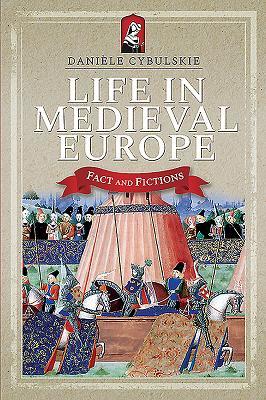
 Have you ever read a book, either historical fiction or nonfiction, about medieval Europe and wondered if what the author was writing about was true? What about historical movies or dramas? You know that they probably have the facts about the important people and events correct, or at least you hope, but you wonder about the small details. What did they eat? How did they keep themselves clean and healthy? How did religion and the criminal justice system work in medieval Europe? What was medieval warfare like? These questions and more are explored in Daniele Cybulskie’s enchanting book, “Life in Medieval Europe: Fact and Fiction”.
I would like to thank Pen and Sword Books for sending me a copy of this book. I have spoken with Daniele Cybulskie on social media in the past about quite a few medieval topics, including when she spoke at the Tudor Summit, so when I heard about this book, I wanted to read it.
Cybulskie’s book is divided into chapters that explore numerous topics about average medieval life. As a reader, one would think that this book would begin with the birth and childhood of those who lived during this time. However, Cybulskie chooses to begin with how medieval people kept themselves and their cities clean. It may seem a bit strange compared to other books about medieval life, but the way she structures this book works in Cybulskie’s favor. Although this book is informative, it feels like you are having a casual conversation with the author about these topics.
By dividing the chapters into topic-based chapters, Cybulskie can explore numerous questions that fit into each topic. From cleanliness to religious life, warfare to pastimes, love to death, she can give her readers an experience that covers the thousand years of history that make up the medieval time period. Along the way, she includes little boxes that contain fun little factoids to provide even more trivia.
What is great about Cybulskie is that as a medievalist, she understands that there was a lot of diversity in the medieval world. It was not just fit European Christians. There were also Jews, Muslims, people with disabilities, rich and poor, and those who generally did not fit well into society. By including every type of person who lived in the medieval world, we can get a better understanding of how vast and colorful it truly was. Cybulskie also includes a simplistic overview of events like the Black Death and the crusades to show the dramatic and damaging effects that they had on medieval society as a whole.
To say that this book was fun to read would be an understatement. Cybulskie’s knowledge radiates in every page of this short book. I honestly did not want to stop reading this book, I wanted to learn more. It was educational and entertaining all at the same time. Simply a wonderful resource for novice medievalists and writers of historical fiction and nonfiction alike. If you want to learn the truth about different aspects of medieval life, I highly suggest you include, “Life in Medieval Europe: Fact and Fiction” by Daniele Cybulskie, to your book collection.
 One of the greatest mysteries of all time is what happened to the young princes, the sons of Edward IV, who were held in the Tower of London. Many people believed that they were killed. There are some who believe that Richard III had them murdered and there are some who say that Henry VII ordered the deed to be done. But what if they were never killed? What if they survived? That is the premise of Matthew Lewis’s book “The Survival of the Princes in the Tower: Murder, Mystery and Myth”.
  Perkin Warbeck. These were the most famous pretenders and the ones who challenged Henry VII’s right to the throne. If they were really the princes in the tower, why were they defeated? Why were they considered pretenders? Lewis explores other people who could possibly be the princes, including a theory by amateur art historian Jack Leslau on “The Family of Sir Thomas More” by Hans Holbein the Younger.
  Adventures of a Tudor Nerd