
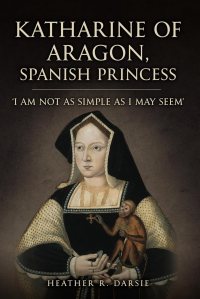
 We all know the gist of the tragic tale of Katharine of Aragon. A Spanish princess who was brought to England to marry the heir of the Tudor throne, Prince Arthur Tudor. When the prince died mere months after their wedding day, Katharine was left in limbo and desolate as the Kings of Spain and England bickered over her dowry. Eventually, she would marry King Henry VIII, was his wife for over twenty years, and have numerous miscarriages before Henry decided to divorce her and marry Anne Boleyn. We know how Katharine’s story ends, but how did the stories of her Trastamara family influence her life and her reign as Queen of England? Heather R. Darsie explores Katharine’s Spanish origins in her latest book, “Katharine of Aragon, Spanish Princess: ‘I Am Not as Simple as I May Seem.’”
I would like to thank Amberley Publishing for sending me a copy of this book. I have enjoyed Darsie’s books, “Anna, Duchess of Cleves: The King’s Beloved Sister” and “Children of the House of Cleves: Anna and Her Siblings.” While her previous books focus on German history and sources, Darsie decided to shift her attention to Spain with this particular book. I was curious how much new information and insight Darsie would provide about Katharine’s life.
Darsie begins by having lovely family trees and a timeline listing the numerous figures that will be covered in this book, because as stated before, this book covers the origins of Katharine of Aragon’s family, the Trastamaras. The book is broken down into three sections. The first focuses on the Trastamaras and the history of the crowns of Castile and Leon and Aragon, culminating with Katharine’s parents, Isabella I of Castile and Leon, and Ferdinand II of Aragon. The second focuses on Katharine’s early life, how she became the bride of Prince Arthur Tudor of England, and how his death affected Katharine. Finally, part three explores Katharine of Aragon’s life as queen consort of King Henry VIII.
To me, the true highlight of this book is the exploration of the Trastamara family tree. While I do know a bit about the origins of Isabella I of Castile and Leon from a book I just read on her life, I did not know the origins of the family. Starting with the origins of both the elected composite crown of Aragon and the inherited composite monarchy of Castile and Leon, we see how the Trastamara dynasty started like the Tudor dynasty. It was a dynasty full of drama, civil wars, a member who married a corpse, a king who died due to alcohol burns, and many mistresses. It is through these stories that you can see where Katharine of Aragon and her daughter Mary I got their strength and determination to keep on fighting for what they believed in, even when the odds were very much against them.
This is yet another triumph by Darsie. It is extremely informative, meticulously researched, and easy to read. It gives the reader a better understanding of not only Spanish royalty and its complexity, but also a better appreciation of Katharine of Aragon. If you want an excellent book exploring the life of King Henry VIII’s first wife from a different perspective, I highly recommend you read “Katharine of Aragon, Spanish Princess: ‘I Am Not as Simple as I May Seem’” by Heather R. Darsie.
 Do you have a favorite historical figure whom you have wondered what would have happened if they survived their dark fate? Have you wondered what would happen if they had fantastical abilities, such as transforming into animals? Maybe the last piece sounds a bit too far-fetched, but it makes for an interesting concept for a novel. What if we took the story of Lady Jane Grey, the Nine-Day Queen of England, and turned the tale into a fantastical comedy full of romance and adventure? Then, you would get the premise of “My Lady Jane” by Cynthia Hand, Brodi Ashton, and Jodi Meadows.
 Do you have a favorite painting? One that grabs your attention whenever you look at it and discover something new. Most paintings are from da Vinci, van Gogh, Rembrandt, Picasso, or Michelangelo, just to name a few. However, there is one artist that I feel doesn’t get a whole lot of attention unless you study the 16th century: Hans Holbein the Younger. While Holbein is known for his single portraits, his double portrait, known as The Ambassadors, is stunning to look at and is filled with symbolism. Tracy Borman, in collaboration with the National Gallery, has written a short book about this remarkable painting entitled “Holbein: The Ambassadors.”
 A princess born to a king and his second wife lost her title and legitimacy when her father decided that her mother, Anne Boleyn, needed to die. Elizabeth Tudor knows the meaning of resilience as she survived her childhood during her father King Henry VIII’s reign. Now that her father is dead Elizabeth is at the mercy of her half-siblings Edward and Mary, plus any scheming man who wants to marry her and get closer to the crown. Can Elizabeth survive her siblings’ reigns or is she destined to be locked in the Tower to await her ultimate fate like her mother? Janet Wertman explores the life of Elizabeth Tudor in her latest series
  Throughout history, the true defining feature of a good queen was whether or not she could give birth to a male heir and a spare to keep the dynasty going. No dynasty relied heavily on the pregnancy of a queen and a male heir than the Tudor dynasty of England. While we tend to focus on the women who wear the crown and give birth to the potential heir, another stands beside her during the entire process; the royal midwife. Not much attention has been given to the royal midwife until now. Brigitte Barnard explores the life of a royal midwife and her daughter who work to help Queen Katherine of Aragon in her novel, “The Tudor Queens’ Midwife.”
 Blurb:
 Author Bio
 England’s history is centuries old, full of colorful characters and change galore. What truly defines the history of England is the monarchy, which has lasted over a thousand years. Over 40 kings and queens left their distinct marks on the history of this proud island nation. While some could maintain the crown with no issues, others had to fight to earn the crown, and a few even died for the crown. While there has been a plethora of books and novels written about individual monarchs and their impacts on the history of England, only a select few have chosen to take the arduous task of telling the story of the British Monarchy from its origins to the modern-day. One such historian who has chosen the latter is Tracy Borman in her book, “Crown and Sceptre: A New History of the British Monarchy from William the Conqueror to Elizabeth II.”
 The Great Matter was a defining event in the lives of King Henry VIII, Catherine of Aragon, and Anne Boleyn. One of the world’s messiest divorces, it saw Henry VIII trying everything in his bag of tricks to annul his marriage to Catherine of Aragon to marry his new infatuation, Anne Boleyn. While we know that the basis for his argument that he should be able to divorce Catherine comes from the book of Leviticus in the Bible, we often see Henry’s debate through the Catholic and Protestant lenses. However, Henry relied on another group of people who had not been on English soil for centuries, the Jews. What does Jewish law bring to the discussion of the Great Matter and did it help Henry? Jerry Rabow examines this often overlooked aspect of Henry’s road to divorce in his book, “Henry VIII and His Rabbis: How the King Relied on Jewish Law to End His First Marriage- and Why He Failed.”
 Have you ever had an incident that was so impactful that it defined your entire life from that moment on? For Anne Howard, Countess of Arundel, it was the death of her younger brother, George. She vows vengeance against those who were behind his untimely demise. In the present day, Sarah must return to her godmother’s home, which holds a lot of memories, mostly painful. It is in the halls of this ancient house that Sarah meets Anne through a book of poetry. Can these two women find peace or will the truths bring even more disasters? Clare Marchant tells the stories of these two women, the tragedies and the poetry that unite them, in her latest novel, “The Shadow on the Bridge.”
 When we think about live theater, we often think about big actors, elaborate sets, and glittery costumes. The world of the Tudor theater, especially during the reign of Elizabeth I, was similar in some ways, but there was an element of danger. Richard Shakespeare, an actor in the Lord Chamberlain’s Men company and a former thief, knew the dangers of Tudor theater life better than anyone. When a manuscript is stolen, suspicion lands squarely on Richard’s shoulders. Can Richard clear his name, or will it be his final curtain call? Bernard Cornwell tells the story of Richard Shakespeare and the debut of A Midsummer’s Night Dream in his novel, “Fools and Mortals.”
 Adventures of a Tudor Nerd