
 When we think of the term “Viking”, we often get images of battle-harden warriors, covered in guts and dirt, with horned helmets. We also believe that Vikings are warriors primarily from the Scandinavian world and that the Viking age ended in 1066 with the Norman Invasion of England. Our assumptions, thanks to television and a certain operatic cycle, are wrong. The Viking Age is a complex period of the past that spans centuries over half the known world. Using archeological evidence and written records, Eleanor Barraclough tells the tale of the Viking Age in her book, “Embers of the Hands: Hidden Histories of the Viking Age.”
I want to thank W.W. Norton & Company and Net Galley for sending me a copy of this book. I enjoy reading books about archeological discoveries, so when I heard about a book about the Viking Age and archeology, I jumped at the chance to read it. I have read a few historical fiction novels about the Viking Age and a few about the Anglo-Saxons, so I was curious what new information Barraclough would present in her book.
The short answer to that question is that Barraclough provided a plethora of information about the Viking Age. As she explains in her prologue, we try to compartmentalize history, but history flows like a river. Just because we label a period like the Viking Age does not mean that it ends at a certain date. We have artifacts from other parts of the world, including Russia and the Middle East, that would be dated to the 1500s. So what can the artifacts from the past tell us about this diverse age?
To tell the story of this age, Barraclough breaks her book into sections that focus on different elements such as beginnings, love, travel, slavery (known in this book as unfreedom), and endings. Each section focuses on not only the artifacts, like a comb, a chess piece, or a runestone with a love story, but also what these pieces can tell us about the average citizens who lived during this period. We can learn about their grooming habits, how they lived, how they traveled, their ever-changing beliefs from Norse mythology to Christianity, and how they approached issues like slavery and childbirth. Barraclough also takes the time to show what the chronicles and sources tell us about this period while showing how to understand what the runes on artifacts can tell us. I think my one concern about this book is that because it was not in chronological order, it was a bit hard to follow and there were points where it was a bit dry for my taste.
Overall, I found this book fascinating and a difficult read. It took me a long time to understand how complex the Viking Age was as I am not as familiar with the language and historical accounts. I think Barraclough does a decent job of presenting the information to not only those who are familiar with the era but to complete novices. If you want to understand the Viking Age through archeological research, I suggest you read, “Embers of the Hands: Hidden Histories of the Viking Age” by Eleanor Barraclough.
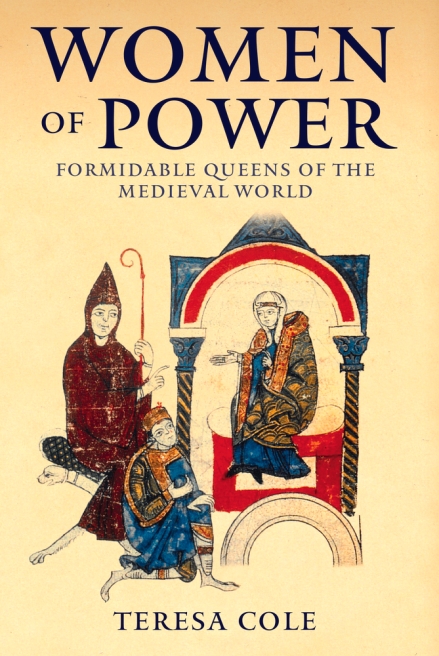 When we think about medieval women, we often think about very pious figures who relied on men, had numerous children, and would often fade into obscurity when they died. While this would be the ultimate fate for many women, it was not so for those close to thrones worldwide. In times of war and political upheaval, the daughters, the wives, and the queens picked up the pieces and patched their respective kingdoms back together. In her latest book, “Women of Power: Formidable Queens of the Medieval World,” Teresa Cole has chosen a select group of women to highlight her point about the strength of women who held power in the Middle Ages.
 When we think of the phrase “middle ages,” we think of a time of bloody battles and deadly plagues, full of warriors and kings, and a more patriarchal society where women sat on the sidelines. Only the highly pious women or women who tore down barriers genuinely stood out in the history books. At least, that is what we have been told for centuries, but what does archeological research tell us? How about the newly discovered historical records? In her latest book, “Femina: A New History of the Middle Ages, Through the Women Written Out of It,” Janina Ramirez tells the story of the Middle Ages innovatively; through the stories of women who, until recently, were hidden voices from the past.
 Adventures of a Tudor Nerd