
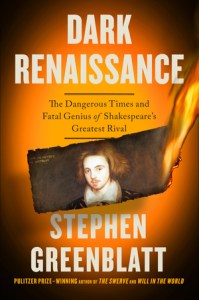
 Sixteenth-century England was a time of great change. There were religious changes as the crown passed from one member of the Tudor family to another. Wars and illnesses like the plague and the sweating sickness were rampant. However, this was also a time of an explosion of the arts, particularly of the theatre. We see men like William Shakespeare and Ben Jonson rise from obscurity to write plays that would propel them to become phenomena. There was a third playwright who should be included in this list. He was the son of a cobbler who was educated at Cambridge University. A brilliant man who wrote groundbreaking plays while he was a spy for her majesty Queen Elizabeth I, his cause of death when he was only in his twenties would remain a mystery for centuries. Christopher (Kit) Marlowe’s story is told in Stephen Greenblatt’s latest book, “Dark Renaissance: The Dangerous Times and Fatal Genius of Shakespeare’s Greatest Rival.”
I would like to thank W. W. Norton & Company and Net Galley for sending me a copy of this book. I will be honest. Although I do spend a lot of time studying the 16th century, I don’t read a lot of plays by Shakespeare or Marlowe. So, when I saw this book and its premise, it piqued my curiosity. I knew that Marlowe was a famous playwright, he was a spy, and that he died young, but that’s all I knew before reading this book. I wanted to know more about Kit Marlowe and his world.
Christopher Kit Marlowe was the son of John Marlowe, an immigrant shoemaker, and his wife, Katherine Arthur. As their only son, it was believed that Kit would become a cobbler, but he had different skills that were more academically inclined. The cobbler’s son would study the classical writers of Ancient Greece and Rome, while learning Latin and debating theology. Kit would find himself at Cambridge University, and he paid for his education on a scholarship. While the main focus of these chapters is Marlowe, Greenblatt does show the lives of the scholars and fellow students who would shape Marlowe’s writings and his path in life.
Just as Marlowe was about to complete his Master of the Arts degree, his attendance dropped, and he was seen in Rheims in France. He was beginning to establish connections to the Elizabethan spy network with William Cecil, Lord Burghley, and Sir Francis Walsingham. This is the stage of life where we not only see Marlowe get in trouble with the law, but we also get to see Marlowe become a playwright who would rival Shakespeare himself. Greenblatt takes his time to analyze Marlowe’s works, including Tamburlaine the Great, Edward II, The Jew of Malta, and Doctor Faustus. Finally, Greenblatt examines Marlowe’s death on May 30, 1593, and who might have been responsible for his murder.
I found this book extremely informative, not only when it comes to the life of Christopher Kit Marlowe, but also the worlds of Elizabethan higher education, the theatrical community, the divides on religious beliefs, and the spy world. Marlowe is one of those figures who challenged what it meant to be a playwright through his rather controversial works, which inspired others like William Shakespeare. If you want a book about a playwright with a tragic end who doesn’t get a lot of attention, I highly recommend you read “Dark Renaissance: The Dangerous Times and Fatal Genius of Shakespeare’s Greatest Rival” by Stephen Greenblatt.
 When we think of the term “Viking”, we often get images of battle-harden warriors, covered in guts and dirt, with horned helmets. We also believe that Vikings are warriors primarily from the Scandinavian world and that the Viking age ended in 1066 with the Norman Invasion of England. Our assumptions, thanks to television and a certain operatic cycle, are wrong. The Viking Age is a complex period of the past that spans centuries over half the known world. Using archeological evidence and written records, Eleanor Barraclough tells the tale of the Viking Age in her book, “Embers of the Hands: Hidden Histories of the Viking Age.”
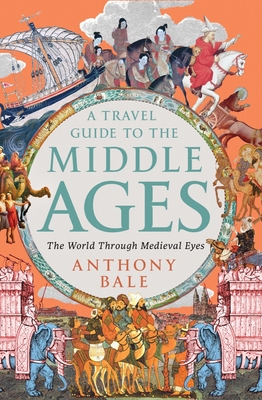 When we think about travel in the Middle Ages, we often think of wealthy nobles or those who went to war fighting in foreign lands. However, that is merely a misconception. Travel was open to everyone, from the wealthy, the poor, the pious pilgrims, and the merchants. Each group had their reasons for traveling to different countries. Still, they all wrote down their experiences to tell future generations about their encounters and encourage others to explore the world, both the known and unknown parts. Anthony Bale has compiled many of these accounts into one comprehensive book called, “A Travel Guide to the Middle Ages: The World Through Medieval Eyes.”
 Adventures of a Tudor Nerd