 Many actors and actresses have portrayed the lives of Henry VIII and his six wives in modern films and dramas. When asking Tudor nerds which Henry VIII stood out the most, the most popular response is Keith Michell in the 1970s BBC series, “The Six Wives of King Henry VIII.” I had not heard about this series until I started “Adventures of a Tudor Nerd.” Many people have wanted me to watch the series solely for the performance of Keith Michell, so when a coworker allowed me to borrow her DVD copy of the series, I finally decided it was time to tackle this legendary series.
For those unfamiliar with the older Tudor dramas like this series, it should be noted that the focus is not on sex or bloody battles but on the relationships between Henry and his six wives. Therefore, the costumes and the scenery take a step back in quality that one would expect when compared with modern dramas. I think the English brides’ outfits are well done, but the native gowns for Katherine of Aragon and Anne of Cleves felt a bit off for me.
Keith Michell plays the titular king, but I will discuss his performance later. I want to look at the actresses who played Henry’s six wives. Each episode focuses on each wife’s story, how they became his wife, and how their story ended.
We begin with Katherine of Aragon, played by Annette Crosbie, who was the wife of Prince Arthur, but when he died, Katherine struggled to survive in a foreign land until it was decided that she would marry her former husband’s brother, Henry VIII. The couple seems to be in love until Katherine cannot deliver a son for the king, so he decides it’s time for a divorce, which we call The Great Matter. With Katherine out of royal favor, it is time for Henry’s second wife, Anne Boleyn, played by Dorothy Tutin, to make her appearance. When it comes to Anne Boleyn’s performances, I don’t know if I like Tutin’s portrayal; it just rubbed me the wrong way.
My favorite episode of this series was Jane Seymour, played by Anne Stallybrass, who shows a more complex side to Jane’s story. We see her interacting with the Seymour family and her desire to reunite Henry VIII and his daughter Mary. The way the episode was structured with Jane on her death bed and witnessing flashbacks to her time with Henry VIII, the issue of the Pilgrimage of Grace, and the birth of her beloved son Edward. With Jane’s death, we see the more human side of Henry as he is in deep mourning for his beloved queen.
It would be several years until he married again to Anne of Cleves to secure a German Protestant alliance. Anne of Cleves, played by Elvi Hale, is a young woman of average looks and very little money who wants to learn everything she can about England. I like how we are introduced to Hans Holbein in this episode and to see how Anne felt about her marriage and ultimate divorce from Henry VIII.
With the divorce of Anne of Cleves settled, Henry VIII turned his gaze on the young Catherine Howard, played by Angela Pleasence. Catherine is young, naive, and only concerned about being queen and having men fawn over her. It was interesting to see Catherine Howard as a nursemaid to the King and how angry he was with her uncle after her execution. Finally, we are introduced to Henry’s final wife, the devout reformer Catherine Parr, played by Rosalie Crutchley. We witness the end of the King’s reign and the rise of the Seymour family to help the young king Edward VI.
Of course, these stories could not be told without side characters like Thomas Wolsey, Thomas, and Edward Seymour, King Henry VII, Eustace Chapuys, Jane Boleyn, and Will Somers. I was a little surprised that they included torture scenes for Anne Askew and Mark Smeaton, especially since they did not show the execution scenes for Anne Boleyn and Catherine Howard. Several small Easter eggs for Tudor fans sprinkled in are quite delightful to discover.
Now, it’s time to discuss the big guy, King Henry VIII, played masterfully by Keith Michell. Before watching this drama, I was only familiar with Keith Michell from his performances in Murder She Wrote and the episodes I would watch with my mom. We begin with Henry as a young king enchanted with Katherine of Aragon. They are madly in love, and it is hard to believe they would ever separate, but they eventually do when Anne Boleyn catches his eye.
Throughout this entire series, we see Michell’s acting range through the rapid emotional change of the king. One minute he could be lovey-dovey, the next raging mad, and then bawling his eyes out. What impressed me the most about Michell’s performance was how we saw Henry VIII’s size and shape change in each episode. As Tudor fans, we have screamed at the TV when we see modern adaptations of Henry VIII that do not meet our standards for what older Henry should look like. Michell exceeds all expectations and gives his audience one of the most believable King Henry VIII performances in modern history.
Overall, I found this a decent show where the political and romantic drama of the reign of King Henry VIII shines through the screen. The queens and the counselors did take a back seat to the titular king, but I did not mind that. If you want to watch a legendary series about the reign of King Henry VIII that does not have the sex and scandals of a modern drama, I highly recommend you watch the BBC series, “The Six Wives of King Henry VIII,” starring Keith Michell.
Casting Source:
https://www.imdb.com/title/tt0066714/?ref_=tt_mv_close

 The year is 1540, and King Henry VIII is looking for a wife. He has been a widower for over three years, and his councilor Thomas Cromwell believes that a foreign alliance will be the best path forward for England, so he arranges a marriage between Henry and Anne of Cleves. In theory, it should be a good match, but it falls apart quickly. To top it all off, one of Anne of Cleves’ Maid of Honour brought her own drama to court that ended with a murder. Can Will Somers, the King’s Fool, navigate the drama at court while dealing with his own love life, or will the mystery of the missing body prove too much for him to handle? This is the premise of the next book in the King’s Fool Mysteries series called “Devil’s Gambit.”
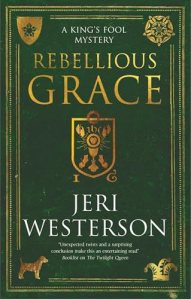 Christmas is a time of merriment and joy unless you are in the court of Henry VIII in 1536. Then it is a time of stress and murder. Henry’s second wife Anne Boleyn has only been dead for a few months while his third wife Jane Seymour is slowly adjusting to her new role as queen. A rebellion known as the Pilgrimage of Grace is taking over northern England and the leader Robert Aske wants to visit the court to discuss matters with King Henry VIII. To top it all off, a servant of Queen Jane has been murdered and the only one who can solve the crime is a fool, Will Somers. Can Will Somers connect the dots and save those closest to him, or will the treasonous act be another downfall in such a tumultuous year? This is the premise for the third book in the A King’s Fool Mystery series, “Rebellious Grace” by Jeri Westerson.
 Greenwich Palace is a Tudor palace full of glamour, intrigue, and murder. A musician has been found murdered in the chambers of the current wife of King Henry VIII, Anne Boleyn. Only one person can solve this crime while protecting the royal family. No, he is not a knight or a lawyer, but a fool. No, an actual fool or jester of the court of Henry VIII, Will Somers. A man who is loyal to his king Henry VIII, but can he save his second wife from the murderer lurking in the shadows? Jeri Westerson’s Will Somers follows the clues to uncover the truth to protect those who are the most important to him in book two of A King’s Fool Mystery series, “The Twilight Queen.”
 Henry VIII is one of the most notorious kings who ever ruled England. He had six wives, two of which were executed, three legitimate children who would change England forever, and he decided to break from Rome and create his own church. Henry was such a larger than life figure, yet when it comes to historical fiction, he tends to play a smaller part in books about his six wives and is often portrayed as a villain. Henry doesn’t get to have his own voice, in historical fiction, on some of the most important parts in his life, so Margaret George decided to give him one in her book, “The Autobiography of Henry VIII: With Notes by His Fool, Will Somers,” to explain what could have been going on in his mind during these pivotal moments.
 Adventures of a Tudor Nerd