
Book Review: “The Lady Rochford Saga Part 2: Tourmens de Mariage” by Danielle Marchant

Marriage has been an integral part of life for centuries. It has been used to create strong alliances and cement love matches. However, once the wedding ceremony is finalized, the facade often fades and the truth about the families is revealed. Jane Parker finally marries the love of her life, George Boleyn, but she soon realizes that her new family is full of ambition, especially her new sister-in-law Anne Boleyn. As one of the greatest marriages of the 16th century is beginning to fall apart, can a new romance be waiting in the wing to rock England and all of Europe to its core and whose side will Jane join in the end? Danielle Marchant continues her exploration of Jane Parker Boleyn, Lady Rochford’s life in her novel, “The Lady Rochford Saga Part 2: Tourmens de Mariage.”

I’d like to thank Danielle Marchant for sending me a copy of this novel. I enjoyed the first novel in this series, “Into the Ranks of the Deceived,” so I wanted to see how Marchant would continue this series and where book two would end. 

We begin with Catherine of Aragon attending the Blackfriars to discuss her marriage with Henry VIII. He wants the marriage dissolved because Catherine was married to his brother Prince Arthur Tudor and that is why they cannot have any living male children. Obviously, Catherine disagrees and is fighting for her marriage, which gains the respect of Jane Parker. However, Anne is not interested in the affairs of the queen and instead has her heart set on marrying Henry Percy. This does not work out for Anne as Cardinal Wolsey finds out and decides to put a stop to their engagement, which creates animosity between Anne and Wolsey. 

While Anne is trying to figure out her love life, we see Mary Boleyn become a mother of two while dealing with the death of her husband William Carey. Jane must navigate these complex issues of her new family while she enters a new chapter of her life when she marries the love of her life, George Boleyn. However, Jane’s married life is not all sunshine and rainbows and she realizes that they are having problems conceiving a child. I think the story of this second novel was good, but I think it should have covered a bit more ground and possibly gone to the marriage of Anne Boleyn and Henry VIII so that the third book could focus on the fall of Anne and George Boleyn and hopefully show a glimpse of Jane’s fall from grace.

Overall, I think it was a decent novel that shows the softer side of Jane and George’s relationship which is sometimes lacking in other novels. I think it was a bit short for the material that I hoped she would cover in this series since there is so much to Jane’s story, but I think she can create a story with believable characters that you don’t want to stop reading. If you have enjoyed the first book in this trilogy, I think you should read, “The Lady Rochford Saga Part 2: Tourmens de Mariage” by Danielle Marchant.

Book Review: “Henry VIII’s True Daughter: Catherine Carey, A Tudor Life” by Wendy J. Dunn

Henry VIII's True DaughterIllegitimate royal children have been known to make an impact on history. Take Henry Fitzroy, the illegitimate son of Henry VIII, and Bessie Blount, whom Henry VIII acknowledged as his son. There were discussions about Henry Fitzroy becoming the heir apparent if Henry VIII did not have a legitimate son. But what about the illegitimate children that a king did not acknowledge? What might their lives have been like? The story of Mary Boleyn and her affair with King Henry VIII has been told many times, but the story of her daughter born during that time is lesser known. In her first full-length nonfiction book, “Henry VIII’s True Daughter: Catherine Carey, A Tudor Life,” Wendy J Dunn has taken on the task of discovering the truth of Catherine Carey’s parentage and how it impacted her life.
I would like to thank Pen and Sword Books and Net Galley for sending me a copy of this book. I just finished reading Wendy J. Dunn’s novel, “The Light in the Labyrinth” about Catherine Carey, which is the book that inspired her to research and write this biography. I wanted to see if Dunn could write nonfiction as well as she writes historical fiction novels.

Dunn begins her biography by exploring what life was like in Tudor England before diving into the main point of her book, that Catherine Carey and her brother Henry Carey, were the illegitimate children of Mary Boleyn and Henry VIII. This was a point that she made in “The Light in the Labyrinth,” but it is in this biography that Dunn is able to expand on her theories even further, including the theory that Catherine was in the Tower and on the scaffold when her aunt, Anne Boleyn, was executed as a young woman. It is a sad theory, but it might explain why she was so close to her potential half-sister, Elizabeth Tudor.

Dunn shows how Catherine Carey grew up in the shadows of Henry VIII’s court. It is there where she met and fell in love with Francis Knollys, whom she married in April of 1540. As an audience, we get to see Catherine become a mother during the last years of the reign of Henry VIII and Edward VI’s tenure as king. It was during Mary I’s reign that life became dangerous for Catherine, Francis, and their family as they were Puritans, so they fled to Germany for three years. It was not until the reign of her potential half-sister Elizabeth that Catherine returned to court to serve her queen until Catherine died in 1569.

I think Dunn does a great job of combining her knowledge of Catherine Carey with her writing style as a historical fiction novelist. It creates a unique reading experience. I think for a first try at a full-length nonfiction book, it is pretty good. If you want a full-length biography of Catherine Carey that is informative with theories that will make you question what you think you know about the Tudors, I would suggest you read “Henry VIII’s True Daughter: Catherine Carey, A Tudor Life” by Wendy J Dunn.

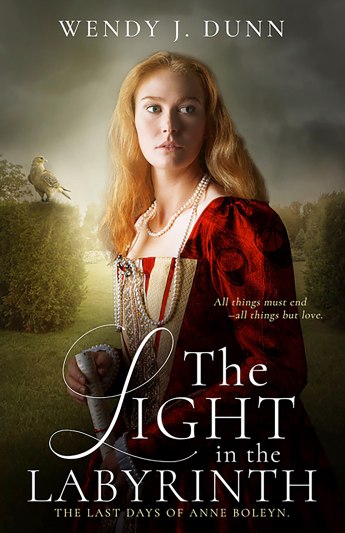
Book Review: “The Light in the Labyrinth: The Last Days of Anne Boleyn” by Wendy J. Dunn

The light in the labyrinthThe year is 1535 and a young girl whose mother was a shining light at court, dreams of getting away from her family and joins her aunt at court. Her name is Kate Carey, the daughter of Mary (Boleyn) Carey, and her aunt is Queen Anne Boleyn. Little does Kate know that the court life she desires is full of danger and enemies around every corner. In the labyrinth of court life, Kate must navigate it successfully to come out alive, even as her aunt’s reign is coming to an end and a secret is revealed that will radically change her life forever. Wendy J. Dunn tells Kate Carey’s story in her young adult novel, “The Light in the Labyrinth: The Last Days of Anne Boleyn.”

I would like to thank Wendy J. Dunn for sending me a copy of this novel. I do love a good young adult novel and so when I heard about Wendy Dunn releasing a new edition of a young adult Tudor novel that she had written previously, I knew I wanted to read it.

We begin with a dispute between Kate and her mother Mary. Kate is upset with her mother after she remarries William Stafford when her father William Carey dies. She wants to get away from home and go to the court of Henry VIII where her aunt, Anne Boleyn, sits as queen. Reluctantly, Mary agrees to Kate’s request and allows Kate to join her brother Harry Carey in court.

Kate’s entrance to the glittery Tudor court comes at a crucial point. Anne Boleyn is pregnant with what she hopes will be the son she and Henry desire. Kate is surrounded by her cousins including Meg Lee, her uncle George, and of course her aunt Anne. Along the way, Kate falls head over heels in love with Francis Knollys and learns a secret about her father that will rock her small world forever. However, Kate learns that love in court is a double-edged sword that can have deadly consequences.

When King Henry VIII had his jousting accident, Anne suffered a miscarriage and lost her son who would have been her savior. The fall of Anne Boleyn was nothing short of tragic, but to see it from her young niece Kate’s perspective added layers of depth and emotion that I was not prepared to read. I have read so many different accounts of the death of Anne Boleyn, both fiction and nonfiction, but Kate Carey’s version hit me emotionally that I was almost in tears by the end.

Dunn has not only shown that she is a brilliant author of historical fiction but also a fantastic young adult historical fiction writer. It is not just the main story, but the poetry and the two short stories that show how much love Dunn has for Kate Carey. A true triumph of a novel that I did not want to end. I do hope she will write more young adult historical fiction novels set in the Tudor era. If you want a heartbreakingly spectacular novel set in the Tudor age, I highly suggest you read, “The Light in the Labyrinth: The Last Days of Anne Boleyn” by Wendy J. Dunn.

Poetry: Epitaphe upon the worthy and Honorable Lady, the Lady Knowles- By Thomas Newton

The next poem I wanted to explore is an epitaph for Lady Katherine Knollys. I found this particular poem in Sarah- Beth Watkins’ book, “Lady Katherine Knollys: The Unacknowledged Daughter of King Henry VIII”. An epitaph was a poem written in memory of a person who died, in this case, Lady Katherine Knollys, the daughter of Mary Boleyn. There are some who believed that she was the daughter of William Carey, while others believed that she was, in fact, the daughter of Henry VIII. She was a lady in waiting for Queen Elizabeth I, as well as her cousin, so it makes sense that Elizabeth would have made such a big deal for her funeral in 1569.

This epitaph was written by Thomas Newton, who was a poet and a clergyman who lived from 1542 until 1607. His major works included translations of the works of Cicero and the Seneca’s Tragedies. This is important because as you read this epitaph, which is one of the few that survive from the 1560s, you will notice a blend of Christian images with Roman images, with the mention of the “Muses” and the “Graces”. It is a unique epitaph for a fascinating woman.

Epitaphe upon the worthy and Honorable Lady, the Lady Knowles

Death with his Darte hath us berefte,

A Gemme of worthy fame,

A Pearle of price, an Ouche of praise,

The Lady Knowles by name.

A Myrroure pure of womanhoode,

A Bootresse and and a stay,

To all that honest were, she was

I say both locke and kaye.


Among the Troupes of Ladies all,

And Dames of noble race,

She counted was, (and was indeede)

In Ladie Fortunes grace.

In favoure with our noble Queene,

Above the common sorte,

With whom she was in credit greate,

And bare a comely porte.


There seemde between our Queene and Death,

Contencion for to be,

Which of them both more entier love,

To her could testifie.

The one in state did her advaunce,

And place in dignitie,

That men thereby might knowe, to doe,

What princes able be.


Death made her free from worldly carke,

From sicknes, paine and strife,

And hath ben as a gate, to bringe

Her to eternall life.

By Death therfore she hath receivde,

A greater boone I knowe:

For she hath made a chaunge, whose blisse,

No mortall wight can showe.


She here hath loste the companie,

Of Lords and Ladies brave,

Of husband, Children, frendes and kinne,

And Courtly states full grave.

In Lieu wherof, she gained hath

The blessed companie

Of Sainctes, Archangels, Patriarches,

And Angelles in degree.


With all the Troupes Seraphicall,

Which in the heavenly Bower,

Melodiously with one accord,

Ebuccinate Gods power.

Thus are we sure: for in this world

She led a life so right,

That ill report could not distaine,

Nor blemish her with spight.


She traced had so cunningly,

The path of vertues lore,

Prefixing God omnipotent,

Her godly eyes before:

And all her dedes preciselie were,

So rulde by reason Squire,

That all and some might her beholde,

From vice still to retire.


The vertues all, the Muses nine,

And Graces three agreed,

To lodge within her noble breast,

While she in Earth did feede.

A head so straight and beautified,

With wit and counsaile sounde,

A minde so cleane devoide of guile,

Is uneth to be founde.


But gone she is, and left the Stage

Of this most wretched life,

Wherin she plaid a stately part,

Till cruell Fates with knife:

Did cut the line of life in twaine,

Who shall not after goe?

When time doth come, we must all hence,

Experience teacheth so.


Examples daily manifolde,

Before our eyes we see,

Which put us in remembraunce,

Of our fragilitie.

And bid us watch at every tide,

For Death our lurking foe,

Sith dye we must, most certainely,

But when, we do not knowe.


Som which today are lusty Brutes,

Of age and courage ripe,

Tomorrow may be layd full lowe,

By Death his grevous gripe.

Respect and parcialitie

Of persons is there none,

For King, or Kaiser, rich or poore,

Wise, foolish, all is one.


God graunt that we here left behinde,

This Ladies steppes may treade,

To live so well, to die no worse,

Amen, as I have saide.

Then maugre Death, we shall be sure,

When corps in earth is closde,

Amonge the joyes celestiall,

Our Soule shal be reposde.  


Sources:

https://books.google.com/books?id=amZjDwAAQBAJ&pg=PA158&lpg=PA158&dq=Epitaphe+upon+the+worthy+and+Honorable+Lady,+the+Lady+Knowles&source=bl&ots=HXAUVDAhHn&sig=ACfU3U2g1k3vB6mPJQEjxlmdFIpPk4Bvbw&hl=en&sa=X&ved=2ahUKEwighKaB7fXgAhXGo4MKHZWRALMQ6AEwAnoECAYQAQ#v=onepage&q=Epitaphe%20upon%20the%20worthy%20and%20Honorable%20Lady%2C%20the%20Lady%20Knowles&f=false

http://ebba.english.ucsb.edu/ballad/32409/xml

Watkins, Sarah-Beth. Lady Katherine Knollys: The Unacknowledged Daughter of King Henry VIII. Winchester, UK: Chronos Books, 2015.

https://en.wikipedia.org/wiki/Thomas_Newton_(poet)

https://www.westminster-abbey.org/abbey-commemorations/commemorations/katherine-knollys

Book Review: “Lady Katherine Knollys- The Unacknowledged Daughter of King Henry VIII” by Sarah-Beth Watkins

51M3PWFQLjLThe children of Henry VIII have been the center of historical studies for centuries. Edward VI, Mary I,  and Elizabeth I were all considered Henry’s “legitimate” children and were able to obtain the crown of England. Henry Fitzroy was the illegitimate son of the king, but he was still able to gain titles and a good marriage before he died. They all had something in common; they were all recognized by their father, Henry VIII. However, there was another child who many believed to have been the daughter of the king. The name of this intriguing lady was Lady Katherine Knollys and her story comes to life in Sarah-Beth Watkins’ book, “Lady Katherine Knollys- The Unacknowledged Daughter of King Henry VIII”.

I would like to thank Sarah-Beth Watkins and Chronos Books for sending me a copy of this great book. I have never read a biography on Lady Katherine Knollys and I found this a delight to read.

Katherine’s mother was the sister of Anne Boleyn, Mary Boleyn. For a time before Anne came into the picture, Mary was Henry VIII’s mistress. Henry VIII did have a child by another mistress, which he did declare as his own, so why did he not acknowledge Katherine as his child? Watkins offers an explanation on why Katherine was not acknowledged by the king and what her life was like:

Katherine would grow up never to be acknowledged as King Henry VIII’s daughter. Henry had every reason not to acknowledge her. He has his daughters, one already born when Katherine came into the world, and he needed no more. His denial of his affair with Katherine’s mother, Mary, would be something that would always position Katherine as a bastard. Yet Katherine joined the Tudor court as maid of honour to Queen Anne of Cleves and she went on to serve Catherine Howard as well as becoming one of Elizabeth I’s closest confidantes- cousins for definite, more likely half-sisters. Katherine lived through the reigns of Henry VIII, Edward VI, Mary I and on into Elizabeth I’s. Never far from court, she lived in a world where she would never be a princess but a lady she was born to be. (Watkins, 1).

Watkins begins her book by exploring Mary Boleyn’s life and her relationship with Henry VIII and the birth of Katherine. As Mary fell out of favor with the king, we see the rise and fall of her sister, Anne Boleyn. As Katherine grows up, we see her becoming a maid of honour for Anne of Cleves and Katherine Howard, until she marries Francis Knollys at the age of 16. Katherine and Francis went on to have quite a large family. Their children included Lettice Knollys, who scandalously married Elizabeth I’s favorite, Sir Robert Dudley. Katherine spent a lot of her life serving others, never flaunting who her father might have been. The only time that Katherine’s life was in danger was when Mary I came to the throne. Katherine and Francis decided to take their family and flee abroad since they were Protestants, but they did return when Elizabeth returned. Elizabeth came to rely on Katherine as a close confidante and when Katherine did die, Elizabeth gave her an elaborate funeral.

This was my first time reading a biography about Lady Katherine Knollys and I really enjoyed it. I go back and forth whether I believe she was the daughter of Henry VIII or not, but I found it interesting to learn more about this fascinating woman. Watkins does a superb job of balancing letters, facts and an easy to understand writing style to tell the story of Lady Katherine Knollys, her family, and the life inside the Tudor court. If you want to learn more about the life of the remarkable daughter of Mary Boleyn, I highly recommend you read, “Lady Katherine Knollys- The Unacknowledged Daughter of King Henry VIII” by Sarah-Beth Watkins.  

Biography: Catherine Carey

800px-Steven_van_der_Meulen_Catherine_Carey_Lady_KnollysAlso known as Catherine Knollys or Lady Knollys.
(Born around 1524- Died January 15, 1569)
Daughter of Mary Boleyn and William Carey.
Married to Sir Francis Knollys.
Mother of Mary Stalker, Sir Henry Knollys, Lettice Knollys, Countess of Essex, William Knollys, 1st Earl of Banbury, Edward Knollys, MP, Sir Robert Knollys, MP, Richard Knollys, MP, Elizabeth Leighton, Lady Leighton, Sir Thomas Knollys, Sir Francis Knollys, MP, Anne West, Lady De La Warr, Catherine, Baroness Offaly, Lady Butler, Maud Knollys and Dudley Knollys.

Catherine Carey was the daughter of Mary Boleyn, the sister of Anne Boleyn, and William Carey. She was the mother of Lettice Knollys and the Chief Lady of the Bedchamber to Queen Elizabeth I.

Catherine Carey was born around 1524 to Mary Boleyn and William Carey. William Carey was from Aldenham in Hertfordshire. He was a Gentleman of the Privy Chamber and Esquire of the Body to Henry VIII. Her parents were married in 1520 and soon after, it is believed that Mary Boleyn started her affair with Henry VIII. Contemporaries have claimed that Catherine Carey was in fact an illegitimate child of Henry VIII, but there is no evidence to support this claim and Henry VIII never acknowledged her as his own child. It is said that Catherine was a witness to Anne Boleyn’s execution, but that is simply not true.

Catherine would become a Maid of Honour for both Anne of Cleves and Katherine Howard. It is believed that Catherine met her future husband Francis Knollys when he was part of the group that welcomed Anne of Cleves to England in November 1539. We do not know if their families arranged the marriage or if the king had a hand in the match, but Catherine and Francis were married on April 26, 1540. The couple had fourteen children, including Lettice Knollys. Francis Knollys was knighted in 1547 and Catherine was called Lady Knollys. During the reign of Mary I, Francis and Catherine took part of their large family and fled to Germany because they were very staunt Protestants.

In January 1559, Catherine and Francis returned to England after the death of Mary I and the succession of Elizabeth I. Sir Francis Knollys was appointed Vice-Chamberlain of the Royal Household and Catherine was made Chief Lady of the Bedchamber. Elizabeth never supported the claim that Catherine was her half sister, but for the ten years that Catherine served Elizabeth, she was seen as one of Elizabeth’s favorites at court and her favorite first cousin. Catherine Carey would die on January 15, 1569 at Hampton Court Palace and she was buried in St. Edmund’s Chapel in Westminster Abbey.

Sources:
https://en.wikipedia.org/wiki/Catherine_Carey

26 April 1540 – The marriage of Catherine Carey and Francis Knollys