 Today, I am pleased to welcome Sharon Bennett Connolly, the author of Ladies of Magna Carta: Women of Influence in Thirteenth Century England. She will be discussing the Magna Carta and the women who influenced this extraordinary document.
Magna Carta is probably the most significant charter in English history and,
today, its importance extends beyond England’s shores, holding a special place in the constitutions of many countries around the world. Despite its age, Magna Carta’s iconic status is a more modern phenomenon, seen in the
influence it has had on nations and organizations around the globe, such as the United States of America and the United Nations, who have used it as the basis for their own 1791 Bill of Rights and the 1948 Universal Declaration of Human Rights, respectively.
After more than 800 years, there are only four original copies of the 1215 charter remains in existence. The best preserved of these four is thought to have arrived at Salisbury Cathedral within days of it being issued on 15 June 1215 and is housed in an interactive exhibition in the cathedral’s Chapter House. A second is owned by Lincoln Cathedral and is now housed in a new, purpose-built, state-of-the-art underground vault in the heart of Lincoln Castle. The remaining two are owned by the British Library in London, one of which was badly damaged by fire in 1731 and has deteriorated over the years; however, the other is on display in the Treasures exhibition, a magnet to visitors from all over the world, who wish to see the iconic Magna Carta.

Originally called the Charter of Liberties, it was renamed Magna Carta or Great Charter, in 1217, when the Charter of the Forest was issued. Sealed (not signed) in the meadow at Runnymede in June 1215, the legacy of Magna Carta, down through the centuries, has enjoyed a much greater impact on history and the people of the world than it did at the time of its creation. As a peace treaty between rebellious barons and the infamous King John, it was an utter failure, thrown out almost before the wax seals had hardened, not worth the parchment it was written on. The subsequent armed rebellion saw a French prince invited to claim the English throne – if he could wrest it from John’s hands – and John spent the last year of his life clinging desperately to his crown and lands.
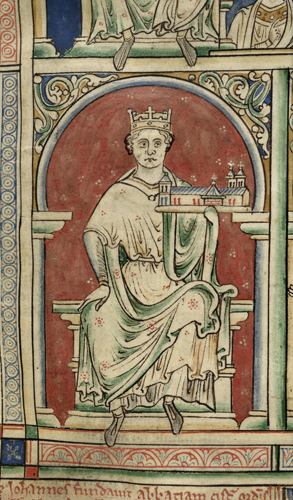
Just fifteen months after Magna Carta was sealed, King John was on his deathbed; he died in his forty-ninth year, at Newark Castle on the
night of 18/19 October 1216. His 9-year old son, Henry III, inherited a country mired in a civil war, with half of it occupied by a French army. The young king and his regent, William Marshal, Earl of Pembroke, had a fight on their hands; they wasted no time in reissuing the Magna Carta and setting about regaining control of the country.
Essentially a peace treaty, Magna Carta is the closest thing England has to a
constitution. It addressed the worries and grievances of the English nobility,
the barons, and sought to curb the powers of the king, firmly placing the
monarch below the law, rather than above it. But what of the women? A small number of Magna Carta clauses were influenced by the experiences of women or sought to protect the rights of women.
Of the sixty-three clauses, two stand out as the guarantors of liberty and the
law, not only in England but around the world. Clause 39 ensures that ‘no man shall be taken or imprisoned or deprived or outlawed or exiled or in any way ruined, nor will we go or send against him, except by the lawful judgment of his peers or by the law of the land.’ This guarantee of justice for all is believed to have been inspired by John’s treatment of Matilda de Braose, wife of William de Braose, Lord of Bamber. William was one of John’s foremost supporters in the early years of his reign, but later fell afoul of the king and saw his family hunted and hounded, almost to destruction. This clause is supported by the one following, clause 49, which states categorically; ‘To no one will we sell, to no one will we deny or delay right or justice.’
As a consequence of John’s rancor poor Matilda and her son, also called
William found themselves languishing in one of John’s prisons. King John
made an agreement with both William and Matilda; freedom for her and a
pardon for William in return for 40,000 marks. However, being either unwilling or unable to pay, Matilda and her son remained in prison – either at Windsor or Corfe Castle – and William was outlawed, eventually escaping into exile in France, disguised as a beggar, where he died in 1211.
Matilda’s fate was more gruesome; she and her son were left to starve to
death in John’s dungeons (though whether this was at Corfe or Windsor is
unclear). Tradition has it, that when their bodies were found, William’s cheeks bore his mother’s bite marks, where she had tried to stay alive following his death:
‘On the eleventh day the mother was found dead between her son’s legs, still
upright but leaning back against her son’s chest as a dead woman. The son,
who was also dead, sat upright, leaning against the wall as a dead man. So
desperate was the mother that she had eaten her son’s cheeks. When William
de Braose, who was in Paris, heard this news, he died soon afterwards, many
asserting that it was through grief.’ (Anonymous of Bethune)

The Magna Carta of 1215 reflects the needs and events of the time in which it was issued; an England on the brink of civil war, disaffected barons demanding redress, the church and cities, such as London, looking for protection. It was drawn up by barons looking for reparations and legal protection from a king whose word could no longer be trusted, who meted out arbitrary punishments and heavy taxes. It was not a charter that was intended for the protection and legal rights of every man, woman and child in the land; though it has come to be seen as just that in subsequent centuries. Indeed, the common man does not get a mention, and of the sixty-three clauses, only eight of them mention women as a gender.
Only one clause uses the word femina – woman – and that is a clause which
restricts the rights and powers of a woman, rather than upholding them.
Clause 54 states: ‘No one shall be taken or imprisoned upon the appeal of a
woman for the death of anyone except her husband.’ At first glance, this has to be the most anti-feminist statement ever made, a woman was not allowed to give evidence of a murder unless it was her own husband who was killed. However, the barons believed they had justification for inserting this clause. In a time when a man had the right to face his accuser in trial by combat to prove his innocence, this right would be automatically removed if his accuser was a woman; women were not allowed to use force of arms. A female accuser was seen as being able to circumvent the law, and therefore the law was open to abuse. It was not just that a woman may bear false witness and the accused would have no right of redress in battle; it was also that a woman may be manipulated by her menfolk to make an accusation, knowing that she would not be required to back it up by feat of arms. Whereas her husband, father or brother may have been challenged to do just that.
However, while it is possible to see why this clause was written, it does not
deny the fact that women were treated so differently and denied the
fundamental right to justice simply because of their gender. This very clause was used on 5 July 1215, when King John ordered the release of Everard de Mildeston, an alleged murderer. Everard had been accused of the murder of her son, Richard, by Seina Chevel. Such a charge was now forbidden under the terms of Magna Carta, and the accused was therefore released. It is, of course, true that many of the clauses of Magna Carta refer to people in general, rather than just men, and that women are included in such clauses, as well as in the eight which refer to them specifically. However, the significance of women in the Magna Carta story is not just their limited inclusion in the charter itself, but also in their experiences of the unsettled times in which they lived, in their influence on the charter and in their use of its clauses to exact recompense for injustices they have experienced.

The political crisis which saw the issuing of Magna Carta, and the civil war which followed, was not just significant to the barons involved, but to their wives and families, tenants and retainers. The conflict tore families apart as they took sides in the struggle and saw more than one baron change sides mid-crisis. Wives and daughters were caught in the middle, often torn by divided loyalties; between their birth family and the family into which they had married; between their fathers and their husbands. For instance, Matilda Marshal was the eldest daughter of William Marshal, a man known for his staunch loyalty to the crown, but she was married to Hugh Bigod, son of Roger, second Earl of Norfolk, one of the leaders of baronial opposition; Roger and Hugh were both named among the twenty- five barons appointed to ensure that John adhered to the terms of Magna
Carta, known as the Enforcers of Magna Carta.
Some of the clauses are specific to the people on the political stage in 1215.
Clause 59 of Magna Carta, for instance, refers to two particular women,
though they are identified by their relationship to the king of Scots, rather than their names. These were two of the sisters of Alexander II, who had been held hostage by King John since the 1209 Treaty of Norham. John had promised to find husbands for the two princesses, preferably within the royal family. However, the marriages had never materialized and, six years on, the young women, Margaret and Isabella, were now in their twenties, and still unmarried. The Magna Carta clause opens with; ‘We will treat with Alexander, king of Scots, concerning the return of his sisters and hostages…’
As with many of the issues addressed in Magna Carta, the problem of the
Scottish princesses was not resolved immediately. Margaret was eventually
married, in 1221, to King Henry III’s justiciar, Hubert de Burgh; a lowly marriage for the daughter of a king. Isabella, however, remained unmarried and in 1222 returned to Scotland. She was eventually wed to Roger Bigod, 4th Earl of Norfolk, in 1225. Roger was the son of Matilda Marshal and therefore grandson of William Marshal, Henry III’s regent. At only 13 years of age, young Roger was still a minor and with an age disparity of around 17 years, the marriage was not a happy one. The couple never had children and Roger tried to have the marriage annulled at one stage but was refused by the church.
These are just a handful of examples of how the lives of women are woven into the Magna Carta story. The deeper you dig, the more fascinating stories you will find. Magna Carta started England on the road to democratic government and, more importantly, universal suffrage, culminating in votes for women in 1918. Magna Carta was the first step. Within a generation of the charter’s first issue, women such as King John’s own daughter, Eleanor de Montfort, were helping to fight for political reform and others, such as Isabel d’Aubigny, were using its clauses to their advantage. Women had been a part of the fight for and against King John in the lead up to the first issuing of Magna Carta. They had influenced its creation and continued to use its clauses to fight for their rights and those of their families. There was still a long way to go, especially for women. Magna Carta was not the start of the women’s rights movement, but
it serves as a benchmark for how far society has come in the last eight
centuries.
Photo information:
Ladies of Magna Carta; the Magna Carta (British Library); Magna Carta memorial, Runnymede (Jayne Smith); King John (British Library); Windsor Castle, possible location for the sad death of Matilda de Braose and her son William (my photo).
Author bio:

Sharon Bennett Connolly has been fascinated by history her whole life. She
has studied history academically and just for fun – and even worked as a tour guide at historical sites. For Christmas 2014, her husband gave her a blog as a gift – http://www.historytheinterestingbits.com – and Sharon started researching and writing about the stories that have always fascinated, concentrating on medieval women. Her latest book, Ladies of Magna Carta: Women of Influence in Thirteenth Century England, released in May 2020, is her third non-fiction book. She is also the author of Heroines of the Medieval World and Silk and the Sword: The Women of the Norman Conquest. Sharon regularly gives talks on women’s history; she is a feature writer for All About History magazine and her TV work includes Australian Television; Who Do You Think You Are.
Links:
Blog: https://historytheinterestingbits.com/
Facebook: https://www.facebook.com/Thehistorybits/
Twitter: @Thehistorybits
Instagram: https://www.instagram.com/sharonbennettconnolly/?hl=en
Amazon: http://viewauthor.at/SharonBennettConnolly
Pen & Sword: https://www.pen-and-sword.co.uk/Ladies-of-Magna-Carta-
Hardback/p/17766

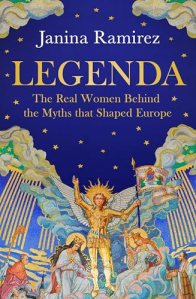 When we think of famous medieval European women, we often think of figures like Joan of Arc and Isabella of Castile. They are seen as women who broke the mold and challenged traditional stereotypes by becoming leaders in traditionally male-dominated fields. These women would be used to craft the identities of their respective nations, but they would help shape the identities of other women from the 18th and 19th centuries. We think we know the stories about these medieval women and their lives, but what new information can we learn from their lives when we examine their lives from their eras? Janina Ramirez takes the stories of seven medieval women and their contemporaries to show how their legacies have been transformed in her latest book, “Legenda: The Real Women Behind the Myths That Shaped Europe.”
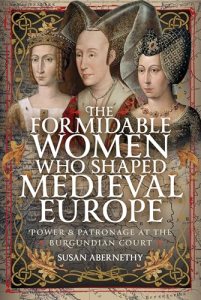 Throughout European history, we tend to think about the countries as a whole when it comes to the political sphere of influence. We think of the big countries like France, Spain, Italy, Germany, Austria, and England as having the most impact, but we have to consider that during the Middle Ages, duchies held immense power. Take, for example, the Duchy of Burgundy, also known as the Burgundian Empire. It was a part of France, but that does not mean that the dukes stayed on the side of the French. The Burgundians used their influence to expand and marry into the medieval European families, affecting European history as a whole. While we tend to focus on the Dukes of Burgundy, we should be paying attention to the women of this duchy. That is why Susan Abernethy chose to focus on these women in her latest book, “The Formidable Women Who Shaped Medieval Europe: Power and Patronage at the Burgundian Court.”
 In each era throughout history, we see how men and women adapt to the struggles and triumphs of the age. Take, for example, the 16th century, primarily in Tudor England. It was a time of great religious changes and dynamic rulers who would change the course of European history forever. While men had the most power, except for a handful of women, the majority of women struggled to survive each stage of life. So, what was life truly like for Tudor women? Elizabeth Norton explores this topic in her book, “The Lives of Tudor Women.”
 When we think about the most impactful women authors, we often think about writers like Agatha Christie, Mary Shelley, and Jane Austen. However, when it comes to religious texts, we have to go back in time centuries. We think about nuns like Bridget of Sweden and a mother of 14 children named Margery Kempe. Yet, we must include an anchorite who stayed in her cell for almost thirty years. Her book, Revelations of Divine Love, is considered the first great work of English prose, but many people are not familiar with the author until now. Janina Ramirez tells the story of Julian of Norwich and how impactful her book was in her book, “Julian of Norwich: A Very Brief History.”
 Throughout history, women have been seen as pious mothers, wives, or daughters who stayed in their lane or vile manipulators who wanted power and were willing to do anything to maintain their status. While the former group of women would be an interesting study, as the saying goes, well-behaved women seldom make history. So why did certain women receive a villainess lens when we look at their lives and what do the historical records tell us about them? Samantha Morris has chosen to take the stories of these misunderstood maidens and tell them in her latest book, “The Most Maligned Women in History.”
 When we think about the Tudor dynasty, we often think about the famous men and women who defined the era. An era full of change in all aspects of life, from religious and political, to the arts and literature. Throughout these changes, we tend to focus on how they affected the lives of Tudor men, but there is a growing field of interest in the lives of the average Tudor women and how their lives were affected. In her latest book, “Women’s Lives in the Tudor Era,” Amy McElroy explores women’s life stages in 16th-century England and how their roles changed.
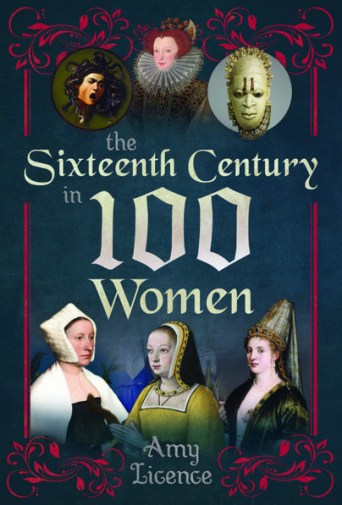 When we think of the phrase “16th-century women,” we often consider those from royal or noble houses throughout Europe. We tend to think of women like the six wives of Henry VIII, Mary I, Elizabeth I, Catherine de Medici, Mary Queen of Scots, and others associated who made an impact during the Renaissance and the Reformation. However, the 16th century did not stop at the borders of Europe; it extended all over the globe. There are many stories of women from all over the world and from different social classes that can help us understand how the world changed in the 16th century. Amy Licence took this concept and decided to write her latest book about a variety of women from around the world who lived in the 16th century, “The Sixteenth Century in 100 Women.”
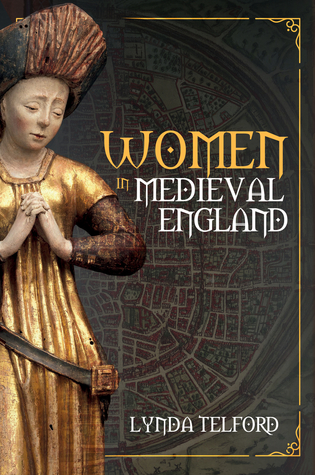 As students of history, we understand that aspects of society change all of the time, and sometimes the change is rapid, and other times it is positively glacial. One of those aspects of culture that we have seen slow and gradual change pertains to women’s rights. Today, women have more rights than they did in the past, and they can have careers, but is this a novel concept? What were the lives of women like in other periods of history, like the medieval period? In Lynda Telford’s book, “Women in Medieval England,” she explores women’s lives from the Anglo-Saxons to the Tudors to give us a picture of what rights and responsibilities women had during this period.
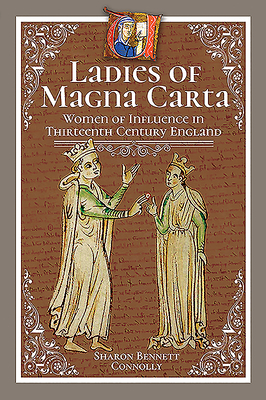 The year of 1215 marked a turning point in English history with the sealing of a rather unique document; the Charter of Liberties, or as we know it today, the Magna Carta. It was a charter from the people to a king demanding the rights that they believed that they deserved. Those who sealed it were rebel barons who were tired of the way King John was running the country, yet instead of asking for his removal, they wanted reform. The clauses mostly concerned the problems of the men who made the charter, however, three clauses dealt with women specifically. In her latest book, “Ladies of Magna Carta: Women of Influence in Thirteenth Century England”, Sharon Bennett Connolly explores the lives of the women who were directly impacted by this document.
 Adventures of a Tudor Nerd