
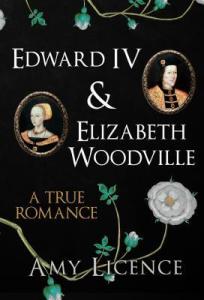
When we think of a fairy tale romance, we think about stories like Cinderella. A girl of lower status captures the heart of the handsome prince. They overcome the odds and live happily ever after. But that kind of romance only exists in books. The closest story we have to that in medieval English history might be the story of Edward IV and Elizabeth Woodville. A widow who begged the handsome and younger King of England for help, but ended up becoming his wife. It’s a story that any romance-loving history lover will swoon over, but how accurate is that story? What is the real story of Edward IV and Elizabeth Woodville? Amy Licence explores the nature of their relationship in her book, “Edward IV & Elizabeth Woodville: A True Romance.”
I have been reading books by Amy Licence for a few years now, so when I saw this title, I knew I wanted to read it. The Wars of the Roses is one of my favorite areas of history to study, but I have not read a joint biography of Edward IV and Elizabeth Woodville. When I saw this title, I knew that this was a must-read for me.
We begin in 1431 in Rouen, France, where the Maid of Orleans, who we know as Joan of Arc, is about to die on the pyre. In the same town, eleven years later, the future King Edward IV would be born to Cecily Neville and Richard, Duke of York. Edward’s future bride, Elizabeth Woodville, was born around six years after the death of Joan of Arc. Her mother, Jacquetta of Luxembourg, had married below her station after the death of her first husband, John Duke of Bedford passed away; Jacquetta would marry a knight, Sir Richard Woodville, Elizabeth’s father. Jacquetta was close to King Henry VI and Margaret of Anjou, the Lancastrian rulers of England, and Edward IV’s father, Richard, Duke of York, would fight against the Lancastrians for the right to rule England during the conflict that we know today as the Wars of the Roses. To top it all off, Elizabeth was married to Sir John Grey of Groby Old Hall, a man who fought and died for King Henry VI.
In other words, Edward and Elizabeth were on different sides of the Wars of the Roses, but somehow these two found each other after Edward IV became king. The obvious choice for Edward’s bride should have been a foreign princess to create an alliance, but there was something about Elizabeth that convinced Edward to forgo the wisdom of Warwick and marry her. Their court was based on the Burgundian court. They had a large family, but the fight for the crown with the Lancastrian cause and Edward’s own family continued. Just when the throne is secure, Edward passes away. Elizabeth had to fight for her children, fight against her brother-in-law, and join forces with her enemy Margaret Beaufort to help usher in the Tudor dynasty.
Licence was able to present the information not only about this period, but also about Edward and Elizabeth in such a comprehensive way that both novices and experts can understand. She can present theories that she either agrees with or disagrees with respectfully. I thoroughly enjoyed this joint biography as it gave me a better appreciation for the reign of Edward IV and Elizabeth Woodville. If you want to learn more about the Wars of the Roses, the first Yorkist king, and his wife, I highly recommend you read “Edward & Elizabeth Woodville: A True Romance” by Amy Licence.
 The Wars of the Roses, a conflict that engulfed English politics for over 30 years and heralded a new dynasty, the Tudors. While there were battles and political intrigue galore during this period of unrest, there were also births, marriages, and deaths of powerful figures. Each day during the Wars of the Roses holds significance to nobles and commoners alike. Dan Moorhouse has compiled his years of research into this conflict into his book, “On This Day in the Wars of the Roses.”
 A banner decorated with three suns flaps in the wind on the field of battle. The young man behind this emblem is Edward, Earl of March, whose father Richard Duke of York and brother Edmund Earl of Rutland were tragically slain at the Battle of Wakefield. His younger brothers, George Duke of Clarence and Richard Duke of Gloucester, will help Edward carry their father’s cause for the family of York to rule England. When loyalty is questioned even among family members, only one man would truly stand behind Edward until the bitter end. That man would be Richard Duke of Gloucester, or as we know him today, the much-maligned King Richard III. He is often viewed as a treacherous child-killer who coveted the throne after Edward IV’s death, but is that accurately portraying the last Plantagenet king? Who was the real King Richard III? In her magnum opus, “The Sunne in Splendour,” Sharon Kay Penman presents her case for Richard III as a man betrayed, both in life and after his death.
 August 22, 1485, marked the end of the Plantagenet Dynasty with the death of King Richard III at the Battle of Bosworth Field. The man who succeeded him as King of England after his death was young Henry Tudor, whose dynasty would live in infamy in English history, thought that he was done fighting on the battlefield for his right to rule. This was only the beginning of a decades-long war against those who claimed to be lingering shadows of the past. They claimed to be the Princes in the Tower, whose disappearances in 1483 left to doubt and confusion on what happened to them and gave those who despised this new dynasty opportunity to exploit a young king’s fear of being overthrown. The young men who made this king who won his way to the throne on a battlefield quake in his boots are known today as “the Pretenders”, but who were they? In Nathen Amin’s much-anticipated book, “Henry VII and the Tudor Pretenders: Simnel, Warbeck, and Warwick”, he traces the origins of each pretender to show what type of threat that they posed to the first Tudor king.
 The year 1483 proved to be a pinnacle point of change for the short-lived Yorkist dynasty. After finally defeating the Lancastrian army, King Edward IV and his family bring peace and order to England, but even their happiness cannot last as King Edward IV dies unexpectedly on April 9, 1483. A power struggle ensues between Richard Duke of Gloucester and Elizabeth Woodville over who should be King of England. Most of Elizabeth Woodville’s children side with her, but there is one child who is staunchly loyal to the Yorkist cause and her uncle Richard; Cecily of York. In her latest novel, “Princess of Thorns”, Saga Hillbom tells the heartbreaking tale of Cecily of York showing how deep her loyalty to her family was and how loyalty came with a cost.
 Adventures of a Tudor Nerd