
 The medieval world could be a treacherous place to live in, especially when it comes to life in the medieval court. There was so much backstabbing and men reaching for titles and crowns that were not given to them. Take, for example, the House of York. Now, we will assume that their desire for the throne truly came to fruition during the period known as the Wars of the Roses in the 15th century. However, the sons and the daughter of Edmund of Langley and Isabella of Castile were fiercely loyal to those they served and were ruthless to those who they deemed as their enemies. This is the world that Constance of York, Lady Despenser, is raised in, but when her world is turned upside down, will she choose to stay on the sideline, or will she scheme with her family and fight for what they believe is right? Constance’s story is woven together in Anne O’Brien’s novel, “A Tapestry of Treason.”
I did have Anne on my blog with a guest post for her novel, “The Queen’s Rival,” and read it, which was a lot of fun, so I decided that I wanted to read more of her novels. I didn’t know a lot about Constance of York before this book, so I was excited to see she would tell Constance’s story.
We begin our tale in 1399 when Richard II sits on the throne, and the House of York is riding high. Constance of York is married to Thomas Lord Despenser, and her family, led by her father Edmund Langley, are sitting in good favor of their cousin, the king. However, things do not stay the same for long as Henry Bolingbroke comes back from exile to take back his Lancastrian titles and lands, but he ends up taking the throne as Henry IV and imprisoning Richard II. Well, Constance and her family simply cannot have an usurper take the throne from their cousin. So, a plan is hatched with Constance’s husband, Thomas, at the center to try and free Richard II from his captivity. To say this failed massively would be an understatement, as it led to the execution of Thomas Lord Despenser.
As a widow, Constance hopes to live a normal life, especially after she falls in love with Edmund Holland, Earl of Kent. He wishes to marry Constance, but her family gets in the way of this love match. Constance is asked to help with a scheme to put one of the Mortimer boys on the throne and overthrow King Henry IV, but to do so, Constance must free the boys from their captivity. Constance agreed, and I wanted to scream at her. She throws away her chance at happiness for a plot that was easily foiled, and Constance ends up imprisoned herself. She loses the one real chance at marrying the man she truly loves as he marries another, and to top it all off, she ends up pregnant with his child.
While Constance of York was not a main character that I particularly enjoyed, O’Brien’s writing style is engaging, and it shows how tumultuous this period was for those closest to the throne. Overall, I enjoyed this novel and I am looking forward to reading more novels by Anne O’Brien. If you are like me and want to read a novel about a time in medieval England that’s not discussed much, I would suggest you read, “A Tapestry of Treason,” by Anne O’Brien.
 What’s better than snuggling up on a cold winter’s day and reading a murder mystery? How about an entire book about historical murders and the laws about murder and revenge? While we do have murder mysteries in every century and every walk of life, the farther back into the past we go, the more difficult it can be to discern fact from fiction. Take, for example, the stories of murder, betrayal, and revenge in Anglo-Saxon England. Annie Whitehead hopes to reveal a deeper understanding of this period through numerous murder cases in her latest book, “Murder in Anglo-Saxon England: Justice, Weregild, Revenge.”
 We all know the story of William the Conqueror and the Norman Conquest. William claimed he was the heir of Edward the Confessor instead of his rival Harold Godwinson. Harold was seen as a villain throughout history thanks to the Norman sources, but what was the historical Harold Godwinson like? Was he a malicious usurper who had to die at the Battle of Hastings for the rightful King William I to take the throne or is there more to his story than his death? Paula Lofting scoured the archives to find the truth about this maligned man in her book, “Searching for the Last Anglo-Saxon King: Harold Godwinson, England’s Golden Warrior.”
 In an age when most women of power did not have much power outside their own countries, one stood higher than most. She was not even supposed to become queen, but fate had a bigger mission for the young woman: rescue Christianity from dying out. As a ruler, this seems like a monumental task to complete especially when their enemies were the Ottoman Empire and the Turks at the height of the power. There was one woman who was up to the challenge while fighting to reclaim Spain for the Christians, exploring the new world, and dealing with her family drama. Isabella of Castile is either viewed as a saintly queen or a horrible woman ruler, but what do the archives tell us about her reign? Kirstin Downey tells the story of this revolutionary queen in her biography, “Isabella: The Warrior Queen.”
 A love that can get through any obstacle even when the couple is married to other people is considered very rare. However, star-crossed lovers at court were practically unheard of, especially multiple couples from the same family. Anne Brandon knows how rare these matches are as her father Charles Brandon married the sister of King Henry VIII. Now she must figure out her feelings about romance while navigating court life. In the modern day, Caroline Harvey has relationship problems while she navigates the loss of her famous writer, grandfather Dexter Blake. How are these two women from different centuries connected and can they fight for who they love or are they destined to be alone? Alexandra Walsh tells both women’s stories in her novel, “The House of Echoes.”
 The life of a 16th-century princess is not all that it is cracked up to be. You can have jewels, and glamorous dresses, attend the glittering yet treacherous court, and have numerous homes. You must marry the person the king says you should marry to create strong alliances for the kingdom, so the concept of marrying for love is not in your vocabulary. You had to ensure your opinions were kept in line with the monarch’s views so you didn’t meet a disastrous end. In other words, the closer you are to the throne, the more scrutiny is forced upon you. No one understood this advice better than Mary Tudor, the daughter of King Henry VII and the younger sister of Henry VIII. She was a daughter, a sister, a wife, a queen, a duchess, and a mother. Her remarkable story is told in Amy McElroy’s book, “Mary Tudor: Queen of France.”
 April 15, 2019, will be a dark day for Paris and the world. We watched in horror as the magnificent Notre Dame Cathedral burned. For centuries, it stood as the symbol of medieval Paris, and in minutes, it was engulfed in flames. While so many of us felt helpless, Ken Follett decided to do something to help rebuild the great cathedral. He wrote this book, “Notre Dame: A Short History of the Meaning of Cathedrals,” with the proceeds going to the charity La Fondation du Patrimoine.
  For centuries, the brave knights of Camelot and the Crusaders have searched for the Holy Grail. The cup that Jesus of Nazareth used during his Last Supper is rumored to be a vessel that can grant eternal life or miraculous healing powers. It can be a cup, plate, or stone, but in all stories, the Grail guardians and those searching for it are predominately male. But what if the guardians were male and female and the ones searching for it were predominately female? Alais from 11th-century France and Alice Tanner visiting France in 2007 share a connection that is centuries deep and it all started with a ring, a book, and an image of a labyrinth. How are these two connected to the labyrinth and the Grail and can they protect it from those who want to use it for their dark purposes? Kate Mosse weaves the tale of the Grail and the two women connected by fate in her novel, “Labyrinth.”
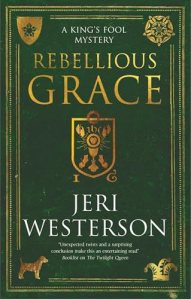 Christmas is a time of merriment and joy unless you are in the court of Henry VIII in 1536. Then it is a time of stress and murder. Henry’s second wife Anne Boleyn has only been dead for a few months while his third wife Jane Seymour is slowly adjusting to her new role as queen. A rebellion known as the Pilgrimage of Grace is taking over northern England and the leader Robert Aske wants to visit the court to discuss matters with King Henry VIII. To top it all off, a servant of Queen Jane has been murdered and the only one who can solve the crime is a fool, Will Somers. Can Will Somers connect the dots and save those closest to him, or will the treasonous act be another downfall in such a tumultuous year? This is the premise for the third book in the A King’s Fool Mystery series, “Rebellious Grace” by Jeri Westerson.
 Adventures of a Tudor Nerd