
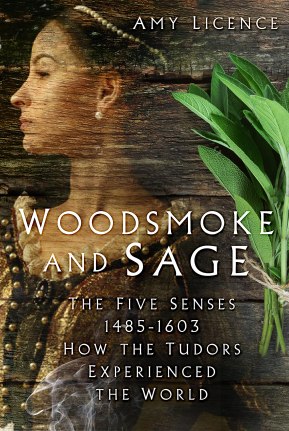
 When we study history, we tend to focus on specific dates, certain people, and the stories that transformed countries forever, no matter how much of an impact they made. What is difficult about studying history is understanding how they experienced life. What did they see? How did they communicate? What did they hear during a typical day? What smells wafted through the air? How did their view on how the body worked affected what they ate and how they cured their illnesses? In her latest nonfiction book,” Woodsmoke and Sage: The Five Senses 1485-1603: How the Tudors Experienced the World”, Amy Licence has taken on the challenge of explaining the Tudor world that they knew through their senses.
Licence breaks her book down into five sections, one for each sense. We begin with sight, since how the Tudors viewed themselves and their world was extremely important. We can walk through their world by taking a tour of their portraits, the architecture, and the landscapes that the average Tudor would find familiar. Of course, what the Tudors wore every day and the colors they chose impacted how others viewed them because image was everything. The next step in our journey is exploring the sense of smell, from the odiferous to the more pleasant scents.
The sounds of musical instruments, news being called, and gossips tell their tales to anyone who would like to fill the air. On their dining tables, culinary experiments with meat and fish combined with odd spices would seem strange to travelers from the 21st century. The closer you got to someone who sat on the throne, the more extravagant the dishes were. Finally, we explore how the Tudors understood how their body worked through the Humours Theory and how they used this theory to concoct cures.
Even though the Tudors lived over 500 years ago, they saw their world similarly to how we view it. They had homes and clothing to show how well off they were compared to others. They had different scents that they enjoyed compared to us. Their music and how they understood their bodies might be different from what we are used to, yet they still tried to enjoy life and live no matter what. The Tudors were humans like us trying to get through life day by day in their unique ways.
When I heard about the concept for this book, I was not sure how Licence would take on such an ambitious idea and what the result would be. However, Licence proved that this was a brilliant idea for a book. It is truly a treasure trove of Tudor trivia that historians, historical fiction authors, and Tudor nerds would all enjoy. If you want a new and exciting book about the Tudors that freshly explores their world, you should check out “Woodsmoke and Sage: The Five Senses 1485-1603: How the Tudors Experienced the World” by Amy Licence.
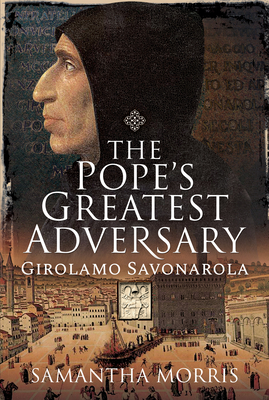 When we think about men who challenged the Church and are known as Reformers, we tend to think of Martin Luther, Jan Hus, and John Calvin. However, a man fought against corruption in his beloved Florence who should be included in the list of great reformers. He was a Dominican monk who was not afraid to preach against sin and took aim at the most powerful men in all of Italy, including Pope Alexander VII. His sermons were so scandalous that they would lead to his demise upon a pyre in the middle of Florence. His name was Girolamo Savonarola, and his story is told in Samantha Morris’s latest biography, “The Pope’s Greatest Adversary: Girolamo Savonarola.”
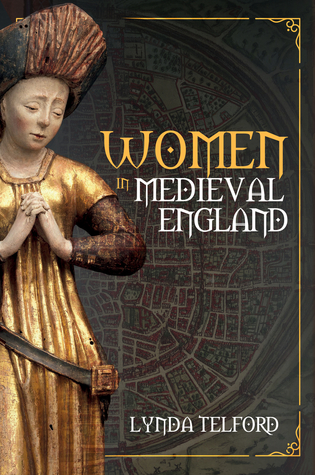 As students of history, we understand that aspects of society change all of the time, and sometimes the change is rapid, and other times it is positively glacial. One of those aspects of culture that we have seen slow and gradual change pertains to women’s rights. Today, women have more rights than they did in the past, and they can have careers, but is this a novel concept? What were the lives of women like in other periods of history, like the medieval period? In Lynda Telford’s book, “Women in Medieval England,” she explores women’s lives from the Anglo-Saxons to the Tudors to give us a picture of what rights and responsibilities women had during this period.
 A man hidden from the world languishes for decades in a prison cell. He is not allowed to speak to anyone, or he will face severe consequences. Often in literature, his head is covered in a mask made of iron. His identity and why he angered King Louis XIV so much have remained a mystery for centuries. The prisoner was known as the man in the iron mask throughout history, but who was this enigmatic figure? In her latest book, “The Man in the Iron Mask: The True Story of Europe’s Most Famous Prisoner,” Josephine Wilkinson dives deep into the archives to construct his story and the stories of the men behind the mystery.
 A banner decorated with three suns flaps in the wind on the field of battle. The young man behind this emblem is Edward, Earl of March, whose father Richard Duke of York and brother Edmund Earl of Rutland were tragically slain at the Battle of Wakefield. His younger brothers, George Duke of Clarence and Richard Duke of Gloucester, will help Edward carry their father’s cause for the family of York to rule England. When loyalty is questioned even among family members, only one man would truly stand behind Edward until the bitter end. That man would be Richard Duke of Gloucester, or as we know him today, the much-maligned King Richard III. He is often viewed as a treacherous child-killer who coveted the throne after Edward IV’s death, but is that accurately portraying the last Plantagenet king? Who was the real King Richard III? In her magnum opus, “The Sunne in Splendour,” Sharon Kay Penman presents her case for Richard III as a man betrayed, both in life and after his death.
 If you go to Fontevrault Abbey in France, you will find two rather extraordinary tombs. These tombs belong to King Henry II and Queen Eleanor of Aquitaine, the first King, Queen of the Plantagenet Dynasty, and the Angevin Empire. Their effigies tell us a lot about the couple that was buried side by side. The husband was restless; his model shows him ready to take action at any moment, with his crown upon his head and a scepter in his hand. His queen lays beside him, reading an unknown book. They seem to be prepared to watch over their kingdom and their family even beyond the grave. Those who know English history recognize their names and understand the family drama behind the scenes. We think we know the truth about Henry and Eleanor, but is there more to their story and their feuding family? In Matthew Lewis’s latest dual biography, “Henry II and Eleanor of Aquitaine: Founding an Empire,” he explores the relationship between this dynamic king and queen and how it shaped European and English history forever.
 The year is 1558, and Queen Mary I is dying. England is engaged in a war between the Reformation and Catholicism. Caught in the middle is an older man named Robin Lewis, who is being taken to London to face his death as a heretic. Fearful that his story may never be told, Robin Lewis tells his captor his tale through the reigns of three Tudor rulers, Henry VIII, Edward VI, and Mary I. Can his story save his life from certain destruction, or is Robin doomed for all eternity? This is the premise of Karen Heenan’s second book in The Tudor Court series, “A Wider World.”
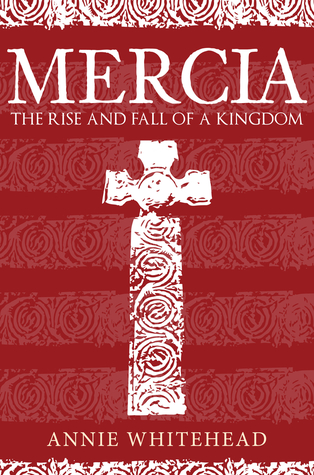 England’s history is full of daring moves and colorful characters, but it is also very ancient compared to other countries. We often considered the “start” of English history in school as the Norman Conquest in 1066. Nevertheless, this was just a stage in the massive story of the island. We have to consider those who called England their home; those who knew England, not as a unified country, but seven kingdoms known as the heptarchy. The most famous of these seven kingdoms was Wessex, the last kingdom, but their mortal enemy had a rich history of their own. Mercia was a thriving kingdom for hundreds of years, with colorful characters that many people are not familiar with. Annie Whitehead has taken the tales of this forgotten kingdom to the forefront with her book, “Mercia: The Rise and Fall of a Kingdom.”
  Adventures of a Tudor Nerd