
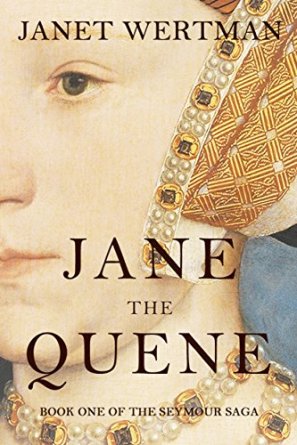
 Henry VIII may have had six wives, but only one could give him the desired son that he wanted. She was kind, demure and everything that Henry VIII’s second wife Anne Boleyn was not. Her name was Jane Seymour, Henry’s third wife. Sadly, she is often remembered for the birth of her son and her death. However, there was a lot more to Jane’s story than the ending. What was her relationship with her family like? How did she fall in love with the King? And how was her relationship with her romantic rival, Anne Boleyn? These are just some of the questions that Janet Wertman strives to answer in her first novel of her new Seymour Saga called, “Jane the Quene”.
I would like to thank Janet Wertman for sending me a copy of “Jane the Quene”. This was a delightful read and a fantastic start to the Seymour Saga.
Wertman begins her book with a prologue of Jane Seymour entering the services of Henry’s first wife Catherine of Aragon. In this opening scene, we begin to see a rivalry bloom between Jane and her cousins Anne and Mary Boleyn. After Catherine and Henry divorce, Anne Boleyn becomes Queen and Jane Seymour is in the services of the new queen, hoping to help and serve while looking for a husband. Her brother Edward does not think that having Jane in court is really working to help her find a husband. He wants to send her home so that her younger sister can possibly find a husband, but things change when King Henry VIII and Anne Boleyn visit Wolf Hall. Wertman description of how the king and Jane become friends during this visit is rather charming and very natural. Jane tries to ignore the king’s interest in her, but Henry can’t forget the kind and demure nature of Jane and eventually, the two fall in love, even though Henry is still married to Anne.
In the middle of this tangled love mess is Thomas Cromwell, a clerk who wants to please his king in order to make his own career grow. Henry is not happy with his marriage to Anne Boleyn since she has not been able to give him a son, so he gives Cromwell the task of “getting rid of her”. However, Cromwell needs to find another wife who would be the opposite of Anne Boleyn. That is when he comes up with a plan to make Jane Seymour Henry’s next wife and queen, which does succeed.
Wertman’s Jane Seymour is a complex character who cares about her family and her husband. She is not just some plain wallflower who merely followed Anne Boleyn as Henry’s wife for a short time. With strong allies, like Cromwell and her brothers Edward and Thomas, Jane rises like a phoenix and survives all of the hate from Anne to become Henry’s beloved wife and queen. Wertman portrays Henry VIII as a man who is intelligent, caring and who struggles with how to reform the church.
Wertman breathes new life into the story of Jane Seymour. I thoroughly enjoyed reading this novel, which is the first book in her Seymour Saga, as it balances the political intrigue of the Tudor court with the romance between Henry and Jane. Their love story is one that is often forgotten in the chaos of Henry’s marriage track record, but one that needs to be told. Jane will not be just the “third wife” or “the mother of Edward VI” after this book. She was a strong woman who truly loved Henry VIII. If you really want to read a novel about Jane Seymour, I highly recommend you read “Jane the Quene” by Janet Wertman.
 The children of Henry VIII have been the center of historical studies for centuries. Edward VI, Mary I, and Elizabeth I were all considered Henry’s “legitimate” children and were able to obtain the crown of England. Henry Fitzroy was the illegitimate son of the king, but he was still able to gain titles and a good marriage before he died. They all had something in common; they were all recognized by their father, Henry VIII. However, there was another child who many believed to have been the daughter of the king. The name of this intriguing lady was Lady Katherine Knollys and her story comes to life in Sarah-Beth Watkins’ book, “Lady Katherine Knollys- The Unacknowledged Daughter of King Henry VIII”.
 Love stories tend to be rare during the Tudor dynasty. They are often of royal women marrying men well below their station in life and then the ruling monarch throwing them in the Tower until they ended up divorcing or dying. Nothing really romantic about these stories. However, there is one story that breaks the mold of disastrous love. It is the story of Mary Tudor, the sister of King Henry VIII and the Dowager Queen of France, who married the charming knight and best friend of her brother, Charles Brandon. Their story is often told in historical fiction novels, but Sarah-Beth Watkins decided to dive deep into the lives of these two lovebirds, before and after they were married, in her book, “The Tudor Brandons: Mary and Charles- Henry VIII’s Nearest and Dearest”.
 When one thinks about Queens of Scotland during the time of the Tudors, many automatically think of Mary Queen of Scots and her tragic life. However, there was another queen who had a deep connection to the Tudors and was also a queen of Scotland. She tends to be pushed aside in favor of her more famous siblings; Arthur Tudor, Henry VIII, and Mary Tudor. Her story is full of turmoil and triumphs. Her only desire was to unite England and Scotland peacefully, but the choices that she made in her lifetime would prove foolish, leading to more troubles between the two nations. This is the story of Henry VIII’s oldest sister Margaret, which is brought to life in Sarah-Beth Watkins’ book, “Margaret Tudor Queen of Scots: The Life of King Henry VIII’s Sister”.
 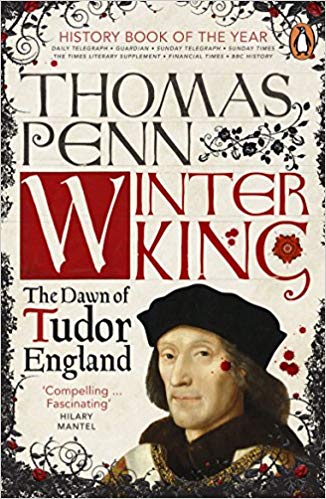 The Tudor Dynasty and its beginning has often been viewed as a glorious dawn after the dark period that we call the Wars of the Roses. It established a firm foundation that the kingdom lost during the 30 years of civil war. It took a lot of effort from the victor of this tumultuous time, Henry VII, to transform England back to a relatively stable country. To some, Henry VII was a virtuous leader who cared about his family and his country, saving money to make sure the dynasty was secure. For others, Henry VII was a figure who clung to his crown and his kingdom no matter the cost, which included conspiracies and underhanded methods. But what did Henry VII do in order to bring back order to England and how did he convince others that the Tudors were the rightful rulers? These are the questions that Thomas Penn wanted to answer in his book, “Winter King: The Dawn of Tudor England.”
 England is on the brink of civil war. Families with royal blood in their veins are fighting amongst each other as King Henry VI has fallen ill. Mistrust runs rampant and sacrifices are made in order to gain the throne. This is the England of 1454 and the beginning of the period in English history that we know today as the Wars of the Roses. Families like the Nevilles, the Percys, and the houses of York, Lancaster, and Tudor would gain fame and infamy during this time. Conn Iggulden decided to explore this tumultuous time after the Jack Cade rebellion, which he explored in his first book “Stormbird”, in the second book of his “Wars of the Roses” series called “Trinity”.
 Henry VIII, the king who was notorious for his six marriages. His first three marriages, to Catherine of Aragon, Anne Boleyn, and Jane Seymour, gave Henry VIII his only children that were considered eligible for succession. Catherine of Aragon was his first foreign bride, but he would divorce her to marry Anne Boleyn. Anne Boleyn would later be executed and Jane Seymour would die after giving birth to Henry’s son Edward. Henry wanted to marry again, so his most trusted advisors decided to try for a foreign alliance as well as a new bride for the king. They decided that Anne of Cleves from Germany would be the perfect bride, but it did not work out and Henry decided to divorce her and claim Anne as his “sister”. She is often viewed as Henry’s “lucky wife”, but who was she and what was her life like before and after she met her husband Henry VIII? That is exactly the question that Sarah-Beth Watkins wanted to explore in her latest book, “Anne of Cleves: Henry VIII’s Unwanted Wife”.
 Henry VIII’s wives were some of the most fascinating women of the Tudor Dynasty. Katherine of Aragon, Henry’s first wife, the mother of Mary I, and the first wife Henry divorced. Anne Boleyn, the mother of Elizabeth I and the first English queen to be executed. Anne of Cleves, the wife Henry did not like and divorced. Katherine Howard, the second wife Henry executed, and Katherine Parr, the wife who outlived Henry. All of these women were unique, however, there was only one who gave Henry the son that he so desperately desired. Her name was Jane Seymour. Her death was well documented since she died shortly after giving birth to Edward, yet we really don’t know who she was or what her life was like. Alison Weir decides to explore Jane’s life in her third book of the Six Tudor Queens series, “Jane Seymour: The Haunted Queen”.
  A knight rescuing a princess and they lived happily ever after. This tends to be a cliché in every romantic fairy tale, but what if it actually happened? Though we do not have many romantic stories in the time of the Tudors because marrying for love was not the norm, one stands out. It is the story of Charles Brandon and Mary Tudor. Mary was the sister of Henry VIII and the Dowager Queen of France. Charles Brandon was one of Henry VIII’s knights and a champion jouster. They would fall in love and eventually marry, much to the chagrin of Mary’s brother, who wanted her to marry to ensure an alliance with another country for England. Charles Brandon, the knight who stole the heart of a former queen, is the focus of Tony Riches’ latest book, “Brandon Tudor Knight”.
 The rise and fall of the Boleyns have been something that has fascinated those who study the Tudor dynasty for centuries. We often view these series of events from the immediate Boleyn family, but what might it have been like for someone who was married to a Boleyn, like Jane Parker Boleyn, the wife of George Boleyn? Jane is often portrayed in literature as a woman who had a tumultuous marriage who sold out her husband when she was interrogated, someone who helped Katherine Howard with her secret liaisons behind Henry VIII’s back, and a woman who suffered from mental illness while in prison. If you take a look at Jane Boleyn’s life from this lens, she sounds like a troubled woman, but what if there was a different side to her? What if she was a good person who loved her husband and his family? That is the Jane Boleyn that Adrienne Dillard wanted to portray in her latest book, “The Raven’s Widow: A Novel of Jane Boleyn”.
  Adventures of a Tudor Nerd