
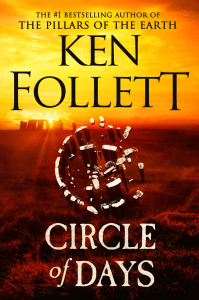
 Stonehenge, a marvel of the ancient world that still stands centuries after it was built. It has been the center of mystery and wonder for all who gaze upon it. A gigantic monolithic structure, whose purpose has been a source of discussion since its origins, but that raises another quandary: who were the people who built such an impressive landmark? This single question presents a grand opportunity for historical fiction writers as we don’t have many written records for this period of time, which means authors have room to play. Ken Follett took on the daunting task of telling the tales of those who built this imposing monument in his latest novel, “Circle of Days.”
I would like to thank Grand Central Publishing and Net Galley for sending me a copy of this novel. I have been a fan of Ken Follett’s historical fiction novels since I read “A Column of Fire” and then the first two books of the Kingsbridge series, “The Pillars of the Earth” and “World Without End.” A bit out of order, but I am loving that series. When I heard that he was writing a brand new historical fiction novel about Stonehenge, it was such an intriguing idea that I knew I wanted to read it.
Like Follett’s previous historical fiction novels, he focuses on several protagonists from different walks of life to create a cohesive story. In the case of this novel, the three main groups; herders, farmers, and woodlanders. Seft, our first main character, is a bit of an outsider. He is the son of a miner who abuses him, but Seft yearns to start a new life and he wants to build things that will help his community. Seft falls in love with a herder girl named Neen, the daughter of a herder elder named Ani. Neen’s sister Joia is a priestess who dreams of a stone monument so that they can keep their traditions alive for generations.
The dreams of Seft and Joia are ambitious in nature, especially because there are those who want to stay in the old ways instead of moving forward. They include Cog, Seft’s abusive father who wants Seft to remain a minder the rest of his life, Troon, the leader of the farmers who refuses to work with the herders and is the enemy of Scagga, an elder of the herders, and finally Baz, once an ally but who turned into an enemy when disaster strikes. From drought and famine to raids and wars, the people of the Great Plains fight for what they believe in while falling in love, starting their own families, and striving to fulfill their ambitions in life.
This is another masterpiece by Ken Follett. Not only are the characters so dynamic, but their world feels so believable. You can tell Follett was meticulous when it came to the research as he made the world of 2500 BC vibrant and so real. I would have liked to have seen a historical note at the end of this particular novel to explain how he was able to create this ancient world. Overall, I loved every moment of this book and I was genuinely sad when it came to an end. I cannot wait to see what Follett will write about next. If you are a fan of Ken Follett or just want a historical fiction novel that explores one of England’s oldest monuments, I highly recommend you read “Circle of Days.”
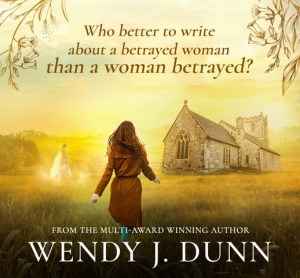 Have you ever wondered what it might be like for a historical fiction writer during their writing process? How do they balance both their own lives and the lives of their characters? While we can read author interviews to find out what goes on in an author’s mind, why not take a fun twist of a historical fiction author writing about a historical fiction writer writing her first historical fiction novel? Meet Lucy Ellis, a new writer who is writing her first novel about the death of Amy Robsart while recovering from cancer and going through a divorce. Can Lucy finish her novel about Amy Robsart before her life and her health come crashing down? Wendy J. Dunn tells the tale of two women betrayed in her latest novel, “Shades of Yellow.”
 Blurb:
 Author Bio
 There’s nothing like a quest to keep a man going, even on the brink of death, but in the case of Uhtred of Bebbanburg, he has several quests. His main goal is to reclaim his birthright, Bebbanburg, but he also wants to help fulfill Alfred’s dream of uniting the kingdoms to create England. However, life can present even more challenges, and Uhtred knows this all too well. Uhtred not only has to save a royal heir and his daughter, but he also must find the sword that wounded him and place a woman on a throne to rule in a time when women were seen rather than heard. It’s a lot to do, but if anyone is up to the task, it is Uhtred of Bebbanburg. The question is, will he survive? Bernard Cornwell brings us another action-packed novel full of adventures in book 8 of the Saxon Stories series, “The Empty Throne.”
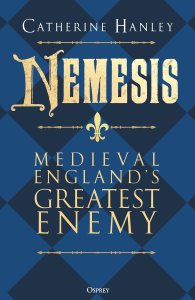 The Plantagenets, one of England’s most dynamic dynasties, were always in the middle of some sort of conflict. Whether they were fighting foreign adversaries, their own people, or their own family, it felt like the Plantagenets were always getting into some sort of trouble. And there was one king who knew how to use the weaknesses of the kings of England to his advantage. He was King Philip II of France, also known as Philip Augustus. He had to deal with four different Plantagenet kings and had a strategy for each one of them. Just what were Philip II’s strategies, and how did his reign affect English/French relationships as a whole? These questions are answered in Catherine Hanley’s book, “Nemesis: Medieval England’s Greatest Enemy.”
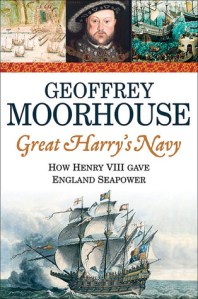 One would assume that, since England is an island nation, its navy has been its strength since its foundation. That, however, was not always the case. While there were naval battles during the Middle Ages, it was not a navy like we know today. The concept of the Royal Navy was founded during the time of the Tudors, especially under the reign of Henry VIII. So, how did Henry VIII turn a navy from 7 ships to over fifty ships that could stand with other European navies? Geoffrey Moorhouse examines the creation of the English navy in his book, “Great Harry’s Navy: How Henry VIII Gave England Sea Power.”
 Sixteenth-century England was a time of great change. There were religious changes as the crown passed from one member of the Tudor family to another. Wars and illnesses like the plague and the sweating sickness were rampant. However, this was also a time of an explosion of the arts, particularly of the theatre. We see men like William Shakespeare and Ben Jonson rise from obscurity to write plays that would propel them to become phenomena. There was a third playwright who should be included in this list. He was the son of a cobbler who was educated at Cambridge University. A brilliant man who wrote groundbreaking plays while he was a spy for her majesty Queen Elizabeth I, his cause of death when he was only in his twenties would remain a mystery for centuries. Christopher (Kit) Marlowe’s story is told in Stephen Greenblatt’s latest book, “Dark Renaissance: The Dangerous Times and Fatal Genius of Shakespeare’s Greatest Rival.”
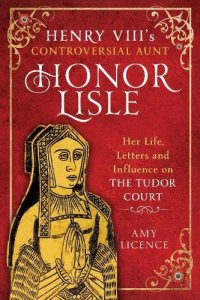 Marrying into the royal family is not all sunshine and rainbows. Of course, we tend to think about those who marry the king, the queen, the prince, or the princess. But we also need to consider the aunts and the uncles of the royals as part of the family. Take, for example, Arthur Plantagenet, the illegitimate son of Edward IV and the uncle of Henry VIII. His second wife, Honor Lisle, would help him rule Calais; however, she is best known for her letters and her devout Catholic faith during the Reformation in England. So why is Honor Lisle considered a controversial figure, and what was the cause of the fall of Honor and Arthur from the royal good graces? Amy Licence explores the life of Henry VIII’s step-aunt in the first full biography dedicated to Honor Lisle, which is entitled “Henry VIII’s Controversial Aunt, Honor Lisle: Her Life, Letters, and Influence on the Tudor Court.”
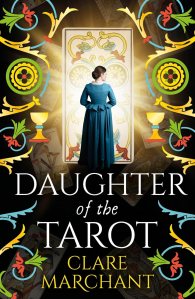 A single deck of cards changed the fate of generations of women. The tarot cards, created in 16th-century Italy, will connect two women separated by centuries. One was a woman in 17th-century London, originally from Milan, who used the cards to rescue women from abusive relationships. The other is a woman from modern-day London starting her life anew when she comes across an old tarot card deck with a missing card. What began as a hunt for a missing card will connect the two women and change lives forever. The cards hold secrets to the past, but will they bring hope or disaster? This is the premise for Clare Marchant’s latest dual-timeline novel, “Daughter of the Tarot.”
 One of the greatest threats to England during the reign of Elizabeth I was the Spanish Armada, under the orders of King Philip II of Spain. In the year 1587, the Spanish ships were spotted off the coast of Devon. Fear grips the country, but one woman is up to the task of keeping her beloved Dartington Hall and its inhabitants from harm. Roberda Chapernowne knows what it means to fight for those she loves and is willing to do it again while her husband, Gawen, is away in Ireland fighting for the Queen after he almost divorced Roberda. Roberda’s life turns upside down when Gawen returns home. Can they rekindle their relationship, or will they fall into despair and ruin? Rosemary Griggs concludes Roberda and Gawen Chapernowne’s stories in her latest novel, “Mistress of Dartington Hall.”
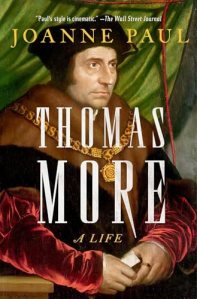 The year is 1535, and an educated scholar, father, writer, and the former Chancellor of England marches to his demise. His crime was staying silent on an issue that the King deemed extremely important: the idea that the King of England should be the Supreme Head of the Church of England, not the Pope. As a Catholic, Sir Thomas More does not agree with this decree and must die. How did one of the most prominent Tudor scholars of his age fall so quickly? Joanne Paul explores the rise and dramatic fall of this infamous Tudor figure in her latest biography, “Thomas More: A Life.”
 Adventures of a Tudor Nerd