Poetry: A Song of an English Knight

I believe that poetry can really help modern readers understand how historical figures and their legacies changed over time. That is why I have decided to start this project, to show poetry that people might not be familiar with to give us a new perspective about different Tudors. I have decided to include the entire poem so that others can read it.

The first poem I found in Sarah-Beth Watkins’ book, “The Tudor Brandons: Mary and Charles- Henry VIII’s Nearest and Dearest”.  According to Watkins, she found this poem in a book called “The Suffolk Garland: or, A collection of poems, songs, tales, ballads, sonnets, and elegies, legendary and romantic, historical and descriptive, relative to that county”, by James Ford. James Ford was an English antiquary, who compiled many antiquarian subjects into books for easy access for the public. This particular book was written in 1818. This poem is just one that he included in this book, but he sadly does not include the author of this poem. We may not know who wrote this poem, but we can take a guess that he might have been a Protestant by the last few lines of the poem. Who do you think wrote the poem and why do you think they wrote it?

A Song of an English Knight

Eighth Henry ruling this land,

He had a sister fair,

That was the widow’d Queen of France

Enrich’d with virtues rare;

And being come to England’s court,

She oft beheld a knight,

Charles Brandon nam’d, in whose fair eyes,

She chiefly took delight.


And noting in her princely mind,

His gallant sweet behaviour,

She daily drew him by degrees,

Still more and more in favour:

Which he perceiving, courteous knight,

Found fitting time and place,

And thus in amorous sort began,

His love-suit to her grace:


I am at love, fair queen, said he,

Sweet, let your love incline,

That by your grace Charles Brandon may

On earth be made divine:

If worthless I might worthy be

To have so good a lot,

To please your highness in true love

My fancy doubteth not.


Or if that gentry might convey

So great a grace to me,

I can maintain that same by birth,

Being come of good degree.

If wealth you think be all my want.

Your highness hath great store,

And my supplement shall be love;

What can you wish for more?


It hath been known when hearty love

Did tie the true-love knot,

Though now if gold and silver want,

The marriage proveth not.

The goodly queen hereat did blush,

But made a dumb reply;

Which he imagin’d what she meant,

And kiss’d her reverently.


Brandon (quoth she) I greater am,

Than would I were for thee,

But can as little master love,

As them of low degree.

My father was a king, and so

A king my husband was,

My brother is the like, and he

Will say I do transgress.


But let him say what pleaseth him,

He’s liking I’ll forego,

And chuse a love to please myself,

Though all the world say no:

If plowmen make their marriages,

As best contents their mind,

Why should not princes of estate

The like contentment find?


But tell me, Brandon, am I not

More forward than beseems?

Yet blame me not for love, I love

Where best my fancy deems.

And long may live (quoth he) to love,

Nor longer live may I

Than when I love your royal grace,

And then disgraced die.


But if I do deserve your love,

My mind desires dispatch,

For many are the eyes in court,

That on your beauty watch:

But am not I, sweet lady, now

More forward than behoves?

Yet for my heart, forgive my tongue,

That speaketh for him that loves.


The queen and this brave gentleman

Together both did wed,

And after sought the king’s good-will,

And of their wishes sped:

For Brandon soon was made a duke,

And graced so in court,

And who but he did flaunt it forth

Amongst the noblest sort.


And so from princely Brandon’s line,

And Mary did proceed

The noble race of Suffolk’s house,

As after did succeed:

And whose high blood the lady Jane,

Lord Guildford Dudley’s wife,

Came by decent, who, with her lord,

In London lost her life.

Sources:

https://archive.org/details/suffolkgarlandor00fordiala/page/120

https://en.wikipedia.org/wiki/James_Ford_(antiquary)

Watkins, Sarah-Beth. The Tudor Brandons: Mary and Charles — Henry VIIIs Nearest & Dearest. Chronos Books, 2016.

Book Review: “Lady Katherine Knollys- The Unacknowledged Daughter of King Henry VIII” by Sarah-Beth Watkins

51M3PWFQLjLThe children of Henry VIII have been the center of historical studies for centuries. Edward VI, Mary I,  and Elizabeth I were all considered Henry’s “legitimate” children and were able to obtain the crown of England. Henry Fitzroy was the illegitimate son of the king, but he was still able to gain titles and a good marriage before he died. They all had something in common; they were all recognized by their father, Henry VIII. However, there was another child who many believed to have been the daughter of the king. The name of this intriguing lady was Lady Katherine Knollys and her story comes to life in Sarah-Beth Watkins’ book, “Lady Katherine Knollys- The Unacknowledged Daughter of King Henry VIII”.

I would like to thank Sarah-Beth Watkins and Chronos Books for sending me a copy of this great book. I have never read a biography on Lady Katherine Knollys and I found this a delight to read.

Katherine’s mother was the sister of Anne Boleyn, Mary Boleyn. For a time before Anne came into the picture, Mary was Henry VIII’s mistress. Henry VIII did have a child by another mistress, which he did declare as his own, so why did he not acknowledge Katherine as his child? Watkins offers an explanation on why Katherine was not acknowledged by the king and what her life was like:

Katherine would grow up never to be acknowledged as King Henry VIII’s daughter. Henry had every reason not to acknowledge her. He has his daughters, one already born when Katherine came into the world, and he needed no more. His denial of his affair with Katherine’s mother, Mary, would be something that would always position Katherine as a bastard. Yet Katherine joined the Tudor court as maid of honour to Queen Anne of Cleves and she went on to serve Catherine Howard as well as becoming one of Elizabeth I’s closest confidantes- cousins for definite, more likely half-sisters. Katherine lived through the reigns of Henry VIII, Edward VI, Mary I and on into Elizabeth I’s. Never far from court, she lived in a world where she would never be a princess but a lady she was born to be. (Watkins, 1).

Watkins begins her book by exploring Mary Boleyn’s life and her relationship with Henry VIII and the birth of Katherine. As Mary fell out of favor with the king, we see the rise and fall of her sister, Anne Boleyn. As Katherine grows up, we see her becoming a maid of honour for Anne of Cleves and Katherine Howard, until she marries Francis Knollys at the age of 16. Katherine and Francis went on to have quite a large family. Their children included Lettice Knollys, who scandalously married Elizabeth I’s favorite, Sir Robert Dudley. Katherine spent a lot of her life serving others, never flaunting who her father might have been. The only time that Katherine’s life was in danger was when Mary I came to the throne. Katherine and Francis decided to take their family and flee abroad since they were Protestants, but they did return when Elizabeth returned. Elizabeth came to rely on Katherine as a close confidante and when Katherine did die, Elizabeth gave her an elaborate funeral.

This was my first time reading a biography about Lady Katherine Knollys and I really enjoyed it. I go back and forth whether I believe she was the daughter of Henry VIII or not, but I found it interesting to learn more about this fascinating woman. Watkins does a superb job of balancing letters, facts and an easy to understand writing style to tell the story of Lady Katherine Knollys, her family, and the life inside the Tudor court. If you want to learn more about the life of the remarkable daughter of Mary Boleyn, I highly recommend you read, “Lady Katherine Knollys- The Unacknowledged Daughter of King Henry VIII” by Sarah-Beth Watkins.  

Book Review: “The Tudor Brandons: Mary and Charles – Henry VIII’s Nearest and Dearest” by Sarah-Beth Watkins

Tudor-Brandons-cover-pic-FBLove stories tend to be rare during the Tudor dynasty. They are often of royal women marrying men well below their station in life and then the ruling monarch throwing them in the Tower until they ended up divorcing or dying. Nothing really romantic about these stories. However, there is one story that breaks the mold of disastrous love. It is the story of Mary Tudor, the sister of King Henry VIII and the Dowager Queen of France, who married the charming knight and best friend of her brother, Charles Brandon. Their story is often told in historical fiction novels, but Sarah-Beth Watkins decided to dive deep into the lives of these two lovebirds, before and after they were married, in her book, “The Tudor Brandons: Mary and Charles- Henry VIII’s Nearest and Dearest”.

I would like to thank Sarah-Beth Watkins and Chronos Books for sending me a copy of this delightful book. The relationship between Mary and Charles has been something that has fascinated me for a while now and I always like learning new information about their lives and their family.

When it comes to studying the relationship between Mary and Charles, one would think that it would be best to start by studying Mary, since she is the Tudor princess. However, Watkins decides to start her book about these two with Charles:

As Charles Brandon lay in his cradle, his father took to the field as standard-bearer for Henry Tudor at the Battle of Bosworth, on 22 August 1485. This defining moment in history, when the Plantagenet dynasty ended and the Tudor began, was also to be a defining moment in this small child’s life. Both Charles’ father and his grandfather were soldiers in the Wars of the Roses and the events leading up to this momentous day. Coming from mercantile beginnings, the men of the Brandon family all rose to positions of importance, but Charles would rise higher than them all to become King Henry VIII’s most favoured companion, and husband to his sister, Mary Tudor. (Watkins, 1).  

Watkins explores the origins of the Brandons, starting with Charles’ grandfather, who was quite an interesting figure. After reading what kind of man Charles’ grandfather was, it is kind of amazing to see how the Brandons rose to be loyal to the Tudors. Before Charles fell in love with Mary, he had a complex love life with Anne Browne and Margaret Mortimer, Anne’s rich aunt. Charles eventually married Anne after and she gave him two daughters before she died, Anne and Mary Brandon. During the time after Anne’s death and before he married Mary, Charles got into an international incident when he attempted to woo Margaret of Savoy. Charles may have looked the part of a knight, but his love life was a mess. That was until he went to France to pick up Mary Tudor, who was the Dowager Queen of France after her husband, King Louis XII, died shortly after their marriage.

The two decided to throw caution to the wind and get married to each other. They risked the wrath of Mary’s brother and huge fines, but they overcame it all and were still managed to be in Henry’s good graces. Charles and Mary were in the middle of court life during Henry’s marriage and divorce to Catherine of Aragon while they were taking care of their own family. Mary wasn’t thrilled about Anne Boleyn, but Charles kept his attitude about Henry’s mistress and future second wife to himself. Mary suffered from multiple bouts of illnesses and would die in 1533. Charles would marry again to Catherine Willoughby and have more children before he died in 1545.

The love story of Charles and Mary Brandon comes to life in Watkins book. What I love about this book is the combination of primary sources and poetry with Watkins’ easy to understand writing style. This book is an absolutely fascinating look into the lives of these two remarkable people and how their relationship helped change England. If you want a fantastic book to introduce you to the relationship between Charles and Mary Brandon, I highly recommend you read Sarah-Beth Watkins’ book, “The Tudor Brandons: Mary and Charles- Henry VIII’s Nearest and Dearest”.

Book Review: “Margaret Tudor Queen of Scots: The Life of King Henry VIII’s Sister” by Sarah-Beth Watkins

51d3s18bI5L._SX322_BO1,204,203,200_When one thinks about Queens of Scotland during the time of the Tudors, many automatically think of Mary Queen of Scots and her tragic life. However, there was another queen who had a deep connection to the Tudors and was also a queen of Scotland. She tends to be pushed aside in favor of her more famous siblings; Arthur Tudor, Henry VIII, and Mary Tudor. Her story is full of turmoil and triumphs. Her only desire was to unite England and Scotland peacefully, but the choices that she made in her lifetime would prove foolish, leading to more troubles between the two nations. This is the story of Henry VIII’s oldest sister Margaret, which is brought to life in Sarah-Beth Watkins’ book, “Margaret Tudor Queen of Scots: The Life of King Henry VIII’s Sister”.  

I would like to thank Sarah-Beth Watkins and Chronos Books for sending me a copy of this wonderful book. Before I read this book, I didn’t know a whole lot about Henry VIII’s eldest sister so it was quite a delight to learn a lot about this remarkable woman.

Watkins begins her book with the birth of Margaret Tudor on November 28, 1489. She was named after her formidable grandmother, Margaret Beaufort, and although she was not the desired second son that her parents, Henry VII and Elizabeth of York wanted, she was beloved. She proved herself to be a great big sister for her younger siblings, Henry and Mary. Margaret ’s early life in England was one full of love, but it was also full of training for her future role in life, that of a future queen. Her father, King Henry VII, like any good European ruler, wanted to build strong alliances with other European powers so he made advantageous marriages for his children. Margaret’s eldest brother Arthur was married to the Spanish princess Catherine of Aragon, the daughter of Queen Isabella of Castile and King Ferdinand of Aragon. Margaret’s first marriage was to the King of Scotland, James IV, through the Treaty of Perpetual Peace, which ceased hostility between England and Scotland.

Margaret married James IV through a proxy marriage ceremony on January 25, 1503. Later that year, Margaret made her way to Scotland, where she met her charismatic first husband. The first couple of days with James were quite happy until she found out that James had many mistresses and illegitimate children. Talk about an awkward situation, but Margaret and James were able to make their marriage work. Margaret did have six children with James but sadly only one survived infancy, the future King James V.  

The situation between England and Scotland was peaceful for a decade and then James decided to break the Treaty of Perpetual Peace in 1513 and attack England, in order to support his ally France. This was a huge mistake by James because it led to the Battle of Flodden on September 9, 1513, which was fought between English and Scottish forces, resulting in the death of James IV. His infant son, James V, was now King of Scotland and Margaret was named regent. Unfortunately, Margaret made a horrible decision in marrying her second husband Archibald Douglas 6th Earl of Angus, who the Scottish council hated. She had a daughter with Archibald named Margaret Douglas, who would later become the Countess of Lennox.

Margaret had to give up her regency to the Duke of Albany and had to rely on the aid of her brother Henry VIII to help her son James V. Margaret’s relationship with her brother is told through the letters that Watkins includes in this book. It adds another layer of depth to this book by including Margaret and Henry’s letters to one another. She would marry a third time, to Henry Stewart 1st Lord Methven but it was just as bad as her second marriage. Margaret would have three sons with Henry Stewart; Arthur, James, and Alexander.

Margaret struggles to keep the peace between  England and Scotland for her son. Through failed marriages and strained relationships with her family, Margaret finally sees her son become the rightful King of Scotland. It would take decades after Margaret’s death for her true vision of Scotland and England united under her great-grandson James I of England. Margaret Tudor was a woman who was strong, even if she did make some very foolish decisions, and would do anything to make sure her son James V was safe and secure. Margaret’s life and legacy comes to life in Sarah-Beth Watkins’ wonderful book. If you are interested in learning about the life of Henry VIII’s eldest sister and the politics between England and Scotland during the tumultuous time after James IV’death, I highly recommend you read “Margaret Tudor Queen of Scots: The Life of King Henry VIII’s Sister”.

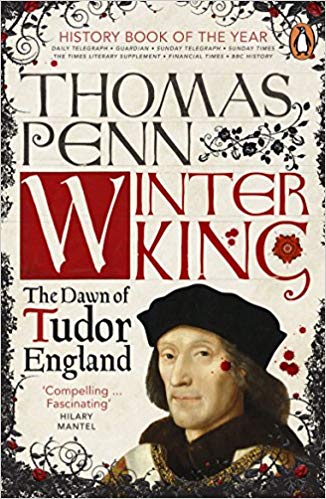
Book Review: “Winter King: The Dawn of Tudor England” by Thomas Penn

61tqSL1PEdL._SX324_BO1,204,203,200_The Tudor Dynasty and its beginning has often been viewed as a glorious dawn after the dark period that we call the Wars of the Roses. It established a firm foundation that the kingdom lost during the 30 years of civil war. It took a lot of effort from the victor of this tumultuous time, Henry VII, to transform England back to a relatively stable country.  To some, Henry VII was a virtuous leader who cared about his family and his country, saving money to make sure the dynasty was secure. For others, Henry VII was a figure who clung to his crown and his kingdom no matter the cost, which included conspiracies and underhanded methods. But what did Henry VII do in order to bring back order to England and how did he convince others that the Tudors were the rightful rulers? These are the questions that Thomas Penn wanted to answer in his book, “Winter King: The Dawn of Tudor England.”

Penn explains the premise of his book and why he chose to explore the last years of this particular king’s reign:

The last, claustrophobic decade of Henry VII’s reign, with an ageing, paranoid king and his dynamic young son at its heart, forms the focus of this book. It is one of the strangest episodes in English history. An atmosphere of fear and suspicion radiated from the royal court into the streets and townhouses of London and throughout England’s far-flung estates and provinces. Established forms of rule and government were bent out of shape, distorted in ways that people found both disorienting and terrifying. But these are also the dawning years of a dynasty. They see the coming of age of Catherine of Aragon, the young Spanish princess who would become Henry VIII’s first wife, and of Henry VIII himself- or rather, Prince Henry, as he is here. To explore these precarious years, and to gain a sense of how and why Henry VII behaved and ruled in the way he did, is to reveal much about the house of Tudor, the family that would, over the course of the sixteenth century, dominate and transform England. (Penn, xxi).

Penn begins his book by explaining how Henry came to the throne after defeating Richard III at the Battle of Bosworth Field and how he proved that the Tudors had royal blood within their veins, therefore they were able to rule England. Henry and his beloved wife, Elizabeth of York,  would have four children who would survive infancy; Arthur, Margaret, Henry, and Mary. It is really Henry’s relationships with his two sons, Arthur and Henry, that Penn focuses on when it comes to Henry’s family. Arthur is married to the beautiful Spanish princess Catherine of Aragon in order to establish a strong alliance with Spain. Their marriage would not last long. Arthur tragically died a few months into their marriage, sending Henry VII into a deep despair, which only deepened when Elizabeth of York died a year later. Henry VII’s only heir was his son Prince Henry, a son who Henry VII did not really have a relationship with and now had to teach him how to become king.

On top of all the personal tragedies during the last decade of Henry VII’s reign, we see men in England and around Europe, trying to earn the king’s trust in order to gain prestige and power. One of these men was Sir Richard Empson who was in charge of the Council Learned, which was a legal committee who collected feudal dues and kept a close eye on the king’s land. Empson, as Penn explains, tended to use underhanded ways to get what he wanted, not only for his king but for himself. Henry VII also used his vast network of connections across Europe in order to gain information about those who wanted to remove him from power. Penn’s view of Henry VII is of a king who was extremely suspicious, aloof and a Machiavellian ruler. A man who trusted no one and valued financial gains over his own people. To Penn, Henry VII’s reign was dark and full of fear.

This is my first time reading a book by Thomas Penn and I must say it was a unique experience. I have to applaud Penn for the amount of details that he used when it came to ceremonial events at the court, such as the arrival of Catherine of Aragon and when Philip of Habsburg, Duke of Burgundy arrived in England. The way Penn described these events was quite enlightening. Penn also introduced a bunch of figures, from England to Italy, which are all fascinating and play a role in the running of Henry VII’s England. However, for those who are not familiar with these particular people might get confused. I know it was difficult for me to figure out who was who, which is why I wished Penn had a list of important people located somewhere in this book that the reader could refer to if they got lost. Overall, I thought Thomas Penn’s book,  “Winter King: The Dawn of Tudor England”, was a fascinating and different, darker view of the founder of the Tudor Dynasty as well as what the relationship between Henry VII and his heir Henry VIII was like.

Favorite Couples from the Wars of the Roses and the Tudor Dynasty

With Valentine’s Day around the corner, I thought it would be appropriate to talk about the couples that we all enjoy studying from the Wars of the Roses and the Tudor Dynasty. These are couples that went through a lot together and stayed together. That is why people like Henry VIII will not be on this list since we all know his marriage track record. This is a list combining your favorites, which you stated as answers to a question I posted on the Facebook page, as well as some of my own. These couples are in chronological order, not by favorites, and the first two couples are before the time that we would call “Wars of the Roses” but they are still important. I did have to narrow down this list quite a bit so if you don’t see a couple that is on this list, let’s discuss it.  I hope you enjoy!

1.) John of Gaunt and Katherine Swynford

200px-johnofgauntJohn of Gaunt, the son of King Edward III and one of the wealthiest men in Europe, and Katherine Swynford, the woman who was the governess to John’s children. It seems like an unlikely match, but these two made it work. Of course, when these two lovebirds first met, they were both married to other people, John of Gaunt to Blanche of Lancaster and Katherine to Hugh Swynford. When both Blanche and Hugh died, rumors began to fly that John and Katherine were having an affair. John decided to quite these rumors by marrying a second time, to Constance of Castile. This marriage was one for political gains, not of love. His hope for marrying Constance was to become King of Castile, similar to how he became the Duke of Lancaster after marrying Blanche of Lancaster, but it ended up being a disaster. After his father’s death, John’s nephew Richard II became king and John gave up his claim to the throne of Castile. While he was married to Constance, John began to see Katherine and they had 4 children out of wedlock. Constance would die in 1394.  John would marry Katherine in 1396 and their children would be given the name “Beaufort”. Their children would be considered legitimate, but they could not inherit the throne. John would die 3 years later in 1399 and would be buried beside his first wife Blanche. John and Katherine’s love for one another lasted decades.

2.) Owen Tudor and Catherine of Valois

Catherine_of_France.jpgThe Dowager Queen of England marrying a man who worked in her own household. That is the gist of the love story of Owen Tudor and Catherine of Valois. Catherine of Valois was married to King Henry V of England and in return, under the Treaty of Troyes, Henry V and his descendants became kings of both England and France. A really great deal, except Henry V, died of dysentery a few months after his son and heir Henry VI was born. Catherine was 21 when she became the Dowager Queen and there was a real concern that she would marry again so Parliament passed a bill that stated that if Catherine wanted to remarry, she had to ask Parliament’s permission to do so. Well, she didn’t listen to this bill at all. She met and fell in love with a Welshman named Owen Tudor, who worked for her as either as the keeper of her household or her wardrobe.  They would marry sometime between 1428 and 1429. Later, in May 1432, Owen was granted the same rights as an Englishman.

To say this match was totally taboo would be an understatement, but for them, it worked. Catherine and Owen were willing to risk everything for their love. They would have anywhere between 4 to 6 children Two of their children would become famous during the Wars of the Roses, Jasper and Edmund Tudor. Catherine would die on January 3, 1437, and would be buried beside her first husband Henry V.   After Catherine’s death, Jasper and Edmund would receive titles and meet their half-brother King Henry VI, but Owen would face jail time. Owen would later be captured and executed after the Battle of Mortimer’s Cross on February 2, 1461.

3.) Richard Woodville and Jacquetta of Luxembourg

Richard Woodville and Jacquetta of Luxembourg. Another story of a wealthy woman marrying a man well below her station for love. Jacquetta was born in France during the height of the Hundred Years War. Her first husband was the brother of King Henry V, John of Lancaster, 1st Duke of Bedford and they were married in April 1433. Their marriage was controversial because John’s first wife Anne died only a few months before they were married. The couple moved back to England and in a matter of weeks, Jacquetta was given the rights of an English woman. In 1434, she was made a member of the Order of the Garter, a huge honor. Their marriage would not last long as John would die a year later in France.

Jacquetta was a widow and Henry VI wanted her sent back to England so he sent  Sir Richard Woodville, a knight, to bring Jacquetta back. This backfired spectacularly as Jacquetta and Richard fell in love and got married in secret while on their way back to England (just like another couple on this list). Henry VI was furious and fined the couple 1000 pounds, but on March 23, 1437, Parliament recognized their marriage as valid. Jacquetta and Richard were happily married and had 14 children, including Elizabeth Woodville, who would become Queen of England.  Jacquetta and Richard were with Margaret of Anjou as she made her way to England and to her marriage to Henry VI and the birth of their son. They were together when their daughter, Elizabeth Woodville, married her first husband and he died in battle when she met and married Edward IV, and Jacquetta was there for the birth of her first granddaughter Elizabeth of York. Jacquetta’s world came crashing down when Richard and their son John were captured and executed on August 12, 1469, after the Battle of Edgecote Moor. Jacquetta was arrested by Warwick and charged with witchcraft, but the charges were dropped. Jacquetta would die only a few years after Richard, on May 30, 1472. Jacquetta and Richard’s marriage lasted through decades and hardships, but it was full of love and a large family, the Woodvilles, that would change English politics forever.

4.) Edward IV and Elizabeth Woodville

edbe20edb2d4ed4682369c7eb997b6dfKing Edward IV and Elizabeth Woodville, the widow of a soldier and a mother of two young boys. In a way, their love story is like a Cinderella story. Elizabeth Woodville was the eldest daughter of Richard and Jacquetta Woodville. She was a maid of honor for Margaret of Anjou and because of her high position at court, her parents arranged a marriage for her to Sir John Grey of Groby in 1452. The couple would have two sons, Thomas, and Richard Woodville. Their marriage would not last long as Sir John Grey was killed at the Second Battle of St. Albans in 1461.

The story of how Edward IV met Elizabeth is often embellished. The story goes that Edward IV met Elizabeth under an oak tree at her family home at Grafton Regis in Northamptonshire, where she pleaded with Edward to help her get an inheritance for her two sons. It is very unlikely that they met underneath this oak tree, but they did fall in love and would eventually get married in May 1464. Edward then told his Parliament, including the man who helped him the most Warwick “the Kingmaker”,  that he couldn’t marry any of the women that they suggested because he was already married. Elizabeth’s large family was given advantageous marriages and titles that helped shaped English politics, much to the chagrin of those who were already in power. Elizabeth was crowned Queen consort on May 16, 1465, and the following year, she gave birth to the couple’s first child, Elizabeth of York.

Things went downhill as politics took their marriage for a rollercoaster ride. Warwick decided that he was going to switch from York to Lancaster and placed Henry VI back on the throne, sending Edward IV into exile. Elizabeth Woodville was forced to seek sanctuary where she gave birth to their first son, the future Edward V. Edward IV would come back with a vengeance and defeated Warwick, reclaiming his crown, and found his wife and children in sanctuary. The family was reunited and happy. Their second son, Richard Duke of York, was married to Anne of Mowbray and they had arranged a marriage for their eldest daughter Elizabeth of York to the Dauphin of France. Elizabeth Woodville’s world came crashing down when her beloved husband, Edward IV, died on April 9, 1483. The crown passed to their young son Edward V, but before he was crowned king, Edward and his brother Richard were sent to the Tower of London, never to be seen again.

Elizabeth would arrange a marriage between her daughter Elizabeth of York, with the son of Margaret Beaufort, Henry Tudor. On August 22, 1485, Henry Tudor was able to defeat Richard III and become King Henry VII. He would marry Elizabeth of York and Elizabeth Woodville would be present for the birth of her grandchildren Arthur, Henry, Mary, and Margaret. Elizabeth Woodville would die less than a decade after Edward IV, on June 8, 1492. Edward and Elizabeth are buried by each other in St. George Chapel in Windsor Castle. Their love was something of legends and even though people did not agree with their union, they made each other stronger.  

5.) Henry VII and Elizabeth of York

89947Henry Tudor, later Henry VII, and Elizabeth of York. The couple that united the houses of York and Lancaster and started the Tudor Dynasty. This is the only couple on this list that was arranged to be married to each other, but they made it work extremely well. Henry Tudor was the son of Margaret Beaufort and Edmund Tudor who would go into hiding after the Yorkist believed he would be the one who could bring back the Lancasterian cause in the Wars of the Roses. After Edward IV died, Edward V and Richard Duke of York were sent to the Tower never to be seen again, and Richard III became king. Elizabeth Woodville and the Yorkists loyal to her did not like Richard III and knew something had to be done in order to end his reign. In order to bring an end to the Wars of the Roses, Elizabeth Woodville and Margaret Beaufort agreed that their children, Elizabeth of York and Henry Tudor, would be married if Henry could invade England successfully and overthrow Richard III. Henry and his uncle Jasper tried to invade in October 1483, but it failed. In December 1483, Henry made an oath in Rennes, France to marry Elizabeth of York.

Finally, in August 1485, Henry and Jasper Tudor made their way back to England, and it worked. They met against Richard III’s forces at the Battle of Bosworth Field on August 22, 1485, where with sheer luck, and the forces of Lord Stanley ( Henry’s stepfather), Henry was able to defeat Richard and become King Henry VII. Henry kept his promise and married Elizabeth of York the following year, on January 18, 1486. A few months later, on September 20, 1486, Henry and Elizabeth welcomed their firstborn son, Arthur Prince of Wales. They would have more children including Henry Tudor (future Henry VIII), Mary and Margaret Tudor. Things started off relatively stable for the first few months of Henry’s reign, but that would change in 1487.

1487 was the year that a young boy named Lambert Simnel claimed to be the earl of Warwick, Elizabeth’s cousin. This was a lie and Henry met Lambert Simnel at the Battle of Stoke Field on June 16, 1487, where Lambert was defeated in the last battle of the Wars of the Roses. Lambert would be a first in a long line of pretenders, trying to usurp the throne from Henry. One of the biggest pretenders was Perkin Warbeck, who claimed to be Richard Duke of York, Elizabeth’s younger brother. This may have been a recipe for a disaster between Henry and Elizabeth, but it actually strengthened their relationship. Elizabeth believed that Perkin Warbeck was not her brother. Perkin Warbeck was hanged at Tyburn on November 23, 1499.

The last few years of Henry and Elizabeth’s marriage was filled with joy and heartache. The couple had arranged advantageous marriages for their children Arthur and Margaret. Margaret was arranged to be married to King James IV of Scotland, to unite England and Scotland under the Treaty of Perpetual Peace.  Arthur was married to Catherine of Aragon, the daughter of Isabella of Castile and Ferdinand of Aragon, on November 14, 1501, uniting Spain and England. The following year, on April 2, 1502, Arthur died unexpectantly, leaving Elizabeth to console her husband and to remind him that they were still young and that they could still have more children. Elizabeth did give birth to a daughter Katherine on February 2, 1503, but she would not live long. Elizabeth of York would die on February 11, 1503, leaving Henry alone in his grief. He never married again and when Henry VII died a few later on April 21, 1509, he wished to be buried next to his beloved wife. Henry and Elizabeth’s marriage may have been arranged, but they developed a deep love for one another that endure many hardships and created the Tudor Dynasty.

6.) Charles Brandon and Mary Tudor
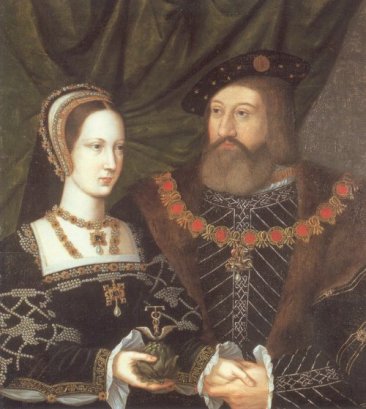
Mary_Tudor_and_Charles_BrandonCharles Brandon and Mary Tudor. A Tudor knight who fell in love with the dowager Queen of France and the sister of the King of England. Their love story is one for the ages. Mary Tudor was the youngest daughter of Henry VII and Elizabeth of York and she was very close to her brother Henry VIII. She was known as the most beautiful princess in Europe. Her first marriage was to the King of France, Louis XII, who was much older than she was and had been married two times before. Their marriage did not last three months as King Louis XII died and they did not have any children. The new King of France, Francis I, tried to arrange a new marriage for Mary, but Henry VIII sent an envoy to collect his sister, which included the charming knight, Charles Brandon.

Charles and Mary probably knew each other their entire life since Charles was a close friend of Henry VIII. While they were on their way to England, the couple decided to get married in secret on March 3, 1515, and to tell Henry later. Henry was angry, at first, and fined the couple 24,000 pounds and the remainder of Mary’s dowry. It was an enormous amount, but the couple took it in stride and their marriage was recognized later that year with an official ceremony on May 13, 1515. This was not Charles’ first marriage as he was married two times before and had two daughters by his first marriage, Anne and Mary. Mary accepted both daughters and raised them along with her four children that she had with Charles. The couple would make their opinion about politics clear to Henry, especially when it came to Henry’s divorce of Catherine of Aragon in order to marry Anne Boleyn, which they were not thrilled with the idea.

Mary, who suffered from illnesses all of her life, died on June 25, 1533. Charles would marry again, this time to his ward Catherine Willoughby who would give him two sons. Charles died on August 22, 1545. Although both married other people before they married each other, one can sense how much Charles and Mary truly loved one another.

Who are your favorite couples from the Wars of the Roses or the Tudor Dynasty?

 

Book Review: “Wars of the Roses: Trinity” by Conn Iggulden

61793uzwgql._sx324_bo12c2042c2032c200_England is on the brink of civil war. Families with royal blood in their veins are fighting amongst each other as King Henry VI has fallen ill.  Mistrust runs rampant and sacrifices are made in order to gain the throne. This is the England of 1454 and the beginning of the period in English history that we know today as the Wars of the Roses. Families like the Nevilles,  the Percys, and the houses of York, Lancaster, and Tudor would gain fame and infamy during this time. Conn Iggulden decided to explore this tumultuous time after the Jack Cade rebellion, which he explored in his first book “Stormbird”, in the second book of his “Wars of the Roses” series called “Trinity”.
Many who study the Wars of the Roses believe that it started in 1455 with the First Battle of St. Albans. However, Conn Iggulden begins “Trinity” with a conflict between the Percys and the Nevilles, which is known as the Battle of Heworth Moor. Iggulden explains why he chose this point to begin his story in his Historical Note:

The ambush by some seven hundred Percy retainers and servants on the Neville wedding party took place a little earlier than I have it here, in August 1453- around the same time King Henry VI fell into his senseless state. It was a key event among years of low-level fighting between the families as they struggled to control the north and widen their holdings. That attack by Thomas Percy, Baron Egremont, was one of the most brutal actions in that private war, sparked by the marriage of Salisbury’s son to the niece of Ralph Cromwell, a union which placed estates claimed by the Percy family into Neville hands. The ‘Battle of Heworth Moor’ failed in its main aim of slaughtering Richard Neville, Earl of Salisbury. I have not included a dozen minor skirmishes, but that feud played a key part in deciding where the Nevilles and the Percys stood in the first battle of St. Albans in 1455- and its outcome. (Iggulden, 463).

The Battle of Heworth Moor is a unique place to start. We are thrust into the middle of the Percy family’s feud with the Nevilles. The plan is to attack the Nevilles during a wedding, but the Percys fail. It would not be a wedding that either family would forget for a long time. The Percy family decides to side with the Lancasters and the King, while the Nevilles side with the Yorkist cause. In the beginning, the Wars of the Roses was nothing but feuds between families to determine who should be taking care of the sick King Henry VI. Iggulden describes Henry VI in a way that shows the King as weak in body but his mind is sharp. When he wakes from his first bout of illness, he dismisses Richard Duke of York from being Lord Protector and reverses everything that  Richard did.

Richard and the Yorkist cause are not upset with the king, but rather those who they believe are responsible for being in control of the king; Queen Margaret of Anjou, the Duke of Somerset and the Nevilles. Anger boils until it bursts at the First Battle of St. Albans in 1455. This battle was so pivotal in the evolution of the conflict that Iggulden goes into great detail to explain how the battle unfolded. The Yorkist cause may have one the “first” battle of the Wars of the Roses, but it ignited a flame inside of Margaret of Anjou to not only protect her son and her husband but to also completely destroy Richard Duke of York. As the story progresses, we see both sides working hard to gain control of the king in a more complex version of “capture the king”.

Conn Iggulden delivers a high action and extremely descriptive sequel to “Stormbird” with “Trinity”. He incorporates beloved characters from the previous novel, like Margaret of Anjou and the charismatic Derry Brewer, with new faces like the Tudors, Thomas Percy Baron Egremont, Warwick, Richard Duke of York and his eldest son Edmund Earl of Rutland. Iggulden transports the reader to this volatile time in English history. This book is so engaging and it keeps the reader wanting more, so he included a side story that is equally entertaining. Once again, Iggulden makes the Wars of the Roses and all of its intrigue come alive. If you were a fan of Conn Iggulden’s first book in the “Wars of the Roses” series “Stormbird”, I strongly encourage you to read “Trinity”.   

Trailer Review: “The Spanish Princess”

As many of you know, the first trailer for “The Spanish Princess”, the new miniseries by Starz and based off books by Philippa Gregory, just dropped. This is the story of Catherine of Aragon coming to England to marry Prince Arthur, but when Arthur dies unexpectantly, Catherine must choose between going back to Spain or marrying her dead husband’s brother Henry Tudor, who would become Henry VIII. I have watched the trailer and I have decided to review the trailer. 

The Books

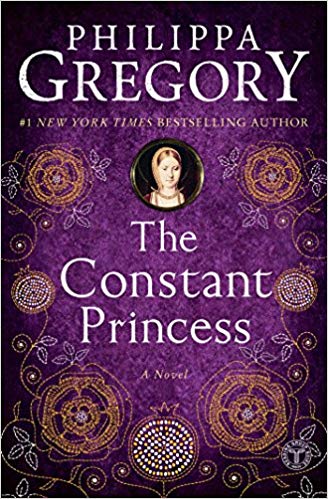
This series is “drawn” from two of Philippa Gregory’s books, “The Constant Princess” and “The King’s Curse”.  It has been over a year or two since I personally read these books. So before we dive into a review of the trailer, I thought it would be appropriate to look at the summaries of both of these books, which you can find from Philippa Gregory’s website,  to see what we might expect to see from this series.

The first book we will look at is “The Constant Princess”:

61uvmxu-owl._sx326_bo1,204,203,200_We think of her as the barren wife of a notorious king; but behind this legacy lies a fascinating story. Katherine of Aragon is born Catalina, the Spanish Infanta, to parents who are both rulers and warriors. Aged four, she is betrothed to Arthur, Prince of Wales, and is raised to be Queen of England. She is never in doubt that it is her destiny to rule that far-off, wet, cold land. Her faith is tested when her prospective father-in-law greets her arrival in her new country with a great insult; Arthur seems little better than a boy; the food is strange and the customs coarse. Slowly she adapts to the first Tudor court, and life as Arthur’s wife grows ever more bearable. But when the studious young man dies, she is left to make her own future: how can she now be queen, and found a dynasty? Only by marrying Arthur’s young brother, the sunny but spoilt Henry. His father and grandmother are against it; her powerful parents prove little use. Yet Katherine is her mother’s daughter and her fighting spirit is strong. She will do anything to achieve her aim; even if it means telling the greatest lie, and holding to it.

The second book is “The King’s Curse”:

This is the story of deposed royal Margaret Pole, and her unique view of King Henry VIII’s 51qydh3apnlstratospheric rise to power in Tudor England. Margaret Pole spends her young life struggling to free her brother, arrested as a child, from the Tower of London. The Tower – symbol of the Tudor usurpation of her family’s throne – haunts Margaret’s dreams until the day that her brother is executed on the orders of Henry VII. Regarded as yet another threat to the volatile King Henry VII’s claim to the throne, Margaret is buried in marriage to a steady and kind Tudor supporter – Sir Richard Pole, governor of Wales. But Margaret’s quiet, hidden life is changed forever by the arrival of Arthur, the young Prince of Wales, and his beautiful bride, Katherine of Aragon, as Margaret soon becomes a trusted advisor and friend to the honeymooning couple. Margaret’s destiny, as an heiress to the Plantagenets, is not for a life in the shadows. Tragedy throws her into poverty and rebellion against the new royal family, luck restores her to her place at court where she becomes the chief lady-in-waiting to Queen Katherine and watches the dominance of the Spanish queen over her husband, and her fall. As the young king becomes increasingly paranoid of rivals he turns his fearful attention to Margaret and her royal family. Amid the rapid deterioration of the Tudor court, Margaret must choose whether her allegiance is to the increasingly tyrannical king, Henry VIII, or to her beloved queen and princess. Caught between the old world and the new, Margaret has to find her own way and hide her knowledge of an old curse on all the Tudors, which is slowly coming true . . .

The Trailer

The trailer for “The Spanish Princess” begins with the introduction of the show’s protagonist, Catherine of Aragon, played by Charlotte Hope, walking outside in her white wedding dress. Her purpose in England was to marry the future King of England in order to make an alliance between England and Spain. I think Charlotte Hope looks the part of Catherine of Aragon. She looks rather regal, a bit shy at first, but she becomes a strong and determined young woman. Plus she has auburn hair; which is the actual hair color Catherine of Aragon was known to have. A huge plus for fans of Catherine of Aragon and her life story.

The first few seconds of the trailer, we are introduced to the important members of the English court. King Henry VII, played by Elliot Cowan, is an older man who seems to dress quite lavishly and who seeks to make England a better country. The one problem that I have with the character of Henry VII is his accent. Though we are not sure what kind of accent he might have had since he was part Welsh and lived in France and Brittany for a time in his life, one would assume he might have some French or Welsh accent, but his accent, from what we can gather, sounds solely English. I might be nit-picking here a bit, but it did bother me a little bit. Always next to Henry’s side is his wife, Elizabeth of York, who is played by Alexandra Moen.

Now we come to the two brothers, Arthur and Henry, or “Harry” as he is called in this series. Prince Arthur, who is played by Angus Imrie, looks very thin and almost sickly in the images that we do see of him. From what we know of Arthur, he was rather healthy, until his death shortly after marrying Catherine. Henry “Harry”, played by Ruairi O’Connor, has that suave and debonaire feel to him. The one problem that many people have, myself included, is the fact that when Catherine and Henry first met, Henry was around 10 or 11 and Catherine was around 16. The trailer makes it seem as though the two were around the same age when they met, which was not the case.

Henry and Catherine developed feelings for each other and Henry wants Catherine to stay and marry him, although she is his brother’s widow. We see two members of the English royal family who are not exactly thrilled with this match. They are Margaret Beaufort, Henry VIII’s grandmother, played by Dame Harriet Walter, and  Margaret “Maggie” Pole, played by Laura Carmichael. We also get a look at the ladies of waiting to Catherine of Aragon, Lina, and Rosa, who are played by Stephanie Levi-John and Nadia Parkes respectfully. The series also decided to include Oviedo, played by Aaron Cobham, who falls in love with Lina.

I do enjoy the costumes for this series as they do seem to honor the past. The scenery is intriguing and transports the viewer to the time of the Tudors. The one scene that I did have a slight problem with was the last one in the trailer, which shows Catherine, Lina, and Rosa dressed in black in the cathedral, mourning for Prince Arthur. From what it looks like in the trailer, it is Arthur’s funeral. Lina and Rosa are wailing while Catherine is in the middle, no tears down her face, as she looks stoically at the camera. My issue with this scene is the fact that members of the royal family did not attend his funeral because of the risk of the sweating sickness. If you would like to read more about Prince Arthur’s funeral, Dr. Sean Cunningham, who wrote the book “Prince Arthur: The Tudor King Who Never Was”, wrote a fascinating article for On the Tudor Trail, which you can find below in the sources.

The series also uses nicknames such as “Harry” for Prince Henry, “Maggie” for Margaret Pole, “Charlie” for Charles Brandon and “Meg” Tudor. It is not clear if “Meg” is a combination of Mary and Margaret or if it is just Margaret Tudor. I don’t know why they would choose to go down this route as both Mary and Margaret are important figures, being the sisters of Henry and Arthur Tudor. Another notable absence from the list of characters is Isabella of Castille, Catherine’s formidable mother. We do, apparently, get an appearance from Christopher Columbus, according to the cast list, but not from Catherine’s own mother, who really shaped what kind of woman Catherine would become.

Overall, I did enjoy the trailer. I think it is interesting that Starz decided to combine both the stories of Catherine of Aragon and Margaret Pole into a mini-series. From what was shown in the trailer, it looks like their main focus will be Catherine and Henry so hopefully, we will see more of Margaret later in the show. “The Spanish Princess” looks like it will be an enjoyable show for those who love historical dramas.

What are your thoughts about this trailer and will you watch “The Spanish Princess”?


Sources:

https://www.harpersbazaar.com/culture/film-tv/a26038583/the-spanish-princess-starz-first-teaser-trailer/

https://www.imdb.com/title/tt8417308/fullcredits?ref_=tt_cl_sm#cast

https://www.philippagregory.com/books/the-constant-princess

https://www.philippagregory.com/books/the-king-s-curse

http://onthetudortrail.com/Blog/2016/07/30/prince-arthurs-funeral-ceremony-despair-and-shifting-politics-in-1502/

https://thefreelancehistorywriter.com/2015/06/19/the-wedding-of-arthur-tudor-prince-of-wales-and-catherine-of-aragon/

Book Review: “Anne of Cleves: Henry VIII’s Unwanted Wife” by Sarah-Beth Watkins

91UpsDD9PWL.jpgHenry VIII, the king who was notorious for his six marriages. His first three marriages, to Catherine of Aragon, Anne Boleyn, and Jane Seymour, gave Henry VIII his only children that were considered eligible for succession. Catherine of Aragon was his first foreign bride, but he would divorce her to marry Anne Boleyn. Anne Boleyn would later be executed and Jane Seymour would die after giving birth to Henry’s son Edward. Henry wanted to marry again, so his most trusted advisors decided to try for a foreign alliance as well as a new bride for the king. They decided that Anne of Cleves from Germany would be the perfect bride, but it did not work out and Henry decided to divorce her and claim Anne as his “sister”. She is often viewed as Henry’s “lucky wife”, but who was she and what was her life like before and after she met her husband Henry VIII? That is exactly the question that Sarah-Beth Watkins wanted to explore in her latest book, “Anne of Cleves: Henry VIII’s Unwanted Wife”.
Sarah-Beth Watkins explains who Anne of Cleves was  and how has she has been described in the past:

Contemporary reports of Anne are mixed but time has not been kind to her memory. In a book by Sarah Tytler published in 1896, I was shocked to read Anne described as ‘a woman of entirely negative characteristics’. The author really had nothing good to say about her. She was ‘dull-witted as well as a hard-favoured young woman, possessed of a stolid sluggishness of temper’. Her writing reads as if Anne had personally upset her in some way. She was ‘plain and stupid’ and even had a ‘meaningless expanse of forehead’! She hasn’t favoured much better with other authors. Hume described her as ‘large, bony and masculine’ and Burnet coined the phrase ‘Flanders mare’ which has stuck to Anne throughout the centuries. Strickland, however, wrote with more sympathy that Anne ‘ was a most unfortunate, ill-treated princess…who deserved a better fate than to become the wife of a king so devoid of the feelings of a gentleman as Henry VIII’…She was Queen of England for just over six months and after became the King’s ‘sister’- a role she adopted and thrived on. She became the richest woman in England for a time with an astounding divorce settlement. Henry may not have wanted her for a wife but he did not blame her for the failure of their marriage- that would fall upon his chief minister. Anne would outlive the king and all of his other wives. (Watkins, 2-3).

Watkins begins her book by diving into Anne of Cleves’ life in Germany before she was even considered as a bride for a king. Anne’s life in Germany was simple. She didn’t really have the education that one would expect for a future queen, but she never was expected to marry a king. She was the sister to William, Duke of Jülich-Cleves-Berg. Her sister, Sybilla, was married to John Frederick, Duke of Saxony, who was one of the leaders of the Protestant Confederation of Germany and was considered one of the champions of the Reformation. Anne didn’t  follow her sister’s path to the Protestant faith as she was a devout Catholic, but the religious issue doesn’t seem to have caused a rift in the family.

Anne was supposed to marry Francis of Lorraine, but the engagement was broken since Francis was only 10 when it was arranged. After the death of Jane Seymour, Henry VIII needed a new wife. He wanted to make an alliance with the Schmalkaldic League, a league of Protestant territories that wanted to defend itself against the Holy Roman Emperor Charles V. Anne was not exactly Henry’s first choice of bride to help join this alliance, but she was the one he decided to marry, and so Anne left her home in 1539. The marriage did not last long, only six months, before Henry divorced her. Anne was a bit disappointed, but Henry was able to provide her with a wealthy lifestyle, one fit for a former queen.  There were talks about Anne becoming queen again after the fall of Katherine Howard, but it never happened. Anne was able to form a close relationship with Mary, Henry’s eldest daughter since they were so close in age. Even when she was not queen, Anne of Cleves kept a close eye on what was happening, not only in the English court but what was happening in her beloved Germany. As stated before, Anne did outlive Henry VIII, the rest of his wives and King Edward VI. Anne of Cleves died at the age of 41 on July 16, 1557.

This is the first time that I have read a book by Sarah-Beth Watkins and I really enjoyed how easy it was to read and the amount of information in this book. I did not know a whole lot about Anne of Cleves before reading this book, other than the fact that she was married to Henry VIII for a short time. Watkins’ book packs in so much information that you want to learn more about Anne of Cleves and her family.  This book is well researched and thoroughly enjoyable. If you want a fantastic book to introduce you to the life of Anne of Cleves, I highly recommend you read “Anne of Cleves: Henry VIII’s Unwanted Wife” by Sarah-Beth Watkins.

Guest Post: Was Henry IV A Usurper? By Michele Morrical

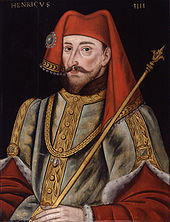
170px-king_henry_iv_from_npg_(2)Some medieval English kings have unfairly gotten a bad rap. Others are deservedly vilified (Richard III, I’m talking to you).

Our modern-day perception of English kings is largely constructed from only a few sources. Of course, we have the writings of Shakespeare which were generally based on the real events of English monarchs but had lots of extra drama added in to spice things up. We also have the writings of chroniclers who actually lived in the middle ages, but they aren’t always reliable. Just imagine if you were hired by Henry VIII to write the history of his reign. You would definitely write it in a way that reflected very well on the king. And we have modern-day historians who try to bring the past to life with new interpretations of English monarchs and their new explanations of their controversial actions.

One of the English kings who has received very little attention over the years is Henry IV, also known as Henry of Bolingbroke and Henry of Derby. The common perception is that Henry was a usurper, but was he really? Did he seize the throne from Richard II illegally or was he the rightful heir?

What was Henry IV’s claim to the throne?

To answer this question, we must go back a couple of reigns to Henry’s grandfather, King Edward III, a Plantagenet king that ruled England from 1327 to 1377. King Edward was also the nephew of King Charles IV of France through his mother Isabella. When Charles IV died childless, Edward asserted his right to the French crown as Charles’ nearest male relative. The French overruled him citing Salic Law which said inheritance could not be passed through a female line. So the throne went instead to Philip of Valois, Charles’ cousin through a completely male line. As if losing his claim to the kingdom of France wasn’t enough of a blow to Edward, Philip also confiscated Edward’s land in France. Edward was not one to take things lying down so he took military action against France and initiated the Hundred Years War.

One of King Edward’s best military commanders was his eldest son, Edward of Woodstock, also known as the Black Prince. The king’s son was raised and educated in preparation to be the next king and he was perfectly suited to follow in his father’s footsteps. However, there was a major problem. His repeated military expeditions around Europe caused him to become quite ill, including a raging case of dysentery. He died in 1376 at the age of 45. He had not outlived his father, therefore he never got the chance to fulfill his destiny as King of England.

After the death of the Black Prince, King Edward wrote his will and “Act of Entail” in which he named his heir. Rather than naming his eldest living son (John of Gaunt) to be the next king, he did something unusual. He instead named his grandson, Richard of Bordeaux, eldest living son of the Black Prince, to be next in the order of succession using a device called “Right of Substitution”. Essentially since the Black Prince died prematurely, his son Richard was accepted as a substitute.

After Richard, he named the next in line for succession to be John of Gaunt and the male heirs of his body, followed by his other living sons, Edmund, Duke of York, and Thomas, Duke of Gloucester. Interestingly enough, the “Act of Entail” document was kept secret from the public. The only people who knew about it were those named in the entail and the king’s closest confidants. It was never introduced to Parliament to put into law. Many rulers were hesitant to publicly name their heir because that gave any discontented subjects someone to rally around and overthrow the king.

If King Edward had followed traditional Salic Law rules, his eldest living son, John of Gaunt, would have been named his heir followed by Gaunt’s son, Henry of Bolingbroke, which would have left Richard completely out of the succession. Imagine how different the course of English history would have been if Edward had not made this decision to use the uncommon right of substitution. The inheritance would have been strictly through the house of Lancaster, cutting out the house of York. The Wars of the Roses may have never even happened.

Henry of Bolingbroke would have known about King Edward III’s act of entail and that he had been named third in line for the throne (after Richard and John of Gaunt) rather than second in line after Gaunt. Even so, being third in line to the throne wasn’t so bad for Henry. He lived a relatively comfortable life as a royal heir and spent his youth preparing to be a successful ruler like his grandfather. Henry became one of the most respected knights in Europe, he traveled abroad on crusades, and he learned it was better to work with the nobles and forge alliances rather than trying to control them. There was only one problem…Richard absolutely hated Henry. Richard was none of the things that Henry was. Richard was not strong and athletic, he did not joust, and he was not an experienced military leader. He was basically the antithesis of Edward III. Richard was terribly jealous of Henry and felt threatened that Henry or his father might one day try to wrestle the crown from his head.

Richard’s Revenge

For the first 10 years of Richard’s reign, it was assumed that Edward’s entail would be upheld by Richard but in the Parliament of 1386, Richard did something shocking. He threw out his grandfather’s entail and instead declared that his heir would be the twelve-year-old earl of March, Roger Mortimer, great-grandson of King Edward III. Roger’s mother Phillipa was the daughter and only child of King Edward’s second-born (yet deceased) son Lionel of Antwerp. Even though Lionel was deceased, Richard used the right of substitution in selecting Roger, just as Edward III had done in selecting Richard as the Black Prince’s substitute. However, it was highly unusual to name an heir through a female line, especially when there were plenty of other male heirs to choose from. Richard selected the Mortimers so that John of Gaunt, Henry of Bolingbroke, and the entire Lancastrian line would be excluded from the succession. He was putting them on notice that they better work for him instead of against him.

Richard’s declaration was met with great resistance from the lords of his realm who were already disgruntled from enduring years of his tyrannical treatment. They had been terribly unhappy about Richard’s style of kingship, lack of military experience, misguided attempts to negotiate with France, reckless financial spending, attempts to degrade the power of Parliament, and general misrule resulting from Richard’s circle of favorites. Threatening civil war and deposition, the Lords were successful in pressing Richard to exclude the minor Roger Mortimer from succession and to reinstate King Edward III’s entail naming John of Gaunt and his son Henry as the next in line to the throne.

Richard was a very spiteful and vengeful man. He would agree to a deal when he was face-to-face with the nobles, but behind their backs, he would plot to punish them for any sign of disloyalty. Over the next 10 years, he continually threatened the lords and nobles with arrest, confiscation of lands, titles, goods, and even exile if they didn’t bend to his every whim. Richard again changed the order of succession, throwing out John of Gaunt, Henry, and the Mortimers. He decided that the person who would be the least threatening to his reign would be Edward III’s fourth son, Edmund of Langley, Duke of York, who was an arthritic invalid.

Henry of Bolingbroke was always at the top of Richard’s hit list but since he was such a close royal relative, Richard couldn’t afford to take him out. His reputation would have been destroyed if he used force to get the likable, respected knight out of the picture. So instead of using force, he used a 1397 civil dispute between Henry and Thomas Mowbray, Duke of Norfolk, as the mechanism to remove him. Richard ruled both men guilty and sentenced them both to exile: Henry for 10 years and Norfolk for life.

As if exile wasn’t punishment enough, just one year later when John of Gaunt died, Richard delivered the knock-out punch. Despite his promise to Gaunt, Richard revoked Henry’s entire Lancastrian inheritance and confiscated all of his lands and assets. Furthermore, Henry was to be considered a traitor to England. Henry of Bolingbroke had nothing left. To fall so far from being the heir to the throne down to a penniless vagabond was untenable for Henry. And there was only one person at fault: his cousin, King Richard II.

Henry’s Return to England

As Henry lived in exile, he thought about his situation and strategies for getting back what was rightly his. There weren’t many options. There was certainly no chance now at reconciliation with Richard, things had simply gone too far. The only way he would be allowed to return to England and be restored to his rightful inheritance would be if Richard was no longer the king of England.

Removing King Richard II from the throne is not something Henry could do by himself. Luckily, he had friends in high places who had also been unfairly treated by Richard. Together with several dukes and earls, Henry planned an uprising against Richard to protest his tyrannical rule. Henry landed in England on July 4, 1399, at Ravenspur in Yorkshire with only 300 men. As he traveled towards the safety of the Lancastrian stronghold, Pontefract Castle, his army grew into the thousands. Henry had become the leader of the revolution. He swore to his followers that his only intent was to defend England from Richard’s tyranny and to reclaim his Lancastrian inheritance. He promised that he would not take the throne for himself by force.

King Richard was with the royal army in Ireland at the time of Henry’s invasion. The Keeper of the Realm during his absence was his 58-year-old heir, Edmund of Langley, Duke of York. Edmund knew that his nephew was a cruel despotic ruler and he instead threw in his lot with Henry. Edmund agreed to support his uprising and would not take measures to suppress his army. Edmund also believed that Henry had been treated unfairly and was perfectly within his rights to reclaim his inheritance.

So Henry’s army moved across the country unchallenged until he came to Conway Castle where King Richard was hiding. Rather than fighting, they negotiated. Henry demanded that he be allowed to return to England and that his lands be restored to him. Richard agreed but then shortly thereafter declared he had no intent to keep his promise. In fact, he was more determined than ever to see Henry dead. Henry’s army arrested Richard and took him into their possession.

While Richard was kept under lock and key in a variety of royal castles, Henry was working with English lawyers to legally reinstate his claim to the Lancastrian inheritance. They determined that the best course of action would be for Richard to sign a written resignation which would then be ratified by Parliament. After much resistance, the king finally relented and signed the document. In doing so, he stepped down from the throne and agreed to Henry’s accession, just as King Edward III’s act of entail had outlined nearly twenty-five years earlier.

The Rule of Succession in England

Was Henry right to overthrow Richard II in an attempt to restore justice to the kingdom of England? Or did he take advantage of the circumstances by claiming the throne for himself?

It all comes down to this. Were any laws broken when Edward named his grandson Richard as his heir instead of his eldest living son John of Gaunt? Likewise, did Richard break any laws when he bypassed Edward’s entail and named Edward of Langley as his heir? Did Henry break any laws when he accepted the crown for himself and deposed his cousin Richard? Should kings have to uphold entails from their predecessors or was it legal for them to change it to their own personal liking?

We cannot judge these decisions as morally right or wrong, rather we can only judge them in terms of the law or the absence of law. In England during the Middle Ages, there was no law that strictly defined the order of succession. Other European kingdoms, such as France, observed Salic Law which prohibited women from being crowned as well as their sons. Germanic kingdoms followed the semi-Salic rule which allowed a woman to inherit but only if all the men in the royal bloodline were dead.

England was a kingdom heavily influenced by their different European neighbors so England’s laws and customs were a mish-mash of the various customs immigrants had brought with them to England. Since England had never put the order of succession into a legal act, it was basically up to the current ruler to choose the next heir to the throne.

Is it any wonder England had so many disputes over control of the kingdom during the Middle Ages? With no legal rules governing the order of succession, it became open to interpretation and that’s when the royal heirs and nobility used it to their advantage. It made it much more possible to maneuver their own royal relatives into positions where they might someday have a shot at the throne themselves.

Was Henry IV a Usurper?

It is my judgment that Henry IV was not a usurper. To be a usurper, one has to either seize authority illegally or by force.

Although Henry did amass a sizable army, they did not resort to violence to solve the conflict. The army was merely a show of force so that Richard would take them seriously and understand the gravity of the situation.

Henry was careful to use lawyers to find a legal way to depose King Richard II and thus overturn his previous statute naming Edmund of Langley as his heir. With Richard deposed and all of his previous acts of Parliament voided, the order of succession had to revert back to the previous king. That would make King Edward III’s act of entail valid again and Henry of Bolingbroke next in line to the throne.

 About the Author

Michele Morrical is a writer, blogger, and amateur historian on all things Tudor and Wars of the Roses. She lives in Indianapolis, Indiana with her husband, son, daughter, and many pets. You can find her writings at michelemorrical.com.

My journey into Tudor history began about 10 years ago with the TV show “The Tudors” from Showtime. As I watched the show, I wondered how much of it was really true because the storylines were more dramatic and shocking than any soap opera I had ever seen. I picked up Margaret George’s autobiography of Henry VIII and I was hooked. I’ve since read over 100 books on the Tudor period and I’m currently writing my own book about the Wars of the Roses