Biography: Jasper Tudor

410px-Arms_of_Jasper_Tudor,_Duke_of_Bedford.svg(Born November 1431- Died December 21, 1495). Son of Owen Tudor and Catherine of Valois. Married to Catherine Woodville. Jasper was really one of the unsung heroes of the Wars of the Roses. He never gave up on fighting for the cause he believed in and he did his best to keep his nephew Henry Tudor safe.

Jasper Tudor was the second son born to Owen Tudor and Catherine of Valois born in 1431. He was the brother of Edmund Tudor and half- brother of King Henry VI. After his mother’s death on January 3, 1437, Jasper and Edmund were sent to Barking Abbey where they were raised and educated by Katherine de la Pole from July 1437 until March 1442. Around that time, their half-brother Henry VI allowed for Edmund and Jasper to live at court, where they received the military training that would be essential for their survival later in life. In 1449, Jasper was knighted and in 1452, he was created the earl of Pembroke.

Jasper worked hard to stop the fighting between the Yorks and the Lancasters while he was still living in the courts. Jasper’s brother Edmund took in a young Margaret Beaufort as his ward and he later married her on November 1, 1455. The following year, on November 3, 1456, Edmund died of the plague, leaving his young and pregnant widow in Jasper’s custody. Henry Tudor, earl of Richmond was born on January 28, 1457.  Jasper was also responsible for maintaining the Lancastrian ties in Western Wales between 1456 and 1459. In 1460, Jasper was able to capture the Duke of York’s North Welsh stronghold of Denbigh Castle.

Jasper and his father Owen Tudor raised an army in Wales for Henry VI and met against the Yorkist forces at the battle of  Mortimer’s Cross on February 2, 1461. It was an utter defeat for the Lancastrians. Owen Tudor was taken into custody and executed while Jasper escaped first into Ireland and then into Scotland.  Jasper then went to France where he was welcomed by King Louis XI in 1462. He stayed in France for 6 years, until he returned to Wales in 1468, when he lost his title of earl of Pembroke and Pembroke Castle to William Herbert.

Jasper did regain the earldom of Pembroke when Henry VI was restored to the throne, but in 1471, he fled to the continent yet again once Edward IV was crowned king. Jasper  and Henry tried to gather more support for the Lancastrian cause but they got caught in a bad storm in the English Channel while escaping from Tenby. They landed in Brittany where they sought the protection of Francis II, Duke of Brittany, which he did give to them.The Lancastrians along with Jasper and Henry, were housed at  the Château de Suscinio in Sarzeau. Edward IV tried his best to apprehend Jasper and Henry but he failed to do so.

In October 1483, Jasper and Henry tried to go back to England, but it failed and they were forced to return to Brittany. When the Duke of Brittany got very ill in 1484, his treasurer Pierre Landais made a deal with Richard III to give over Jasper and Henry in exchange for 3,000 English archers to defend a French attack. A bishop in Flanders John Morton heard about the deal and warned Jasper and Henry just before Landais could reach them. Jasper and Henry fled into France where King Charles VIII allowed them to stay until Duke Francis II felt better.

Jasper and Henry made their way back to England in August 1485, where they faced off against Richard III at the Battle of Bosworth Field on August 22, 1485. Richard III was defeated and Henry became Henry VII. Jasper’s titles and properties were all returned to him and he was made a Knight of the Garter as well as Duke of Bedford. On November 7, 1485, Jasper married Catherine Woodville, the sister of Queen Elizabeth Woodville. They had no children. Jasper would die on December 21, 1495 at Thornbury Castle at the age of 64.
Biography: Owen Tudor

Full name: Owen ap Maredudd ap Tudur. (Born around 1400- Died February 2, 1461) Son of Maredudd ap Tudur and Margaret ferch Dafydd. Husband of Catherine of Valois.  Father of 4-6 children, including Edmund and Jasper Tudor.

Owen Tudor was the son of Maredudd ap Tudur and Margaret ferch Dafydd. We do not know much about his early life. Owen’s father and his uncles were involved in the rebellion of Owain Glyn Dwr, the last Welsh Prince of Wales, against the English. This rebellion was suppressed and Welshmen moved into England to find work. In 1421, he found work with Sir Walter Hungerford, the steward of King Henry V. In 1422, King Henry V would die from dysentery, leaving behind his 21 year old wife Catherine of Valois and their baby son, who was now King Henry VI. It was during this time that  it is said that Owen came to work in Catherine’s household.

Parliament passed a bill that stated that the dowager queen could not marry again unless she had the king’s permission. If she did marry without permission, her husband would lose everything, but their children would remain legitimate. It is said that the couple was married between 1428 and 1429. In May 1432, Owen Tudor was given the same rights as an English gentleman. The couple had at least 4 children; Edmund born in 1430, Jasper born in 1431, a son who is rumored to have become a monk, and a daughter who either died young or became a nun.

Catherine would enter Bermondsey Abbey to receive medical attention, where she died on January 3, 1437. Edmund and Jasper were sent to the Abbess of Barking to receive  their education while Owen dealt with the king’s Regency council. Owen was nervous about the council and so he sought sanctuary at Westminster Abbey; when he did arrive at the council, he was cleared of all charges and was allowed to return to Wales. However, he was captured by Lord Beaumont and sent to Newgate Prison.

In 1438, he managed to escape with the help of a priest and a servant; he was recaptured and held at Windsor Castle under the guardianship of Edmund Beaufort. In 1439, King Henry VI pardoned Owen Tudor, restored all of his lands, provided him a position at court, and made the Keeper of the King’s Parks in Denbigh. In 1442, Henry VI welcomed his half- brothers Edmund and Jasper to court with open arms. In November 1452, Edmund became the earl of Richmond and Jasper became the earl of Pembroke. On November 3, 1456, Edmund Tudor died from the plague, leaving his young son and wife in the capable hands of his brother Jasper Tudor.  Owen and Jasper would serve Henry VI by capturing Yorkist supporters for the king and in return gaining their estates, including John, Lord Clinton in 1459; that same year, Owen had a son with an unknown mistress named Sir David Owen, born at Pembroke Castle.

Owen joined his son Jasper’s army to raise an army in Wales in January 1461. On February 2, 1461, their army faced off against the Yorkist army at the battle of Mortimer’s Cross. It was a devastating loss for the Lancasterian cause. Jasper Tudor escaped, but Owen was captured and beheaded under the orders of Edward Earl of March, later Edward IV, at Hereford.

Biography: Catherine of Valois

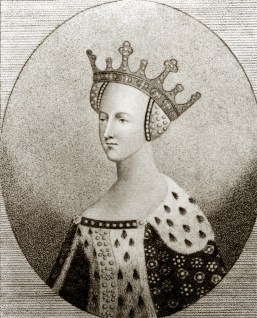
Catherine_of_France(Born October 27, 1401- Died January 3, 1437). Daughter of Charles VI of France and Isabella of Bavaria. Married to Henry V of England and Owen Tudor. Mother of Henry VI, Edmund Tudor and Jasper Tudor.
Catherine of Valois was the tenth child of Charles VI of France and Isabella of Bavaria. Her father suffered from mental illness and some believe that Catherine and her siblings were neglected by their parents. When Catherine was young, she was sent to the convent in Poissy to receive a religious education. From a young age, Catherine was on the marriage market. Her first potential groom was the son of Henry IV, the prince of Wales, but the king died before the negotiations could really get started. In 1414, a young Henry V re-opened the negotiations. In May 1420, the Treaty of Troyes was signed between England and France that made Henry V and his descendants the next heirs to the French throne. In order to cement this alliance, Henry V married Catherine of Valois on February 21, 1421.

Henry V went back to France to campaign a few months later, leaving a pregnant Catherine of Valois behind. Henry VI was born on December 6, 1421. Henry V would die from dysentery that he had contracted during the siege of Meaux on August 31, 1422. A few months later, Catherine’s father Charles VI died, leaving Catherine’s baby son both the king of England and France and it left Catherine a dowager queen at the age of 21.

Since Catherine was still young, there was a strong concern that she would marry again, especially to Edmund Beaufort, her late husband’s cousin. That is why Humphrey duke of Gloucester, the Lord Protector and Parliament passed a bill in 1427-1428 that the queen could not get remarried without the king’s consent of her husband would lose everything, except their children would remain legitimate.

Catherine met and fell in love with a Welshman named Owen ap Maredudd ap Tudur, also known as  Owen Tudor. Not much is known about his early life but in 1421, he was in service of Henry V’s steward Sir Walter Hungerford. He then became a member of Catherine’s household as either keeper of Catherine’s household or wardrobe. Sometime between 1428 and 1429, the couple is said to have gotten married, but there is no evidence to support this claim. In May 1432, Parliament granted Owen Tudor the rights of an Englishman. The couple had at least 4 children, at most 6; Edmund, Jasper, Owen, and a daughter Margaret who became a nun and died young. All of their children were born outside of court.

Catherine entered Bermondsey Abbey, possibly seeking a cure from an illness. Three days later, on January 3, 1437, she died. Catherine is buried at Westminster Abbey in Henry V’s Chantry Chapel. Catherine of Valois was the mother of Henry VI, Edmund and Jasper Tudor, as well as the grandmother of Henry Tudor, the first monarch of the Tudor Dynasty.

Biography: King Henry V

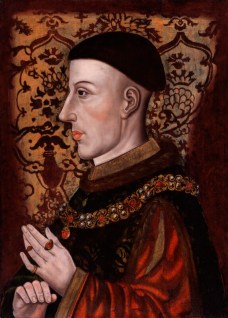
mw03074(Born September 16, 1387- Died August 31, 1422). Son of Henry IV and Mary de Bohun. Married to Katherine of Valois. He only had one son Henry VI.

Henry V was a soldier from birth. He did so much for his country, yet he died too soon, leaving his kingdom in the incapable hands of his baby son Henry VI.

At the age of fifteen, Henry V fought alongside his father against the Welsh rebels under Owain Glyn Dwr and the English rebels under Edmund Mortimer and Henry “Hotspur” Percy. Henry’s relationship with his father in the later years of Henry IV’s life was not great. The two argued about many issues, but it was mostly about the English involvement in France. Henry IV wanted to press his claim to the French throne while France was in the midst of a civil war between the Burgundians and the Armagnacs; Henry IV supported the Armagnacs while Henry V supported the Burgundians. This issue would never be resolved between them as Henry IV would die in 1413 and Henry V became king.

As king, Henry V desired to regain the lands in France that he believed was rightfully his, but unlike his father, he was able to get the full support of Parliament to do so. Henry V tried to negotiate with the French to regain all of the old Angevin Empire,  but when that failed, he invaded on August 11, 1415. On October 25, 1415, the Battle of Agincourt took place. Even though the French had the English outnumbered, the English had longbowmen. The French lost some 6,000 men whereas the English only lost 400 men.

Agincourt was a tremendous victory for the English, but the French refused to fall. Henry V gained support from Sigismund, the Holy Roman Emperor and John, duke of Burgundy and started a new campaign in August 1417. In the spring of 1419, Normandy fell to Henry V. In May 1420, Henry V signed the Treaty of Troyes with the Burgundians which recognized him and his heirs  as heir to the French throne. In order to cement this new alliance, he married the daughter of the French King Katherine of Valois.

Everything seemed right in Henry’s kingdom, but he still wanted to gain more French land. In 1421, he went back to France and was able to gain control of the Dauphin’s stronghold of Meaux in May 1422. Unfortunately, in the winter of 142, Henry V fell ill from dysentery and died on August 31, 1422. He left his kingdom in the hands of his infant son Henry VI. Even though Henry V’s reign was one of the shortest of any English king since the Norman Conquest, it was one of the most successful. England was in a position of power on the world stage thanks to the actions of Henry V.

Biography: King Henry IV (aka Henry Bolingbroke)

(Born April 3, 1367- Died March 20, 1413). Son of John of Gaunt and Blanche of mw03072Lancaster. Married to Mary de Bohun and Joan of Navarre. He had 7 children with Mary, including the future Henry V. He was the 1st king from the house of Lancaster.

Henry was the son of John of Gaunt and Blanche of Lancaster and was born at Bolingbroke Castle on April 3, 1367. Early in his life, he became one of the Lords Appellant who were opposed to the rule of Richard II. He stepped down from this role in 1389 and in 1390, went on his first adventure, journeying with the Teutonic Knights to Lithuania. Two years later, he went on a pilgrimage to Jerusalem. During this time, he visited numerous courts in Europe and was held in high regards. He was a handsome young man, but it was early in life where Henry’s ill health that plagued him during his reign started to appear.

Henry was a good person to help the king, however the only one who failed to realize this was Richard II. He banished Henry in 1398 for ten years, but when John of Gaunt died the following year and Henry became the next Duke of Lancaster, Richard II took all of his lands and banished him forever. This was the last straw for Henry. While Richard was occupied with unrest in Ireland, Henry took his chance and invaded England, forcing Richard to abdicate. The next one in line to the throne was Edmund Mortimer, earl of March, but he was only eight years old, so Parliament agreed that Henry would be a better choice to be king. His reign as Henry IV began on September 30, 1399.

However, not everyone was happy with Henry as king. Henry IV’s first rebellion that he had to deal with was by the earls of Kent, Salisbury and Huntingdon, just a month after he became king. Henry took care of this rebellion quickly and violently. It is also believed that this was around the same time that Henry ordered the death of Richard II. A few months after the first rebellion, Henry IV had to deal with a second rebellion in Wales, where Owain Glyn Dwr was declared Prince of Wales in September 1400. This revolt was quickly put down, but Owain evaded capture for several years, leading to guerrilla style warfare.

Owain’s supporters grew not only amongst Welsh barons, but English ones as well, including the Mortimers who were upset that Henry was king and not Edmund, who was Owain’s son in law after he married Owain’s daughter. Another supporter was Henry “Hotspur” Percy, the son of the earl of Northumberland who believed that he did not get the recognition that he deserved after he fought against the Scots. These forces came together and fought against Henry at the battle of Shrewsbury on July 21, 1403, where Henry defeated Hotspur easily and killed him. Henry was not going to let the rebel army get away and by 1408, they were all but eliminated.

Two years before this, in 1406, Henry IV took James I of Scotland hostage and his young heir was sent to France. James was in the English court for 17 years as a hostage and for that time, the relationships between England, Scotland and France were good. Things were looking up for Henry IV, except for his health. Starting in 1406, his health was in decline and there was a serious concern for his life. He tried to govern, but he became more reliant on his Parliament. In 1409, Henry’s son Prince Henry was made chancellor over Thomas Arundel, archbishop of Canterbury. Arundel returned in 1411 when Henry and his council were debating if he should step down in favor of Prince Henry, which Henry refused to do. Henry died in 1413 from some sort of wasting disease at the age of 45. His son Prince Henry would succeed him as Henry V.

Biography: King Richard II

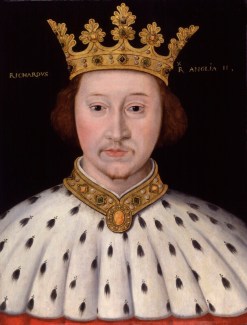
mw05302(Born January 6, 1367- Died on or about February 14, 1400). Son of Edward the Black Prince and Joan 4th Countess of Kent. Married to Anne of Bohemia and Isabella of Valois. He had no children.
Richard II was the second son of Edward the Black Prince, but when his older brother Edward died when Richard was three, Richard became second in line to the throne after his father. When Edward the Black Prince and Edward III died, Richard II became king at the tender age of 10. There was no formal regent that could help guide Richard II, but his uncle John of Gaunt did the best that he could, taking a more active political role.

Richard II and his government decided to start taxing the people with poll taxes to pay for the wars in France and the campaigns in Scotland. At first, they were tolerated, but then the people got mad. In June 1381, a man named Wat Tyler had enough and killed a tax collector and raised a force of around 100,000 to march against the king. When the two forces finally met, Wat Tyler was killed by the Lord Mayor of London William Walworth. Richard at the age of 14 stopped the Peasants’ Revolt by promising the people reforms that he, in the end,  did not fulfill the reforms.

He was the champion of England, but inside his court, things were more divisive. Richard II had two very close advisors, Robert de Vere earl of Oxford and Michael de la Pole. He granted favors upon the two men, causing anger in the court. Richard also sought military glory in Scotland, which ended up being a disaster. To top it all off in 1386, Richard made Robert de Vere duke of Ireland and Michael de la Pole was made a chancellor, without consulting Parliament first. This was the last straw for those who opposed Richard II. They decided to act. Five of his strongest opponents; Thomas duke of Gloucester,  the earl of Arundel, Thomas Beauchamp, the earl of Warwick, Thomas Mowbray, and Henry Bolingbroke the son of John of Gaunt, became known as the Lords Appellant. They took over the country and they tried to convince Richard to give up his courtiers.

He did comply for a little while, until he became of age. His first wife Anne of Bohemia died in 1394 from the plague, leaving Richard heartbroken. He married his second wife Isabella of Valois as part of a peace treaty with France, strengthening his position in his own country. He went after the Lords Appellant. Most of them were killed, except for Mowbray and Henry Bolingbroke. Mowbray was exiled for life while Henry was exiled for ten years. During his reign “The Canterbury Tales” by Geoffrey Chaucer was published and literature was on the rise.

In 1399, John of Gaunt died and instead of pardoning his son Henry Bolingbroke, Richard banished him for life. Richard left later that same year to quell the unrest in Ireland and Henry Bolingbroke took his chance to invade. Richard’s support dwindled and on August 19, 1399, Richard II forfeited to Henry and he was imprisoned in the Tower of London. The next in line for the throne, since Richard II had no children, was Edmund Mortimer earl of March, who was only 8 years old at the time. Parliament did not want a similar situation than the one that they were in, so they forced Richard II to abdicate and on September 29, 1399, Henry Bolingbroke became Henry IV. Richard II was moved to Pontefract Castle and on or around February 14, 1400, he died. Some believe that he starved to death as there was no evidence of a physical murder.

With Richard II’s abdication and Henry IV’s accession came the rise of the House of Lancaster.


Biography: Katherine Swynford

(Born November  25, 1350 – Died May 10, 1403). Daughter of Payne de Roet. Sister of Philippa Chaucer, the wife of Geoffrey Chaucer. Married to Hugh Swynford and John of Gaunt, 1st Duke of Lancaster. Mother of the Beauforts as well as 3 children with Hugh Swynford.

Katherine was probably born on or around November 25, 1350 to Payne de Roet, a herald and later a knight. We don’t know much about her early life.  Katherine was appointed governess to watch over the children of John of Gaunt and Blanche of Lancaster in 1365. In 1367, she married Hugh Swynford, a knight, and they had 3 children; Blanche, Thomas and Margaret Swynford.

Hugh Swynford and Blanche of Lancaster would both die in 1371, the same year that rumors began that Katherine and John were having an affair. John quickly silenced those rumors by marrying Constance of Castile later the same year. In 1372 Katherine’s position in John’s household got better and by 1373, their first child John, was born. They would have 4 children; John, Henry, Thomas and Joan.They would adopt the last name Beaufort in honor of their father’s lost of his lordship of Anjou.

During the 1380’s, Katherine left court so John could repair his reputation after the Peasants’ Revolt. When Constance died in 1394, everything changed for the couple. They were married in 1396 and their children became legitimate, however they were banned from the line of succession for the throne of England. John would die on February 3, 1399, leaving Katherine a widow yet again. Katherine would die on May 10, 1403.

Her children with John of Gaunt, the Beauforts and their children, would change English history forever.

Biography: John of Gaunt

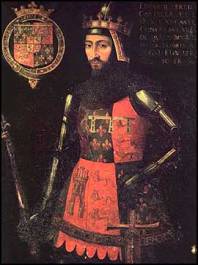
gaunt(Born March 6, 1340- Died March 15, 1399). Son of King Edward III and Philippa of Hainault.  He had three wives, Blanche of Lancaster, Constance of Castile, and Katherine Swynford. He was the 1st Duke of Lancaster, the Duke of Aquitaine, King of Castile, and one of the wealthiest men of his time. His children would become the House of Lancaster, the Beauforts, the monarchs of Portugal and Castile, and the Hapsburgs.


John of Gaunt was the third surviving son of Edward III. He wasn’t supposed to be as wealthy or influential as he became but he achieved prestige by marrying well. With his first marriage to Blanche of Lancaster, John of Gaunt was able to become the first Duke of Lancaster. Blanche of Lancaster would die in 1369 and John would marry Constance of Castile in 1371. She was next in line for the throne of Castile and for years John fought for her crown against the Spanish. The problem was that they were also fighting the French as the Hundred Years’ War was just starting.   After his brother Edward The Black Prince’s death in 1376, John took John Wycliffe under his protection as he now had more of a political influence.

When Edward III died, John of Gaunt’s nephew Richard II became king and John was his right hand man. There was a lot of mistrust with the nobility and the common folk which lead to the Peasants’ Revolt of 1381, which was quickly and brutally taken care of. John went  back to Castile try to take the throne, but as soon as he left, England almost fell into civil war because of how poorly Richard II ruled. John gave up his claim to the Castilian throne to help bring England back to some stability.


He would also help sponsor  Geoffrey Chaucer, who was his brother in law since Chaucer married the sister of John’s third wife and long time mistress, Katherine Swynford. John and Katherine met while he was married to Constance and had 4 children out of wedlock. After they were married in 1396, their children were made legitimate and given the name “Beaufort”. There was one catch, they were not allowed to inherit the throne, although their half- brother Henry IV allowed them to have some royal status. John of Gaunt died  of natural causes on March 15, 1399 with Katherine Swynford by her side. He would later be buried by his first wife, Blanche of Lancaster.

Biography: King Edward III

mw02027(Born November 13, 1312- died June 21, 1377. Reigned from January 1327 until June 21, 1377).Son of Edward II and Isabella of France.Married to Philippa of Hainault. They had 13 children including Edward “The Black Prince”, Edmund Duke of York, and John of Gaunt Duke of Lancaster.
Edward III was the king who started The Hundred Years’ War with France. His sons Edmund Duke of York and John of Gaunt Duke of Lancaster would be the founders of the Houses of York and Lancaster respectfully.

To say the early part of Edward III’s reign was turbulent would be an understatement. His mother Isabella of France and her lover Roger Mortimer had his father Edward II disposed and placed Edward III on the throne at the tender age of 14. A few years later after a terrible campaign in Scotland, Edward III had Mortimer executed.

Edward III had to deal with Scotland and France throughout his entire reign. He overthrew his brother in law David II King of Scotland for Edward Balliol, but it did not last long. Unfortunately before Edward III could really start a war with Scotland, he had to declare a truce with them as France was becoming a bigger headache. While the English were dealing with the Scots, the French had raided English coastal towns because Scotland and France had an alliance. Edward had a claim to the throne of France and so he decided to fight the French for what he believed was rightfully his, starting the Hundred Years’ War. Edward was able to capture Gascony, Calais, and other colonies in France for England.

Edward III modeled his court after that of King Arthur. It was a time that chivalry was becoming popular. Edward III established the Noble Order of the Garter, which is still active today, and his son Edward The Black Prince, was among the first members. However, the prosperous times would not last long as the Black Death of 1348 consumed all of Europe, including England, killing off a third of the population. In 1356, Edward The Black Prince won an important victory against the French at the Battle of Poitiers. The French king and his son were captured and it looked like England had won, but Edward III would sign the Treaty of Brétigny in 1360, which renounced his claim to the French throne, but allowed the English to keep its French territories.

Edward III relied on the military strength of his sons, especially Edward The Black Prince and John of Gaunt. In 1369, Philippa of Hainault died of what seems like dropsy. Edward was distraught and he decided to take a mistress Alice Perrers, who held too much power at court and was banished in 1376. Also in 1376, Edward The Black Prince passed away. Edward III would die the following year from an apparent stroke. He left the throne to his grandson Richard II.

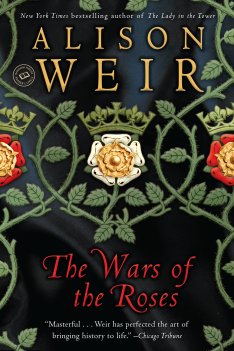
Book Review: “The Wars of the Roses” by Alison Weir

911GmwfEpdLThe Wars of the Roses was a series of wars from 1455 until 1487 for the throne of England. It is traditionally taught that it was between the houses of York and Lancaster, yet there were a lot more players involved than these two families. In fact the conflict started much earlier with the children of Edward III and Philippa of Hainault. The Lancasters were the descendants of John of Gaunt and his wife Blanche of Lancaster while the Yorks were descendants of Edmund of Langley Duke of York. This was a series over the question of who had the strongest claim to the throne. This question and the series of wars that would try to answer it is explored in depth in Alison Weir’s book “The Wars of the Roses”.

Alison Weir explains the struggle of studying this time period and what she is trying to accomplish in her book:

Sources for this period are meagre and often ambiguous, yet much research has been done over the last hundred years to illuminate a little for us what is often described as the twilight world of the fifteenth century. Many misconceptions have been swept away, yet even so the dynastic conflict still confuses many. My aim has been throughout to eliminate that confusion and try to present the story in chronological sequence, clarifying the problems of the royal succession in an age in which no certain rules of inheritance applied. I have also tried to bring the world of the fifteenth century to life by introducing as much contemporary detail as space permits, in order to make the subject relevant to any read, academic or otherwise. Chiefly, however, I have tried to re-tell an astonishing and often grim story of power struggles in high places that involved some of the most charismatic figures in English history. (Weir, xix).

Weir begins her book by explaining  what England in the fifteenth century was like before diving into the history of Edward III and the Plantagenets in the late 1300s. This may seem a little complex since there were many sons of Edward III, but the throne first went to Richard II, but when he was forced to abdicate, the throne went to Henry of Bolingbroke, who became Henry IV. He was the son of John of Gaunt and Blanche of Lancaster. John of Gaunt and his third wife Katherine Swynford had children who would become known as the Beauforts. They would become important later on.

Henry IV’s son would become Henry V who was married to Katherine of Valois. When Henry V died, their son Henry VI became king; he was a baby. His mother would remarry a Welsh man named Owen Tudor and they would have a few children, including Edmund and Jasper Tudor. Henry VI would marry Margaret of Anjou. Richard Earl of Cambridge, the son of Edmund of Langley, would have a son with his wife Anne Mortimer named Richard Plantagenet Duke of York. He would marry the “Rose of Raby” Cecily Neville and they would be the parents of Edward IV, George Duke of Clarence and Richard Duke of Gloucester, later Richard III.

This all may seem a bit complex, but it is important to understand how all of the players in the Wars of the Roses were connected. Henry VI was a weak king who was known for his madness and so someone had to lead the government. Richard Duke of York believed that he should have been Lord Protector, however Margaret of Anjou and her party at court had other ideas. The beginning of this conflict was a battle between court factions, but eventually it escalated rather quickly into a full on rebellion by Richard Duke of York. This was now a battle between the Yorks and the Lancasters. When Richard Duke of York died at the Battle of Wakefield on December 30, 1460, his son Edward took on the Yorkist cause and would become king after the battle of Towton on March 29, 1461, the bloodiest battle on English soil. After Towton, it was a battle between Edward IV and those who supported Henry VI, until 1471 when Edward IV ultimately won, thus ending the conflict between the Yorks and the Lancasters.

Weir chooses to end her book here at 1471 even though the Wars of the Roses will pick back up with the death of Edward IV in 1483 when his brother Richard becomes Richard III. Weir truly brought this time period to life. I have been studying the Wars of the Roses for a few years now and I have to say this book really simplified this complex family struggle in a way that makes sense. I love this book and I have read it several times. If you really want a great book that explains the causes of the Wars of the Roses, I highly recommend this book, “The Wars of the Roses” by Alison Weir. It is a fantastic introduction to this tumultuous time period.