Book Review: “The House of Echoes” by Alexandra Walsh

A love that can get through any obstacle even when the couple is married to other people is considered very rare. However, star-crossed lovers at court were practically unheard of, especially multiple couples from the same family. Anne Brandon knows how rare these matches are as her father Charles Brandon married the sister of King Henry VIII. Now she must figure out her feelings about romance while navigating court life. In the modern day, Caroline Harvey has relationship problems while she navigates the loss of her famous writer, grandfather Dexter Blake. How are these two women from different centuries connected and can they fight for who they love or are they destined to be alone? Alexandra Walsh tells both women’s stories in her novel, “The House of Echoes.”

I want to thank Boldwood Books and Net Galley for sending me a copy of this novel. The concept of this novel and the cover were what pulled me into the story. I know about the children of Charles Brandon and Mary Tudor, but when it comes to Charles’ other children, I don’t know much. I wanted to learn a bit about Anne Brandon and have a good time with the story of Caroline Harvey.

We begin with the story of Caroline Harvey as she returns home to England from America after a bad break-up with her former fiance Travis Hibbert. She is the personal assistant to her grandfather, the recluse writer Dexter Blake, the author of the Ether Heracles book series. Dexter Blake is dying and it is up to her and her family to announce it to the rest of the world while releasing the last book in the series and making movies about the books. While the world mourns Dexter’s death, Caroline is given the gift of Dexter’s home and she begins researching the history of the house, which will lead her to an old fling Gideon and his book store Ten-to-Midnight. It is through Caroline’s research that she discovers the story of Anne Brandon and the truth about her life.

Meanwhile, in Tudor England, Anne Brandon is getting used to being the step-daughter of Mary Tudor, the sister of King Henry VIII. She is not used to court life, but she has friends who will become famous like Anne Boleyn and Margaret More Roper. As a young girl, Anne falls head over heels in love with Randall Hanworth and she believes that she is destined to marry him. However, fate and her father have someone else in mind; Edward Grey 3rd Baron of Powis, which made Anne Baroness of Powis. That doesn’t mean it was a happy marriage as the couple never had any children. Anne lived throughout the reign of Henry VIII, saw two of his wives beheaded including her friend Anne Boleyn, and had a great falling out with her father Charles Brandon before he died, which meant that she was left out of his will. Anne was willing to fight for the lands that she believed rightfully belonged to her and the love of her life Randall.

This was a fun novel with so many twists and turns, including one at the end that I did not see coming. I especially love the little details that Walsh included especially coming up with blurbs for each of the Dexter Blake books as well as the inner workings of the Brandon household. As someone who reads a lot about the Tudors, it was refreshing to read about Tudors that were new to me. If you want a fresh take on the Tudor with a modern twist, I greatly recommend you read, “The House of Echoes” by Alexandra Walsh.

Book Review: “Mary Tudor: Queen of France” by Amy McElroy

The life of a 16th-century princess is not all that it is cracked up to be. You can have jewels, and glamorous dresses, attend the glittering yet treacherous court, and have numerous homes. You must marry the person the king says you should marry to create strong alliances for the kingdom, so the concept of marrying for love is not in your vocabulary. You had to ensure your opinions were kept in line with the monarch’s views so you didn’t meet a disastrous end. In other words, the closer you are to the throne, the more scrutiny is forced upon you. No one understood this advice better than Mary Tudor, the daughter of King Henry VII and the younger sister of Henry VIII. She was a daughter, a sister, a wife, a queen, a duchess, and a mother. Her remarkable story is told in Amy McElroy’s book, “Mary Tudor: Queen of France.”
I want to thank Pen and Sword Books and Net Galley for sending me a copy of this book. I have read Amy McElroy’s previous books, “Women’s Lives in the Tudor Era” and “Educating the Tudors,” and I enjoyed both books. When I heard that she would write her first-ever biography on Mary Tudor, I jumped at the chance to read it because Mary is my favorite of the children of Henry VII and Elizabeth of York.

McElroy begins with a quick overview of the conflict that brought the Tudors to the throne, the Wars of the Roses. The marriage of Mary’s parents, Henry VII and Elizabeth of York united the kingdom and started the Tudor dynasty. Like any dynasty, it was important to have heirs, spares, and daughters who could be used essentially as pawns in the marriage market to create strong alliances. Mary’s eldest brother Arthur married Katherine of Aragon to form an alliance with Spain and her older sister Margaret married James IV of Scotland for another alliance. From a young age, Mary Tudor was a proposed bride for Charles of Castile, the son of King Philip the Handsome and Queen Joanna of Castile and Aragon, who would become Holy Roman Emperor Charles V. Unfortunately, this marriage plan fizzled, but another bride groom was waiting in the wing, King Louis XII of France.

Mary’s marriage to King Louis XII of France and her time as Queen of France did not last long because Louis died mere months after their wedding. Now Mary could have returned to England or stayed in France and waited for another royal match to happen, but Mary chose option number three. Mary’s heart belonged to her brother Henry VIII’s best friend Charles Brandon, and the two devised a plan to marry in secret. It was out of the ordinary and it did create quite the scandal, but at the end of the day, it was a love match. Charles and Mary had a family and were involved in court politics including the Great Matter, before Mary died on June 26, 1533.

I think what has impressed me about McElroy’s books, including this one, is her ability to reveal something new to the subject material. While I knew quite a bit about Mary’s life, it was the marriage negotiations and her inner circle that truly fascinated me. If you want a new book about the sister of Henry VIII with new insight into her life and the politics of marriage, I highly suggest you read, “Mary Tudor: Queen of France” by Amy McElroy.

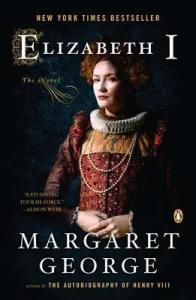
Book Review: “Elizabeth I” by Margaret George

The stories of queens have been told in numerous ways for centuries, but one of the most famous queens in human history is the Virgin Queen, Elizabeth I. The daughter of Anne Boleyn and Henry VIII who famously decided not to marry any man and instead devout her entire life to serve England’s people. That does not mean she was subservient to others she demanded respect and adoration from her subjects. Most stories of Elizabeth I begin in her golden years, but what could a novel about the queen’s silver years tell us about her personality, her reign, and the people who choose to follow or rebel against the famous queen? Margaret George gives her readers an innovative look at the titular queen in her novel, “Elizabeth I.”
This is only the second novel I have read written by Margaret George, the first being the brilliant “The Autobiography of Henry VIII.” I knew that she had written a novel about Elizabeth I, but I had not had the chance to read it until I saw it at a used bookstore. It was an instant buy for me even before I read the description, but the blurb made me even more intrigued.

George does not begin with Elizabeth’s coronation in 1558, like many novels about Elizabeth, but in the year 1588, which was arguably the queen’s most difficult challenge, fending off the Spanish Armada. To start at this most pivotal moment in Elizabeth’s reign is a bold choice that pays off because it sets the tone for the rest of the novel. Nothing is stable for the queen even after victory is won. Shortly after the Armada is defeated, the love of Elizabeth’s life, Robert Dudley Earl of Leicester dies. It is a huge loss for the queen, but she is not the only one who loves Leicester. He leaves behind his wife and cousin to the queen, Lettice Knollys, however, the two women cannot share their grief as the queen banished her cousin from court after she heard about the marriage.

The only one who can connect the two women at this point is Lettice’s son the Earl of Essex, who desires to be a great man, so he becomes a favorite of Queen Elizabeth. The arrogant young up-starter soon finds out that court is not all that he dreamed it would be and that to be a great man, he has to follow every rule of his monarch, which goes as well as you would imagine. What I appreciate about this novel is that George does not gloss over Elizabeth’s reign and instead chooses to show how muddy the political landscape was during the late Elizabethan age. We also get to see events that are not often featured in other novels about the Elizabethan age, such as Roanoke, Grace O’Malley, the return of the Armada, diplomats from farther countries, and the connection between Lettice Knollys and William Shakespeare. She fought every second of every day to keep her crown because she never knew who was the threat and when they would strike next until her dying breath.

I think this novel does an excellent job of showing George’s readers what Elizabeth I was like further into her reign. It balanced both the harsh reality of the Tudor court with plenty of intrigue with Elizabeth the person who had her heart broken on more than one occasion and had to be harsh to fight for what she loved, the English people. If you want an unforgettable portrayal of the Virgin Queen and her court towards the end of her reign, I highly recommend you read, “Elizabeth I” by Margaret George.

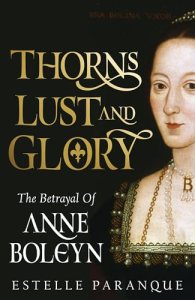
Book Review: “Thorns, Lust, and Glory: The Betrayal of Anne Boleyn” by Estelle Paranque

A young woman catches the attention of a king already married to a princess from a faraway kingdom. The king desires the young lady and divorces his wife to marry her. However, there is a catch. The young lady spent some time in the French court of Francis I and Claude of France, whereas the king’s wife was the daughter of the Spanish King and Queen as well as the aunt of the Holy Roman Emperor. The Great Matter of Henry VIII, Anne Boleyn, and Catherine of Aragon is considered one of the messiest divorces in English history and rightfully so when you consider the diplomatic consequences that this divorce would have across Europe. Estelle Paranque highlights the connection between Anne Boleyn and the French court in her latest book, “Thorns, Lust, and Glory: The Betrayal of Anne Boleyn.”

I want to thank Hachette Books and Net Galley for sending me a copy of this book. I heard that Estelle Paranque was writing a new book about the 16th century, but when I heard that it dealt with Anne Boleyn’s connections with the French court, I jumped at the chance to read it. While I do know quite a bit about the rise and fall of Anne Boleyn, it is her connection with the French court that I have never really explored in depth.

Paranque begins her book by examining the meeting between King Henry VIII and King Francis I with Anne Boleyn at Calais between October 25th and 27th, 1532. This was a significant meeting as it was right before Henry and Anne married in secret and they desired that Francis would support their side in the Great Matter. But how did they get to this meeting in Calais? This is where this book shines as Paranque takes the time to show her audience what life was like for Anne in the French court and the connections that she forged with women like Louise of Savoy, Claude of France, and Marguerite of Angouleme Queen of Navarre. It was fascinating to see how the Boleyns were able to use their connections to forge alliances with the French court that would prove useful in the future.

Possibly my favorite part of this book was seeing how the diplomatic channels across Europe interacted with one another during the Great Matter, the queenship of Anne Boleyn, and the fall of the Boleyns. I think we so often overlook that there were diplomats who were working on the sidelines to convey messages between kings and emperors to form or strengthen alliances. While many might consider the way Paranque wrote the correspondence and dialogue between diplomats and the monarchy as hard to get used to because she does insert emotions, I believe it adds depth to the story because they were human beings not in a vacuum. They had feelings about what was happening around them, passionate feelings in fact, and that should be displayed to readers.

While the actual events of this book were not new to me, the way that Paranque was able to present the information and show the men behind the scenes was fascinating. It presents the relationship between Henry VIII and Anne Boleyn in a different more complex light. If you want a different angle to the rise and fall of Anne Boleyn, I recommend you read, “Thorns, Lust, and Glory: The Betrayal of Anne Boleyn” by Estelle Paranque.

Book Review: “The Most Maligned Women in History” by Samantha Morris

Throughout history, women have been seen as pious mothers, wives, or daughters who stayed in their lane or vile manipulators who wanted power and were willing to do anything to maintain their status. While the former group of women would be an interesting study, as the saying goes, well-behaved women seldom make history. So why did certain women receive a villainess lens when we look at their lives and what do the historical records tell us about them? Samantha Morris has chosen to take the stories of these misunderstood maidens and tell them in her latest book, “The Most Maligned Women in History.”

I want to thank Pen and Sword Books and Net Galley for sending me a copy of this book. I enjoyed the previous books that I have read by Samantha Morris which covered Lucrezia and Cesare Borgia and Girolamo Savonrola When I heard that she was writing a book about maligned women in history, it caught my attention immediately as I wanted to see which women would be discussed in this book.

As Morris states in her introduction, there are numerous women who she could have chosen for this book she could make a second book, but in the end, she selected eleven women from different countries and centuries to highlight. The eleven women in this book are Cleopatra VII, Empress Wu, Joan of Arc, Lucrezia Borgia, Anne Boleyn, Elizabeth Bathory, Catherine the Great, Marie Antoinette, Lizzie Borden, Empress Dowager Cixi, and Iva Toguri the “Tokyo Rose.” Morris takes the time to tell their stories succinctly while explaining why they are considered maligned.

I do appreciate the fact that she included women from different walks of life and different centuries to show how women have been vilified throughout history. We had women who were born queens, those who were mistresses or concubines and became rulers, and average women who did extraordinary things to the ire of those in charge. While I knew some of these stories like Anne Boleyn, Marie Antoinette, Cleopatra, and Lucrezia Borgia, others were completely new to me, such as Empress Wu, Empress Dowager Cixi, and Iva Toguri. The other women in this book were names that I had heard mentioned and knew some elements of their tales, but I didn’t know their full stories.

I found this book such a fun read full of vivacious women who were not afraid to go beyond the status quo. I do hope Morris will write a sequel book and include even more women from the past who have been viewed as maligned and maybe include women from Africa, Australia, and South America to show women from even more diverse backgrounds. If you want a delightful and insightful book about women who had some bad reputations, I highly suggest you read, “The Most Maligned Women in History” by Samantha Morris.

Book Review: “The Lady Rochford Saga Part 2: Tourmens de Mariage” by Danielle Marchant

Marriage has been an integral part of life for centuries. It has been used to create strong alliances and cement love matches. However, once the wedding ceremony is finalized, the facade often fades and the truth about the families is revealed. Jane Parker finally marries the love of her life, George Boleyn, but she soon realizes that her new family is full of ambition, especially her new sister-in-law Anne Boleyn. As one of the greatest marriages of the 16th century is beginning to fall apart, can a new romance be waiting in the wing to rock England and all of Europe to its core and whose side will Jane join in the end? Danielle Marchant continues her exploration of Jane Parker Boleyn, Lady Rochford’s life in her novel, “The Lady Rochford Saga Part 2: Tourmens de Mariage.”

I’d like to thank Danielle Marchant for sending me a copy of this novel. I enjoyed the first novel in this series, “Into the Ranks of the Deceived,” so I wanted to see how Marchant would continue this series and where book two would end. 

We begin with Catherine of Aragon attending the Blackfriars to discuss her marriage with Henry VIII. He wants the marriage dissolved because Catherine was married to his brother Prince Arthur Tudor and that is why they cannot have any living male children. Obviously, Catherine disagrees and is fighting for her marriage, which gains the respect of Jane Parker. However, Anne is not interested in the affairs of the queen and instead has her heart set on marrying Henry Percy. This does not work out for Anne as Cardinal Wolsey finds out and decides to put a stop to their engagement, which creates animosity between Anne and Wolsey. 

While Anne is trying to figure out her love life, we see Mary Boleyn become a mother of two while dealing with the death of her husband William Carey. Jane must navigate these complex issues of her new family while she enters a new chapter of her life when she marries the love of her life, George Boleyn. However, Jane’s married life is not all sunshine and rainbows and she realizes that they are having problems conceiving a child. I think the story of this second novel was good, but I think it should have covered a bit more ground and possibly gone to the marriage of Anne Boleyn and Henry VIII so that the third book could focus on the fall of Anne and George Boleyn and hopefully show a glimpse of Jane’s fall from grace.

Overall, I think it was a decent novel that shows the softer side of Jane and George’s relationship which is sometimes lacking in other novels. I think it was a bit short for the material that I hoped she would cover in this series since there is so much to Jane’s story, but I think she can create a story with believable characters that you don’t want to stop reading. If you have enjoyed the first book in this trilogy, I think you should read, “The Lady Rochford Saga Part 2: Tourmens de Mariage” by Danielle Marchant.

Book Review: “Planning the Murder of Anne Boleyn” by Caroline Angus

The 16th century was filled with tales of remarkable women. Still, one of the most defining figures of the century was a woman of noble birth who the King of England fell in love with and decided that he was going to divorce his first wife of over twenty years to marry her. The Great Matter caused a great scandal across Europe, however, it was a love match that would not last long. The relationship between Henry VIII and his second wife Anne Boleyn would turn volatile and in the end, Anne and the men around her would be executed. We often blame Anne Boleyn’s death at the foot of Henry VIII’s right-hand man Thomas Cromwell, but who was behind the death of this famous queen? Caroline Angus has chosen to re-examine the case to find out who was truly responsible for the fall of this famous queen in her latest book, “Planning the Murder of Anne Boleyn.”

I would like to thank Pen and Sword Books and NetGalley for sending me a copy of this book. I have enjoyed previous books by Caroline Angus, so when I heard that she was writing a book about Anne Boleyn’s “ trial,” I was curious to see what new insights she would bring to the case.

Angus begins by explaining to her audience that this case is hard to put together centuries after the fact because papers pertaining to the case were destroyed after the verdict was carried out. She then dives into how the fall of Anne Boleyn and the men around him happened, starting with the aftermath of the Great Matter, and the divorce between Henry VIII and Katherine of Aragon. We see how the Boleyns rose to power and Henry was so infatuated with Anne that he knew she would be the next Queen of England. Angus explores the men and women who served Anne Boleyn and Thomas Cromwell, it was fascinating to see how they would shape the case against the queen. Finally, we get to see the rivalry between Thomas Cromwell and Anne Boleyn develop regarding religious reform issues and Princess Mary’s place in the line of succession.

The second half of this book focuses on the actual fall, trial, and execution of Anne Boleyn and the men who were associated with her. Angus takes the time to do a diary-style section, starting at the time when the idea to remove Anne from power to her actual execution to show her readers how quick this “case” was and to show that Henry wanted her out of his life permanently. She has taken the available information and the gaps left behind to create a plausible case for what truly happened in these few weeks. Angus shows what Princess Mary and Jane Seymour had to do with the fall of Anne Boleyn. We also see that most people knew that Anne Boleyn and the men around her were innocent and didn’t deserve to die, but it was a foregone conclusion as the king wanted them dead.

Overall, I found this enjoyable and enlightening with the new information Angus brought to the table. Yes, there is a bit of repetition of information already shared in previous books about Anne Boleyn, but it was one of the most infamous cases in English history, so it has been examined for centuries. It’s hard to show new information about this case without repeating facts that we already know but I think Angus does an excellent job of balancing the old and the new information about this case. If you want a solid book specifically about the fall of Anne Boleyn, I recommend you read, “Planning the Murder of Anne Boleyn” by Caroline Angus.

Book Review: “Heroines of the Tudor World” by Sharon Bennett Connolly

Heroines of the Tudor WorldThe world of the 16th century was full of change and equally colorful characters. Most of the dynamic figures of this century were women, who were willing to fight in their ways for what they believed in, whether it was family, faith, or their country. They were heroines in different ways, and each had a story to tell. Each woman had to deal with her obstacles to reach their desired goal, no matter what her station was, from queens and great heiresses to nuns, and even a pirate. Sharon Bennett Connolly has decided to include a handful of these stories in her latest book, “Heroines of the Tudor World.”

I would like to thank Amberley Publishing for sending me a copy of this book. I have been a fan of Sharon Bennett Connolly’s books on medieval women, so when I heard that she was going to tackle the 16th-century and the Tudor world, I knew I wanted to read it. I wanted to see what stories she would select and how far into the Tudor world she would explore.

Connolly begins her book by explaining how the 16th century differed from the medieval times as records about women were becoming more accessible. It was also a time of transition, reformation, and the discovery of the “new world.” Each chapter focuses on a different kind of woman; from the ideal to martyrs for their faiths, scandalous heroines, those who were disinherited, pawns in the bigger game of life, warriors, captives, and survivors. Although it can be difficult to place certain tales of women in just one category, Connolly gave her readers a thrilling look into the 16th century.

It was the stories of these extraordinary women who made this book an exceptional read. There are the typical women who are featured heavily in these kinds of narratives; Elizabeth of York, Margaret Beaufort, the wives of Henry VIII, Mary I, Elizabeth I, Mary Queen of Scots, and Catherine de Medici. However, Connolly decided to include lesser-known women. We have mistresses like Diane de Poitiers and spies like Margaret Dymoke, Lady Coffin. Some great heiresses were disinherited like Claude of France and Elizabeth Fitzgerald, as well as pawns like Marguerite de Valois and captives such as Lady Katherine Gordon and Honor Grenville, Lady Lisle. Of course, some women decided to take matters into their own hands and fight for what they believed in, such as Isabella of Castile, Jeanne d’Albret Queen of Navarre, and Grace O’Malley.

I thoroughly enjoyed learning about the heroines that Connolly included in this book, but my only complaint is that it was not a longer book. There are so many interesting women outside of the European world in the 16th century and I wish she would have highlighted them. Maybe Connolly will write a sequel book to this one to include even more Tudor heroines. If you have enjoyed Sharon Bennett Connolly’s previous books and you are a Tudor nerd, I highly suggest you read, “Heroines of the Tudor World.”

Book Review: “The Passionate Tudor: A Novel of Queen Mary I” by Alison Weir

The Passionate TudorA king’s eldest child is usually the next in line to inherit the throne and become the next ruler. At least that is how the line of succession is supposed to work if the heir is male. Mary I knew this better than anyone. As the eldest daughter of King Henry VIII, she knew that once her mother Katherine of Aragon had a son, Mary would become a pawn in the marriage game. She was willing to accept this fate until her father fell in love with Anne Boleyn. Mary is declared a bastard and must fight for her inheritance and the crown of England while maintaining her Catholic faith. Alison Weir tells the tale of this remarkable woman, from her tumultuous childhood to her short reign that marked her legacy, in her latest novel, “The Passionate Tudor: A Novel of Queen Mary I.”

I would like to thank Ballantine Books and Net Galley for sending me a copy of this book. I have enjoyed the previous novels in The Tudor Rose trilogy by Alison Weir about Elizabeth of York and King Henry VIII, so when I heard she was writing a book about Mary I, I knew I wanted to read it. Mary I is one of those figures who shows how devastating it can be to be close to the throne and the hard decisions one makes when king or queen of a country.

Weir began her novel with Mary at the age of nine in 1525. She is her parent’s pride and joy as she is their only child. Her mother Katherine of Aragon is arranging an advantageous marriage for Mary that would create a strong alliance for England. Not even the birth of her half-brother Henry Fitzroy could dampen Mary Tudor’s spirits. However, that all changed when Anne Boleyn entered the picture and the Great Matter was made public. Katherine of Aragon is no longer queen, Anne Boleyn is Mary’s stepmother, and Mary is now declared a bastard in favor of her half-sister Elizabeth Tudor.

Mary’s life after the birth of Elizabeth Tudor begins to become even more tragic. Her mother Katherine of Aragon dies before she can see her daughter again and Anne Boleyn is executed for treason soon afterwards. Henry VIII marries Jane Seymour, has his desired male heir Edward VI, before Jane tragically dies quickly. As the Supreme Head of the Church of England, Henry wants his daughter Mary, a devout Catholic, to submit to his will, which she ultimately does. We also get to see how Mary interacted with her other stepmothers, Anna of Cleves, Katherine Howard, and Katherine Parr, until the death of her father Henry VIII. Before he died, Henry VIII revised his Act of Succession, making Mary Edward’s heir if he did not have children. However, Edward VI has his idea for who will succeed him after he dies and he names Lady Jane Grey as his heir, although that plan does not last long and Mary is proclaimed the first queen of England to rule on her own.

Weir shows Mary’s life and reign in a very sympathetic way. Even though she does still give her the nickname “Bloody Mary”, we can see a woman who is concerned about the faith of her kingdom and the well-being of her family, especially Edward, Prince Philip her husband, and Elizabeth, who she argues with on matters that matter to her. It is such a tragedy that Mary never had a child that she desperately wanted to have as she suffered through phantom pregnancies. At the end of the day, whether it was matters of faith or family, Mary was someone who was passionate and someone who desired to be loved.

This is a delightful novel about a woman who has often been vilified but maybe we should have sympathy for everything she had to endure starting at a young age. I enjoyed this novel very much and I look forward to the next novel by Weir. If you have enjoyed the previous books in the Tudor Rose trilogy or you just want a different take on Mary I’s story, I highly suggest you read, “The Passionate Tudor: A Novel of Queen Mary I” by Alison Weir.

Book Review: “The Twilight Queen” by Teri Westerson

The Twilight QueenGreenwich Palace is a Tudor palace full of glamour, intrigue, and murder. A musician has been found murdered in the chambers of the current wife of King Henry VIII, Anne Boleyn. Only one person can solve this crime while protecting the royal family. No, he is not a knight or a lawyer, but a fool. No, an actual fool or jester of the court of Henry VIII, Will Somers. A man who is loyal to his king Henry VIII, but can he save his second wife from the murderer lurking in the shadows? Jeri Westerson’s Will Somers follows the clues to uncover the truth to protect those who are the most important to him in book two of A King’s Fool Mystery series, “The Twilight Queen.”

I would like to thank Severn House and Net Galley for sending me a copy of this novel. I have not read any of Jeri Westerson’s previous novels, including the first book of the A King’s Fool Mystery series, so I was going into this one completely blind. What caught my eye about this book was the concept that Will Somers, a character who is not featured much in Tudor novels, acts as an armchair detective trying to protect Henry VIII and Anne Boleyn.

This mystery takes place in April 1536, when Anne Boleyn is nervous that her husband has lost interest in her and has chosen his next bride. To make matters worse, she comes back from a night of revelry to find a dead body in her chambers. What can a queen do but call on a man who recently solved a murder mystery, Will Somers, her husband’s fool.

Will Somers is a complex character. He tries to balance keeping his monarch entertained while speaking his mind about those closest to the king, especially Thomas Cromwell and Anne Boleyn. Will is married to Marion Greene, the illegitimate daughter of the Yeoman of the Records, Lord Robert Heyward, whom he loves, but Somers has his affairs with men at court, like his lover in this book, Nicholas Pachett.

While I did enjoy the characters of Will, Marion, and Nicholas, I felt that the whole love triangle situation distracted me from the actual mystery. I feel like you can do a love story and a mystery together in the same novel, but in this instance, it felt a bit too much. There were a lot of good ideas, but it felt a bit rushed in a 250-page novel. Some elements made it feel a bit too modern than Tudor for my taste. Overall, I think some elements could be better, but I did feel attached to the main characters of Will, Marion, and Nicholas.

I think as my first dive into Westerson’s Tudor world, it was a bit rushed with compelling characters, but I do want to go back and read the first book in this series as well as see what kind of mystery Westerson will come up with next for Somers to solve. I think if you want an unconventional Tudor mystery that has an unlikely sleuth as the protagonist, you should check out “The Twilight Queen” and A King’s Fool mystery series by Jeri Westerson.