
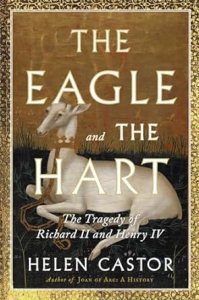
Book Review: “The Eagle and the Hart: The Tragedy of Richard II and Henry IV” by Helen Castor

The story of the Plantagenets is filled with high triumphs and devastating tragedies. It is a story of families torn apart for a crown and the desire to either rule with an iron fist for the glory of England or live a life of luxury at the expense of their citizens. The story explored in this particular book is the tale of two cousins born months apart, Richard of Bordeaux and Henry Bolingbroke. Richard and Henry were not born to become King of England, but Fortune’s Wheel had a different plan for the cousins. So how did these cousins become kings and how did their tale turn to tragedy not only for their relationship but for all of England? Helen Castor tells the tale of these two Plantagenet kings in her latest book, “The Eagle and the Hart: The Tragedy of Richard II and Henry IV.”

I want to thank Avid Reader Press and Net Galley for sending me a copy of this book. I have seen this book on social media and ever since it was announced, I knew I wanted to read it. I have enjoyed Castor’s posts online as well as her documentary on the She-Wolves, based on her book of the same name, so when I heard about this one, it was an intriguing premise and so I jumped at the chance to read it. 

The fact that Richard of Bordeaux and Henry Bolingbroke became King Richard II and King Henry IV respectively is quite the story. Richard was the son of Edward The Black Prince and Henry was the son of John of Gaunt; both of their fathers were sons of Edward III and so the idea was that one of his sons would inherit the throne. However, Edward III had different plans after the death of Edward The Black Prince. It was announced that the young Richard of Bordeaux would be crowned King of England. This should have been the first red flag for England because it means that a Regency council must be formed. There are fights for power and fights over finances that culminate in the Peasants’ Revolt. Richard II doesn’t have much desire to fight for his country on the battlefield against the French or the Scottish, but he does care about favoring his favorites, even if it means turning the government against him. One such group, the Appellant Lords, will prove an extremely dangerous challenge for Richard II, and it will include his cousin Henry Bolingbroke. While many of the Appellant Lords will end up dead, Henry Bolingbroke is merely exiled, which in the long run, was not the best decision for Richard II. 

In 1400, John of Gaunt died and the title as well as the lands of the Duke of Lancaster were turned over to Richard II while Henry Bolingbroke was in exile in France. This marks the turning point for Henry as he decides to invade England while Richard is away dealing with problems in Ireland. It will end with Richard’s abdication and the coronation of Henry Bolingbroke as King Henry IV. However, things are not all sunshine and rainbows for Henry IV, the 1st Lancastrian King of England, as he finds out that it is not easy being a king. 

I must applaud Castor for writing a dual biography that is both balanced and utterly brilliant. It did take me a while to read this book because I was taking so many notes while I was reading and it gave me a better understanding of this tumultuous time. I would suggest that if you do read this book, take your time so that you can understand the complex nature of the conflict between these two cousins. If you are a fan of the Plantagenet dynasty, I highly recommend you read, “The Eagle and the Hart: The Tragedy of Richard II and Henry IV” by Helen Castor.

Book Review: “The Most Maligned Women in History” by Samantha Morris

Throughout history, women have been seen as pious mothers, wives, or daughters who stayed in their lane or vile manipulators who wanted power and were willing to do anything to maintain their status. While the former group of women would be an interesting study, as the saying goes, well-behaved women seldom make history. So why did certain women receive a villainess lens when we look at their lives and what do the historical records tell us about them? Samantha Morris has chosen to take the stories of these misunderstood maidens and tell them in her latest book, “The Most Maligned Women in History.”
I want to thank Pen and Sword Books and Net Galley for sending me a copy of this book. I enjoyed the previous books that I have read by Samantha Morris which covered Lucrezia and Cesare Borgia and Girolamo Savonrola When I heard that she was writing a book about maligned women in history, it caught my attention immediately as I wanted to see which women would be discussed in this book.

As Morris states in her introduction, there are numerous women who she could have chosen for this book she could make a second book, but in the end, she selected eleven women from different countries and centuries to highlight. The eleven women in this book are Cleopatra VII, Empress Wu, Joan of Arc, Lucrezia Borgia, Anne Boleyn, Elizabeth Bathory, Catherine the Great, Marie Antoinette, Lizzie Borden, Empress Dowager Cixi, and Iva Toguri the “Tokyo Rose.” Morris takes the time to tell their stories succinctly while explaining why they are considered maligned.

I do appreciate the fact that she included women from different walks of life and different centuries to show how women have been vilified throughout history. We had women who were born queens, those who were mistresses or concubines and became rulers, and average women who did extraordinary things to the ire of those in charge. While I knew some of these stories like Anne Boleyn, Marie Antoinette, Cleopatra, and Lucrezia Borgia, others were completely new to me, such as Empress Wu, Empress Dowager Cixi, and Iva Toguri. The other women in this book were names that I had heard mentioned and knew some elements of their tales, but I didn’t know their full stories.

I found this book such a fun read full of vivacious women who were not afraid to go beyond the status quo. I do hope Morris will write a sequel book and include even more women from the past who have been viewed as maligned and maybe include women from Africa, Australia, and South America to show women from even more diverse backgrounds. If you want a delightful and insightful book about women who had some bad reputations, I highly suggest you read, “The Most Maligned Women in History” by Samantha Morris.

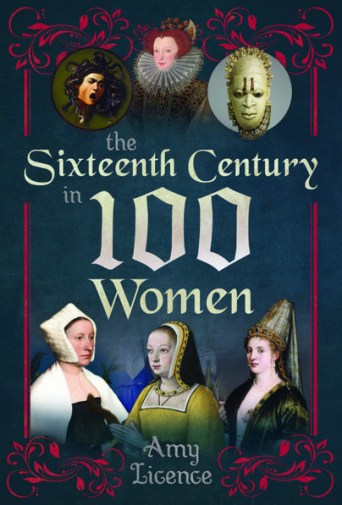
Book Review: “The Sixteenth Century in 100 Women” by Amy Licence

16th century womenWhen we think of the phrase “16th-century women,” we often consider those from royal or noble houses throughout Europe. We tend to think of women like the six wives of Henry VIII, Mary I, Elizabeth I, Catherine de Medici, Mary Queen of Scots, and others associated who made an impact during the Renaissance and the Reformation. However, the 16th century did not stop at the borders of Europe; it extended all over the globe. There are many stories of women from all over the world and from different social classes that can help us understand how the world changed in the 16th century. Amy Licence took this concept and decided to write her latest book about a variety of women from around the world who lived in the 16th century, “The Sixteenth Century in 100 Women.”
Thank you, Pen and Sword Books and Net Galley, for sending me a copy of this book. When I heard that Licence was writing this book, it intrigued me. I wanted to know more stories from the 16th century from all around the world.

“The Sixteenth Century in 100 Women” is a collection of 100 mini-biographies of women from every walk of life and every corner of the globe. Licence has decided to organize this particular book in chronological order, with the date emphasis on the significant events of their lives. Staying true to her word, she writes about women from different countries, like Japan, Nigeria, Russia, Mexico, Poland, Chile, Morocco, and Burma, to name a few.

What I loved the most about this book is the diversity of figures that Licence chose to include in this journey from 1500 to 1600. They were not just queens, princesses, and noblewomen. Licence included women who would have been seen as outsiders in everyday society, such as prostitutes during the Banquet of Chestnuts, Margaret Drummond, Ellen Sadler, and La Malinche. There were those whose appearance made them outsiders, like Aura Soltana, Elena/Eleno de Cespedes, and Tognina Gonsalvus. Some women stood up for what they believed was right, such as Cecily Bodenham, abbess of Wilton Abbey, Lady Nata of Japan, Margaret Cheney, Sayyida al-Hurra, and Beatriz de Luna.

Some women suffered horrendous tragedies beyond their control, like Suphankanlaya, whose husband was killed in an angry rage, Amy Robsart, and an unknown woman who dealt with a tsunami in Chile. Others were women who had nasty reputations associated with their lives, such as Elizabeth Bathory, Mary Frith, and the Irish pirate Grace O’Malley. We also see female artists, authors, fictional figures, and those who sat for portraits.

Licence has painted a colorful picture of the 16th century with the 100 miniature biographies she chose to include in this book. This book may highlight only a select few stories of the century, but they were new and enthralling tales of women I had never heard of, which broadened my understanding of the era. An informative, refreshing, and unique approach to the 16th century, “The Sixteenth Century in 100 Women” by Amy Licence is a breath of fresh air for anyone who wants to discover new tales from the past.

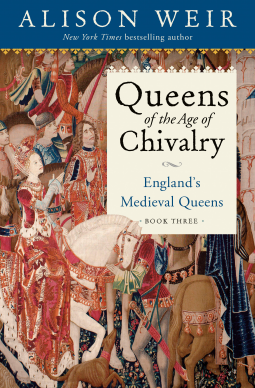
Book Review: “Queens of the Age of Chivalry: England’s Medieval Queens” by Alison Weir

cover263156-mediumWhen we think of the title “medieval queen,” a few things come to mind. They were seen as mere trophy wives who were only suitable for making alliances and giving birth to children. It may be a cruel assessment for a modern audience, but that was the reality of the medieval world. However, the late Plantagenet queens decided to step outside the socially acceptable path for their lives and forged a new one. In Alison Weir’s latest nonfiction book, “Queens of the Age of Chivalry: England’s Medieval Queens,” she explores the lives of five Plantagenet queens who had to adapt quickly to the ever-changing world of late medieval England.

Thank you, Ballantine Books and Net Galley, for sending me a copy of this book. I have read and enjoyed the previous books in England’s Medieval Queens series, and I wanted to see which queens would be included in this book.

The years covered in this book are 1299-1399, a time of turmoil, change, and the plague. During that time, five queens forever left their marks on England: Marguerite of France, Isabella of France, Philippa of Hainault, Anne of Bohemia, and Isabella of Valois. Their royal husbands were Edward I, Edward II, Edward III, and Richard II. Since these queens were foreign brides, it was a balancing act between what their home country expected of them and what England expected their new queen to do, which was, in most cases, to give birth to heirs and to stay out of politics.

We begin with Marguerite of France, who was the second wife of Edward I and the step-mother of Edward II; her most extraordinary claim to fame was to try and prevent her son from ever seeing Piers Gaveston, which sadly did not last long. Isabella of France had to deal with Edward II’s favoritism to not only Piers Gaveston but to Hugh Despenser the Younger. This led her to join Roger Mortimer and rebel against her husband. This decision would create a black cloud around her reputation for centuries.

As part of the rebellion, Edward III married Philippa of Hainault, who was the closest of these five queens to be the ideal medieval queen. She gave Edward III many heirs that would help define future generations. Richard II’s first wife, Anne of Bohemia, was the essence of sophistication, but her death sent him reeling, forcing him to take a child bride named Isabella of Valois.

Being a queen in the late medieval period was not easy, especially with the Black Death, the Hundred Years’ War, the Peasants’ Revolt, and internal struggles were constantly in play, but the five queens mentioned in this book were able to navigate this tumultuous time to create their legacies. Weir once again weaves fun facts and compelling tales of each queen to give her readers her perspective on their true legacies. If you have enjoyed the previous books in “England’s Medieval Queens” series, I would highly recommend you read “Queens of the Age of Chivalry: England’s Medieval Queens” by Alison Weir.

Book Review: “The Woodville Women” by Sarah J. Hodder

61772589Three women in one family who shared the same first name saw England change over a tumultuous century. They saw the end of the Plantagenet dynasty and the rise of the Tudors while on the sidelines of great battles. Through heartaches and triumphs, the women of the Woodville family became princesses and queens that would transform the political landscape of England forever. These three women, Elizabeth Woodville, Elizabeth of York, and Elizabeth Grey, were incredible examples of what it meant to be medieval royal women. They are featured in Sarah J. Hodder’s latest book, “The Woodville Women.”
I want to thank Pen and Sword Books and NetGalley for sending me a copy of this book. I have read other books by Sarah J. Hodder about women from the Woodville family, so when I heard about this title, I wanted to see what new information she would share with her audience.

We begin our adventure into the Woodville family by exploring the matriarch of this rather extraordinary family, Jacquetta of Luxembourg, the future wife of Richard Woodville. For a woman of Jacquetta’s status to marry a man well below her rank was unheard of in medieval Europe, but their union would change history during the tumultuous time known as the Wars of the Roses. Their daughter, Elizabeth Woodville, would marry a Lancastrian soldier named Sir John Grey of Grosby, but when John died, she caught the eye of the young Yorkist king, Edward IV.

During King Edward IV’s reign, Elizabeth Woodville, now queen of England, showed her true strength. As a mother to a large family, including the infamous Princes of the Tower, and her eldest child Elizabeth of York, Elizabeth Woodville fought for her children’s rights, even after her beloved husband’s death. Elizabeth of York would follow in her mother’s footsteps and become Queen of England when she married the victor of the battle of Bosworth Field, Henry Tudor, the patriarch of the Tudor dynasty.

The woman who proved the most fascinating character in this particular book for me was Elizabeth Grey, the daughter of Thomas Grey and Cecily Bonville. Elizabeth Grey would marry Gerald Fitzgerald, 9th Earl of Kildare, who she met at the Field of Cloth of Gold. They would live in Ireland and have many children together, but things were not smooth sailing as Kildare’s rivalries would lead to rebellions in Ireland and land him in the Tower of London a few times. Although Kildare had a rocky relationship with King Henry VIII, Elizabeth Grey was cordial with her royal relation.

Hodder was able to tell the stories of these three women in an illuminating way that reminds readers of the tales of Elizabeth Woodville and Elizabeth of York while giving new insights into their lives and telling the story of Elizabeth Grey. This book was engaging and informative, just like Hodder’s previous books. If you want a book that tells the thrilling tales of Elizabeth Woodville, Elizabeth of York, and Elizabeth Grey, you should check out “The Woodville Women” by Sarah J. Hodder.

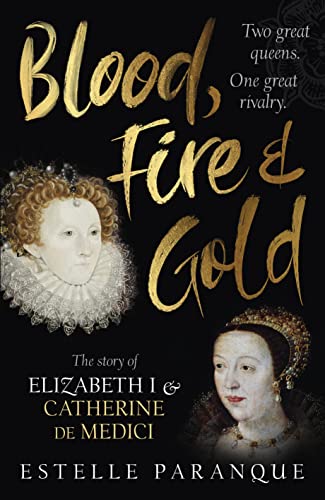
Book Review: “Blood, Fire & Gold: The Story of Elizabeth I and Catherine de Medici” by Estelle Paranque

9781529109221-usTwo queens; one a wife and the mother of kings and the other a virgin who had to fight for the right to rule her country independently. Two women who found friendship and a rivalry between each other with only a sea that divided them and religious discord to drive them apart. Catherine de Medici and Elizabeth I would define what it meant to be female rulers in the 16th century for France and England, respectively. The tales of Elizabeth I and Catherine de Medici have been covered in numerous books, but a joint biography of these two powerhouses is a rarity until now. Estelle Paranque demonstrates how both queens greatly affected each other’s lives in her latest book, “Blood, Fire & Gold: The Story of Elizabeth I and Catherine de Medici.”

Paranque begins her book with a short story about an encounter between Elizabeth I’s English ambassador to France, Sir Nicholas Throckmorton, and Catherine de Medici, who acted as regent for her son Charles IX. It is an example of how each queen viewed diplomacy and the dance they had to do to keep their respective dynasties on the thrones of England and France.

Catherine de Medici was the daughter of Lorenzo II de Medici, Duke of Urbino, and Madeline de La Tour, d’Auvergne. Her parents died when Catherine was young, leaving her to be a wealthy heiress and a powerful pawn in the marriage market. Her husband would be King Henry II, known to have several mistresses, including Diane de Poitiers, who was her husband’s, true love. Despite issues with Diane, Henry and Catherine had a huge family, including several sons, including King Francis II, King Charles IX, King Henry III, and Francis, Duke of Anjou. After the death of her husband, Catherine worked hard to be the regent for her sons until they came of age to rule and continue the Valois dynasty.

In England, Elizabeth I was the daughter of Anne Boleyn and the notorious King Henry VIII; their relationship was the most infamous of the 16th century for obvious reasons. After the deaths of King Henry VIII, King Edward VI, and Queen Mary I, Elizabeth got her chance to rule England in her way. When the issue of Elizabeth’s marriage came into play, Catherine de Medici entered Elizabeth I’s life, starting a 30- year relationship that began as a friendship but changed into a rivalry in the end.

Over the thirty years, Catherine de Medici and Elizabeth I dealt with many obstacles in their relationship. Catherine had to deal with the antics of her children and her daughter-in-law, Mary Queen of Scots, who would become one of Elizabeth’s biggest rivals. The bond between the two queens started over a desire for one of Catherine’s sons to marry Elizabeth and become King of England and France, but alas, this was wishful thinking. Catherine and Elizabeth also had to deal with other nations, like Spain, getting in the way of their relationship, as well as the issue of religion; Catherine was a devout Catholic, and Elizabeth was more Protestant. Catherine had to deal with several wars of religions and the St. Bartholomew’s Day Massacre, while Elizabeth had to deal with the Spanish Armada and what to do with Mary Queen of Scots.

Catherine de Medici and Elizabeth I had to communicate through ambassadors and letters, which Paranque translated into modern English, making it easier for modern readers to understand. I cannot stress how much I loved this book and how Paranque was able to weave the stories of the two most powerful women in 16th-century Europe.

“Blood, Fire & Gold: The Story of Elizabeth I and Catherine de Medici’ by Estelle Paranque is a tour de force dual biography of two influential badass queens. This book is a must-read for anyone passionate about the 16th century.

Book Review: “The House of Dudley: A New History of Tudor England” by Joanne Paul

60126565._SY475_When we think about the Tudor dynasty, we think about the monarchs who made the dynasty, but we also pay attention to those around the king or queen who sat on the throne. There were families like the Boleyns, the Howards, and the Seymours who stood on the sidelines for a short amount of time, but one family saw the majority of the dynasty through highs and extreme lows. The Dudleys have been seen as a power-hungry family who would do anything to sit on the throne of England, but is there more to their story? In her debut book, “The House of Dudley: A New History of Tudor England,” Joanne Paul explores the lives of this extraordinary family to find the truth about their ambitions and their resilience.

This is one of those titles that I heard about from friends online, and I wanted to check it out for myself. I have followed Joanne Paul for a while now, and when I heard about her first book, I knew I wanted to read it.

Paul begins her biography about the Dudleys with the funeral of Anne Dudley, the first wife of Edmund Dudley, which occurred around the same time as the death of Elizabeth of York. Edmund Dudley would go to serve as King Henry VII’s principal tax collector, which would prove beneficial to his family and the king even if he did use underhanded methods to collect the money from taxpayers. Edmund’s strategies were so ruthless that he didn’t survive long after the death of Henry VII as his son Henry VIII had him executed for treason, leaving his young son John as the heir to the Dudley name, which was now tainted with scandals.

John Dudley took the lessons from his father’s dramatic downfall and applied them to his own life. It is how he survived the reigns of Henry VIII and Edward VI and earned his position as one of the most influential men in the kingdom, as the Duke of Warwick. He held influence in Edward VI’s regency council, so much so that when it came time for Edward VI to name an heir, he named John Dudley’s daughter-in-law, Lady Jane Grey, the wife of Guildford Dudley, as his heir. The issue was this put the Dudleys in danger as Mary I marched towards the throne. There was no room for negotiations with Mary as she saw the Dudleys as a threat that must be eliminated through the executions of John, Guildford, and Lady Jane Grey.

For the remaining members of the Dudley family, the key to surviving Mary’s reign was to stay safe and make sure they had good allies, like King Philip II of Spain, Mary’s husband. With Queen Mary’s death and the rise of Queen Elizabeth I, the Dudleys were once again in the spotlight. The suave and debonair Master of the Horse, Robert Dudley, had captured the heart of the young queen, but the problem was Robert was married to Amy Robsart. Unfortunately, Amy dies under mysterious circumstances, leaving it open for the possibility of Robert and Elizabeth to wed, but it never happens.

A dazzling debut of the tragedies and triumphs of one family, “The House of Dudley: A New History of Tudor England” by Joanne Paul is one of my favorite new releases of this year so far, and I cannot recommend it highly enough.

Book Review: “Harry of England: The History of Eight Kings, From Henry I to Henry VIII” by Teresa Cole

52509401English kings are some of the most recognizable monarchs in all of European history, and when we think of Kings of England, a few names pop into our minds. Edward, George, and William tend to be popular, but you cannot study English history without Henry. Eight kings of England were Henry, and they would change the history of England forever. These eight kings give us an entire range of what kingship was like in medieval Europe. From men born to be king to opportunists who decided to take the throne as their own, from saints to warrior kings, the Henrys of English history were a colorful group of characters. Each king has had numerous biographies written about him, but there has never been a collection of biographies about the kings named Henry until now. This is “Harry of England: The History of Eight Kings, From Henry I to Henry VIII” by Teresa Cole.

I want to thank Amberley Publishing for sending me a copy of this book. When I saw this title, I was fascinated by the concept. I have read several books about certain Henrys, but I have never read one that talks about them all in one book.

Cole begins her book with the first Henry, the 4th son of William the Conqueror. The prospects of him ever becoming king was very slim, especially when William the Conqueror passed away and the crown went to William Rufus, the eldest son. Yet destiny took an unexpected turn when William Rufus was killed in a hunting accident, and Henry was there to take the throne before his other brothers had a chance. Henry had to deal with numerous rebellions and the tragedy of the White Ship, which killed his only legitimate son and heir. This led to the period of fighting between Henry’s daughter Matilda and Stephen of Blois, known as the Anarchy, which led to the reign of King Henry II and the beginning of the Plantagenet Dynasty.

King Henry II had his fair share of family drama with his sons and his wife Eleanor of Aquitaine, plus a deadly confrontation with his former best friend, Thomas Becket. The following Henry, Henry III did not have the best of starts to his reign as he followed King John and had to deal with barons’ war and external threats to the throne while balancing the Magna Carta. Luckily for Henry III, he had the longest reign of any medieval English king, fifty-six years.

We enter the Hundred Years’ War with France during the reign of Henry IV, the son of John of Gaunt, who took the throne from Richard II. Henry IV’s son Henry V was the great warrior king who won a decisive victory against the French at Agincourt. Henry V’s son Henry VI became king when he was just a baby, and it was during his reign, that we saw the emergence of what we call today the Wars of the Roses. Finally, Cole tackles the Tudor kings, Henry VII and his second son Henry VIII.

Cole has done her research and given her readers a collection of biographies that are easy to read. Each king has his moment to shine, and Cole does not show favoritism as she explains important battles, events, policies, and changes to the law and religion that each king brought forth. If you want an excellent book that gives you an introductory course into the English kings named Henry, I would recommend “Harry of England: The History of Eight Kings, From Henry I to Henry VIII” by Teresa Cole.

Book Review: “Henry II and Eleanor of Aquitaine: Founding an Empire” by Matthew Lewis

50419849If you go to Fontevrault Abbey in France, you will find two rather extraordinary tombs. These tombs belong to King Henry II and Queen Eleanor of Aquitaine, the first King, Queen of the Plantagenet Dynasty, and the Angevin Empire. Their effigies tell us a lot about the couple that was buried side by side. The husband was restless; his model shows him ready to take action at any moment, with his crown upon his head and a scepter in his hand. His queen lays beside him, reading an unknown book. They seem to be prepared to watch over their kingdom and their family even beyond the grave. Those who know English history recognize their names and understand the family drama behind the scenes. We think we know the truth about Henry and Eleanor, but is there more to their story and their feuding family? In Matthew Lewis’s latest dual biography, “Henry II and Eleanor of Aquitaine: Founding an Empire,” he explores the relationship between this dynamic king and queen and how it shaped European and English history forever.
I would like to thank Amberley Publishing for sending me a copy of this book. I have enjoyed Matthew Lewis’s previous books, and when I heard about this one, I was pleasantly surprised. There is just something so intriguing about the lives of Henry II and Eleanor of Aquitaine, and I could not wait to see how he would approach this famous couple.

Eleanor of Aquitaine was a grand heiress of France who attracted the young French King Louis VII; they would eventually marry and take on the monumental task of protecting French territories and embark on the 2nd Crusade. Eleanor showed her strength and resilience during the Crusade as rumors tried hard to tarnish her good name. Unfortunately, her marriage did not last long as the couple realized that they would never have a male heir.

As soon as they divorced, Eleanor fell in love with a young noble who was the son of Empress Matilda and Geoffrey Duke of Anjou, Henry Plantagenet. Empress Matilda fought hard against her cousin King Stephen for Henry to become Stephen’s heir during The Anarchy. Henry and Matilda would prevail, allowing Henry and Eleanor to become King and Queen of England after Stephen’s death.

It was when Henry became a father when troubles began to arise. His sons, Henry the Younger, Geoffrey Duke of Brittany, Richard, and John, would be a thorn at his side as they fought against each other and Henry for power. Eleanor was woefully caught in the middle as she strived to do what was best for her sons, even if it pitted her against her beloved husband. To top it all off, Henry had to deal with a man who he felt was right to help him reign in the power of the Church; Thomas Becket, Archbishop of Canterbury. The disastrous end to their friendship would be the lowest point in Henry’s reign.

Lewis gives his readers a brand new perspective on the relationship between Henry II and Eleanor of Aquitaine. Although I knew this story rather well before reading this biography, I still found myself entranced by Lewis’s narrative with scrupulous attention to detail. I thought I knew the nature of their relationship, but I was wrong. If you want a biography that is elegant while it challenges your views on the first Plantaganet couple, I highly suggest you read “Henry II and Eleanor of Aquitaine: Founding an Empire” by Matthew Lewis.

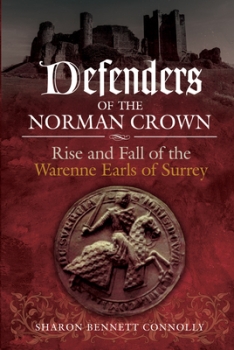
Book Review: “Defenders of the Norman Crown: The Rise and Fall of the Warenne Earls of Surrey” by Sharon Bennett Connolly

Pen & Sword Book Cover / Jacket artwork

To survive during the reigns of the Norman and Plantagenet Kings of England, one must understand where their loyalty and trust lied. Did they follow the crown or did they take a risk and follow those who opposed the person who wore the crown? For one family, there was no question who they were loyal to, which was the crown. The Warenne Earls of Surrey served the Kings of England from William the Conqueror to Edward III, gaining titles, prestige, and marriages that would cement their names in history books. They survived some of the most turbulent times in English history even if they did have a few scandals in their illustrious history. In Sharon Bennett Connolly’s latest non-fiction adventure, “Defenders of the Norman Crown: The Rise and Fall of the Warenne Earls of Surrey ”, she explores this family’s history that spanned over three centuries.

I would like to thank Pen and Sword Books and NetGalley for sending me a copy of this book. I have been a fan of Sharon Bennett Connolly’s books for a while now, so when I heard about this title, I knew I wanted to read it. I was going in a bit blind since I have never heard of the Warenne Earls of Surrey, but that is part of the fun of studying a new aspect of history.

The first Earl of Surrey, William de Warenne began this family’s tradition of royal loyalty as he joined William the Conqueror on his journey to England and fought alongside him to establish Norman rule at the Battle of Hastings. William’s descendants would be involved in some of the most important events of the time, from the crusades to the 1st and 2nd Baron’s Wars and the sealing of the Magna Carta. At some points, the earls would briefly switch sides if they thought the king was not in the best interest of the country, but they remained at the heart of English politics and worked hard to help guide the king and the country to become stronger.

What made the Warennes a tour de force when it came to noble families was their ability to marry well, except for the final earl and his scandalous relationships. The second earl desired to marry into the royal family, which did not happen, but his daughter, Ada de Warenne would marry William the Lion, King of Scotland. One of the daughters of Hamlin and Isabel de Warenne would be the mistress of King John and would give birth to his illegitimate son Richard of Chilham. The only woman of the family who inherited the earldom of Surrey, Isabel de Warenne, was married twice and so both of her husbands, William of Blois and Hamelin of Anjou, are considered the 4th earl of Surrey.

Connolly does a wonderful job explaining each story in de Warenne’s long history, including the minor branches of the family. I was able to understand the difference between family members who shared the same first name, (like William, John, and Isabel) but I know that others might have struggled with this aspect. I think it would have been helpful if Connolly had included either a family tree or a list of family members of the de Warennes at the beginning of this book to help readers who did struggle.

I found this particular title fascinating. The de Warennes were a family that proved loyalty to the crown and good marriages went a long way to cement one’s legacy in medieval England. Connolly proved that she has a passion for bringing obscure noble families to the spotlight through her impeccable research. If you want a nonfiction book of a noble family full of loyalty, love, and action, you should check out “Defenders of the Norman Crown: The Rise and Fall of the Warenne Earls of Surrey” by Sharon Bennett Connolly.