
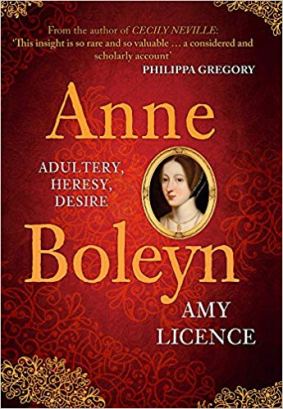
 Anne Boleyn, the second wife of Henry VIII and the mother of the future Queen Elizabeth I, is one of the unique characters of the Tudor era. She was the sister of one of the king’s mistresses, Mary Boleyn, which she could have been, but Henry wanted Anne as his queen. Unfortunately, he was married to his first wife, Catherine of Aragon. It is Henry’s divorce to Catherine and his relationship with Anne, the rise and fall, is what many people look at, but there is more to Anne’s story than just her life with Henry. What was Anne’s life really like and what really caused her fall? These are just a few questions that Amy Licence tackles in her latest biography, “Anne Boleyn: Adultery, Heresy, Desire.”
I would like to thank Amberley Publishing for sending me a copy of this book to review. I haven’t read many biographies about Anne Boleyn so this was a unique experience.
In her introduction, Amy Licence explains her approach to Anne’s life and why she is such an interesting figure to study:
Anne’s is very much a Tudor story, a narrative that balances on the cusp of old and new, equally informed by both. It has been told many times before, but what this version aims to offer afresh is a sense of continuity with earlier Boleyn generations. She was born into an ambitious dynasty, with each generation taking a step forward in terms of career and martial advancements…. That she was the most successful Boleyn cannot be disentangled from her gender and class. By the definitions of her time, Anne was an overreacher in more than one sense. She was a woman, born to be a wife, but not that of the king. She was an aristocrat, descended from the influential Howards, observing but not trained in the demands of queenship. She transcended boundaries of expected behaviour on both counts, which was both her most remarkable achievement and created her two areas of greatest vulnerability. This account of Anne’s life prioritises her relationship with the defining issues of gender and class, tracing their role in her rise and fall. (Licence, 8).
Licence begins her biography by going back to the origins of the Boleyn family, with Anne’s ancestor, Geoffrey Boleyn. Geoffrey came from very humble beginnings, but he worked hard and rose to become the Lord Mayor of London, as well as a knight. His descendants continued this tradition of working hard, which Licence takes the time to explain thoroughly so that the reader can understand that they were not necessarily overreachers; they were hard workers. This background information is extremely helpful to understand the Boleyn family as a whole.
The main focus of Licence’s book is Anne’s relationship with Henry VIII, her husband. By including the letters between Anne and Henry, the reader can see how the relationship started and how their relationship ended in a dramatic fashion. Henry was the one who really took control of the relationship. Anne may have learned how to be a strong woman from working in the French court, but she was no match for Henry VIII.
Although there have been many biographies about Anne Boleyn, this one stands out because Anne is seen in more of a sympathetic light. Licence combines a plethora of details with a writing style that is easy to understand to bring Anne out of the dark side of history. I learned so much about a queen I thought I knew.“Anne Boleyn: Adultery, Heresy, Desire” by Amy Licence was an absolute delight to read. It is a real page-turner and is a must for anyone who loves to read about the Tudors, the wives of Henry VIII, and Anne Boleyn.
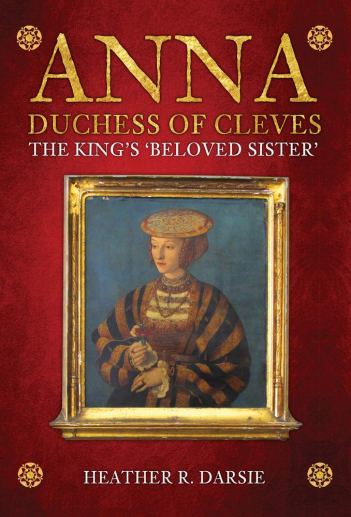 The wives of Henry VIII are some of the most hotly-discussed women of the Tudor Dynasty. They all had unique lives and origins before and after they met the man that connects them all. Two of his brides, Catherine of Aragon and Anna, Duchess of Cleves, were foreign princesses and their marriages were used to create alliances with Spain and Germany respectfully. While Catherine of Aragon and the rest of the wives of Henry VIII get a ton of attention, Anna Duchess of Cleves tends to be brushed aside. She is often seen as the wife that Henry did not approve of because of her looks. However, Heather R. Darsie decided to change how we view Anna with her groundbreaking debut biography, “Anna, Duchess of Cleves: The King’s ‘Beloved Sister’”.
  The Wars of the Roses was a time of great hardships and strong men and women who did everything they could in order to survive. One of these remarkable people was a woman who did everything she could to make sure her only son lived and prospered. She was the daughter of a man who, allegedly committed suicide, she had four different husbands and gave birth to her son at the age of thirteen. She helped organize rebellions and a marriage that helped her son win the throne of England. Her name was Margaret Beaufort, the mother of King Henry VII. Her remarkable story is told in Elizabeth Norton’s insightful book, “Margaret Beaufort: Mother of the Tudor Dynasty.”
 When we study history and look at certain people, we often have a tendency to treat them almost like fictional characters. They are either the hero, all good with no flaws, or villains, all bad where we only focus on their flaws. We don’t see the person as “human”, neither good nor bad, just someone who tried their lives to the best of their abilities. One such person who tends to get either the hero or the villain treatment is King Richard III of England. To some, he is “white knight”, a man who was wrongly accused and who was faultless. To others, he was a “black legend”, a dastardly villain who wanted power and did not care who he stepped on in order to achieve his goals. With these two different portrayals of Richard III, we often forget that he was just an ordinary man who became king. Matthew Lewis has decided to strip away both the white and black portrayals of Richard III and explore who Richard III the man was in his latest book, “Richard III: Loyalty Binds Me.”
 (Baptized April 26, 1564- Died April 23, 1616)
 (Born around February 26, 1564( the date he was baptized)- Died May 30, 1593)
 (Born October 8, 1515- Died March 7, 1578)
 (Born November 8, 1543- Died December 25, 1634)
 Also known as Elizabeth Cavendish and Elizabeth Talbot, Countess of Shrewsbury
 Adventures of a Tudor Nerd