
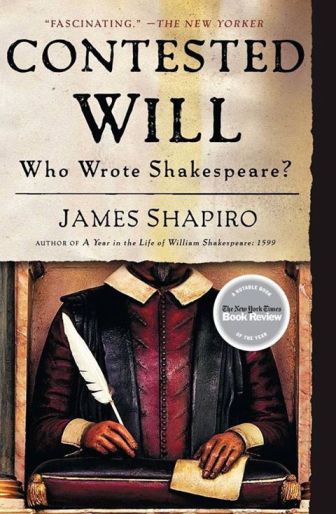
 First of all, great Shakespeare questioned? How unthinkable, controversial, bizarre…
I had scraps of information on Shakespeare’s authorship question, from “The Everything Shakespeare Book”, that I read years ago and some recently viewed TV programs, such as “Shakespeare Uncovered” and “Shakespeare: The legacy”. Nevertheless, it was appealing enough for the skeptical mind to question – was really William Shakespeare of Stratford the writer behind these great comedies, tragedies, historical plays, and sonnets?
Looking into the materials on authorship, James Shapiro’s book “Contested Will: Who wrote Shakespeare” came up. How exciting! I would finally know who wrote Shakespeare.
James Shapiro is an English and Comparative Literature professor and the book feels quite academic at first, although well structured.
Then book unfolds to a quest through principal candidates to Shakespeare himself. The division of text by a candidate gives the opportunity to read it by paying attention to one particular contestant, allowing to step out and research other materials, before continuing to the next one.
James Shapiro is leading the reader on a path to rediscover Shakespeare. He navigates the wide historical timeframe from 15xx to modern days, up to 2007. On that journey, that is full of caveats, the reader will meet Freud, Mark Twain and number of Shakespeare’s followers and doubters and discover how authorship movement was born and how political inclinations affected it.
And as in life, the journey feels more important than the outcome.
I definitely came up with much more understanding what is behind the authorship question as well as learning along the way some fascinating tidbits (such as why intermissions in theaters were introduced) – an additional benefit to history nerds!
We might never know the truth behind historical events and personages, although research brings us as close as possible to a realistic version.
I really enjoyed this book and recommend it to readers interested in Shakespeare’s life and works. Though it’s not a book for a novice – some historical interest in medieval times, Britain’s history or 18-19 century’s literature exposure would help to appreciate this meticulously researched and well-written work.
Note:
Just after completing this review and verifying some of the titles, one more interesting resource came up on Amazon Prime “Shakespeare: The King’s Man”, the series by James Shapiro as well. This is on my watch list now!
About the Guest Author:
Hi
My name is Maya Cherny,
I’m a software engineer and mathematician by profession, ballet dancer at heart and recently (about 2 years ago) discovered my interest in British medieval and Tudor history. Started with Philippa Gregory books and then continued to look for authors of fiction and non-fiction for that period in British and medieval history. I picked up Alison Weir “Innocent Traitor” and was enchanted with her style. This prompted me to dive into Alison Weir’s non-fiction (Princes in the Tower were the first, of course), and now almost through her published books.
My favorite historical personages so far are Elizabeth Woodville (started with Elizabeth I and Elizabeth of York) and Reginald Pole (Richard of York and Richard III were on the list as well 😉.
Expanding my learning resources, I completed courses on FutureLearn “The Tudors” and “Learning Shakespeare”. Thus – “Contested Will”, the book which I’m posting a review, seemed to be a good addition to the Shakespearean course.
This is an enjoyable learning process, starting at the point “why they all were called the same name and is it possible to distinguish them?” and moving on to talking only about history and looking for the kids’ history books to involve them as well.
 Historically, royal marriages have been viewed with such interest. A king and a queen who can come from either similar or different backgrounds in order to make their country better, or in some cases, worse. During the Wars of the Roses, there were some legendary relationships that shaped the war between the Yorks and the Lancasters. Edward IV and Elizabeth Woodville. George Duke of Clarence and Isabel Neville. Richard III and Anne Neville. Henry Tudor and Elizabeth of York. However, these relationships fail in comparison to the impact that the marriage of Henry VI and Margaret of Anjou had on England during this time. Henry VI was seen as a weak, pious ruler; Margaret was seen as too strong for a woman. They have been viewed separately for a long time, never as a couple. That is until Amy Licence wrote her latest biography, “Henry VI and Margaret of Anjou: A Marriage of Unequals”.
 Anne Boleyn, the second wife of Henry VIII and the mother of the future Queen Elizabeth I, is one of the unique characters of the Tudor era. She was the sister of one of the king’s mistresses, Mary Boleyn, which she could have been, but Henry wanted Anne as his queen. Unfortunately, he was married to his first wife, Catherine of Aragon. It is Henry’s divorce to Catherine and his relationship with Anne, the rise and fall, is what many people look at, but there is more to Anne’s story than just her life with Henry. What was Anne’s life really like and what really caused her fall? These are just a few questions that Amy Licence tackles in her latest biography, “Anne Boleyn: Adultery, Heresy, Desire.”
 The wives of Henry VIII are some of the most hotly-discussed women of the Tudor Dynasty. They all had unique lives and origins before and after they met the man that connects them all. Two of his brides, Catherine of Aragon and Anna, Duchess of Cleves, were foreign princesses and their marriages were used to create alliances with Spain and Germany respectfully. While Catherine of Aragon and the rest of the wives of Henry VIII get a ton of attention, Anna Duchess of Cleves tends to be brushed aside. She is often seen as the wife that Henry did not approve of because of her looks. However, Heather R. Darsie decided to change how we view Anna with her groundbreaking debut biography, “Anna, Duchess of Cleves: The King’s ‘Beloved Sister’”.
  Every family has their own stories. Stories of how they became a family, how they fought hard to get where they are today. Stories filled with love, drama, and endurance. When it comes to royal families, their stories tend to be broadcast to the masses, and none more so than the Tudors, who have captured the imagination of history lovers for generations. The Tudor’s story is often told in parts, focusing on individual people like Henry VIII or Elizabeth I. The Tudor story is fascinating told in parts, but as a whole, one sees how hard they worked to become a dynasty that will be remembered for centuries after their deaths. It is time for the story of this extraordinary family to be told as a whole and Leanda de Lisle does so in her book, “Tudor”.
 The Tudor era has enchanted generations of history lovers with its interesting monarchs and scandals. The beautiful outfits, the political drama of the age, the legendary marriages of King Henry VIII, the children of Henry VIII, and how England grew into a dominant force in European politics. These are the things that people tend to focus on when studying the Tudors, yet this is a very narrow view of the time period. We tend to focus on the inner workings of the court system, but we don’t focus on the common people who lived in England during this time. What was it like to live in Tudor England for the common people? This is the question that Ruth Goodman explores in her book, “How To Be a Tudor: A Dawn-to-Dusk Guide to Everyday Life”.
  The Wars of the Roses was a time of great hardships and strong men and women who did everything they could in order to survive. One of these remarkable people was a woman who did everything she could to make sure her only son lived and prospered. She was the daughter of a man who, allegedly committed suicide, she had four different husbands and gave birth to her son at the age of thirteen. She helped organize rebellions and a marriage that helped her son win the throne of England. Her name was Margaret Beaufort, the mother of King Henry VII. Her remarkable story is told in Elizabeth Norton’s insightful book, “Margaret Beaufort: Mother of the Tudor Dynasty.”
 In recent years, the study of the English conflict known as the “Wars of the Roses” has become rather popular. The Lancasters and the Yorks fighting for the English throne. Only one can be the winner. When we do look at this time period, we tend to focus on the people involved in the battles and the political aspect of the conflict. The battles, how they were fought, and why the conflict started in the first place tend to be pushed to the sideline. That is not the case with this particular book. In Hugh Bicheno’s book, “Battle Royal- The Wars of the Roses: 1440-1462”, the political and military aspects combine with family histories for a comprehensive look into what made this time period so fascinating.
 By the year 1470, England had been embroiled in a civil war between the houses of York and Lancaster for nearly 20 years. Edward IV was king until he was driven out of the country by his former best friend Warwick and Edward’s own brother, George Duke of Clarence. The House of Lancaster is back in charge with Henry VI, but Edward IV and his other brother Richard Duke of Gloucester are not giving up without a fight. However, there is another family who wants to fight for the throne, the Tudors. How will it come to an end? Who will become King of England when all the major battles come to an end? These questions are answered in Conn Iggulden’s thrilling conclusion to his Wars of the Roses series, “Ravenspur- Rise of the Tudors.”
 The deaths of the Duke of York, Earl Salisbury and Edmund Earl of Rutland at the Battle of Wakefield at the end of 1460 marked a changing point for how the Wars of the Roses was fought. Now it was not going to be simply a matter of who was going to be the King of England, but it was a war of revenge. What the Lancastrians did not realize at the time was the fact that these deaths would unleash two men who would mark the destruction of the Lancastrian cause; Edward Duke of York, the future King Edward IV, and Richard Neville Earl of Warwick “the Kingmaker”. In the third book of Conn Iggulden’s Wars of the Roses series called “Bloodline”, Iggulden explores the rise of these two dynamic men and how family matters tore the two best friends apart.
 Adventures of a Tudor Nerd