
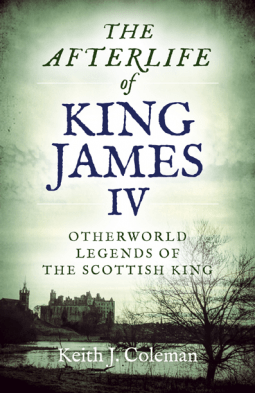
 A king who died on the battlefield and his remains were never found. His story and his legacy went through many revisions throughout history. This sounds like a certain English king, King Richard III, but this story actually takes place decades after Richard’s death in Scotland. This is the story of King James IV of Scotland, who died at the Battle of Flodden in 1513. It was this event and how James IV was viewed afterward which Keith J. Coleman explores in his book, “The Afterlife of King James IV: Otherworld Legends of the Scottish King”.
I would like to thank Chronos Books for sending an advance copy of this book. I was not very familiar with Scottish history before reading this book so it was a very interesting read.
Coleman explains why James IV’s reign is so unique and why there were some who questioned whether the king actually died at Flodden:
Whispers about James IV defying fate and living on after his catastrophic last battle were a widespread reflex to unexpected tragedy common with many countries. Other kings are said to have cheated death and gone into hiding, or become religious penitents who went to Jerusalem or Rome. Some of these lost leaders shared another of the king’s rumoured fates: murdered by some person they knew and trusted. But very few have been believed to be actually resident in another, supernatural dimension, as one tradition of James IV insisted. This was the destiny of the truly elite, such as the primal warlord Arthur. No ruler, not even the great emperor Charlemagne, attracted so many diverse tales about himself so immediately after his apparent death. (Coleman, 5-6).
Coleman begins his book by exploring the relationship between James IV and his father James III, as well as exploring what James IV’s reign was like. James IV did not have the best relationship with his father since James IV became the figurehead of the opposition party who wanted to see his father dead. After his father’s death, James IV became king and is said to have worn an iron belt to atone for his sins against his father. James IV was something of a ladies’ man and had numerous illegitimate children, but he did marry Margaret Tudor, the sister of Henry VIII, and had legitimate children with her. Under their marriage arrangement, James IV was not to attack England and vice versa, but James IV decided to attack while Henry VIII was away fighting in France. The one flaw in his plan was the fact that Henry VIII had his wife Catherine of Aragon take over military command while he was away and she was not going to let James IV invade. The Scottish and English armies met at the Battle of Flodden on September 9, 1513.
Since we don’t have accurate records of the Battle of Flodden, Coleman explains how the Scottish viewed the battle versus how the English and the rest of Europe viewed this event through literature. It is a very typical historiographical study, but what makes it unique is the addition of the legends and folklore about the king that came after his death. In some parts, this book does read like a ghost story combined with history. It is different, but it does capture the fascination with the supernatural that the Scottish had. In addition, Coleman explores how other historical figures received similar treatments throughout history.
This was the first book that I have read solely on Scottish history and it was a compelling read. It was a bit confusing at points when the history and supernatural elements combine, which was different to be sure, but overall it was a thought-provoking book. This may not be the best book for those who are being introduced to Scottish history, but it is one for those who are familiar with the eclectic approach of Scottish history and those who are interested in King James IV. Keith J. Coleman achieves a unique balance of the historical and supernatural elements to this specific king’s life and legacy in his book, “The Afterlife of King James IV: Otherworld Legends of the Scottish King”.
“The Afterlife of King James IV: Otherworld Legends of the Scottish King” by Keith J. Coleman, published by Chronos Books, comes out on April 26, 2019. If you are interested in ordering this book, you can find more information about how here: https://www.johnhuntpublishing.com/chronos-books/our-books/afterlife-king-james-iv
 known as the Hundred Years’ War, and the massively destructive illness that we know today as either “the Black Death” or “the Black Plague”. This was a time of despair, but it was also a time where we see a shift from old traditions of the church and the state. It is also two centuries after the events of Ken Follett’s massively popular book, “The Pillars of the Earth”. Follett explores how the people of Kingsbridge survived during this tumultuous time in his second book of the Kingsbridge series, “World Without End”.
 When one thinks about epic tales stories of adventures and romance tend to come to mind. One hardly thinks about the construction of a magnificent building as an “epic tale” with monks and builders as the main characters. We see cathedrals as these massive buildings from the past used as churches, but we rarely think about how they were constructed and why. Who were the people who decided to make these spectacular buildings and what might have their lives have been like? These are just some of the questions that Ken Follett wanted to try and answer in his monumental historical fiction masterpiece, “The Pillars of the Earth”.
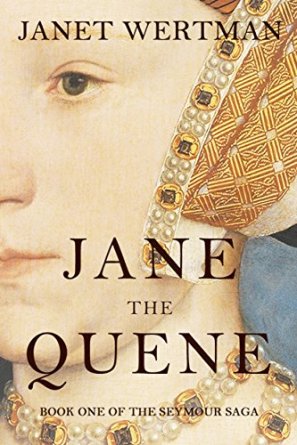 Henry VIII may have had six wives, but only one could give him the desired son that he wanted. She was kind, demure and everything that Henry VIII’s second wife Anne Boleyn was not. Her name was Jane Seymour, Henry’s third wife. Sadly, she is often remembered for the birth of her son and her death. However, there was a lot more to Jane’s story than the ending. What was her relationship with her family like? How did she fall in love with the King? And how was her relationship with her romantic rival, Anne Boleyn? These are just some of the questions that Janet Wertman strives to answer in her first novel of her new Seymour Saga called, “Jane the Quene”.
  The children of Henry VIII have been the center of historical studies for centuries. Edward VI, Mary I, and Elizabeth I were all considered Henry’s “legitimate” children and were able to obtain the crown of England. Henry Fitzroy was the illegitimate son of the king, but he was still able to gain titles and a good marriage before he died. They all had something in common; they were all recognized by their father, Henry VIII. However, there was another child who many believed to have been the daughter of the king. The name of this intriguing lady was Lady Katherine Knollys and her story comes to life in Sarah-Beth Watkins’ book, “Lady Katherine Knollys- The Unacknowledged Daughter of King Henry VIII”.
 Love stories tend to be rare during the Tudor dynasty. They are often of royal women marrying men well below their station in life and then the ruling monarch throwing them in the Tower until they ended up divorcing or dying. Nothing really romantic about these stories. However, there is one story that breaks the mold of disastrous love. It is the story of Mary Tudor, the sister of King Henry VIII and the Dowager Queen of France, who married the charming knight and best friend of her brother, Charles Brandon. Their story is often told in historical fiction novels, but Sarah-Beth Watkins decided to dive deep into the lives of these two lovebirds, before and after they were married, in her book, “The Tudor Brandons: Mary and Charles- Henry VIII’s Nearest and Dearest”.
 When one thinks about Queens of Scotland during the time of the Tudors, many automatically think of Mary Queen of Scots and her tragic life. However, there was another queen who had a deep connection to the Tudors and was also a queen of Scotland. She tends to be pushed aside in favor of her more famous siblings; Arthur Tudor, Henry VIII, and Mary Tudor. Her story is full of turmoil and triumphs. Her only desire was to unite England and Scotland peacefully, but the choices that she made in her lifetime would prove foolish, leading to more troubles between the two nations. This is the story of Henry VIII’s oldest sister Margaret, which is brought to life in Sarah-Beth Watkins’ book, “Margaret Tudor Queen of Scots: The Life of King Henry VIII’s Sister”.
 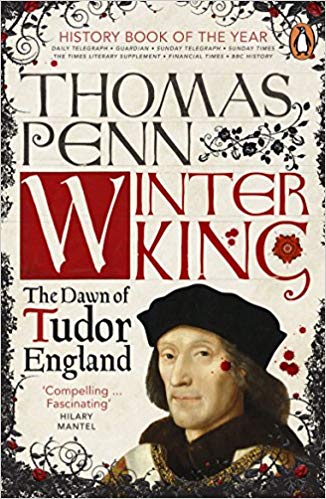 The Tudor Dynasty and its beginning has often been viewed as a glorious dawn after the dark period that we call the Wars of the Roses. It established a firm foundation that the kingdom lost during the 30 years of civil war. It took a lot of effort from the victor of this tumultuous time, Henry VII, to transform England back to a relatively stable country. To some, Henry VII was a virtuous leader who cared about his family and his country, saving money to make sure the dynasty was secure. For others, Henry VII was a figure who clung to his crown and his kingdom no matter the cost, which included conspiracies and underhanded methods. But what did Henry VII do in order to bring back order to England and how did he convince others that the Tudors were the rightful rulers? These are the questions that Thomas Penn wanted to answer in his book, “Winter King: The Dawn of Tudor England.”
 England is on the brink of civil war. Families with royal blood in their veins are fighting amongst each other as King Henry VI has fallen ill. Mistrust runs rampant and sacrifices are made in order to gain the throne. This is the England of 1454 and the beginning of the period in English history that we know today as the Wars of the Roses. Families like the Nevilles, the Percys, and the houses of York, Lancaster, and Tudor would gain fame and infamy during this time. Conn Iggulden decided to explore this tumultuous time after the Jack Cade rebellion, which he explored in his first book “Stormbird”, in the second book of his “Wars of the Roses” series called “Trinity”.
 Henry VIII, the king who was notorious for his six marriages. His first three marriages, to Catherine of Aragon, Anne Boleyn, and Jane Seymour, gave Henry VIII his only children that were considered eligible for succession. Catherine of Aragon was his first foreign bride, but he would divorce her to marry Anne Boleyn. Anne Boleyn would later be executed and Jane Seymour would die after giving birth to Henry’s son Edward. Henry wanted to marry again, so his most trusted advisors decided to try for a foreign alliance as well as a new bride for the king. They decided that Anne of Cleves from Germany would be the perfect bride, but it did not work out and Henry decided to divorce her and claim Anne as his “sister”. She is often viewed as Henry’s “lucky wife”, but who was she and what was her life like before and after she met her husband Henry VIII? That is exactly the question that Sarah-Beth Watkins wanted to explore in her latest book, “Anne of Cleves: Henry VIII’s Unwanted Wife”.
 Adventures of a Tudor Nerd