
Today, I am pleased to welcome Sarah Kennedy to my blog to discuss the historical aspect of her latest novel Queen of Blood. Thanks to the Coffee Pot Book Club and Sarah Kennedy for allowing me to be part of this tour.
The most obvious historical aspect of my latest novel, Queen of Blood, is the Wyatt Rebellion, which occurred early in the reign of Mary Tudor (“Bloody Mary”). It was carried out, unsuccessfully, by a group of men who opposed her rule and her marriage to Philip of Spain. The uprising was soon put down, partly because some of the other nobles who were initially involved in the plot failed to raise their armies, and so the band that descended on London was small—and they did not get the support from Londoners that they expected.
That’s the historical context of the book, and it may be the most compelling part of the narrative for some readers. But it’s not the historical aspect that interests me the most. As in all of the novels in my Tudor series, The Cross and the Crown, the element that draws me in the most is the daily lives of everyday people. We know quite a lot about the lives of royals and nobles—and life was not easy even for people with vast resources of wealth and land—but my attention is always on people who lacked these privileges. I’ve always had sympathy for ordinary people who found (and still find) themselves tossed and turned by changes in their governments and their cultures; such changes occurred dramatically during the Tudor years in England.
I try to imagine what daily life was like, particularly for women, who had to worry about childbirth (or the inability to bear children); maintaining and running a household (or working in a household); and caring for extended family members. Just thinking about the number of chores and tasks that had to be accomplished every day, just to stay alive, is exhausting. Women like my main character, Catherine, sometimes had to keep the books for their husbands’ businesses; sometimes had to work in the business (Catherine’s current husband is a wool dealer), and they surely had to stop everything sometimes to show a young maid how to pluck a chicken correctly or how to make soap. I think, too, about the bodily needs that we take for granted today: staying clean; treating wounds and injuries; maintaining personal hygiene during menstruation, pregnancy, breastfeeding, and childbirth.
Can you imagine how time-consuming and difficult it was just to get through a day with enough food, shelter, and clothing?
My Catherine is fortunate in that she knows how to read and write because she was raised in a convent. She knows quite a lot about herbs and medicines, so she generally knows what to do if someone in her household falls ill or, say, cuts herself. She also has maids to help out around the house. But having a household staff means looking out for those people, and that job often fell to the lady of the house.
Now, when all of that daily toil is combined with turmoil in the government and the religion of the country, everything becomes more complicated. England, at the beginning of Mary Tudor’s reign, was Protestant. The convents and monasteries had been closed, and their lands and goods seized by the Crown. Mary, of course, remained Catholic, and one of her goals was to return England to Rome.
This goal was supported by some, opposed by others, and just entirely frustrating and confusing to many. A person could be arrested, imprisoned, and possibly executed for failing to submit to the current requirements of the current church, and I’m sure that this created anxiety, anger, and resentment. Which prayers was a person supposed to say? In what language? What if those requirements violated a person’s conscience? Those were questions that, under the Tudor monarchs, ordinary people often simply had to keep to themselves. They had to follow the rules or suffer the consequences, even if the rules were completely different from what they had been in the previous year.
So, on top of all the necessary daily, drudging work, everyday people were forced to submit to the requirements of church attendance, following the dictates from the throne. It’s no wonder that people rebelled. And it’s no wonder that those rebellions were met with force from the court.
People often adapt to the circumstances in which they find themselves if they can. And if they can’t? If they don’t understand the enormous changes, or don’t approve of them, or can’t bear them? The possible answers to those questions are at the center of my historical interest, and those questions, to me, are the most important historical aspect of my Cross and Crown series.
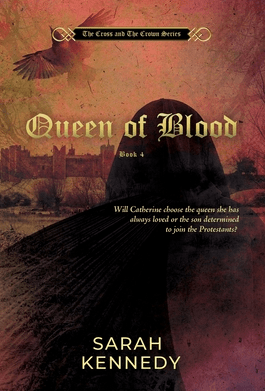 (Blurb)
Queen of Blood, Book Four of the Cross, and the Crown series continue the story of Catherine Havens, a former nun in Tudor England. It is now 1553, and Mary Tudor has just been crowned queen of England. Still a Roman Catholic, Mary seeks to return England to its former religion, and Catherine hopes that the country will be at peace under the daughter of Henry VIII. But rebellion is brewing around Thomas Wyatt, the son of a Tudor courtier, and when Catherine’s estranged son suddenly returns from Wittenberg amid circulating rumors about overthrowing the new monarch, Catherine finds herself having to choose between the queen she has always loved and the son who seems determined to join the Protestants who seek to usurp her throne.
Buy Links
Universal Link: mybook.to/QueenofBloodBookFour
Amazon UK: https://www.amazon.co.uk/dp/1950586758
Amazon US: https://www.amazon.com/Queen-Blood-Sarah-Kennedy/dp/1950586758
Amazon CA: https://www.amazon.ca/dp/1950586758
Amazon AU: https://www.amazon.com.au/dp/1950586758
 Author Bio
Sarah Kennedy
Sarah Kennedy is the author of the Tudor historical series, The Cross and the Crown, including The Altarpiece, City of Ladies, The King’s Sisters, and Queen of Blood. She has also published a stand-alone contemporary novel, Self-Portrait, with Ghost, as well as seven books of poems. A professor of English at Mary Baldwin University in Staunton, Virginia, Sarah Kennedy holds a Ph.D. in Renaissance Literature and an MFA in Creative Writing. She has received grants from both the National Endowment for the Arts, the National Endowment for the Humanities, and the Virginia Commission for the Arts.
Social Media Links:
Website: http://sarahkennedybooks.com
Twitter: https://twitter.com/KennedyNovels
Facebook: https://www.facebook.com/sarah.kennedy.520125
Amazon Author Page: https://www.amazon.com/Sarah-Kennedy/e/B0054NFF6W
Goodreads: https://www.goodreads.com/author/show/6538009.Sarah_Kennedy

 A war between brothers and cousins to determine the future of England is raging, but it is not the same kind of war England saw during medieval times. It is a clash of ideas, religious beliefs, and a fight for the survival of the reigning English king. On one side were the Catholic supporters of King Charles I, known as Cavaliers, and on the other were the Protestant Roundheads who wanted to see the king removed from the throne. Caught in the middle was the home of the Winchesters, known as Basing House, a royalist stronghold, which withstood sieges and bloodshed for two years amid the conflict. Jessie Childs’ latest book, “The Siege of Loyalty House: A Story of the English Civil War,” is dedicated to telling the story of this remarkable house and the men and women who fought to the death to defend it.
 The Tudor dynasty was a time of significant political change, but it was also a time of tremendous religious change. Each Tudor monarch had a different view on the divide between Catholics and Protestants. Although we have an idea of what it might have been like during the reign of Mary I, the way Elizabeth I tackled the issue of religion during her reign. One story of how Catholics were treated in the so-called “Golden Age” of Elizabethan England is the story of Margaret Clitherow. She helped hide a couple of Catholic priests and ended up suffering for her actions by being crushed to death. Tony Morgan tells her story and how she became a Catholic martyr in his book, “Power, Treason, and Plot in Tudor England: Margaret Clitherow, an Elizabethan Saint.”
 Two cousins fighting for the right to rule England during the 16th century. One was the daughter of Henry VIII and Anne Boleyn who fought tooth and nail to rule without a man by her side. The other was the daughter of Mary of Guise and King James V of Scotland whose marriage record would prove to be fatal. Elizabeth I and Mary, Queen of Scots, may have been sister queens, but the way they were treated in their own countries differed completely. While Elizabeth I was praised and protected from harm in England, Mary was a scapegoat for so many in Scotland. The way that Mary was used as a pawn even though she wore a crown was nothing short of extraordinary. The story of how these two queens came on a collision course that would leave one queen beheaded and the other forever changed has been told in many different ways from both sides of the tale, but it has rarely been told as a cohesive nonfiction book. That is until Kate Williams’ marvelous biography, “The Betrayal of Mary, Queen of Scots: Elizabeth I and Her Greatest Rival”.
 When one thinks about women reformers during the time of the Tudors, certain women like Catherine Parr and Anne Aske come to mind. However, there was one who really should get more attention and her name is Katherine Willoughby. She was the last wife of Charles Brandon. Her mother was Maria de Salinas, a lady in waiting to Catherine of Aragon and a devout Catholic. Katherine knew all six of Henry VIII’s wives on a personal level and knew all of his children. She has often been seen as an afterthought; someone you associate with other people, but never a stand out herself. That is until now. Katherine Willoughby finally gets her time to shine in Tony Riches’ latest historical fiction novel and his conclusion to his Tudor trilogy, “Katherine-Tudor Duchess”.
 Adventures of a Tudor Nerd