
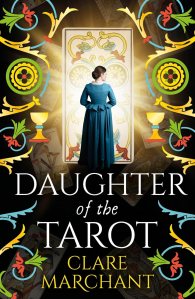
 A single deck of cards changed the fate of generations of women. The tarot cards, created in 16th-century Italy, will connect two women separated by centuries. One was a woman in 17th-century London, originally from Milan, who used the cards to rescue women from abusive relationships. The other is a woman from modern-day London starting her life anew when she comes across an old tarot card deck with a missing card. What began as a hunt for a missing card will connect the two women and change lives forever. The cards hold secrets to the past, but will they bring hope or disaster? This is the premise for Clare Marchant’s latest dual-timeline novel, “Daughter of the Tarot.”
I would like to thank Boldwood Books and Net Galley for sending me a copy of this novel. I recently read her novel, “The Shadow on the Bridge,” which I enjoyed, so when I saw this novel, it had such an intriguing description that I wanted to read it. I am not familiar with the history of tarot cards, and I have not read many novels set in the 17th century, so I was excited for a new adventure.
As this is a dual-timeline novel, there are two protagonists from two different periods: Portia from 17th-century England and Beatrice from 21st-century England. We begin in Milan in 1629, which has just been hit by the plague, where we are introduced to Portia and her baby daughter, Vittoria, who are struggling to survive. The next time we see Portia and Vittoria, iits 1644 and they are living in London. Vittoria is 15 years old, and Portia is using her talent with tarot cards to help those in need. What Vittoria does not know is that Portia uses her readings to help women escape abusive relationships by using the Devil’s Card as a message for the boatsman Jack, who is in love with Portia. Secrets and truths slowly begin to reveal themselves as someone from Portia’s past has come to London and may destroy her relationship with Vittoria.
In the modern storyline, we meet Beatrice, or Bea, who is starting a new life in London and is opening her own antiques shop. Bea has been avoiding her father and his new love interest since her mother died. She has the gift of reading tarot cards, and one day, she comes across an old deck of cards. The only problem is that it is missing a key card, the Devil’s Card. Bea and her landlord, Jack, search high and low for the missing card and find exactly what they are searching for, and some surprises.
It took me a while to get into this book as it was a slower pace than the previous novel that I read by Marchant. While I enjoyed the modern storyline, the 17th-century portion felt a bit slower, and it didn’t feel like the 17th century to me, but more like the 16th century. Overall, I think it was a decent novel with an interesting pair of protagonists. If you want a story about the 17th century with a unique premise, I recommend you read “Daughter of the Tarot” by Clare Marchant.
 Have you ever had an incident that was so impactful that it defined your entire life from that moment on? For Anne Howard, Countess of Arundel, it was the death of her younger brother, George. She vows vengeance against those who were behind his untimely demise. In the present day, Sarah must return to her godmother’s home, which holds a lot of memories, mostly painful. It is in the halls of this ancient house that Sarah meets Anne through a book of poetry. Can these two women find peace or will the truths bring even more disasters? Clare Marchant tells the stories of these two women, the tragedies and the poetry that unite them, in her latest novel, “The Shadow on the Bridge.”
 Today, I am pleased to welcome Clare Marchant to my blog to discuss her latest novel, “The Queen’s Spy,” and her use of dual timelines. I would like to thank The Coffee Pot Book Club and Clare Marchant for stopping by on this tour.
  (Blurb)
 Author Bio:
 Adventures of a Tudor Nerd