
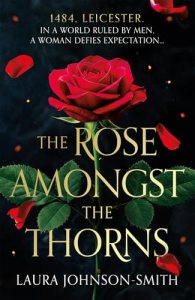
 Lady Katherine Turner was never meant to be the Countess of Leicester, but when her brother William dies suddenly, she must take on the mantle of power. Unfortunately, with power comes responsibility, and in medieval England, women in power could not hold onto that power unless they married. That does not sit well with Katherine, who is a very independent woman. However, a choice must be made between two suitors, Lord Henry Tyrell, Earl of Dornton, and Lord James Stanford. Who will Lady Katherine Turner choose, and can she maintain her independent spirit while falling in love? Laura Johnson-Smith explores Lady Katherine’s love story in her debut novel, “The Rose Amongst the Thorns.”
I would like to thank The Book Guild and Net Galley for sending me a copy of this novel. I enjoy reading novels that are set during the Wars of the Roses, and I like to read debut historical fiction novels. When I read the description for this novel, it sparked an interest in me to give it a try.
We begin with Katherine and her brother William, who is about to go on a mission for King Edward IV in France. William is engaged to be married to Isabelle, but things come crashing down when William is killed in France. Now, the title of the Duchess of Leicester has been passed down to Katherine. We flash forward a few years, where we see Katherine adjusting to her new role. Now, her aunt and uncle are pushing Katherine to marry, even though she has no desire to marry. That is, until she meets her two potential suitors. Lord Henry Tyrell is the first man to sweep Katherine off her feet, but she soon realizes that he has nefarious plans for her. And then there is Lord James Stanford, whom Katherine truly falls for.
As a debut, it was a fine novel, but it was hard for me to figure out when it was supposed to take place. If it wasn’t for the description, I would have felt completely lost as the story felt like it could have been placed in any time period. It didn’t have a distinct feeling of being in the middle of King Richard III’s short reign. I also felt like this plot was pretty predictable for me, and it didn’t give me a wow factor. That being said, I can sense that the author does have a passion for the past, and the novel is pretty well-written for her first novel. If you want to give a new reader a try and enjoy a good historical love triangle, you might enjoy “The Rose Amongst the Thorns” by Laura Johnson-Smith.
 Miguel de Cervantes, the author of Don Quixote, lived quite an interesting life. He was a poet, soldier, war hero, prisoner, husband, brother, uncle, father, and author. His writing might portray a man of honor and dignity, but his home life was messy. You see, Miguel was married, but his daughter was not the daughter of his wife, Catalina de Salazar. His daughter, Isabel, was illegitimate, and when her mother died, Miguel decided the best possible solution was to invite Isabel to live with his sisters and his niece. What’s the worst that could happen? Martha Batiz explores the women’s lives connected to Miguel de Cervantes in her debut novel, “A Daughter’s Place.”
 Florence, Italy, in the 16th century, was a city of opportunity and full of art and architecture. It was also a city on the precipice of great change. The great banking family, the Medicis, holds the reins of government in Florence, and Lorenzo de’ Medici is the family’s current head. However, two bastards will radically change his life and the Medici family. One was a bastard son of a notary who became one of the most famous artists ever. The other was a bastard son who became a priest and the enemy of the Medici family. Their stories of power and ambition intersect in the city of Florence in Phil Melanson’s debut novel, “Florenzer”.
 When we think about the period known as the Renaissance, we often think about Italy and the artists like painters and sculptors. However, other craftsmen made Italy their home. Take, for example, tailors and seamstresses. These skilled craftsmen and women can create art you can walk in with their hands. However, there are gender barriers between tailors and seamstresses in that only men can be tailors and only women can be seamstresses. One orphan girl from Bologna not only challenges what it means to be a woman tailor but also challenges one of the wealthiest merchants in the entire city who has a dark connection to her past. This is the premise for Glennis Virgo’s debut novel, “City of Silk.”
 Have you ever read about a historical figure and wondered what it would be like to interact with them in the present day? How would they deal with modern problems and technology? Could they function in the 21st century or would they become overwhelmed? And even if they could come to the 21st century, how would it affect their timeline and history? This intriguing premise plays out in Maria Vetrano’s novel, “Queen Bess: A Tudor Comes to Save America,” which sees Queen Elizabeth I coming forward about 400 years in time to become the President of the United States in the 2028 election.
 The Wars of the Roses was a time filled with dynamic figures who fought for the right to restore order to England. We often think about the strong warrior men who marched into battle, facing their inevitable doom just for the chance to wear the crown and rule the land. The women who stood by their husbands’ and sons’ sides were just as strong as their male counterparts, even if they did not wear armor. They were on the sidelines, ensuring that they could create alliances that would prove helpful in future conflicts. The most famous examples of strong women during the Wars of the Roses are Margaret of Anjou, Margaret Beaufort, and Elizabeth Woodville. Yet, there was another woman who stood firmly on the side of the Yorkist cause. She was known as the Rose of Raby and the wife of Richard, Duke of York. Her name was Cecily Neville, and she is the protagonist of Annie Garthwaite’s brilliant debut novel, “Cecily.”
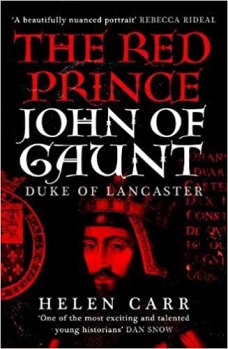 When one studies the history of the English monarchy, we tend to consider those who ruled and those who advised the ruler as significant characters. We rarely study the family members of the monarch who did not win the right to rule the kingdom. Yet, they are often either extremely loyal or they desire the crown with such ferocity that they rebel against their own family. It seems like a rather cruel world, but that was the life of a medieval monarch. True loyalty for one’s family was a rare feat. One man showed the depth of his loyalty to his family, even when the people despised him. He was the son of King Edward III, the brother of the famous Black Prince, the uncle of King Richard II, and the father of Henry Bolingbroke who would become King Henry IV. Gaunt’s reputation and legacy have been marred by his wealth and the role that he played with the Peasants’ Revolt, but was he such a bad person? In Helen Carr’s brilliant debut biography, “The Red Prince: The Life of John of Gaunt, the Duke of Lancaster”, she looks to uncover the truth about the man behind the throne and why he never desired the crown for himself.
 Adventures of a Tudor Nerd