
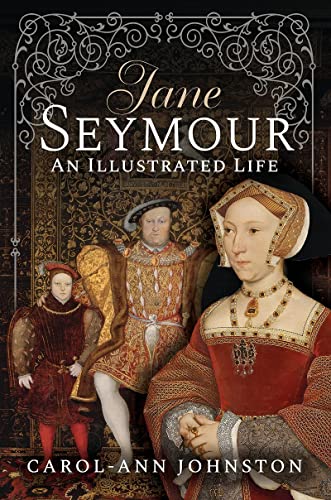
 King Henry VIII’s six wives each have their unique story that transcends time. Katherine of Aragon was his first wife, the mother of Mary Tudor, and the one Henry left behind after 24 years to marry his mistress Anne Boleyn, the most famous of his wives and the mother of Elizabeth Tudor. Anna of Cleves had the shortest marriage to Henry VIII and ended up with an excellent annulment deal. Catherine Howard was young and a bit naive when it came to the ways of men, which led to her downfall while Catherine Parr survived until the end of Henry VIII’s reign. These five women are stories we know by heart, but the one whose story remains a mystery is Jane Seymour, Henry’s third wife, and the mother of the future King Edward VI. In her debut book, “Jane Seymour: An Illustrated Life” Carol-Ann Johnston tells the story of the wife who gave Henry his desired son.
I want to thank Pen and Sword Books and Net Galley for sending me a copy of this book. Jane Seymour is someone who I have wanted to learn more about ever since I started studying the Tudors. When I heard that the founder of the Jane Seymour- Henry VIII’s Third Wife was turning her research into a book, I knew I wanted to read it.
Johnston begins by tracing the origins of the Seymour family to the town of Touraine, Saint-Maur-sur-Loire, and a man named Richard de St. Maur from the 7th and 8th centuries. She then traces the family to John Seymour, the Sheriff of Hampshire, the one who inherited Wolf Hall, and the grandfather of Jane Seymour. Johnston also explores how Jane Seymour, Anne Boleyn, and Catherine Howard were related, as they were all half-second cousins. Sir John and Margery Seymour had a large family with at least 9 children including Jane, Thomas, and Edward, who would play important roles in the Tudor court.
The bulk of this particular book explores the time Jane Seymour spent at the Tudor court, starting with her time with Katherine of Aragon, exploring her relationship with Anne Boleyn, and finally her time as Queen of England. We get to see how she dealt with big events in the reign of Henry VIII like the Great Matter, the rise and fall of Anne Boleyn, the Pilgrimage of Grace, and the Dissolution of the Monasteries. Johnston also explores what made Jane Seymour famous, the birth of her son Edward VI and her death a matter of days afterward.
For her debut book, I think Johnston does a decent job telling Jane Seymour’s story for a modern audience with lovely photographs of ways she was remembered through art and architecture. There were some really interesting facts about Jane’s life that I did not know about including her family’s origin and her suitor before Henry, but a lot of this felt like information that I already knew from other books. I think it would be nice if Johnston does write another book that she focuses on the origins of the Seymour family because it covers centuries of English history and I am sure there are some intriguing tales in their family tree.
Overall, I enjoyed this book and the information I learned from reading it. If you want to learn more about Jane Seymour’s life and her family, I recommend reading, “Jane Seymour: An Illustrated Life” by Carol-Ann Johnston.
 When we think about the men who surrounded King Henry VIII, a few names come to mind. Cranmer, More, Wolsey, and Wroithesley are just a few, but the man who is synonymous with the infamous king’s reign is Thomas Cromwell. The man who helped Henry get his divorce from Katherine of Aragon saw both the rise and fall of Anne Boleyn. He also assisted in the dissolution of the monasteries and brought reform to England with the break from the Roman Catholic Church. To modern audiences, it feels as if we know everything that there was to know about Thomas Cromwell’s public life, but what was he like in his private life when his friends and family surrounded him? Caroline Angus gives her readers an insight into Cromwell’s personal life in her latest book, “The Private Life of Thomas Cromwell.”
 When it comes to studies into the Tudor dynasty, many different approaches have been taken in the past. We have examined every monarch, their spouses, how they lived, what they wore, and the various political events that defined the dynasty. The list is endless to the different studies that have been done with the Tudors, yet there are still new areas of study that are being explored. One of those areas of study is how individuals with disabilities survived in the past. How did society treat those who had disabilities, and what rights did they have according to the laws of the land? In her first non-fiction book, “Disability and the Tudors: All the King’s Fools,” Philippa Vincent-Connolly explores the lives of famous fools and monarchs with disabilities to discover how they were treated by Tudor society.
 The year is 1558, and Queen Mary I is dying. England is engaged in a war between the Reformation and Catholicism. Caught in the middle is an older man named Robin Lewis, who is being taken to London to face his death as a heretic. Fearful that his story may never be told, Robin Lewis tells his captor his tale through the reigns of three Tudor rulers, Henry VIII, Edward VI, and Mary I. Can his story save his life from certain destruction, or is Robin doomed for all eternity? This is the premise of Karen Heenan’s second book in The Tudor Court series, “A Wider World.”
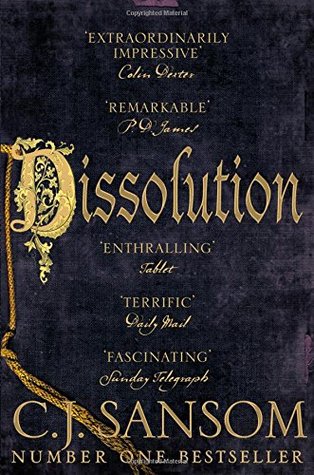 The Tudor dynasty marked tons of changes in society and religious norms. In 1537, the changes are in full force. Anne Boleyn was executed a year earlier and Henry’s third wife, Jane Seymour recently passed away after giving birth to Edward VI. Religious reformers are clashing with the Catholic Church after Henry VIII has declared himself the Supreme Head of the Church of England. Henry VIII’s reign marked the changing point in societal and religious norms, none more so than the dissolution of the monasteries. As monasteries and monks alike adjust to the new ways of life, the monastery at Scarnsea buzzes with activity and murder. Henry VIII’s right-hand man, Thomas Cromwell, sends an unlikely man to investigate the situation; the hunchback reformer lawyer, Matthew Shardlake. This is the world that C.J. Sansom has chosen to create in the first book of his Tudor mystery series, aptly named, “Dissolution”.
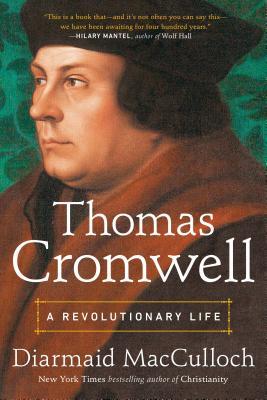 The stories of King Henry VIII and the men around him have fascinated generations of historians, but there was one man who has received a negative reputation for his actions. He was the supposed son of a butcher who rose to be Henry VIII’s right-hand man, until his dramatic fall in July 1540. Thomas Cromwell was credited for helping Henry with his Great Matter, the fall of Anne Boleyn, the establishment of the Church of England, and the disastrous marriage between Henry and Anna of Cleves. Diarmaid MacCulloch has taken on the challenge to figure out who Thomas Cromwell really was by sifting through all remaining archival records that we have from this extraordinary man. It is in this book, “Thomas Cromwell: A Revolutionary Life” that MacCulloch masterfully explores the story of this man who changed English and European history forever.
 Adventures of a Tudor Nerd