
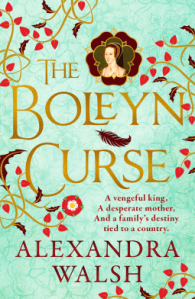
 The court of Henry VIII was a treacherous place for anyone, but especially for the Boleyn family. We all know the stories of Anne, Mary, George, and Thomas, but one figure from this illustrious family does not get enough attention: Elizabeth Boleyn, the mother of Anne, Mary, and George. What was her relationship like with her family, her husband, and most importantly, King Henry VIII? And what does a Chaucer manuscript recently discovered at Cerensthorpe Abbey have to do with Elizabeth and the Boleyns? Alxandra Walsh explores the life of Elizabeth Boleyn and the mystery of the missing Chaucer in her latest dual-timeline novel, “The Boleyn Curse.”
I would like to thank Boldwood Books and Net Galley for sending me a copy of this novel. I enjoy a good dual-timeline novel, and when I saw that this one also featured Elizabeth Boleyn as the main character, I was intrigued. Elizabeth Boleyn has not been the focus of novels of the Boleyn family that I have read, so I was interested to see how her story would translate into historical fiction.
Since this is a dual timeline novel, there are two main timelines. We get to explore the Tudor period with Elizabeth Boleyn and the modern day with Tabitha Mundy, the archivist of Cerensthorpe Abbey. We begin with the modern storyline and Tabitha, who is employed by the owner of Cerensthorpe Abbey, Edith Swanne, to archive the entire estate. Tabitha is dealing with the death of her husband, Blake, when she meets Edith’s nephew and heir to the estate, Gulliver. Edith gives Tabitha the task of finding a missing Chaucer manuscript by decoding clues left behind in a journal from the 1900s. The journey to the missing manuscript holds a connection to Elizabeth Boleyn and the curse upon the family.
We also jump back to the life of Elizabeth Boleyn, who was Elizabeth Howard when the audience is introduced to her in 1485. Her father was arrested by the new King Henry VII for supporting King Richard III, but eventually the family rebuilt their reputation. Elizabeth falls in love with Thomas Boleyn and joins the glittery court of King Henry VIII, where she catches the eye of Henry VIII himself. Elizabeth fights for her family and the love of her husband, even if it means making an enemy of the crown itself.
I think this was a decent novel, even though it explored my least favorite rumor about the Boleyn family. I also thought the diary entries were a bit distracting from the rest of the narratives, a case of too many stories going on at once. Overall, I did enjoy this book. If you want a novel that is a dual timeline or a novel that features Elizabeth Boleyn, you should check out “The Boleyn Curse” by Alexandra Walsh.
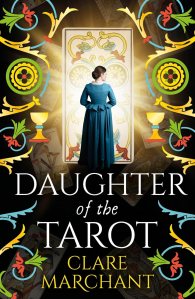 A single deck of cards changed the fate of generations of women. The tarot cards, created in 16th-century Italy, will connect two women separated by centuries. One was a woman in 17th-century London, originally from Milan, who used the cards to rescue women from abusive relationships. The other is a woman from modern-day London starting her life anew when she comes across an old tarot card deck with a missing card. What began as a hunt for a missing card will connect the two women and change lives forever. The cards hold secrets to the past, but will they bring hope or disaster? This is the premise for Clare Marchant’s latest dual-timeline novel, “Daughter of the Tarot.”
 A love that can get through any obstacle even when the couple is married to other people is considered very rare. However, star-crossed lovers at court were practically unheard of, especially multiple couples from the same family. Anne Brandon knows how rare these matches are as her father Charles Brandon married the sister of King Henry VIII. Now she must figure out her feelings about romance while navigating court life. In the modern day, Caroline Harvey has relationship problems while she navigates the loss of her famous writer, grandfather Dexter Blake. How are these two women from different centuries connected and can they fight for who they love or are they destined to be alone? Alexandra Walsh tells both women’s stories in her novel, “The House of Echoes.”
 For centuries, the brave knights of Camelot and the Crusaders have searched for the Holy Grail. The cup that Jesus of Nazareth used during his Last Supper is rumored to be a vessel that can grant eternal life or miraculous healing powers. It can be a cup, plate, or stone, but in all stories, the Grail guardians and those searching for it are predominately male. But what if the guardians were male and female and the ones searching for it were predominately female? Alais from 11th-century France and Alice Tanner visiting France in 2007 share a connection that is centuries deep and it all started with a ring, a book, and an image of a labyrinth. How are these two connected to the labyrinth and the Grail and can they protect it from those who want to use it for their dark purposes? Kate Mosse weaves the tale of the Grail and the two women connected by fate in her novel, “Labyrinth.”
 Two independent women separated by time but united over two compelling portraits and the secrets hidden behind the paint. Mira (Miramonde) is a nun from a Renaissance convent in the Pyrenees who believes she is an orphan who wants to escape her small community and explore the world. Five hundred years later, Zari, an art scholar, begins the journey to discover who Mira is by using the clues she left behind in her works of art that will take her on a journey that will change her life forever. These two tales are woven together in the first book of the Miramonde series, “The Girl From Oto” by Amy Maroney.
 The year is 1560, and a young woman hatches a way to escape her loveless marriage. Her name is Amy Robsart, and she is the wife of Robert Dudley, one of Queen Elizabeth I’s favorites at court. Unfortunately, things do not go as planned, and the consequences reverberate throughout the centuries. Lizzie Kingdom, a television star, struggles to find her way in life. When tragedy strikes when her friend Dudley’s wife is found dead at the bottom of a staircase, the scandal breaks, threatening to ruin Lizzie’s life and reputation. A deadly secret from the past and an encounter with a mysterious young man will forever transform the lives of these two women from different centuries. Will Lizzie Kingdom discover the truth before it is too late? This mystery is masterfully told in Nicola Cornick’s Tudor novel, “The Forgotten Sister.”
 Today, I am pleased to welcome Clare Marchant to my blog to discuss her latest novel, “The Queen’s Spy,” and her use of dual timelines. I would like to thank The Coffee Pot Book Club and Clare Marchant for stopping by on this tour.
  (Blurb)
 Author Bio:
 Adventures of a Tudor Nerd