
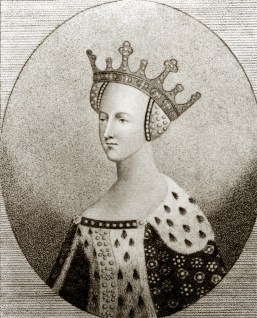
 (Born October 27, 1401- Died January 3, 1437). Daughter of Charles VI of France and Isabella of Bavaria. Married to Henry V of England and Owen Tudor. Mother of Henry VI, Edmund Tudor and Jasper Tudor.
Catherine of Valois was the tenth child of Charles VI of France and Isabella of Bavaria. Her father suffered from mental illness and some believe that Catherine and her siblings were neglected by their parents. When Catherine was young, she was sent to the convent in Poissy to receive a religious education. From a young age, Catherine was on the marriage market. Her first potential groom was the son of Henry IV, the prince of Wales, but the king died before the negotiations could really get started. In 1414, a young Henry V re-opened the negotiations. In May 1420, the Treaty of Troyes was signed between England and France that made Henry V and his descendants the next heirs to the French throne. In order to cement this alliance, Henry V married Catherine of Valois on February 21, 1421.
Henry V went back to France to campaign a few months later, leaving a pregnant Catherine of Valois behind. Henry VI was born on December 6, 1421. Henry V would die from dysentery that he had contracted during the siege of Meaux on August 31, 1422. A few months later, Catherine’s father Charles VI died, leaving Catherine’s baby son both the king of England and France and it left Catherine a dowager queen at the age of 21.
Since Catherine was still young, there was a strong concern that she would marry again, especially to Edmund Beaufort, her late husband’s cousin. That is why Humphrey duke of Gloucester, the Lord Protector and Parliament passed a bill in 1427-1428 that the queen could not get remarried without the king’s consent of her husband would lose everything, except their children would remain legitimate.
Catherine met and fell in love with a Welshman named Owen ap Maredudd ap Tudur, also known as Owen Tudor. Not much is known about his early life but in 1421, he was in service of Henry V’s steward Sir Walter Hungerford. He then became a member of Catherine’s household as either keeper of Catherine’s household or wardrobe. Sometime between 1428 and 1429, the couple is said to have gotten married, but there is no evidence to support this claim. In May 1432, Parliament granted Owen Tudor the rights of an Englishman. The couple had at least 4 children, at most 6; Edmund, Jasper, Owen, and a daughter Margaret who became a nun and died young. All of their children were born outside of court.
Catherine entered Bermondsey Abbey, possibly seeking a cure from an illness. Three days later, on January 3, 1437, she died. Catherine is buried at Westminster Abbey in Henry V’s Chantry Chapel. Catherine of Valois was the mother of Henry VI, Edmund and Jasper Tudor, as well as the grandmother of Henry Tudor, the first monarch of the Tudor Dynasty.
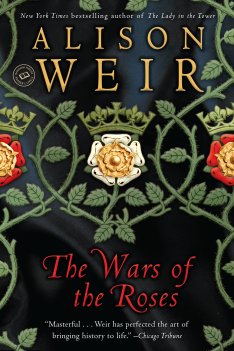 The Wars of the Roses was a series of wars from 1455 until 1487 for the throne of England. It is traditionally taught that it was between the houses of York and Lancaster, yet there were a lot more players involved than these two families. In fact the conflict started much earlier with the children of Edward III and Philippa of Hainault. The Lancasters were the descendants of John of Gaunt and his wife Blanche of Lancaster while the Yorks were descendants of Edmund of Langley Duke of York. This was a series over the question of who had the strongest claim to the throne. This question and the series of wars that would try to answer it is explored in depth in Alison Weir’s book “The Wars of the Roses”.
  Owen Tudor, the second husband of Catherine of Valois and the father of Edmund and Jasper Tudor. His affair with Catherine changed English history forever, yet not much is known about his past before he met Catherine. Was he married before he met Catherine and after she died? What must have been like for him as the Wars of the Roses began to take hold of England and everything he worked hard for began to fade away. The man who started as a Welsh servant turned step- father to King Henry VI and the grandfather of King Henry VII, the patriarch of the Tudor Dynasty, this is the protagonist in Tony Riches’ book, “Owen: Book One of the Tudor Trilogy”.
 Adventures of a Tudor Nerd