
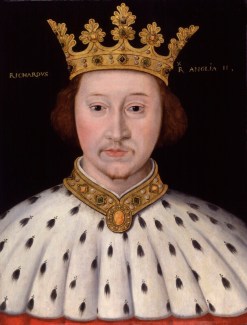
 (Born January 6, 1367- Died on or about February 14, 1400). Son of Edward the Black Prince and Joan 4th Countess of Kent. Married to Anne of Bohemia and Isabella of Valois. He had no children.
Richard II was the second son of Edward the Black Prince, but when his older brother Edward died when Richard was three, Richard became second in line to the throne after his father. When Edward the Black Prince and Edward III died, Richard II became king at the tender age of 10. There was no formal regent that could help guide Richard II, but his uncle John of Gaunt did the best that he could, taking a more active political role.
Richard II and his government decided to start taxing the people with poll taxes to pay for the wars in France and the campaigns in Scotland. At first, they were tolerated, but then the people got mad. In June 1381, a man named Wat Tyler had enough and killed a tax collector and raised a force of around 100,000 to march against the king. When the two forces finally met, Wat Tyler was killed by the Lord Mayor of London William Walworth. Richard at the age of 14 stopped the Peasants’ Revolt by promising the people reforms that he, in the end, did not fulfill the reforms.
He was the champion of England, but inside his court, things were more divisive. Richard II had two very close advisors, Robert de Vere earl of Oxford and Michael de la Pole. He granted favors upon the two men, causing anger in the court. Richard also sought military glory in Scotland, which ended up being a disaster. To top it all off in 1386, Richard made Robert de Vere duke of Ireland and Michael de la Pole was made a chancellor, without consulting Parliament first. This was the last straw for those who opposed Richard II. They decided to act. Five of his strongest opponents; Thomas duke of Gloucester, the earl of Arundel, Thomas Beauchamp, the earl of Warwick, Thomas Mowbray, and Henry Bolingbroke the son of John of Gaunt, became known as the Lords Appellant. They took over the country and they tried to convince Richard to give up his courtiers.
He did comply for a little while, until he became of age. His first wife Anne of Bohemia died in 1394 from the plague, leaving Richard heartbroken. He married his second wife Isabella of Valois as part of a peace treaty with France, strengthening his position in his own country. He went after the Lords Appellant. Most of them were killed, except for Mowbray and Henry Bolingbroke. Mowbray was exiled for life while Henry was exiled for ten years. During his reign “The Canterbury Tales” by Geoffrey Chaucer was published and literature was on the rise.
In 1399, John of Gaunt died and instead of pardoning his son Henry Bolingbroke, Richard banished him for life. Richard left later that same year to quell the unrest in Ireland and Henry Bolingbroke took his chance to invade. Richard’s support dwindled and on August 19, 1399, Richard II forfeited to Henry and he was imprisoned in the Tower of London. The next in line for the throne, since Richard II had no children, was Edmund Mortimer earl of March, who was only 8 years old at the time. Parliament did not want a similar situation than the one that they were in, so they forced Richard II to abdicate and on September 29, 1399, Henry Bolingbroke became Henry IV. Richard II was moved to Pontefract Castle and on or around February 14, 1400, he died. Some believe that he starved to death as there was no evidence of a physical murder.
With Richard II’s abdication and Henry IV’s accession came the rise of the House of Lancaster.
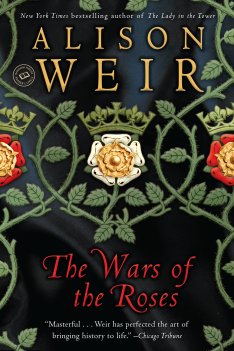 The Wars of the Roses was a series of wars from 1455 until 1487 for the throne of England. It is traditionally taught that it was between the houses of York and Lancaster, yet there were a lot more players involved than these two families. In fact the conflict started much earlier with the children of Edward III and Philippa of Hainault. The Lancasters were the descendants of John of Gaunt and his wife Blanche of Lancaster while the Yorks were descendants of Edmund of Langley Duke of York. This was a series over the question of who had the strongest claim to the throne. This question and the series of wars that would try to answer it is explored in depth in Alison Weir’s book “The Wars of the Roses”.
  Adventures of a Tudor Nerd