
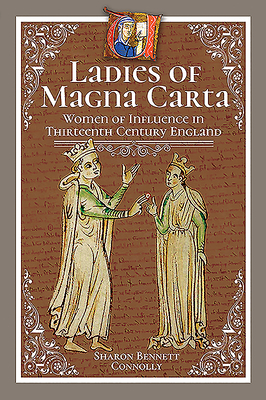
 The year of 1215 marked a turning point in English history with the sealing of a rather unique document; the Charter of Liberties, or as we know it today, the Magna Carta. It was a charter from the people to a king demanding the rights that they believed that they deserved. Those who sealed it were rebel barons who were tired of the way King John was running the country, yet instead of asking for his removal, they wanted reform. The clauses mostly concerned the problems of the men who made the charter, however, three clauses dealt with women specifically. In her latest book, “Ladies of Magna Carta: Women of Influence in Thirteenth Century England”, Sharon Bennett Connolly explores the lives of the women who were directly impacted by this document.
I would like to thank Pen and Sword for sending me a copy of this book. I enjoyed the last book that I read by Sharon Bennett Connolly and so when I heard that this book was going to be released, I knew I wanted to read it. I did not know much about thirteenth-century English history and the Magna Carta, so I was excited to start this new adventure.
To understand why the Magna Carta was considered an essential document for the time that it was forged, Connolly dives into the life of King John. His life and legacy will touch every woman in this book so it is vital to understand how John ran England while he was king. Although Connolly tends to be slightly repetitive with information about John, it is imperative that we as readers understand the significance of this reign and why it led to the Magna Carta, which radically changed English history forever.
Now, when one thinks about women who lived during thirteenth-century England, we tend to think about women whose marriages and bloodlines would interlace the numerous noble families of the time. Though some of the tales follow this pattern, there were some women and families who went against the norm. Women like Matilda de Braose, whose horrific imprisonment and starvation that led to her death, paved the way for clause 39 of the Magna Carta. There were also extremely strong women, like Nicholaa de la Haye, who was England’s first female sheriff and gained power and prestige by her own merits. These women acted as peacemakers by marrying foreign princes, or they were married to rebels against John. And of course, some women knew John well, like his wife Isabella of Angouleme, who had a very negative reputation because of John.
What I enjoyed about this book is how Connolly shared stories from women of many different walks of life. They were all so different and so unique. Connolly’s meticulous research and her true passion for this time paired with her easy to understand writing style make this book an engaging and insightful read. I found this a delightful read. If you want a fantastic book that introduces you to the world of the Magna Carta and the women who directly affected by this charter, I highly recommend you read, “Ladies of Magna Carta: Women of Influence in Thirteenth Century England” by Sharon Bennett Connolly.
 A foreign princess who travels to England to marry the king to establish a strong political alliance. To those who study history, this is a story that has been told numerous times, but what makes this particular story unique is the people involved. The bridegroom was the recently-widowed Henry VIII, the shadow of his former self and notorious throughout Europe for having his second wife Anne Boleyn executed. His new bride to be is the German princess Anna of Kleve. To say that they did not see eye to eye would be an understatement as the marriage did not last long. Her story is often swept under the rug. Anna is often viewed as the “lucky” wife of Henry VIII, but was she? What was Anna’s story and what was her marriage with Henry really like? Alison Weir has taken up the challenge to give her readers a taste of what Anna’s life might have been like in this novel, “Six Tudor Queens: Anna of Kleve, Queen of Secrets”.
 Medieval kings are often painted as strong, colorful figures in history. They were warriors who fought to protect their families and countries. Often, we tend to think of men like King Henry V and King Edward IV when it comes to the late medieval kings of England. However, there was a man who was sandwiched between these two pillars of strength. He was the son of Henry V, the king who came before Edward IV, and the man who started the conflict known as the Wars of the Roses. Unlike these two men, Henry VI was a pious peacemaker and is often viewed as a mere man in the background who never measured up to the standards his famous father left behind. His story is often incorporated into other biographies of people of his time; Henry VI has not had a solid biography about his life in a long time. That is until now. Lauren Johnson has taken up the challenge of exploring the life of this often-overlooked monarch in her latest biography, “Shadow King: The Life and Death of Henry VI”.
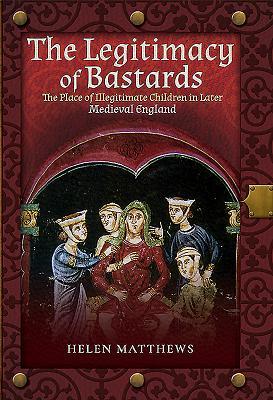 In the medieval world, a person’s lineage was everything. It determined who you could marry, what job you could have, and where you could live. To be considered a legitimate child meant that the world was your oyster, for the most part. It was a bit difficult if you were considered an illegitimate child. We often look at lineage when it comes to royal families, but what about the nobility and the gentry. If you were considered an illegitimate child in the late medieval time period to a family who is part of the nobility or the gentry, what kind of opportunities would be available to you? This question and others are explored in Helen Matthews’ book, “The Legitimacy of Bastards: The Place of Illegitimate Children in Later Medieval England”.
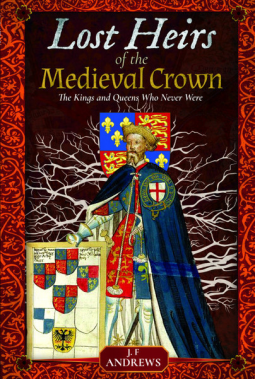 In history, we tend to focus on those who were crowned kings and queens of different nations. Their strengths and their weaknesses. Their accessions and the legacies that they left behind. With every story of someone who triumphed in gaining the throne, there are tales of those who were close to the throne but were never able to achieve the ultimate goal of ruling a nation. These “lost heirs” fall into two categories; either their names live on in infamy or they are thrown into the dust of the past. Who were these men and women and why did they lose their chances to sit on the throne? These questions are explored in J.F. Andrews’ book, “Lost Heirs of the Medieval Crown: The Kings and Queens Who Never Were”.
 Young Nora Basset has no memory of her father, John, as he died when she was very young. Her first years are spent at Umberleigh in Devon with her family. When she is three years old, she meets her grandmother, Honora Lisle, who has returned from imprisonment in Calais and has been tragically widowed. Nora and her grandmother form a close bond, as the child unwittingly assists the older woman to come to terms with her loss. The following year, Nora’s mother, Frances Plantagenet, remarries. Her new husband is Thomas Monk of Potheridge and the family leaves Umberleigh to begin their new life.
 The medieval era was one of the most turbulent times in all of English history, full of family feuds, gruesome wars, and so many twists and turns. We tend to focus on the big stories, but, it was not just about the royalty and the nobility, there were also lower classes whose lives went on in the background. What was everyday life like for both the rich and the poor? What ceremonies and recipes did they use? What were wills and court cases like? These questions and more are explored in Toni Mount’s delightful book, “A Year in the Life of Medieval England”.
 In history, we tend to focus on the stories of the men and women who shaped the era. This is obviously important, but the locations where the events of the past happened are equally as important. Sadly, many of the buildings that the men and women from the past knew no longer exist. However, there are a few, especially from the Tudor period, that we can still visit. Suzannah Lipscomb explored over 50 of these remarkable buildings and decided to tell their tales in her book, “A Journey Through Tudor England”.
 In English history, the story of the royal families tends to capture the imagination of those who study it. Full of dynamic tales of kings and queens, and numerous nobles, these are tales that make it into history books and history classes. We tend to focus on the same kings and queens, who have become the popular royals. But what about those who are left in the dust of those popular royals? Who were the royal women who lived in the shadow of the throne that time has forgotten? What were the lives of these women like? It is these women who are the focus of Erin Lawless’s latest book, “Forgotten Royal Women: The King and I”.
 There is a new film that has been getting a lot of hype lately and that is based on the story of King Henry V and the Battle of Agincourt. Starring Timothee Chalamet as the main protagonist King Henry V, “The King” on Netflix is the latest historical drama movie that has come out this year. From the trailers and the information that we learned about the film before it was released, I was really intrigued, so I decided to watch it this weekend. Since there were a lot of things I wanted to discuss, I have decided to write a sort of movie review for “The King”.
 Adventures of a Tudor Nerd