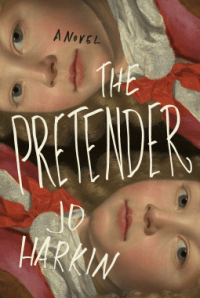
Book Review: “The Pretender” by Jo Harkin

The Wars of the Roses are ending, and with it comes uncertainty about who will lead the country. On one side is King Richard III, who many believe killed his nephews to become King of England; on the other is Breton Henry, Henry Tudor, who believes he is the rightful king due to his bloodline. However, there is a third player in this entire debacle. A young farm boy named John Collan may spend his days daydreaming and studying to his heart’s content, but he is destined for more. A path that will lead him to hobnob with nobility and become the enemy of a king who just sat on his throne. Just who is John Collan, and how did this boy go from the farm to a life of infamy? Jo Harkin tells the story of how John Collan became Lambert Simnel in her novel, “The Pretender.”

I would like to thank Knopf and Net Galley for sending me a copy of this novel. As someone who reads a lot about the Wars of the Roses, I tend to gravitate towards the main players and the nobility. However, there was something about a novel all about one of the pretenders, Lambert Simnel, that piqued my curiosity. Plus, the fact that this was the author’s first foray into historical fiction was a nice touch. I wanted to see how well Harkin would do with an obscure figure and her first historical fiction novel.

We begin with John Collan, a son of a farmer who dreams of being a scholar and running away from a rather vicious goat. John’s father, Will Collan, is a pretty wealthy man, but he is also connected to a man named Maister Richard Simons, who agrees to tutor John at Oxford. Such a remarkable turn of luck for a farm boy, but why choose him over others? Maister Simons explains that Will Collan is not John’s father. His name is not even John. He is to be known as Lambert Simnel, and his true father is none other than George, Duke of Clarence, which makes him Edward, Earl of Warwick. It’s a lot to take in, but then John/Lambert is taken to both Burgundy and Ireland so that he can gain powerful allies such as Margaret, Dowager Duchess of Burgundy, John de la Pole, 1st Earl of Lincoln, and the Earl of Kildare.

John/Lambert continues to study, falls in love with a girl named Joan, is crowned king, and even goes to war against the Tudor king. But the boy will soon learn the bitter taste of betrayal and the heartache of losing those he loves the most to try and wrest the crown from Henry VII. While the dialogue was at times borderline vulgar, I did enjoy most of the story until the aftermath of the Battle of Stoke Field. It was when John/Lambert was held captive that it fell flat, and it was a bit difficult to follow along for me. I also wish Harkin had included some sort of author’s note or explanation of her research to help those who are new to Lambert Simnel’s story understand why she wrote the novel in the way she did.

Overall, I think this was a decent novel. It is ambitious to tackle an obscure figure like a pretender as a protagonist of a historical novel, but I think Harkin does a good job. It makes you wonder what must have been going on when this young man decided that he was going to take on a crowned king. Such a small footnote in history makes one compelling tale. If you want a novel about someone who does not get enough attention, I recommend you read “The Pretender” by Jo Harkin.

Book Review: “On This Day in the Wars of the Roses” by Dan Moorhouse

On this day in the Wars of the RosesThe Wars of the Roses, a conflict that engulfed English politics for over 30 years and heralded a new dynasty, the Tudors. While there were battles and political intrigue galore during this period of unrest, there were also births, marriages, and deaths of powerful figures. Each day during the Wars of the Roses holds significance to nobles and commoners alike. Dan Moorhouse has compiled his years of research into this conflict into his book, “On This Day in the Wars of the Roses.”

I would like to thank Dan Moorhouse for sending me a copy of this book. I have been studying the Wars of the Roses for a few years now and so when I hear about books on the subject, I jump at the chance to read them to see if they bring any new revelations to the period.

Like many other books that focus on historical events of the past, Moorhouse highlights each date, starting from January and ending in December. However, unlike other books, the dates do not go in chronological order by year the entries jump from decade to decade, telling a more comprehensive story of the conflict.

Throughout this book, Moorhouse explores major battles, the disappearances of the Princes in the Tower, the madness of King Henry VI, and plots and executions of nobles and commoners alike. We also get to see how commoners got along during these tumultuous times through advancements in trade, alchemy, military tactics, and marriages. By focusing on the stories of those who were not nobility, Moorhouse is showing that even though this was a conflict for the crown, normal life moved on, as it always does.

Moorhouse is very knowledgeable about the period and can share all that he knows succinctly. He is also able to keep a neutral tone, neither siding with the Lancastrians nor the Yorkists, for the historical facts to speak for themselves. I found myself enjoying this book and the new stories from this conflict that I never knew. If you want a different approach to the Wars of the Roses, I recommend you read, “On This Day in The Wars of the Roses” by Dan Moorhouse.

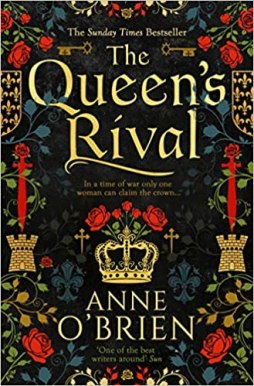
Book Review: “The Queen’s Rival” by Anne O’Brien

the queen's rivalEngland is in the midst of chaos in a conflict known as the Wars of the Roses. The Yorkist cause is formulating a case to take the throne’s power from Henry VI and the Lancastrians and replace the king with Richard, Duke of York, whose claim to the throne is a bit stronger. Caught in the middle of the Wars of the Roses was one strong and courageous woman who would fight tooth and nail for her family and the Yorkist cause. Her name was Cecily Neville, Duchess of York, and her story is masterfully told in Anne O’Brien’s novel, “The Queen’s Rival.”

A few years ago, I hosted Anne O’Brien to discuss this book as part of a blog tour for The Coffee Pot Book Club. I will admit that this was the first time I had read a novel by Anne O’Brien, but I had heard amazing things about her writing style, so when I saw this novel at a bookstore, it was an instant buy for me.

We begin in the year 1459 and the house of York is facing a disaster. The Yorkists have lost the Battle of Ludford Bridge and must now separate and go into exile. Cecily can only watch as the Lancastrians lay siege to her home, forcing her and her young children to be imprisoned at Tonbridge Castle. This moment might have broken Cecily’s spirit, but Cecily is a proud Neville, willing to fight until the bitter end to see her family safe and secure on the throne of England. Along the way, she must endure heartache (such as the death of her husband Richard Duke of York) and moments of betrayal, such as George, Duke of Clarence, and Richard, Earl of Warwick. Cecily’s name and reputation are dragged through the mud on numerous occasions. However, she gets to witness moments of glory, the crowning of her sons Edward IV and Richard III, and the birth of her grandchildren, to create the House of York.

My favorite aspect of this novel is that the chapters are not written like traditional chapters. The chapters are a series of letters to and from Cecily to her family members or those she considers her enemies to convince them to give her and her family leniency. Cecily’s main correspondences are with her sisters, Anne Duchess of Buckingham, and Katherine Dowager Duchess of Norfolk. One of my favorite characters is the author of England’s Chronicle, who reminds me of a gossip columnist, ready to spill all the secrets and rumors to anyone who will hear it.

I had such a fun time reading this novel. Even though I knew the events of the Wars of the Roses and what would happen, I found it refreshing to read it as a series of letters so that you can sense how the historical figure might have felt during that moment. This may have been my first novel by Anne O’Brien, but it definitely will not be my last. If you want a thrilling novel about the Wars of the Roses from the perspective of Cecily Neville, I highly suggest you read, “The Queen’s Rival” by Anne O’Brien.

Book Review: “Red Rose, White Rose” by Joanna Hickson

20892659One woman is torn between the loyalty to her birth family and the loyalty to her family by marriage. Now, this may sound like the story of Elizabeth of York, but alas, it is not. This story does take place in the fifteenth century, but it is the story of Elizabeth of York’s grandmother, “The Rose of Raby,” Cecily Neville. Born to the proud Neville family, who were proud Lancastrians, Cecily’s father, Ralph Neville, the Earl of Westmorland, arranged a marriage for his daughter to the young and ambitious Richard, Duke of York. She is now one of the most powerful women in England, but with power comes risks of ruin as Cecily has a secret that could be disastrous. War looms between the Red Roses of Lancaster and the White Roses of York, one that will transform English history forever, with Cecily caught in the middle. Her story is told in Joanna Hickson’s novel, “Red Rose, White Rose.”

Hickson begins her book by showing the interaction between Cecily and her half-brother, Cuthbert or Cuddy. Cecily is engaged to Richard Duke of York when she is kidnapped but is later rescued by John Neville, a distant cousin. In John Neville’s care, Cecily Neville’s life takes an unexpected turn, and a secret relationship is formed between the two. Although I know this was a fictitious relationship invented for this book, it still did not sit well with me. I have always thought Cecily was loyal and devoted to her husband and family (even though there were rumors of her and a knight having an affair), so this did not fit my view of Cecily Neville.

The bulk of this novel explores how Cecily and Richard were able to navigate the complex world of 15th-century English politics while their family grew. We also see Cuthbert fall in love and have his own family while he stays by Cecily’s side during such a tumultuous time.

This novel did not spend much time on the Wars of Roses. We get to see the origins of the major battles and how Edward became king, but we don’t see Cecily trying to hold her family together. I wanted to see her interactions with her sons Edward, George, and Richard during their feuding years. I wanted to see her reactions to Edward’s marriage to Elizabeth Woodville and her interactions with her daughter-in-law. In short, I wanted a longer story that focused more on the Wars of the Roses and how Cecily Neville dealt with the changes in her family dynamic due to the throne’s power.

Overall, this novel was enjoyable and well-written. Some elements were included that I disagreed with their concept. The story was engaging and gave Hickson’s audience a sneak-peek into Cecily Neville, Richard Duke of York, and their children. If you want a solid novel about Cecily Neville, I recommend reading “Red Rose, White Rose” by Joanna Hickson.

Book Review: “Cecily” by Annie Garthwaite

55818511._SY475_The Wars of the Roses was a time filled with dynamic figures who fought for the right to restore order to England. We often think about the strong warrior men who marched into battle, facing their inevitable doom just for the chance to wear the crown and rule the land. The women who stood by their husbands’ and sons’ sides were just as strong as their male counterparts, even if they did not wear armor. They were on the sidelines, ensuring that they could create alliances that would prove helpful in future conflicts. The most famous examples of strong women during the Wars of the Roses are Margaret of Anjou, Margaret Beaufort, and Elizabeth Woodville. Yet, there was another woman who stood firmly on the side of the Yorkist cause. She was known as the Rose of Raby and the wife of Richard, Duke of York. Her name was Cecily Neville, and she is the protagonist of Annie Garthwaite’s brilliant debut novel, “Cecily.”

I have been a fan of Wars of the Roses historical fiction for a while now, and so when I heard about this novel, I knew I wanted to read it. I usually don’t comment about the covers of books, but this particular cover was simply gorgeous, which added to my desire to read it. Cecily Neville is one of those characters that is rarely given a chance to shine, so this book was a treat to see how Garthwaite would portray her.

Garthwaite’s novel begins with the execution of Joan of Arc, which was an event that Cecily Neville witnessed with her husband Richard Duke of York. It marked a turning point for the English campaign in France as the young King Henry VI was crowned King of France. Richard Duke of York is a cousin of the young king and is considered next in line to the throne until Henry VI has a son. Richard is given command of the French campaign, with his beloved wife by his side. Cecily and Richard have known the sorrow of losing children, but eventually, their family begins to grow with the birth of their eldest son Edward. More children will follow, including Edmund, George, and little Richard often referred to as Dickon.

The campaign in France does not end well, so Cecily, Richard, and their growing family go back to England. Along the way, Henry VI decides to take Marguerite of Anjou as his bride; Marguerite and Cecily start as friends and allies, but their relationship will eventually sour and turn into rivals. Richard and Cecily will travel to Ireland to help their king to show their loyalty. Still, when Henry VI falls ill, Richard believes that he must protect his king and country from men like Henry Beaufort, Duke of Somerset, who is a favorite of Queen Marguerite.

It was during this conflict that Cecily’s true strength shines through. She not only has to be a mother to her growing family, but she has to act as a political advisor and confidant to her husband while staying loyal to her king and undermining the queen’s authority. It was not a rebellion that Richard and Cecily wanted, but they felt that it was a necessary evil to protect their family and their kingdom. To see Cecily protecting her young children from the Lancastrian as her husband and oldest sons flee to fight another day. When Richard and their son Edmund tragically died at the battle of Wakefield, to see Cecily go through her grief while fighting to give Edward a chance to defend her family’s honor was inspiring.

This novel was a delightful read. Garthwaite portrayed Cecily as a strong, independent wife and mother who would stop at nothing to protect her dear ones. For a debut novel, this is a smash hit. It is unique and tells an engaging story that every fan of the Wars of the Roses will love. I cannot wait for Garthwaite’s next novel. If you want a new book with a heroine that you will adore, check out “Cecily” by Annie Garthwaite.

Book Review: “The Sunne in Splendour” by Sharon Kay Penman

1321064._SY475_A banner decorated with three suns flaps in the wind on the field of battle. The young man behind this emblem is Edward, Earl of March, whose father Richard Duke of York and brother Edmund Earl of Rutland were tragically slain at the Battle of Wakefield. His younger brothers, George Duke of Clarence and Richard Duke of Gloucester, will help Edward carry their father’s cause for the family of York to rule England. When loyalty is questioned even among family members, only one man would truly stand behind Edward until the bitter end. That man would be Richard Duke of Gloucester, or as we know him today, the much-maligned King Richard III. He is often viewed as a treacherous child-killer who coveted the throne after Edward IV’s death, but is that accurately portraying the last Plantagenet king? Who was the real King Richard III? In her magnum opus, “The Sunne in Splendour,” Sharon Kay Penman presents her case for Richard III as a man betrayed, both in life and after his death.

I want to thank everyone who has recommended this book to me in the past. I know that Sharon Kay Penman recently passed away, and I felt that the only way to celebrate the anniversary of the Battle of Bosworth Field this year was to read this novel. I knew that it was well beloved in the Ricardian and the Wars of the Roses communities, so I wanted to see what made this novel so memorable.

Penman chooses to tell this story through multiple points of view, which, contrary to popular belief, works cohesively and allows each character to have their voice. We are introduced to Richard as a young boy before his father and Edmund die in battle. He is a timid child who witnesses death and destruction all around him and is trying to process everything. We see him grow from a scared child to a warrior duke and later into a king who had to deal with betrayal and heartache around every corner.

What Penman does brilliantly is how she writes her characters to make them so realistic that you forget that you are reading a novel. She fleshes out the conflicts exceptionally well, like the struggle between the brother Richard, George Duke of Clarence, and Edward IV. The love between Richard and his bride Anne Neville is pure and wholesome. The loyalty between Richard and Edward IV and towards Edward’s children, especially the princes in the tower is undeniable. Then there is the tension between the brothers and their cousin Richard Earl of Warwick trying to establish this new York dynasty. And what would a series of wars be without those fighting to keep their rule, which was the Lancastrians led by the ferocious Margaret of Anjou. It felt like I was being introduced to a new side of the Yorkist cause when I read this novel.

The action scenes are intense, and the betrayals hit harder than what you usually read in nonfiction books about the Wars of the Roses. This novel is truly a love letter to this period and a brilliant work of literature. I am not sure why I waited so long to read this masterpiece, but I am glad I finally read it. If you want an exceptional novel about the Wars of the Roses and Richard III, “The Sunne in Splendour” by Sharon Kay Penman is a must-read.

Guest Post: “Cecily Neville, Duchess of York: Inspiration for The Queen’s Rival” by Anne O’ Brien

The Queen's RivalToday, I am pleased to welcome Anne O’Brien to my blog to discuss the inspiration for her latest novel, The Queen’s Rival. I would like to thank Anne O’Brien and The Coffee Pot Book Club for allowing me to be part of this blog tour. 
In past years I have written about a variety of medieval women, either royal or attached to the Court.  I enjoy investigating how these women played a role in the political manoeuvrings of their day.  Although we so rarely hear the voices of these women, since they lived in a man’s world and the history was invariably written by men, their involvement was often considerable and they deserve our interest.

Cecily Neville, Duchess of York, is one of the most appealing women of English medieval history, worthy of celebration.  Most medieval women verge towards the invisible, a two-dimensional entity without character or apparent influence; Cecily Neville is an exception.  The Wars of the Roses were both vast in scope and complex in the range of family connections.  So was Cecily’s own Neville family with its royal blood inherited through their mother Joan, Countess of Westmoreland, daughter of John of Gaunt. Cecily demanded in a regal fashion that she be allowed to speak for herself.  It was a challenge that lured me to become involved; I accepted the challenge and wrote about her. 

Without a doubt, Cecily was a remarkable woman, living for eighty years through five reigns, interacting with a vast dramatis personae of famous, infamous, and influential characters in these tumultuous years.  She was the mother of two kings, Edward IV and Richard III, and  grandmother to a Queen Consort, Elizabeth of York, who stepped across the divide between York and Lancaster and married King Henry VII.

On the surface, this would seem to be a life bringing Cecily immense satisfaction and personal achievement, but it was also a life of tragedy.  Cecily outlived all but two of her twelve children, both daughters, some dying in infancy, others meeting terrible ends.  George, Duke of Clarence, was executed for treason, on the orders of his brother King Edward, in the Tower of London.  Richard III died on the battlefield at Bosworth; Edmund of Rutland met his end in an act of revenge after the Battle of Wakefield.  What heartbreak this must have inflicted on her, added to the death of her husband, Richard, Duke of York, at Wakefield.

Cecily’s life also witnessed its share of scandal.  The rumour of her liaison with the common archer Blaybourne, thus prompting the blot of illegitimacy against King  Edward IV, was too valuable a rumour to ignore for those such as the Earl of Warwick and Duke of Clarence who would willingly depose King Edward.  Was the scandal true?  Unlikely, but the widespread gossip must be faced.  How difficult for a woman of Cecily’s pride to accept that her own family would dishonour her reputation.

Would such tragedy obliterate the strength of Cecily’s character?  Cecily worked tirelessly for the House of York. She stood by her children as far as it was possible, even George of Clarence, trying to bring him back into the Yorkist fold.  In Ludlow, abandoned by her husband, Cecily faced a leaderless Lancastrian army and howling mob intent on plundering the town. She proved to be a woman of great courage.  As old age approached, she devoted herself to a life of duty and formidable piety almost worthy of the life of a nun, a life of loyalty to the family she had always supported.

Cecily, Duchess of York, was the doyenne of late medieval history, the Queen who was never crowned.  It would have been unforgivable of me to leave her out of my pantheon of medieval ‘heroines’. 

The Queen's Rival final version(Blurb)

England, 1459. 

One family united by blood. Torn apart by war…

The Wars of the Roses storm through the country, and Cecily Neville, Duchess of York, plots to topple the weak-minded King Henry VI from the throne.

But when the Yorkists are defeated at the Battle of Ludford Bridge, Cecily’s family flee and abandons her to face a marauding Lancastrian army on her own.

Stripped of her lands and imprisoned in Tonbridge Castle, the Duchess begins to spin a web of deceit. One that will eventually lead to treason, to the fall of King Henry VI, and to her eldest son being crowned King Edward IV.

Buy Links

Amazon UK: https://www.amazon.co.uk/Queens-Rival-Anne-OBrien/dp/0008225532

Amazon US: https://www.amazon.com/Queens-Rival-Anne-OBrien/dp/0008225532

Amazon CA: https://www.amazon.ca/Queens-Rival-Anne-OBrien/dp/0008225532

Amazon AU: https://www.amazon.com.au/Queens-Rival-Anne-OBrien/dp/0008225508

Barnes and Noble: https://www.barnesandnoble.com/w/the-queens-rival-anne-obrien/1137842630

Waterstones: https://www.waterstones.com/book/the-queens-rival/anne-obrien/9780008225544

Kobo: https://www.kobo.com/gb/en/ebook/the-queen-s-rival-the-sunday-times-bestselling-author-returns-with-a-gripping-historical-romance

Audio: https://www.audible.co.uk/pd/The-Queens-Rival-Audiobook/0008225524

Blackwells: https://blackwells.co.uk/bookshop/product/The-Queens-Rival-by-Anne-OBrien-author/9780008225544

WHSmith: https://www.whsmith.co.uk/products/the-queens-rival/anne-obrien/hardback/9780008225544.html

Anne O'Brien promo picAuthor Bio

Anne O’Brien

Sunday Times Bestselling author Anne O’Brien was born in West Yorkshire. After gaining a BA Honours degree in History at Manchester University and a Master’s in Education at Hull, she lived in East Yorkshire for many years as a teacher of history.

Today she has sold over 700,000 copies of her books medieval history novels in the UK and internationally. She lives with her husband in an eighteenth-century timber-framed cottage in the depths of the Welsh Marches in Herefordshire. The area provides endless inspiration for her novels which breathe life into the forgotten women of medieval history.

Social Media Links:

Website: https://www.anneobrienbooks.com/

Twitter: https://twitter.com/anne_obrien

Facebook: https://www.facebook.com/anneobrienbooks/?ref=bookmarks

LinkedIn: https://www.linkedin.com/in/anne-o-brien-89668a45/

Pinterest: https://www.pinterest.co.uk/thisisanneobrie/_saved/

Amazon Author Page: https://www.amazon.co.uk/Anne-OBrien/e/B001HD1NHI

Goodreads: https://www.goodreads.com/book/show/51111864-the-queen-s-rival?from_search=true&from_srp=true&qid=MIYPBpVMFH&rank=1

News Letter sign up: https://www.anneobrienbooks.com/

Book Review: “The Wars of the Roses: The Fall of the Plantagenets and the Rise of the Tudors” by Dan Jones

24611635._SY475_England throughout the centuries has known internal strife with civil wars to determine who had the right to rule the island nation. None more so than in the fifteenth century when a tug of war for the English crown broke out. Today, we call this time period “The Wars of the Roses”, but what was it all about? Who were the main figures during this time? What were the crucial battles that defined these wars? How did the Plantagenet Dynasty fall and how did the Tudors become the new dynasty to rule England? These questions and more are explored in Dan Jones’ book, “The Wars of the Roses: The Fall of the Plantagenets and the Rise of the Tudors”.
I will admit that this was not my first time reading this particular book. I did borrow it from my local library and read it a few years ago, but I enjoyed it so much that I decided that I wanted to add it to my personal collection.

Jones begins his book with the horrific execution of the elderly Margaret Pole, the last white rose of York. Her death had more to do with her Plantagenet blood and the fact that she was the daughter of George, Duke of Clarence, than with any crime she committed. It was the royal blood and who had the right to rule that was at the heart of the Wars of the Roses, as Jones goes on to explain.

Although the true origins of the conflict go back to the sons of Edward III and Philippa of Hainault, Jones chooses to explore the reign of King Henry V, Catherine of Valois, and their son Henry VI. When Henry V tragically died of dysentery, his infant son Henry VI became king of both England and France. This wouldn’t have been a problem if Henry VI was as strong as his father, but alas, as king was very weak, which meant that he needed help to rule his kingdoms. It was the rivals between the powerful men and women behind the crown, like Richard, Duke of York and Margaret of Anjou, which led to the thirty years of civil wars.

What I appreciate about Jones’ book is that his focus is on the people who made the Wars of the Roses so fun to study. From Henry VI and his dynamic wife Margaret of Anjou to the sons of Richard duke of York; Edward IV, Richard III ( Ricardians might not agree with Jones’ assessment of Richard III) and George Duke of Clarence. Then there are figures who stand on their own who worked behind the scenes, like Warwick “The Kingmaker”, Margaret Beaufort, Owen and Jasper Tudor, the Princes in the Tower, and the ultimate victor, Henry VII.

Jones was able to weave the stories of these extraordinary people with the bloody battles and the politics that defined the era into this delightful book. It acts as a fantastic introduction to this turbulent time in English history that brought the downfall of the powerful Plantagenets and brought forth the Tudors. Another enjoyable and engaging book by Dan Jones. If you want to begin a study into this time, I highly recommend you read, “The Wars of the Roses: The Fall of the Plantagenets and the Rise of the Tudors”.

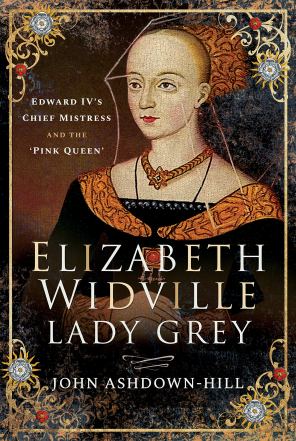
Book Review: “Elizabeth Widville Lady Grey: Edward IV’s Chief Mistress and the ‘Pink Queen’” by Dr. John Ashdown-Hill

A1EHw9PpVwLThe English conflict known as the Wars of the Roses is filled with dynamic figures whose stories are those of legends. None more so than the wife of Edward IV and the mother of Elizabeth of York and the princes in the Tower, Elizabeth Woodville. She has been known in popular culture as the commoner turned “White Queen” consort, but do we really know the true story about her life? Was she really Edward IV’s wife? How much influence did she actually carry? These questions and more are tackled in Dr. John Ashdown-Hill’s latest book, “Elizabeth Widville Lady Grey: Edward IV’s Chief Mistress and the ‘Pink Queen’.

I would like to thank Pen and Sword Books for sending me a copy of this book. I have had my eyes on this particular title for a while since I like learning about the women of the Wars of the Roses, and because I have never read a book by Dr. John Ashdown-Hill.

Since I was not familiar with Dr. John Ashdown-Hill and his work before I read this book, I decided to look into him in order to understand the position he might take on this particular topic. He is a medieval historian, who mainly focuses on Yorkist history. His main claim to fame was when he helped find the location where Richard III’s remains were buried. He also traced the female-line descendants of Richard III to his sister, which established the mtDNA haplogroup that was necessary to identify the remains found in the Leicester parking lot as Richard III. For this important research, Dr. John Ashdown-Hill was awarded an MBE in 2015 but sadly passed away from motor neurone disease on May 18, 2018. This was one of the last books he had ever written.

Knowing this information about Dr. John Ashdown-Hill, it helps to understand that he knows this subject rather well. He does show his knowledge through the family trees, the letters, and the tables that he does include. These sources give the reader an understanding of where Ashdown-Hill is coming from and a different perspective on Elizabeth Widville’s life and times in the courts of Edward IV, Richard III, and Henry VII. Ashdown-Hill does use his own books quite frequently as sources, which can come across as braggadocious at times.

Ashdown-Hill refers to Elizabeth Widville as the ‘Pink Queen’ because, at different times in her life, she was supporting the Lancastrians and the Yorkists causes. I do agree with this terminology because it does tell her story in a colorful way. However, it is his calling Elizabeth Edward IV’s ‘chief mistress’ where I do have an issue. Personally, I believe that Elizabeth was Edward’s wife, but Ashdown-Hill believes that Edward’s pre-contract with one Eleanor Talbot was valid and that Edward’s marriage to Elizabeth was bigamous. This is a central point in this book, but he does not really go into the depth that I wished he would have gone into to explain his point of view.

Another part of his book that I do not exactly agree with is his assessment of how many deaths Elizabeth was associated with, including possibly poisoning George Duke of Clarence’s wife and young son. He does not take into account illnesses as possible causes of death and jumps straight into malicious intentions, mostly by Elizabeth herself. Ashdown- Hill can come across as either passionate or brash in his writing style, which can be a bit off-putting at times. It feels like, at least to me, that Elizabeth was either treated as a villain or was in the background for this particular biography, instead of in the spotlight, which is something one would expect in a biography about a certain person.

Although I do not entirely agree with Dr. John Ashdown- Hill’s assessment of Elizabeth Widville’s life, I do respect the amount of research he obviously poured into this book. It is meticulously researched and I found it a unique experience to read a different perspective from my own. I wasn’t exactly the biggest fan of this book, as I did have to stop reading it and come back to it several times to get my head around what he was saying since it was different than what I accept as fact about her life. However, I do believe that it is important to read books and authors who you don’t agree with in order to expand one’s knowledge about a topic. If you are a fan of Dr. John Ashdown-Hill or you would like to read a unique take on Elizabeth Widville’s life and times, I would suggest you read “Elizabeth Widville Lady Grey: Edward IV’s Chief Mistress and the ‘Pink Queen’”.

Elizabeth Widville, Lady Grey: Edward IV’s Chief Mistress and the ‘Pink Queen’ by Dr. John Ashdown-Hill will be published in the United States on November 2, 2019. If you are interested in pre-ordering this book, you can follow this link: https://www.amazon.com/Elizabeth-Widville-Lady-Grey-Mistress/dp/1526745011/

Book Review: “Wars of the Roses: Ravenspur- Rise of the Tudors” by Conn Iggulden

41+RQteGLUL._SX324_BO1,204,203,200_By the year 1470, England had been embroiled in a civil war between the houses of York and Lancaster for nearly 20 years. Edward IV was king until he was driven out of the country by his former best friend Warwick and Edward’s own brother, George Duke of Clarence. The House of Lancaster is back in charge with Henry VI, but Edward IV and his other brother Richard Duke of Gloucester are not giving up without a fight. However, there is another family who wants to fight for the throne, the Tudors. How will it come to an end? Who will become King of England when all the major battles come to an end? These questions are answered in Conn Iggulden’s thrilling conclusion to his Wars of the Roses series, “Ravenspur- Rise of the Tudors.”

We are thrown back into the story with Edward forced to leave England and his wife and children forced to go into sanctuary while the Lancasters, with Warwick and George Duke of Clarence taking over military control. We are also introduced to new characters. Jasper Tudor, his nephew Henry Tudor, and Edward’s other brother Richard Duke of Gloucester, who would one day become King Richard III. In his historical note, Conn Iggulden explains Richard, his twisted spine and the struggle he might have had on the battlefield:

For all those who have imbibed a romantic view of King Richard III, I think they have cause to be grateful to Shakespeare, for all the bard’s delight in making him a hunchbacked villain. Without Shakespeare, Richard Plantagenet was only king for two years and would have been just a minor footnote to his brother’s reign. There is not one contemporary mention of physical deformity, though we know now that his spine was twisted. He would have lived in constant pain, but then so did many active fighting men. There is certainly no record of Richard ever needing a special set of armour for a raised shoulder. Medieval swordsmen, like Roman soldiers before them, would have been noticeably larger on their right sides. A school friend of mine turned down a career as a professional fencer because of the way his right shoulder was developing into a hump from constant swordplay- and that was with a light, fencing blade. Compare his experience to that of a medieval swordsman using a broader blade, three feet long or even longer, where strength and stamina meant the difference between victory and a humiliating death. (Iggulden, 456-457).

Iggulden explores the relationship between the main characters; Edward IV, Warwick, Jasper Tudor, Richard III, George Duke of Clarence, and Henry Tudor, and how the events between 1470 and 1485 radically changed their lives forever. The betrayal of Warwick and George and how that affected Edward and Richard. How Edward and Richard leaving England for a time affected Elizabeth Woodville and her children. When Edward and Richard landed in Ravenspur and marched against Warwick and George at the Battle of Barnet. The final defeat of the Lancasterian cause at the Battle of Tewkesbury and what followed after the death of Edward IV in 1483. And of course, the Battle of Bosworth where Henry Tudor wins the crown and begins the Tudor dynasty.

“Ravenspur” is a well-written and thrilling conclusion to Iggulden’s “Wars of the Roses” series. He was able to combine exciting battle scenes with family drama, internal dialogue, and political intrigue to create a masterpiece of a series. The only problem I had with the book was that I did want more dialogue from Elizabeth Woodville, Elizabeth of York and Margaret Beaufort. They seemed to have been sprinkled in when it was convenient. Overall, I found “Ravenspur” engaging and enjoyable. If you have read the three previous books in Conn Iggulden’s series, I highly encourage you to read “Ravenspur- Rise of the Tudors” as it brings the Wars of the Roses to a dramatic end.