
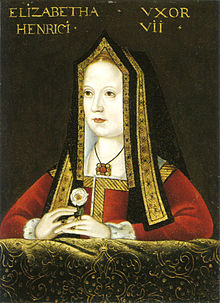
Biography: Elizabeth of York

220px-Elizabeth_of_York_from_Kings_and_Queens_of_England(Born February 11, 1466- Died February 11, 1503). Daughter of King Edward IV and Elizabeth Woodville. Married to King Henry VII. Mother of Arthur, Prince of Wales, Margaret, Queen of Scots, Henry VIII, King of England and Mary, Queen of France.
Elizabeth of York was the daughter, niece, sister, wife and mother of kings. It was through her marriage with Henry VII that helped create the Tudor Dynasty.

Elizabeth of York was the eldest child of Edward IV and Elizabeth Woodville. She was born at the Palace of Westminster on February 11, 1466. She was christened at Westminster Abbey; her godparents were Jacquetta of Luxembourg, Duchess of Bedford, Cecily Neville, Duchess of York, and Richard Neville 16th Earl of Warwick. When she was three years old in 1469, she was briefly betrothed to George Neville, the nephew of Richard Neville, but it did not go far since his uncle would die two years later. In 1475, Louis XI agreed to arrange a marriage between nine year old Elizabeth of York to his son, Charles, the Dauphin of France; in 1482, Louis decided not to go along with the promised wedding.

Elizabeth’s world drastically changed forever when her father, Edward IV, suddenly died on April 9, 1483. Her young brother Edward V was proclaimed king and her uncle Richard Duke of Gloucester was named Lord Protector. On April 29, as previously agreed, Richard and his cousin, the Duke of Buckingham, met Queen Elizabeth’s brother, Anthony Woodville, 2nd Earl Rivers, at Northampton. The young king himself had been sent to Stony Stratford. Richard had Earl Rivers, his nephew Richard Grey and his associate, Thomas Vaughan, arrested. They were taken to Pontefract Castle, where they were executed on June 25 on the charge of treason against the Lord Protector after appearing before a tribuna. Richard took the young king under his protection, escorted him to London, and placed him in the Tower for his protection. After hearing about what had happened, Elizabeth Woodville took her children, including Elizabeth of York, her other daughters, her youngest son Richard Duke of York, and fled to sanctuary in Westminster Abbey. Elizabeth Woodville tried to keep her son Richard Duke of York away from Richard Duke of Gloucester, but she eventually did give up her son. We do not know how Elizabeth of York reacted to these events.

In early June of 1483, the marriage between Elizabeth’s parents, Edward IV and Elizabeth Woodville, was declared invalid because it is said that Edward IV had entered into a pre-contract marriage with Lady Eleanor Butler before he married Elizabeth Woodville. This meant that any children of Edward IV and Elizabeth Woodville were considered illegitimate, including Edward V, Richard Duke of York and Elizabeth of York. Since the children of George Duke of Clarence were barred from succession because of their father’s treason and execution, the next in line to the throne was Richard Duke of Gloucester. Richard was crowned King Richard III on July 6, 1483 and Elizabeth’s brothers disappeared. Some say that they were murdered, others say they escaped, but at this point we do not know what happened to Edward V and Richard Duke of York.

Elizabeth’s mother Elizabeth Woodville was now known as Elizabeth Grey and she decided to side with the Duke of Buckingham and Margaret Beaufort to put Margaret’s son Henry Tudor on the throne. Henry Tudor was the closest male Lancastrian heir and in order to cement this new alliance, Elizabeth Woodville and Margaret arranged that Henry would marry Elizabeth of York. Buckingham’s rebellion against Richard would fail and he would be killed on November 2, 1483. In December 1483, Henry Tudor made an oath in Rennes, France that he would marry Elizabeth of York when he became King of England. In January 1484, the act known as Titulus Regius was passed by Parliament, which confirmed under law that the marriage between Edward IV and Elizabeth Woodville was invalid.

On March 1, 1484, Elizabeth Woodville and her daughters left sanctuary after Richard III promised not to harm them and to arrange marriages for all of Elizabeth’s daughters. There were rumors that after Anne Neville in March 1485, Richard III’s wife, died that he was seeking to marry Elizabeth of York, but there is no evidence to support this claim. Soon after Anne Neville’s death, Richard III sent Elizabeth away from court to the castle of Sheriff Hutton and opened negotiations with King John II of Portugal to marry his sister, Joan, Princess of Portugal, and to have Elizabeth marry their cousin, the future King Manuel I of Portugal.

These marriage arrangements did not come to fruition. Elizabeth of York stayed at Sheriff Hutton during August 1485, when Henry Tudor invaded England and on August 22, 1485 when Richard III fell at the Battle of Bosworth Field and Henry Tudor became King. Henry did keep his promise and married Elizabeth of York on January 18, 1486. The couple’s first child, Arthur, was born on September 20, 1486.

During 1487, a young man named Lambert Simnel, claimed that he was the earl of Warwick, Elizabeth’s cousin, so Henry VII had the real earl of Warwick taken from the Tower and paraded through London. It was at the last battle of the Wars of the Roses, the Battle of Stoke Field on June 16, 1487 that Lambert Simnel was defeated. Henry decided to let the boy live and gave him a job at the castle. Elizabeth was crowned on November 25, 1487 and she would have seven children total, four survived into adulthood; Arthur, Henry, Margaret and Mary. Although Elizabeth had a strong claim to the throne, she did not seek to become queen regnant.
In the early 1490s, another threat to the peace emerged with the contention that Elizabeth’s younger brother, Richard, Duke of York, was still alive. Her aunt, Margaret of York, Dowager Duchess of Burgundy and James IV of Scotland, were sponsoring a young man, later revealed to be a youth named Perkin Warbeck. Warbeck received wide-spread support from amongst Yorkists, who did not like Henry VII. Ultimately, however, Warbeck could not command enough support at home or abroad, to mount a successful challenge and in 1497, he was captured.

Warbeck’s wife Lady Catherine Gordon was made one of the ladies-in-waiting for Queen Elizabeth of York. In June 1498, Warbeck was forced to make two public appearances at Westminster and Cheapside, where he admitted that he was not Richard Duke of York and that Margaret of Burgundy was to blame for the entire scheme. Henry VII was kind to Warbeck at the beginning, allowing him to live at court, but Warbeck tried to escape and it landed him in the Tower of London, close to Edward Plantagenet, 17th Earl of Warwick, son of the late George, Duke of Clarence. Warbeck and Warwick plotted to escape the Tower, but the plan was uncovered and both men were charged with treason. Perkin Warbeck was hanged at Tyburn on November 23, 1499. We don’t know if Elizabeth of York ever met Warbeck.

Elizabeth was a very pious woman and was very dedicated to her children’s wellbeing. Elizabeth was very involved in the marriage negotiations for her two eldest children, Arthur and Margaret, Arthur to Katherine of Aragon, daughter of Isabella I of Castile and Ferdinand II of Aragon, and Margaret to James IV of Scotland. Elizabeth helped convince Katherine’s parents that she would be well taken care of and with Margaret’s marriage, Elizabeth was concerned that she was getting married at such a young age.

In November 1501, Katherine of Aragon arrived in England and Elizabeth was part of the celebrations of the marriage. The following year, tragedy hit hard as Arthur died on April 2, 1502. This was a tragic loss for Henry and Elizabeth because this meant that there was only one heir to save the Tudor Dynasty, the young Henry Tudor. While Henry was grieving, it is said that Elizabeth comforted him and told her husband that they were still young enough to have more children. Later, Elizabeth would break down and it was Henry who consoled his wife. Elizabeth would have one more child, a girl named Katherine, on February 2, 1503, but the baby would not live long. Elizabeth of York would die on her 37th birthday, on February 11, 1503.
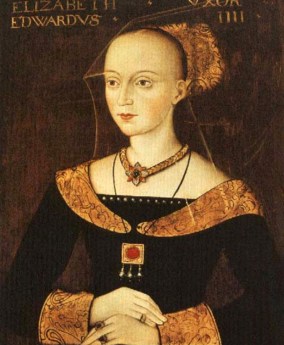
Biography: Elizabeth Woodville

(Born around 1437- Died June 8, 1492). Daughter of Jacquetta of Luxembourg and ElizabethWoodvilleRichard Woodville. Married to Sir John Grey and King Edward IV of England. Mother of Thomas Grey, Marquess of Dorset, Richard Grey, Elizabeth, Queen of England, Mary of York, Cecily, Viscountess Welles, Edward V, King of England, Margaret of York, Richard, Duke of York, Anne, Lady Howard, George, Duke of Bedford, Catherine, Countess of Devon and Bridget of York. Elizabeth Woodville was the woman who Edward IV fell in love with and married, much to the chagrin of Warwick. Elizabeth was the mother of the Princes in the Tower and Elizabeth of York, the mother of the Tudor Dynasty.

Elizabeth Woodville was the eldest child of Richard Woodville and Jacquetta of Luxembourg, born around 1437 at Grafton Regis, Northamptonshire. Her parents marriage was controversial because they married for love and without King Henry VI’s permission. Jacquetta was previously married to the brother of King Henry V and, although the Woodvilles were wealthy landowners, they were still considered genteel rather than nobles. Jacquetta was considered the second lady at court, next to the Queen Margaret of Anjou and Elizabeth was able to become one of the maids of honor for Queen Margaret of Anjou. With her high position at court, Elizabeth was able to marry well with her first marriage. She married Sir John Grey of Groby in 1452 and during this time, Elizabeth became one of the four ladies of the bedchamber to Margaret of Anjou. In 1461, Sir John Grey would die at the Second Battle of St. Albans, fighting for the Lancastrian cause, leaving Elizabeth a widow with two infant sons, Thomas and Richard Woodville.

Elizabeth Woodville’s sons, Thomas and Richard, did not receive the Bradgate inheritance that they deserved. Elizabeth went into mourning for two years at her family home at Grafton Regis in Northamptonshire. After the Yorkist victory a few weeks later at Towton, Edward IV, the new king, stopped by at Grafton Regis for a couple of days, where it is said he fell in love with Elizabeth Woodville. It is said that he saw her under an oak tree, waiting for him to arrive and to plead her case to get her sons’ inheritance, but there is no evidence that this actually happened. The couple married in secret sometime in May 1464.

At this time, Richard Neville “The Kingmaker” Earl of Warwick, was working on a marriage alliance with France. When Warwick and the Council found out about the marriage, they were rightfully upset. Not only did the King marry a woman who was a widow and not a princess, but now her relations were able to capitalize in the marriage market. Three of Elizabeth’s sister married sons of earls and her brother John, who was in his 20s at the time married Katherine Duchess of Norfolk, who was widowed three times and was in her 60s, causing quite a scandal. On May 16, 1465, Elizabeth was crowned queen consort and the following year, she gave birth to the couple’s first child, Elizabeth of York. Elizabeth of York’s godparents were her grandmother Jacquetta of Luxembourg and Warwick.

In 1469, Warwick decided to rebel against Edward IV and join the Lancastrian cause to put Henry VI back on the throne. After the Battle of Edgecote Moor, Elizabeth’s father Richard and her brother John were arrested and executed on August 12 at Kenilworth. Elizabeth’s mother Jacquetta was arrested by Warwick on the charges of witchcraft. These charges were dropped in February 1470.

In September 1470, Warwick invaded England and placed Henry VI back on the throne, forcing Edward IV to flee and Elizabeth and her children sought sanctuary at Westminster Abbey. During this time, Elizabeth gave birth to her first son, the future Edward V. In total, Elizabeth and Edward would have 10 children, including Richard Duke of York. Edward IV returned and defeated Warwick at the Battle of Barnet in April 1471. When Margaret of Anjou returned, she formed an army to march against Edward IV, which forced Elizabeth to seek shelter at the Tower of London. After the Battle of Tewkesbury, Elizabeth exited the Tower and Margaret of Anjou and Henry VI entered it; Henry VI would later die in the Tower. Elizabeth’s mother Jacquetta would die on May 30, 1472.

Life returned to a normal pace for Elizabeth Woodville and her family. In January 1477, she watched as her young son Richard Duke of York was married to Anne Mowbray; both the bride and groom were not over the age of 5 when the wedding happened. Another marriage, arranged between Elizabeth’s daughter Elizabeth of York and the Dauphin of France, fell through. Shortly afterward, Elizabeth’s world changed forever when her husband Edward IV died April 9, 1483 and Elizabeth was made queen dowager.

Elizabeth’s son was named Edward V and his uncle Richard Duke of Gloucester was named Lord Protector. On April 29, as previously agreed, Richard and his cousin, the Duke of Buckingham, met Queen Elizabeth’s brother, Anthony Woodville, 2nd Earl Rivers, at Northampton. At the queen’s request, Earl Rivers was escorting the young king to London with an armed escort of 2000 men, while Richard and Buckingham’s joint escort was 600 men. The young king himself had been sent to Stony Stratford. Richard had Earl Rivers, his nephew Richard Grey and his associate, Thomas Vaughan, arrested. They were taken to Pontefract Castle, where they were executed on June 25 on the charge of treason against the Lord Protector after appearing before a tribunal led by Henry Percy, 4th Earl of Northumberland. Richard took the young king under his protection, escorted him to London, and placed him in the Tower for his protection. After hearing about what had happened, Elizabeth Woodville took her children, including her daughters and her youngest son Richard Duke of York, and fled to sanctuary in Westminster Abbey.

Gloucester wanted Elizabeth to hand over her son Richard Duke of York. Elizabeth was very reluctant to hand over her son to his uncle, but eventually she did. Richard was said to have been informed with information that Edward V was illegitimate because Edward IV had entered into a previous marriage contract. On June 25, Parliament agreed that Edward V was illegitimate and the following day, June 26, Richard was proclaimed king. His joint coronation with his wife Anne Neville would occur on July 6, 1483, and his title was confirmed in an act of Parliament called the Titulus Regius, which was passed in January 1484.

We do not know what happened to the Princes in the Tower, Edward V and Richard Duke of York. They disappeared from sight after the summer of 1483, which has led many to speculate that Richard III had them murdered. At this point we cannot confirm or deny this theory. We don’t even know if they were murdered at all. It still remains one of the biggest unsolved mysteries in history.

Elizabeth Woodville was now known as Elizabeth Grey and she decided to side with the Duke of Buckingham and Margaret Beaufort to put Margaret’s son Henry Tudor on the throne. Henry Tudor was the closest male Lancastrian heir and in order to cement this new alliance, Elizabeth and Margaret arranged that Henry would marry Elizabeth of York. Buckingham’s rebellion against Richard would fail and he would be killed on November 2, 1483. In December 1483, Henry made an oath at a cathedral in Rennes, France to marry Elizabeth of York. At Richard III’s first Parliament in January 1484, he stripped Elizabeth Woodville of all of her lands that were granted to her during the reign of Edward IV. On March 1, 1484, Elizabeth and her daughters left sanctuary after Richard III promised not to harm them and to arrange marriages for all of Elizabeth Woodville’s daughters. There were rumors that after Anne Neville in March 1485, Richard III’s wife, died that he was seeking to marry Elizabeth of York, but there is no evidence to support this claim.

Later in August 1485, Henry Tudor invaded England and was able to defeat Richard III at the Battle of Bosworth on August 22, Henry became King Henry VII of England. Henry would marry Elizabeth of York, revoke the Titulus Regius and restore Elizabeth Woodville’s title and honors of queen dowager. The last five years of Elizabeth Woodville’s life she spent at Bermondsey Abbey. She was present for the birth of her grandchildren including Margaret Tudor and Henry Tudor, the future Henry VIII. Elizabeth of York and her sister Cecily Woodville would often visit their mother. Elizabeth Woodville died at the Abbey on June 8, 1492 and she was buried with her husband King Edward IV in St George’s Chapel in Windsor Castle.

Book Review:“Elizabeth of York: A Tudor Queen and Her World” by Alison Weir

91FsSB3hb9LThe Wars of the Roses was a dynastic battle between the houses of York and Lancaster for the throne of England that lasted for 30 years. There were plenty of people who lived during this time that continue to fascinate us even to this day. Men like Richard III, Henry VI, Edward IV, Henry VII,  and Richard Neville duke of Warwick to just name a few. There were also women who worked hard on the sidelines to make sure that their sides would win the wars. Women like Margaret of Anjou, Elizabeth Woodville, Cecily Neville, and Margaret Beaufort. However, one of the most important person during this conflict tends to get left behind when discussing the most influential people of this conflict; Elizabeth of York, the wife of Henry VII. She was the mother of the Tudor dynasty, yet she does not get the attention that she rightfully deserves. In Alison Weir’s book “Elizabeth of York: A Tudor Queen and Her World”, Weir explores the life of this influential woman and her impact on the world around her.

Weir begins her book by explaining her role in history:

Elizabeth of York’s role in history was crucial, although in a less chauvinistic age it would, by right, have been more so. In the wake of legislation to give women the same rights in the order of succession as male heirs; it is interesting to reflect that England’s Elizabeth I would not have been celebrated Virgin Queen but Elizabeth of York. But in the fifteenth century, it would have been unthinkable for a woman to succeed to the throne. Elizabeth lived in a world in which females were regarded as inferior to men physically, intellectually, and morally. It was seen as against the laws of God and Nature for a woman to wield dominion over men: it was an affront to the perceived order of the world. Even so, Elizabeth of York was important. She was the daughter, sister, niece, wife, mother and grandmother of monarchs: daughter  to Edward IV, sister to Edward V, niece to Richard III, wife to Henry VII, mother to Henry VIII, and grandmother to Edward VI, Mary I, and Elizabeth I; and she was the mother of two queen consorts. She was also the ancestress of every English monarch since 1509, every Scots monarch since 1513, and every British monarch since 1603, including the present queen, Elizabeth II. (Weir, xviii).

Elizabeth of York obviously had a significant impact on English history from the end of the Wars of the Roses on to the present day, but what is more impressive is when you realize how much Elizabeth went through in her lifetime in order to achieve these accomplishments. Elizabeth of York was the eldest daughter of Edward IV and Elizabeth Woodville.  She was going to be married to the Dauphin of France, until the French decided to pull out of the marriage agreement. When her father fled as Warwick marched against him for the Lancastrians, Elizabeth Woodville took her children into sanctuary, where she gave birth to the future Edward V. Her father was a strong man, but he tragically died at the age of 40. Her young brother Edward V was to be the next king, but Edward was taken into the custody of her uncle, the future Richard III. Elizabeth Woodville took her children back into sanctuary where Richard told Elizabeth to give up her younger son. She did comply. The young king and his brother were taken to the Tower, Elizabeth’s brothers were never seen again, and Richard III became king.

Elizabeth’s mother never liked Richard so she arranged a marriage between Elizabeth of York and Henry Tudor, the son of Margaret Beaufort. When Richard III’s wife Anne Neville died there were rumors circulating that Richard would marry his niece, but Weir explains thoroughly the relationship between Elizabeth and her uncle. After Richard was defeated at the Battle of Bosworth Field, Henry VII waited to marry Elizabeth of York and have her crowned queen, which angered many Yorkist supporters, but Elizabeth loved Henry and kept her cool. Elizabeth took her role as wife and mother very seriously. When there were those who tried to take Henry’s throne by pretending to be Elizabeth’s brothers, she stood by Henry and by his claim to the throne. Elizabeth was the mother of Arthur Tudor, Margaret Tudor, Mary Tudor and the future Henry VIII. When Arthur died, Elizabeth consoled her husband in his sorrow and helped him realize that they did have another heir in Henry. She would die on February 11, 1503. Her husband Henry VII would never marry again and mourned her greatly.

Alison Weir brought Elizabeth of York’s life and her world to life in this book. As many of you know, I love the Wars of the Roses and one of the reasons I do is because of the life of Elizabeth of York. There is just something about her story that completely fascinates me. I have read a few fiction books about the life of Elizabeth of York,  but this was the first biography that I have read about Elizabeth of York. Like any Alison Weir book, Weir is able to balance her unique writing style with amazing details to create a vivid description of the person’s life, in this case the life of Elizabeth of York. This is a beautiful book about the life of a pious queen who united the houses of York and Lancaster to create the Tudor Dynasty through her marriage with Henry Tudor. I highly recommend “Elizabeth of York: A Tudor Queen and Her World” by Alison Weir for anyone who is interested in the Wars of the Roses or the love story of Elizabeth of York and Henry VII. An amazing woman who lived in an extraordinary time.

Biography: Margaret Beaufort

(Born May 31, 1443- Died June 29, 1509). Daughter of John Beaufort, 1st Duke of Somersetdownload (2) and Margaret Beauchamp of Bletsoe. Married to John de la Pole 2nd Duke of Suffolk, Edmund Tudor 1st Earl of Richmond, Sir Henry Stafford, and Thomas Stanley 1st Earl of Derby. Mother of Henry Tudor, later known as Henry VII. Margaret was the mother of the Tudor Dynasty. She never gave up on her son Henry Tudor.

Margaret Beaufort was born on May 31, 1443 to John Beaufort, 1st Duke of Somerset and Margaret Beauchamp of Bletsoe. She had seven half-siblings from her mother’s first marriage to Sir Oliver St John. Her father was the  second son of John Beaufort, 1st Earl of Somerset, the first son of John of Gaunt and Katherine Swynford. Margaret’s father went to France to fight for King Henry VI, but it went badly, and he either died from illness or committed suicide on May 27, 1444, leaving Margaret his sole heiress.

Under a deal that her father made with Henry VI, the king took wardship of Margaret, but the king broke that deal and passed on the wardship to William de la Pole 1st Duke of Suffolk. At this time, Margaret remained in her mother’s house to receive her education. On January 28, 1450, William de la Pole, who was not popular at all with Parliament, was ordered to be arrested. Between January 28 and February 7, 1450, Margaret and John de la Pole, the eldest son of William de la Pole, were married, yet they never lived together. With this marriage, William de la Pole was seen as reaching too far since Margaret was a potential heir for the throne and was charged with treason. William de la Pole was murdered on May 2, 1450. Margaret never recognized this marriage as she was under twelve when she was married.

In 1453, Margaret and her mother were called to court when Henry VI granted the wardship of Margaret to his half brothers Edmund and Jasper Tudor. With her first marriage annulled, it paved the way for the marriage between Margaret and Edmund. Margaret was 12 and Edmund was 24 at the time of the wedding on November 1, 1455. The marriage was consummated and soon Margaret was pregnant. Unfortunately, Edmund would never meet his son as he died on November 1, 1456 of the plague. Margaret gave birth to her only son Henry Tudor on January 28, 1457 at the age of 13. It was a difficult birth and Margaret was never to have another child after Henry.

Being a single mother and a young widow, Margaret knew that she had to marry again to make sure that she could financially survive. She arranged her own marriage and after the required one year of mourning was over, Margaret married Sir Henry Stafford on January 3, 1458. From what we can tell, it sounds like a happy marriage between Margaret and Sir Henry Stafford. When Henry was two years old, his uncle Jasper was granted wardship over him and so Margaret and Henry were seperated. After the Battle of Towton, Jasper fled to Scotland to help Margaret of Anjou, Edward Duke of York became Edward IV, and Henry Tudor was stripped of his lands and put in the custody of William Herbert. At this time, Margaret was able to keep in contact with her son.

In 1469, the House of Lancaster came back into power, but only for a short amount of time as the House of York came back into power. At the Battle of Barnet on April 14, 1471, Sir Henry Stafford was injured  fighting for the Yorkists and he would die from his wounds on October 4, 1471. Margaret was a widow again at the age of 28. Henry and Jasper fled the country for their own protection, leaving Margaret alone and in need of another husband and protector.

In June 1472, Margaret married her fourth and final husband Thomas, Lord Stanley. This was a marriage of convenience as Margaret was able to enter the court of Edward IV and Elizabeth Woodville in order to gain favor and secure her son’s return to England. Before this could happen, Edward IV died on April 9, 1483. The crown passed on to the king’s eldest son Edward V, but Edward and his brother Richard went to the tower for their own protection, never to be seen again. Their uncle Richard III became king, and even though Margaret carried the train at Queen Anne’s coronation, Richard stripped Margaret of all of her titles and land. During this time Margaret was plotting with Elizabeth Woodville to arrange a marriage between Henry Tudor and Elizabeth of York.

In 1483, Henry and Jasper failed to invade England. Richard found out that Margaret was part of this plot and she was charged with high treason, but instead of being executed, she was placed under house arrest. Margaret’s life changed for the better when her son was able to defeat Richard at the Battle of Bosworth Field on August 22, 1485, with the help of Margaret’s husband Thomas, Lord Stanley, and became King Henry VII.  Thomas, Lord Stanley was made Earl of Derby and Margaret was made Countess of Richmond and Derby. Margaret was able to see her son once again after 14 years apart. Margaret became the King Mother and was the second most important woman at court, next to Queen Elizabeth of York, who married Henry VII on January 18, 1486. Margaret was there to help with the births of her grandchildren, and the deaths of a few including Arthur Prince of Wales, who died on April 2, 1502.

Elizabeth of York would die on February 11, 1503, leaving Margaret’s son a widower. Thomas, Lord Stanley would die in 1504, and although she spent most of her son’s reign styling herself as a widow in order to have control over her own properties and finances, it still must have been a hard loss for Margaret. Margaret’s beloved son Henry VII died on April 21, 1509, and she took his death the hardest. Margaret Beaufort was able to see her grandson Henry VIII’s coronation on June 23, 1509, but then she died only six days later on June 29, 1509.

Book Review: “The First Elizabeth” by Carolly Erickson

78c6ce34a9b7447cedba2378b607f3d4The story of Elizabeth I is full of twists and turns. From the moment she was born, she had to fight to survive. Through all that she went through, Elizabeth found the strength and courage to become the legendary queen to help England to enter into a golden age of peace and prosperity. This, however, is just one side of Elizabeth. The other side of Elizabeth’s personality, her anger and her interactions with her councilors, is explored thoroughly in Carolly Erickson’s book “The First Elizabeth”.

Carolly Erickson explains this other side of Elizabeth a bit further:

But if Elizabeth’s political and intellectual skills served her well, though hardly infallibly, in dealing with her councilors she relied on her volatile, imperious temperament and on her inbred capacity for duplicity and deceit to keep them at bay. She was dangerously unpredictable in her moods. She blustered one minute and beguiled the next. Now coaxing and cajoling, now spitting out ringing oaths and insults, she kept her advisers off balance and perpetually astonished them by the range and mutability of her passions. Beyond this, they came to know that, with Elizabeth, nothing was ever what it seemed. Beneath her surface emotions were layer upon calculating layer of secondary reactions, ploys and schemes. She took pleasure in laying traps for her unwary ministers and ensnaring them later with their own words. Even the wittiest of them were sometimes left tongue-tied and flat footed in her presence, while all of them, however fleetingly, were on occasion dazzled by her youthful, radiant femininity and sexual magnetism.(Erickson, 173).

Erickson begins her book with the birth of Elizabeth and her relationship with her father Henry VIII. With the death of the king, Elizabeth had to adapt to the rules of her step brother and sister, Edward VI and Mary. It’s really Mary’s reign where Erickson focuses her attention for the first part of the book. To her, Elizabeth is more timid and scared whereas Mary comes off strong. It’s a different look at these two sisters and their relationship.

With Mary’s death, the twenty-five year old Elizabeth is declared Queen of England. The people of England were relatively hesitant about  this newcomer since they did not know much about her. Elizabeth worked hard to create an image of a good and benevolent queen for her people while hiding her temper that she was notorious for. Those who were closest to Elizabeth would often feel her anger first hand. Erickson also shows how even though there was a facade of peace in England during Elizabeth’s reign, there were those who wanted Elizabeth dead. Elizabeth fought both internal and external enemies in order to survive. It was her strength and her determination that made her a legend.

Erickson’s book may be a biography but it reads like a historical fiction novel. There were times when Erickson would mention famous passages or rumors and I was wishing that she had included the actual text in the book. Another thing that Erickson did that I bothered me a bit was that she made Elizabeth a bit darker than she is normally portrayed. When it came to the death of Mary Queen of Scots, Erickson really did not mention how much of a struggle it was for Elizabeth to sign the death warrant against Mary.

Overall, I think that “The First Elizabeth” by Carolly Erickson was an interesting read. There were some facts and rumors in this book that I was not aware of and her portrayal of Elizabeth was memorable. Elizabeth was prone to angry tirades but ultimately she had her people’s best interest in mind. I am glad that I read Carolly Erickson’s book because it did show a different side of this remarkable queen. I would recommend this book for anyone who is looking for a different perspective on Elizabeth I.

Book Review: “The Lady in the Tower: The Fall of Anne Boleyn” by Alison Weir

6282683Anne Boleyn, the  second wife of Henry VIII and the mother of Elizabeth I. Most of us know her story of how she fell in love with Henry VIII and how their relationship changed England forever as Henry broke off with Rome in order to get a divorce from his first wife Katherine of Aragon so that he could marry Anne. Unfortunately, when Anne couldn’t give Henry the son he so desired, their love began to fade. Anne Boleyn’s story ends in tragedy as she was accused of having multiple affairs, plotting the death of Henry VIII, and witchcraft, Anne was found guilty and was killed. Her fall happened in May 1536, a month that changed everything, but how much of these charges are true? Did she indeed have these affairs? Did she plot to kill her husband? What is the truth behind her fall? These are the questions that Alison Weir try to answer in her book “The Lady in the Tower: The Fall of Anne Boleyn.”

Alison Weir states that:

In assessing Anne’s character and impact on history, we should ask ourselves how she would be viewed today if she had not perished on the scaffold. Her end was one of the most dramatic and shocking episodes in English history, her last days the best documented period of her life, vividly described in the sources, while the powerful image of her on the scaffold, courageously facing a horrible death, has overlaid all previous conceptions of her. (Weir, 337-338).

Weir begins her book with the May Day joust of 1536, when Henry VIII abruptly left Anne all alone. A few months before, Anne had her last miscarriage, unable to provide Henry the son that he so desired. Henry’s attention began to wander towards Jane Seymour, even though, at this time, he still had feelings for Anne. After Katherine of Aragon’s death, a few weeks before the miscarriage,  Anne’s enemies began to make their moves. Anne had many enemies in court and the entire country was against her in her role in the divorce of Henry and Katherine of Aragon, who was extremely popular.Cromwell, who despised Anne, planned a way to get Anne off the throne with the help of Chapuys, the Imperial ambassador to England for Charles V.

Cromwell had enlisted the help of Anne’s servants, including her sister-in-law Anne Boleyn, to make a tale of scandal. The story goes that Anne had affairs with five men: Sir Henry Norris, Sir Francis Weston, Sir William Brereton, Mark Smeaton, and her brother George Boleyn. Alison Weir explores the validity of the claims of the affairs as well as the details of the trials. Of course, the trials did not go in a way that was what we would now today consider “fair” and the sentence of death was passed on all of the accused. Anne Boleyn and the men accused with her are executed. The only legacy Anne left behind was her daughter, who would become Queen Elizabeth I.

I have been a fan of Alison Weir’s for years. I love the amount of details that she puts into her books and how both her fiction and non-fiction books are so easy to read. “The Lady in the Tower: The Fall of Anne Boleyn” follows this trend. For me, Anne Boleyn has been one of those people in the Tudor time  that really has not interested me. That was until I read this book. The story of her fall is so dramatic and quick that it leaves a lot of intriguing questions about if Anne and the men who fell with her were indeed innocent. “The Lady in the Tower: The Fall of Anne Boleyn” by Alison Weir is such a fascinating read for anyone who is interested in Anne Boleyn and her fall from grace.

Book Review: “The Path to Somerset” by Janet Wertman

Path-to-Somerset-eBook-Cover-ProofEdward Seymour, the brother of Thomas and Jane Seymour, as well as the uncle of Edward VI. Many people remember him for his role as Lord Protector to his nephew as well as his role in the execution of his brother Thomas. That, however, is only a small snapshot into the life of an interesting man. His life  after his sister Jane died and before he became the 1st Duke of Somerset was one of twists and turns. Nothing was safe for the brother of Henry VIII’s most beloved wife, especially when it came to dealing with his enemy at court, Bishop Stephen Gardiner. This is the time period that Janet Wertman has decided to explore in her latest book, “The Path to Somerset”, the second book in her Seymour saga (The first book of the Seymour saga is called “Jane the Quene”).
I would like to thank Janet Wertman for sending me an advance review copy of “The Path to Somerset”. This is my first time reading a Janet Wertman book and I must say that it was a joy to read. I am familiar with some aspects of the Seymour family, like Jane and Thomas, but Edward Seymour is one of those people who I have wanted to read more about for quite a while. From the books that I have read, Edward seemed like a cruel person when it came to his brother. That is not how he is portrayed in this book. In fact, Edward Seymour is a loving and caring husband who only wants to do what he believes is best for his King, Henry VIII. He tries to navigate the ever changing political scene, the religious dilemma, as well as Henry’s three wives, all while trying to stay alive.

His family and friends were always there to support him, especially his beloved wife Anne Stanhope and his brother Thomas, or “Tom” in this book. Anne has always been one of those women from this period that I never really liked, but in this book, she is very likable. Henry VIII himself is a sick man, full of pain and regrets of his past. He is a loving family man who misses Jane terribly and tries to fill the void in his heart while trying to keep control of his country. Bishop Stephen Gardiner tries to pursue a way to get on the King’s good side using some very underhanded methods.

Janet Wertman is able to bring to life this tumultuous rivalry between Gardiner and Seymour in such a way that you can understand both sides. Two men fighting for the control of  King Henry VIII, and later King Edward VI, but only one man can come out on top. This book was a fantastic read. It was very engaging and intriguing. It gave me a different perspective on Edward Seymour and the people who surrounded him during this time. Janet Wertman does a fantastic job navigating this complex political landscape to show Edward Seymour in a new light. This may be my first time reading a book by Janet Wertman, but this will not be my last. I thoroughly enjoyed her writing style and I look forward to reading more books by her. I would highly recommend this book for anyone who is interested in the Seymour family or the last years of Henry VIII’s life.

If you are interested in this book and want to learn more on how you can get a copy for yourself, you can pre-order a copy of it here.

“The Path of Somerset” by Janet Wertman will be released in August 2018.

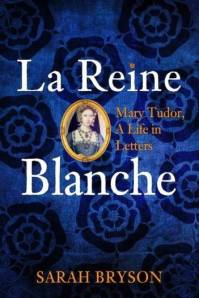
Book Review: “La Reine Blanche: Mary Tudor, A Life in Letters” by Sarah Bryson

35067557_1710198212397536_7023071200330907648_nWhen we think of the Tudors, we often think of  strong women like Katherine of Aragon, Anne Boleyn,  Elizabeth I, Margaret Beaufort and Mary I. However, there was another Mary who made an impact during this time. She was the daughter of Henry VII, the sister of Henry VIII, and the wife of King Louis XII of France. She was referred to as one of the most beautiful women in the world. She gave away all of her titles to marry the man she loved, even though he was not a king. She took on debt to have a family and helped those who needed help. This is the life of Mary Tudor.  In Sarah Bryson’s debut book, “La Reine Blanche: Mary Tudor, A Life in Letters”, Bryson explores the life of this extraordinary woman through her letters.
Sarah Bryson explains why she decided to include Mary’s letters in this book:

Mary Tudor’s letters are a fascinating and captivating look at how a woman could wield power without publically challenging the patriarchy. They show how Mary was able to manoeuvre those around her to follow her heart- marrying her second husband for love, rather than being dragged back to the international chess game as a marriage pawn. They are also, on occasion, a way of looking into Mary’s life whereby the layers of princess and queen are stripped back and only the woman remain. (Bryson, 11).  

Bryson decides to begin her book not with the birth of Mary, but rather with the Wars of the Roses in order to understand how the Tudors came into power and the importance of the marriages that Henry VII established for his children were. She then moves onto the family aspect of the Tudors and the birth of Mary, which to me was fascinating to understand those early years of a young princess. Unfortunately  Mary’s world was not a picture perfect one as her father was constantly fighting those who wanted to take his throne, including Lambert Simnel and Perkin Warbeck. Her brother Arthur, Prince of Wales, would marry Katherine of Aragon, but only a few months after they were married, Arthur tragically died. Mary’s mother would also pass away while trying to give birth to a baby girl. In order to build a strong alliance, Henry VII made a marriage treaty between Mary and Archduke Charles (later Charles V, Holy Roman Emperor), but it would eventually fall through.

Henry VII would die on April 21, 1509, leaving the throne to his son Henry VIII; Henry would marry his brother’s widow Katherine of Aragon on June 11, 1509. Henry arranged Mary’s first marriage with King Louis XII with an enormous dowry, but their marriage would not last long as Louis XII would die on January 1, 1515. Mary would retire from public life and would wear the white mourning clothes of a widow, thus the nickname “La Reine Blanche”, the white queen. Mary would not stay single for long as she married Charles Brandon, Duke of Suffolk. Charles Brandon was a notorious ladies’ man and happened to be one of the people who Henry VIII sent over to France to help Mary. To say that Henry was upset would be an understatement; he refused for the couple to return to England, for a time, and ordered that Charles Brandon would pay off Mary’s dowry. It would leave the couple impoverished for the rest of their lives, but they were happy and in love. It was really during this time that Mary’s letters showed her heart and who she truly was. Mary had to be incredibly strong to show the love that she had for her husband to her brother. Henry eventually accepted the couple and they went on to have four children of their own: Henry, Frances, Eleanor and Henry 1st Earl of Lincoln. Their daughter Frances would marry Henry Grey and would become the mother of Lady Jane Grey, Katherine Grey and Mary Grey. Mary Tudor would die on June 25, 1533, shortly after Anne Boleyn was crowned queen.


Mary Tudor’s story is one of tragedy and love. I will be honest and say that I only knew about half of her story, but Sarah Bryson made Mary come alive. “La Reine Blanche: Mary Tudor, a Life in Letters” may be Bryson’s debut book but it feels like she has been writing for a while. This is a lovely book that combines facts and letters in such a way that it is a joy to read. I look forward to reading more from Sarah Bryson in the near future. If you are interested in the life of Mary Tudor, this is a great book about her life through her letters.

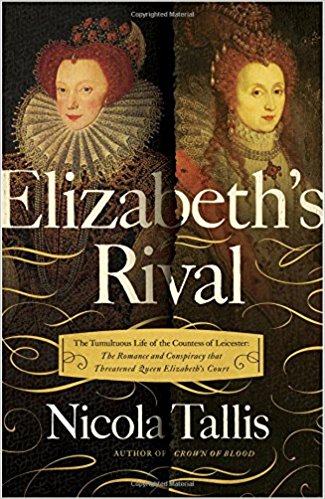
Book Review: “Elizabeth’s Rival” by Nicola Tallis

61RyJJYKwfL._SX323_BO1,204,203,200_When we think of Lettice Knollys, we often think about the kinswoman who made Elizabeth I really mad when she married Robert Dudley, Elizabeth’s favorite. These two women were once best of friends, but that one event torn then apart forever.  However, there is more to Lettice Knollys than this one event. She was married three times, survived seven different monarchs, and lived well into her nineties. Her story has always been hidden, until now. Lettice Knollys story is finally being told in “Elizabeth’s Rival: The Tumultuous Life of the Countess of Leicester: The Romance and the Conspiracy that Threatened Queen Elizabeth’s Court” by Nicola Tallis.

Lettice Knollys was born on November 6, 1543 to Sir Francis Knollys and Katherine Carey; her mother was the Mary Boleyn, the sister of Anne Boleyn and mistress to Henry VIII. Lettice was one of sixteen children. Her family was solely devoted to their Protestant faith and to their service to the crown. Two of Lettice’s brothers, Robert and William, would later become favorites in Elizabeth’s court. Katherine Carey would be one of the ladies in Elizabeth’s court alongside Katherine Knollys and Lettice; Lettice and Elizabeth became very good companions very quickly. Lettice caught the eye of one Walter Devereux, Viscount Hereford, and sometime between 1560 and 1562, they were married, much to the chagrin of the queen who wanted her ladies to remain single. They would have four children: Dorothy, Penelope, Robert and Walter (named after his father).

Both Sir Francis Knollys and Walter Devereux would travel towards Scotland to deal with rebellion for Elizabeth, but Walter would also travel to Ireland for Elizabeth as well. While Walter was away, it is rumored that Robert Dudley had an affair with Lettice after his wife Amy died in 1560, but in 1574, Robert was having an affair with Douglas Sheffield. When Walter died on September 22, 1576, Lettice was  left to deal with the copious amount of debt her husband left her. It wasn’t until September 21, 1578 when Robert Dudley and Lettice Knollys would marry in secret.

Elizabeth would banish Lettice from court forever, but Lettice’s story does not end there. In fact, this is where her story picks up the pace. After Robert Dudley died on September 4, 1588, he left Lettice with yet again a copious amount of debt to pay off so in July 1589, she married Sir Christopher Blount, thinking that he would help alleviate some of the debt; he did not. On top of all of this, her children were having their own martial difficulties and her son Robert Devereux, the 3rd Earl of Essex, would launch an unsuccessful rebellion against Elizabeth and would be executed February 25, 1601; Sir Christopher Blount would also be executed on March 18, 1601. After Elizabeth I died on March 24, 1603, Lettice thought her problems would be solved after James I cleared all of her debt, but Dudley’s illegitimate son by Douglas Sheffield, Robin Sheffield, would file a suit against her, which Lettice would win. On December 25, 1634, Lettice Knollys would die after living well into her 90’s.

Nicola Tallis does an excellent job in navigating Lettice’s life and times. With the amount of research and care Tallis took in portraying this woman who was once hidden in history behind her husband Robert Dudley and Elizabeth I. Her story is one of survival and strength. With this fabulous book, “Elizabeth’s Rival” by Nicola Tallis, Lettice Knollys will not be hidden in the past anymore.


Top 5 “Tudor” Men to Study

Hello everyone! So a few weeks ago, I made a list of my top 5 Tudor women to study. This time around, I decided to focus on the men of this era. The reason that I have the word Tudor in quotations is that one of the men on this list is technically not a Tudor nor did he serve in the Tudor court. As always, this list is in no particular order and it might change after I do more research on the era. These men at the moment fascinate me and I look forward to learning more about them as I continue my exploration of the Tudor age.

1.) Jasper Tudor

The man in the sidelines who helped make the Tudor dynasty happen.80aa362b8647d5844194e415a130c3fd

Brother of Edmund Tudor, half- brother to Henry VI, and uncle to Henry Tudor. A man of many titles, but also a man who spent most of his adult life on the run. Jasper is one of those people who has an epic story, but he really doesn’t get a whole lot of attention and to me, that’s a little sad. I can’t even imagine what was going through his head when he found out that his brother died and that his widow Margaret Beaufort had a son. And that was just in a span of a few months. Now let’s throw in the fact that the time that Jasper was living in was the Wars of the Roses where they basically played musical chairs with the crown of England so one minute his half brother was king of England and the next he was a prisoner. Pretty stressful is putting it mildly. To add insult to injury, Jasper’s nephew Henry, was placed into York households to be raised and to watch over the young boy.

Jasper was always on the run, trying to keep himself and Henry safe. Whether in Wales or in France, where both Jasper and Henry were held as prisoners for very powerful people, Jasper worked hard to keep them alive. You would think that these two would lay low the rest of their lives. You would be wrong. Margaret Beaufort, Henry’s mother, had bigger plans for her son. With Henry VI dead and the Yorks on the throne with Edward IV and then Richard III, Margaret believed that her son was the next rightful king of England. So while Jasper and Henry were overseas in France, Margaret and Jasper orchestrated a coup d’etat. They were able to muster a force for Henry so that he could march against Richard III and on August 22, 1485, their plan worked. Henry was declared king and Jasper went back to his natural place, working for Henry’s good as his right hand man.

As the step brother of a king, I have often wondered why Jasper didn’t seize the crown for himself. This man was full of such intense loyalty for his family and had such an interesting life and yet he chose a life on the sidelines. I want to read biographies on him. Such a dynamic figure in Tudor history.

2.) Henry Tudor (later on Henry VII)

download (1)The man who would become king of England and the patriarch of the Tudor dynasty.  
As stated above, Henry’s life started off rough. Always on the run, he never knew his father and he never really got a chance to know his mother that well until after he became king. That all changed  at Bosworth Field when Richard III was killed and Henry became king. From rags to riches real quick. But if Henry wanted to end the constant calamity that the Wars of the Roses was causing, he needed to marry the right woman. His mother and Elizabeth Woodville arranged a marriage between Henry and Elizabeth of York, joining the houses of York and Lancaster. It was a brilliant move and helped put an end to the fighting. Henry and Elizabeth would have a large family including two sons, Arthur and Henry, thus starting the Tudor dynasty.

Henry is often thought of as being a mizer and a usurper or being a hero, but who was the true Henry? The more I study him, the more I realize how complicated this man was. He was not just a man who took the throne or a hero who started a brand new dynasty, but a family man and someone who knew heartache and love. There is something about Henry that is intriguing. His descendants might get all the attention for all their drama, but Henry Tudor was a man who built a dynasty out of practically nothing. He had to fight for all that he had against numerous pretenders who believed that he was not the rightful king. Overall, he was a survivor who became king.

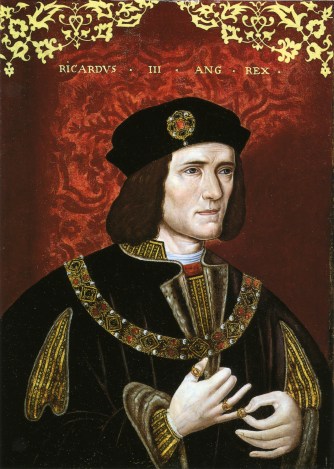
3.) Richard III

The “black legend”.

Now I know what you are thinking, Richard III is not a Tudor king or someone who King_Richard_III.jpgserved a Tudor king so why is he on this list? To me, Richard has just as much influence in creating the Tudor dynasty as the Tudors themselves. If you think about it, if he didn’t take the throne, then Henry wouldn’t have marched against him at the Battle of Bosworth Field. It was his death that helped start the Tudor dynasty.

I do tend to berate Richard quite a bit since I believe he did kill his nephews, but there is something about this man that keeps me wanting to learn more about him. I may think that he is a murderer but as a king, I am learning that he was pretty decent. Just like Henry Tudor was just a man who survived, so was Richard. The more I study these two, the more I am realizing how similar they were. Even though Richard only ruled for two years, there is still a lot that we do not know about him. Maybe he was a family man just like Henry. His childhood might have shaped the way he ruled England and how he handled his enemies.

Even though there has been quite a bit of research about Richard III in the last 500 years, he is still a mysterious legend and I look forward to learning more about him and his times.

4.) Henry VIII

henry-viii-of-england-1The man. The myth. The legend.

When you hear his name, instantly you think about his multiple marriages and his break from the Roman Catholic Church. But who was Henry VIII the man behind this legend? Henry was second in line to the throne behind his brother Arthur, but when Arthur died shortly after he was married to Katherine of Aragon, the throne passed on to Henry. To say Henry was not prepared for this, nor were his parents, would be the understatement of the year. But he had to carry on in his father’s place when he passed away. The boy who was once a scholar now had to become a king.  It was a tall order to fill and it looked like from the very beginning he was doing a pretty good job.

And then things changed rapidly when his attention moved from his first wife to his second, and so on and so forth. Henry’s major flaws were his wandering eyes and his anger. We think we know everything there is to know about Henry, but do we really? This legendary man seems almost too fanciful to be a real human being. But he was. He was flawed like everyone else. Though he was a king, he was still human.

That is what keeps me fascinated about Henry VIII and his life. How did the king figure compare and contrast to the man who was Henry VIII? Who was Henry VIII really? No matter how much I read about him and his reign, its his human aspects and how he dealt with his wives and children that keep me coming back for more. I believe that there is more to Henry VIII than most people realize.

5.) Robert Dudley

The man who almost married the “Virgin Queen”220px-Robert_Dudley

If you have studied Elizabeth I, you know Robert Dudley. He was the man who stayed by Elizabeth’s side through the good times and the bad, even when he was married not once but twice. His first wife Amy, died when she fell down a flight of stairs, but many believed that Robert had her poisoned so that he could marry the queen. Robert was always close to Elizabeth and some in the court believed that he was too close. But maybe Elizabeth knew this when she suggested that Robert should marry Mary Queen of Scots. This deal, however, fell through when Mary married Lord Darnley.

As Elizabeth grew older, Robert kept trying to propose marriage, but he was become restless. He had affairs with some of Elizabeth’s ladies and would later marry Lettice Knollys, a kinswoman of the Queen. Elizabeth was livid and banished both Robert and Lettice from court. Robert would come back into her good graces; Lettice would not.

Robert loved Elizabeth deeply and many suspect that she loved him back. It is said that after he died, she kept his last letter to her in a chest that she kept close to her. Robert was a man who loved the queen, but he could never have her as his wife.

I have often wondered what Robert felt towards his two wives Amy and Lettice. Did he actually love them or did he use them to get closer to Elizabeth? If he did marry the queen, what would England look like? These are only a few questions that come to my mind when I think of Robert Dudley.


These are my top 5 “Tudor” men to study. Who are your top 5?