Guest Post: “Historical Aspect of Queen of Blood” by Sarah Kennedy

Queen of Blood Blog Tour Banner
Today, I am pleased to welcome Sarah Kennedy to my blog to discuss the historical aspect of her latest novel Queen of Blood. Thanks to the Coffee Pot Book Club and Sarah Kennedy for allowing me to be part of this tour.

The most obvious historical aspect of my latest novel, Queen of Blood, is the Wyatt Rebellion, which occurred early in the reign of Mary Tudor (“Bloody Mary”). It was carried out, unsuccessfully, by a group of men who opposed her rule and her marriage to Philip of Spain. The uprising was soon put down, partly because some of the other nobles who were initially involved in the plot failed to raise their armies, and so the band that descended on London was small—and they did not get the support from Londoners that they expected.

That’s the historical context of the book, and it may be the most compelling part of the narrative for some readers. But it’s not the historical aspect that interests me the most. As in all of the novels in my Tudor series, The Cross and the Crown, the element that draws me in the most is the daily lives of everyday people. We know quite a lot about the lives of royals and nobles—and life was not easy even for people with vast resources of wealth and land—but my attention is always on people who lacked these privileges. I’ve always had sympathy for ordinary people who found (and still find) themselves tossed and turned by changes in their governments and their cultures; such changes occurred dramatically during the Tudor years in England.

I try to imagine what daily life was like, particularly for women, who had to worry about childbirth (or the inability to bear children); maintaining and running a household (or working in a household); and caring for extended family members. Just thinking about the number of chores and tasks that had to be accomplished every day, just to stay alive, is exhausting. Women like my main character, Catherine, sometimes had to keep the books for their husbands’ businesses; sometimes had to work in the business (Catherine’s current husband is a wool dealer), and they surely had to stop everything sometimes to show a young maid how to pluck a chicken correctly or how to make soap. I think, too, about the bodily needs that we take for granted today: staying clean; treating wounds and injuries; maintaining personal hygiene during menstruation, pregnancy, breastfeeding, and childbirth.

Can you imagine how time-consuming and difficult it was just to get through a day with enough food, shelter, and clothing?

My Catherine is fortunate in that she knows how to read and write because she was raised in a convent. She knows quite a lot about herbs and medicines, so she generally knows what to do if someone in her household falls ill or, say, cuts herself. She also has maids to help out around the house. But having a household staff means looking out for those people, and that job often fell to the lady of the house.

Now, when all of that daily toil is combined with turmoil in the government and the religion of the country, everything becomes more complicated. England, at the beginning of Mary Tudor’s reign, was Protestant. The convents and monasteries had been closed, and their lands and goods seized by the Crown. Mary, of course, remained Catholic, and one of her goals was to return England to Rome.

This goal was supported by some, opposed by others, and just entirely frustrating and confusing to many. A person could be arrested, imprisoned, and possibly executed for failing to submit to the current requirements of the current church, and I’m sure that this created anxiety, anger, and resentment. Which prayers was a person supposed to say? In what language? What if those requirements violated a person’s conscience? Those were questions that, under the Tudor monarchs, ordinary people often simply had to keep to themselves. They had to follow the rules or suffer the consequences, even if the rules were completely different from what they had been in the previous year.

So, on top of all the necessary daily, drudging work, everyday people were forced to submit to the requirements of church attendance, following the dictates from the throne. It’s no wonder that people rebelled. And it’s no wonder that those rebellions were met with force from the court.

People often adapt to the circumstances in which they find themselves if they can. And if they can’t? If they don’t understand the enormous changes, or don’t approve of them, or can’t bear them? The possible answers to those questions are at the center of my historical interest, and those questions, to me, are the most important historical aspect of my Cross and Crown series.
unnamed(Blurb)

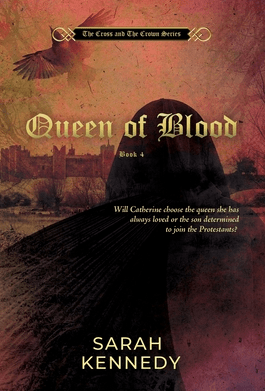
Queen of Blood, Book Four of the Cross, and the Crown series continue the story of Catherine Havens, a former nun in Tudor England. It is now 1553, and Mary Tudor has just been crowned queen of England. Still a Roman Catholic, Mary seeks to return England to its former religion, and Catherine hopes that the country will be at peace under the daughter of Henry VIII. But rebellion is brewing around Thomas Wyatt, the son of a Tudor courtier, and when Catherine’s estranged son suddenly returns from Wittenberg amid circulating rumors about overthrowing the new monarch, Catherine finds herself having to choose between the queen she has always loved and the son who seems determined to join the Protestants who seek to usurp her throne.

Buy Links

Universal Link: mybook.to/QueenofBloodBookFour

Amazon UK: https://www.amazon.co.uk/dp/1950586758
Amazon US: https://www.amazon.com/Queen-Blood-Sarah-Kennedy/dp/1950586758
Amazon CA: https://www.amazon.ca/dp/1950586758
Amazon AU: https://www.amazon.com.au/dp/1950586758

unnamedAuthor Bio

Sarah Kennedy

Sarah Kennedy is the author of the Tudor historical series, The Cross and the Crown, including The Altarpiece, City of Ladies, The King’s Sisters, and Queen of Blood. She has also published a stand-alone contemporary novel, Self-Portrait, with Ghost, as well as seven books of poems. A professor of English at Mary Baldwin University in Staunton, Virginia, Sarah Kennedy holds a Ph.D. in Renaissance Literature and an MFA in Creative Writing. She has received grants from both the National Endowment for the Arts, the National Endowment for the Humanities, and the Virginia Commission for the Arts.

Social Media Links:

Website: http://sarahkennedybooks.com
Twitter: https://twitter.com/KennedyNovels
Facebook: https://www.facebook.com/sarah.kennedy.520125
Amazon Author Page: https://www.amazon.com/Sarah-Kennedy/e/B0054NFF6W
Goodreads: https://www.goodreads.com/author/show/6538009.Sarah_Kennedy

Book Review: “Inside the Tudor Court: Henry VIII and his Six Wives through the eyes of the Spanish Ambassador” by Lauren Mackay

25266205The story of King Henry VIII and his six wives has been regaled for centuries in different mediums. We love the marital problems of this one English king because of how much of an impact it made on all of Europe in the 16th century and beyond. Yet our love affair with the Tudor dynasty would not have gotten to the point that it is today without the tireless efforts of the ambassadors who went to England to report the news of the day to their respected kings and emperors. We tend to think that the ambassadors are better left in the shadows, working to promote peace between countries and report what was happening, but one man made a name for himself as an ambassador and transcended time. His name was Eustace Chapuys. His story and his mission are finally being told in Lauren Mackay’s brilliant debut book, “Inside the Tudor Court: Henry VIII and his Six Wives through the eyes of the Spanish Ambassador”.
I have heard about this book in the past and how much of an impact it has made in the Tudor community in the past. I have read Lauren Mackay’s two other books and I have enjoyed them thoroughly and so I really wanted to read this book.

To understand the man behind the now-infamous words about the Tudors, especially Henry VIII and Anne Boleyn, we have to go back to Chapuys hometown of Annecy. It is here where we see the Chapuys family rise in prominence to the point where Eustace Chapuys was employed by the Holy Roman Emperor Charles V as the Spanish Ambassador to England. His main job was to report information back to Charles about the Henirican court as accurately as possible.

Chapuys started his job as ambassador at a critical junction in English history when Henry VIII was in the middle of his divorce from his first wife Katherine of Aragon in 1529. Chapuys admired Katherine of Aragon’s strength and worked tirelessly to protect her daughter Mary. Since Chapuys had a close connection to those who were essential in the Tudor court, he has given historians fabulous insights into these tumultuous times. It was really his relationship with Anne Boleyn which has caused a lot of controversy over the years and has blackened Chapuys’ name for centuries. Mackay has masterfully examined Chapuys’ correspondences to uncover the truth about how he felt about the Tudor court from 1529 until 1545.

You cannot separate Tudor history during the reign of Henry VIII and the works of Eustace Chapuys, which is why this biography and Mackay’s research are so essential in understanding the 16th century. It sheds new light on the stories of Henry VIII and the lives of his six wives; Katherine of Aragon, Anne Boleyn, Jane Seymour, Anne of Cleves, Catherine Howard, and Catherine Parr. Chapuys was not afraid to speak his mind and to share the rumors of the day, which gives us significant insight into how the royal family was perceived by their public, both the positive and the negative aspects.

Eustace Chapuys has been one of those ambassadors who we think we know, but do we really? Mackay has rescued the much-maligned messenger of Charles V and restored him to the glory that he so rightfully deserves. Chapuys’ story was hidden in plain sight, but it took an extraordinary historian to bring his story to the spotlight. If you think you know about Eustace Chapuys and the Henrician court, you need to read this sublime biography, “Inside the Tudor Court: Henry VIII and his Six Wives through the eyes of the Spanish Ambassador” by Lauren Mackay. It might change how you view the Tudor dynasty.

Book Review: “The Brandon Men: In the Shadow of Kings” by Sarah Bryson

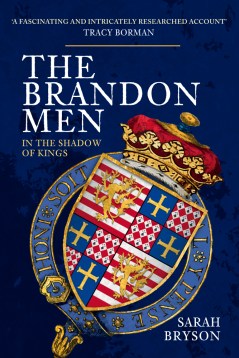
50419855Loyalty to one’s king was imperative during times of war and strife. This statement was painfully true during periods of civil war when cousins fought against cousins. The Wars of the Roses was where we see families rise and fall like the tides, depending on which side they were loyal to and who was on the throne. One family who was able to navigate this political quagmire and end up on the side that would win in the end was the Brandons. Many recognize the name Brandon because of Charles Brandon and his rise in the court of Henry VIII, but how did they reach that point? What are the origins of the Brandon family? In her latest book, “The Brandon Men: In the Shadow of Kings”, Sarah Bryson takes her readers on a ride to find out what loyalty to the crown gave this family and why their legacy lives on today.

I would like to thank Amberley Publishing for sending me a copy of this book. I have read Bryson’s first book on Mary Tudor and her marriage to Charles Brandon, which I found a delightful read. When I heard about this book, I was interested in reading it as I have always enjoyed the story of Charles Brandon and I wanted to know more about his family.

Bryson begins her journey into the Brandon family with William Brandon, who lived during the reign of King Henry VI and the origins of the Wars of the Roses. William’s gradual rise in power is nothing short of extraordinary and it extended to his son, also named William. William Sr would serve Henry VI, Edward IV, and Richard III, even when his son William decided to work with Henry Tudor. William’s loyalty to Henry Tudor would ultimately cost him his life as he died at the Battle of Bosworth Field as the standard-bearer for the would-be king.

The bulk of this particular title explores the life of Charles Brandon and his relationship with his best friend, King Henry VIII. We have seen how loyal the Brandons can be with the first two generations, but Charles took it to a whole new level. Since Bryson had mentioned a good portion of Charles’ life in her previous book, this felt a bit like a review. I know Charles is her favorite Brandon man, but I wish she would have focused a bit more on his grandfather, father, and his uncle, Sir Thomas Brandon. These men were crucial to understanding what kind of man Charles would become and why he was so loyal to the crown, even if he didn’t agree with all the decisions that Henry VIII made.

Overall, I found this book informative and easy to follow. Bryson has a passion for the Brandon family, and it shows with this particular title. The family trees and the letters that she included in this book are impressive and give the reader a deeper understanding of the family dynamic as well as the dynamic between the Brandons and the kings that they served. If you are interested in learning more about the Brandon family and the depth of their loyalty to the English crown, I highly suggest you read, “The Brandon Men: In the Shadow of Kings” by Sarah Bryson.

Book Review: “The Betrayal of Mary, Queen of Scots: Elizabeth I and Her Greatest Rival” by Kate Williams

40554521Two cousins fighting for the right to rule England during the 16th century. One was the daughter of Henry VIII and Anne Boleyn who fought tooth and nail to rule without a man by her side. The other was the daughter of Mary of Guise and King James V of Scotland whose marriage record would prove to be fatal. Elizabeth I and Mary, Queen of Scots, may have been sister queens, but the way they were treated in their own countries differed completely. While Elizabeth I was praised and protected from harm in England, Mary was a scapegoat for so many in Scotland. The way that Mary was used as a pawn even though she wore a crown was nothing short of extraordinary. The story of how these two queens came on a collision course that would leave one queen beheaded and the other forever changed has been told in many different ways from both sides of the tale, but it has rarely been told as a cohesive nonfiction book. That is until Kate Williams’ marvelous biography, “The Betrayal of Mary, Queen of Scots: Elizabeth I and Her Greatest Rival”.
Before we get to the part of the tale that many Tudor fans know very well, the end of the tale, we must understand what shaped Elizabeth I and Mary, Queen of Scots to be the queens of England and Scotland respectfully. As someone who knows quite a bit about Elizabeth I’s story, I found Williams’ explanation of her childhood informative and relatively brief.

Williams chooses to focus on the much-maligned Mary, Queen of Scots. We tend to assume that Mary’s life as a pawn with a crown began after her first husband, King Francis II of France, tragically died and she had to go back to her native Scotland. However, Mary was a pawn in someone else’s game her entire life. The only man that Mary loved and who loved her back was Francis. Her other relationships with Darnley and Bothwell were trainwrecks that would cause Mary immense pain and sorrow. Bothwell was the epitome of a disastrous relationship that was doomed to ruin Mary’s life. The two people who Mary thought she could depend on, Elizabeth I and Mary’s own son King James VI, ultimately chose to save face than to help protect a queen who had nowhere else to go.

I will be honest and say that before I read this book, I felt that Mary was the villainess of Tudor propaganda. She, after all, was wanting to dethrone Elizabeth I so that she could become the Catholic Queen of England. I have always been someone who has been a big fan of the reign of Elizabeth I, so I assumed that I would not be a fan of Mary, Queen of Scots. However, that all changed after reading this book. To see Mary put her faith and trust into those who she thought had her best interest at heart and to be betrayed every single time was utterly heartbreaking.

This is a gorgeously written biography of Mary, Queen of Scots that shows Mary in a sympathetic light while portraying how cataclysmic the numerous betrayals she endured affected her life. It was my first time reading a biography about Mary, Queen of Scots, or a book by Kate Williams, and I have to say it is one of my favorite biographies that I have read so far this year. I did not want to stop reading this biography. It made me feel so sympathetic towards Mary and her plight. If you want an exceptional biography about Mary, Queen of Scots, “The Betrayal of Mary, Queen of Scots: Elizabeth I and Her Greatest Rival” by Kate Williams is a must to have in your collection.

Book Review: “The York Princesses: The Daughters of Edward IV and Elizabeth Woodville” by Sarah J. Hodder

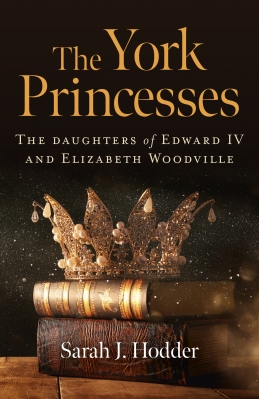
54363954The life of a medieval princess was not a life of luxury that we often see in fantasy films. It can be filled with lovely gowns and castles, but it can change in an instance. Take, for example, the lives of the daughters of King Edward IV and Elizabeth Woodville. One minute their father was King of England and life was comfortable; the next minute, they were in the sanctuary, hoping and praying that they would be able to be reunited with their father one day. Their lives were planned out for them when their father was alive, but when Edward IV died unexpectedly in April 1483, the princesses found their world taking another turn. We know what happened with the eldest daughter, Elizabeth of York, as she married Henry VII and became the first Tudor queen, but what about her sisters? In her second book, “The York Princesses: The Daughters of Edward IV and Elizabeth Woodville”, Sarah J. Hodder explores what happened to Elizabeth of York and her sisters once the House of York fell and the Tudors became the new dynasty.
I would like to thank Chronos Books for sending me a copy of this book. I have read Sarah J. Hodder’s previous book, “The Queen’s Sisters” and I enjoyed it. When I saw that Hodder was going to release this book, I knew that I wanted to read it.

I knew quite a bit about Elizabeth of York as she was the eldest child of Edward IV and Elizabeth Woodville and the wife of Henry VII. Hodder knew that she was the most popular of the princesses so she gave a brief overview of her life and moved onto the sisters who do not get enough attention. For those who are not familiar with this family, the other sisters are Mary, Cecily, Margaret, Anne, Katherine, and Bridget. Although Elizabeth’s sisters did not win a crown, it does not mean that their lives were not exciting.

To make sure that the sisters’ stories were told in an equal manner, Hodder dedicated a chapter to each one of their tales. From the youngest who died shortly after they were born to those who lived to see Henry VIII crowned King of England. The men who they married ranged from those who backed the Yorkist cause, leading to a very awkward family clash, to those who proved extremely loyal to the young Tudor dynasty. The sisters would never share the joys and heartbreaks that Elizabeth experienced as a mother (especially Bridget of York who would become a nun), but they were eyewitnesses to dramatic changes in England’s history.

I found it remarkable that Elizabeth accepted her sisters with open arms after she became Queen of England, even when their husbands disagreed with Henry VII. Elizabeth supported her sisters and their families whenever she could.

Hodder tells the story of strong family bonds that connected these sisters through the good times and the bad. You can tell that Hodder was passionate about the subject she was writing about as this book was very well researched. It is often difficult to tell the stories of siblings of monarchs as their sibling who sits on the throne tends to overshadow them, but Hodder brought the stories of the York princesses into the light. “The York Princesses: The Daughters of Edward IV and Elizabeth Woodville” by Sarah J. Hodder may be small in size, but it is full of information for those who want to know more about this extraordinary royal family.

Book Review: “Katharine Parr: The Sixth Wife” by Alison Weir

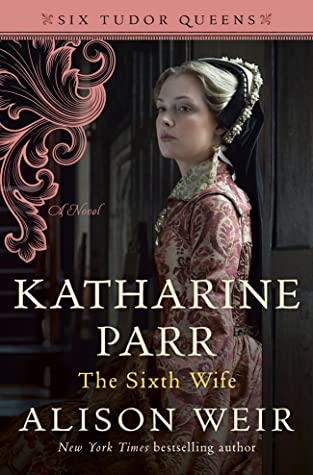
34020934._SY475_A woman twice widowed with no children of her own has the opportunity to choose who she will marry next. Will she marry the man of her dreams or marry the man who has been married numerous times and has killed two of his wives already? It seems like a no-brainer who she should choose, but the man she married for her third marriage was the man who was married numerous times before simply because he is the notorious King Henry VIII and you do not disobey the king. However, his last wife, Katharine Parr, is willing to fight for the religious reforms and her stepchildren that she loves dearly. In the last book of the Six Tudor Queens series, “Katharine Parr: The Sixth Wife”, Alison Weir takes her readers on an extraordinary journey to explore who this brave woman was and why she is the one who survived Henry’s last days.

I would like to thank NetGalley and Random House/ Ballantine Books for sending me a copy of this novel. I have enjoyed the Six Tudor Queens series so far and I was looking forward to reading the last book. Like many people, I know what happened with Katharine during her marriage to Henry VIII and her fourth marriage to Thomas Seymour, but I am not well informed when it comes to her first two marriages. Katharine Parr has been my favorite wife of King Henry VIII for a while now and I wanted to read a novel about her life, to see what Weir’s interpretation of her life story would be like.

Katharine Parr’s story begins with her childhood and her connection with her family. It was unique to see how her childhood helped shaped what type of queen she would become as her mother pushed hard for her daughters to be well educated. Katharine’s first husband, Sir Edward Burgh, was just a boy who followed whatever his father, Sir Thomas Burgh, asked him to do. I think Weir has a unique spin on Katharine’s life with Edward Burgh and their marriage, but it did not last long as Edward Burgh would die in 1533.

Katharine’s second husband, John Neville 3rd Baron Latimer, was her longest marriage. Although they had no children of their own, like Katharine’s marriage to Edward Burgh, it was a happy relationship. They may have differed when it came to their views on religion, but they did seem to love each other. Their happy household was thrown asunder when the Pilgrimage of Grace and Robert Aske knocked on their door and asked for help. There was a real sense of danger during this episode and the bravery that Katharine showed was nothing short of astounding.

When John died, Katharine was left with a choice of who her third husband would be; either the ailing Henry VIII or the suave and debonair Thomas Seymour who deeply loved Katharine. Katharine’s choice was Henry VIII who she hoped she could sway to accept the religious reforms that she believed in strongly. She developed a friendship with the king and his children, but she was still in love with Thomas Seymour. She wrote books during this time that gave her comfort during the difficult times when the court tried to attack her for what she believed and wanted to pit her against Henry. In the end, love triumphed over sorrow and Katharine survived to live with her beloved until the end of her days.

I found this book an absolute treat to read. As someone who loves Katharine Parr and her story, this novel just made me love her even more. The one problem that I had was actually with the spelling of her name as Weir spelled it a bit differently than what I am used to, but it was really a minor detail. I am a bit sad that this is the last book in this wonderful series, but this book was worth the wait.

This novel was a delight to read. It was full of action and intrigue, intense love, and immense sorrow. Katharine was one remarkable woman, just like every wife of Henry VIII Weir has written about in this marvelous series. “Katharine Parr: The Sixth Wife” by Alison Weir is a masterpiece in historical fiction and the perfect conclusion to the Six Tudor Queens series that will leave readers satisfied.

Guest Post: “Life at the Tudor Court” by Karen Heenan

I am pleased to welcome Karen Heenan to my blog today to discuss life at the Tudor Court. This is part of the book tour to promote Karen Heenan’s book, “Songbird (The Tudor Court, book 1). Thank you The Coffee Pot Book Club and Karen Heenan for allowing me to participate in this tour. 

“Bess!”

The voice, close to my ear, startled me awake. I’m alone in the bed, and the small attic room shared by the female members of the music is empty but for Flora and one other girl. They are nearly dressed—I’m late. Bolting out of bed, I asked Flora, “Why didn’t you wake me?”

She shrugged. “The rest of us get up when Mistress Edith calls.” Relenting, she said, “Here, I’ll help you.”

I pulled my nightdress over my head and washed quickly at the basin. Flora handed me my shift, then helped lace my kirtle. My hair was braided for sleeping, so I pinned it into a hasty knot and settled a white linen coif over it, hoping I wouldn’t run into Nick Hawkins when I looked so untidy.

Breakfast was served in the great hall, which was filled with trestle tables and benches. Servants brought out great bowls of steaming pottage and pitchers of ale, and there were loaves of bread set along the length of the table, for us to cut with our knives.

When the trenchers have been cleared, and the remaining food was taken away for manners—to feed the beggars at the gate—we make out way to the chapel. I let my mind drift during mass until the choir begins to sing. It is impossible not to pay attention to every sound, every note—my dream, when I first arrived, had been to sing in the choir, but girls were not permitted to offer their voices to God. No one had still given me a good explanation as to why.

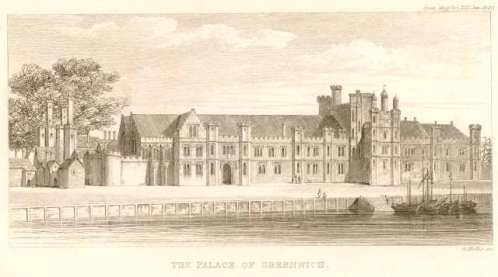
If we were at Greenwich—where we would travel in the morning, the king had decided to move from Westminster in London—we could also attend the local church, St. Nicholas. Their choir was inferior, but it was pleasing to get outside the palace. The king had less need of us at Greenwich than Westminster, where we were held constantly within call.

Once mass was done, I was free to do what I liked until dinner. Flora had gone off with friends, so I went up to the practice rooms. Someone might be willing to play for me, but if not, I would sing along. If I was fortunate, Tom would be there. He was my dearest friend, and a talented lutenist and composer, though he would blush and deny that his songs are any good.

Someday it would be known, and his songs would be sung all over the court, and perhaps all over England.

He was there, supervising the packing of the many musical instruments which would be transported to Greenwich, along with all the nobles and a good number of the court servants, and all their varied possessions.

 “Do you want me to play for you?” he asked, swaddling a lute in soft wrappings like a babe. His own instrument, I knew, would travel in his grasp; Tom would not trust it to the rough men who loaded the carts and barges for the trip between palaces.

“I can wait.” I leaned against the window, watching the flurry of activity below. In addition to the carts which would start this day so that things might be in place when King Henry stepped off his barge on the morrow, there were the usual clusters of men and horses, servants scurrying across the courtyard on some errand or another, and, to my delight, a certain gentleman atop a shining black horse. 

I let my eyes rest on him. A man such as Nick Hawkins would never pay any mind to a minstrel girl, no matter how lovely my voice. The fact that he had spoken to me on occasion proved nothing. He was handsome—beautiful, really—and powerful, a friend of the king. A man who could have any woman in the kingdom, save the queen. 

He would never look at me.

I turned to Tom, smiling. He would always look at me, always see me for who I was. But it wasn’t the same, and though I loved him as a friend and a brother, I did not think of him as I drifted off to sleep.

“What will you have me play?” Tom settled on a stool with his instrument on his lap, the light from the narrow window falling on his fair hair. “Bess?”

“Sorry.” I shook away my fancies. “We are to perform this evening for the French ambassador and his party.” 

“At least we will have time to eat.” He tuned the lute carefully. “And we will be in the gallery, so you can watch the gathering to your heart’s content.”

I ignored his words, knowing he was teasing. I did like singing from the gallery so I could watch the crowd, and not just because of Nick. It was more impressive, somehow, from above. Crowded in the narrow gallery with the other minstrels, with the horns and drums and shawms, and Tom’s lute singing a sure line beneath for me to follow, I was at peace and could watch the dancers and pretend I was one of them.

A gathering for the French ambassador was sure to run late; I should go back to the girls’ chamber and pack my things for the morning so that when we were done, I could just fall into bed. “Are you happy about going to Greenwich?”

“What does it matter?” he asked. Seeing my expression, he said, “I am if you must know. The stables are closer to the palace.”

Tom loved horses, and though our indoor lives gave us little contact with the beasts, when we were at Greenwich or visiting the cardinal at Hampton Court, he always found his way to the stables. I was glad he was happy, but prolonged time in the stables made me sneeze, and I preferred to walk in the gardens if I was to take my scant free time outdoors.

Other minstrels came in and we went over our evening’s program until the bells chimed eleven; then we all streamed downstairs to dinner. I stayed with Tom; even if the others left us after the meal, we would probably sing and play together until it was time to get ready for the evening’s entertainment. Despite my dreams of greater things, singing with him was when I was happiest, and when I knew that my father had done the right thing. 

I belonged in this place.

 Several hours later, changed into a green gown and clean coif, with my few things packed into a small chest for the morning, I reassembled with other members of the Music in the gallery overlooking the presence-chamber. The vast room was hung on all sides with vivid tapestries depicting scenes both secular and religious, interspersed with gold and silver plate that reflected the hundreds of candles lighting the space.

The king was all aglitter himself, clad head-to-toe in cloth of gold studded with diamonds and pearls. His queen, Katherine, was dressed more soberly, though her fabrics were equally rich. They sat on their thrones under the gold cloth of state, speaking quietly, until the music started. Then the king stopped, mid-sentence, his ear cocked toward the gallery. How fortunate that Tom had instructed the others to begin with one of Henry’s own songs. 

He leaned over to the French ambassador, who stood near the throne, and gestured toward us. I imagined he was telling the Frenchman that he’d written the song—though he praised us lavishly, it was much more likely that he was taking credit for the song.

I sang while the people below mingled and preened, showing off their finery for the king and each other. When the dancing started, I would step back; my voice did not lend itself to the stately pavanes which began the dancing each evening. Those were for the musicians—Tom, Harry, and Gilbert would play their instruments and the courtiers would parade slowly down the length of the room, bowing and circling, flirting with their eyes and their hands, the only parts of their bodies which touched during the dance.

King Henry began the dancing, leading Queen Katherine down from the dais and onto the floor. The jeweled crowd stepped back to give them room, and they traversed the floor alone, the focus of all eyes before the king raised his hand and called for everyone to join him. Then the courtiers paired off, men swiftly bowing before ladies and taking their chosen partner to join the king. 

Nick was there, I noticed almost immediately. He danced with the prettiest women, and once arrived before a woman at the same time as King Henry, bowing deeply and giving way to his monarch, who would dance until dawn if allowed. The queen would retire early, taking her women, though some of them crept back after Her Majesty had been settled for the night.

It was after midnight when the chamber finally began to empty. I sipped from the ale which had been set aside for us; my throat was dry from singing for hours in the stuffy gallery. Tom was yawning behind his hand, and several of the other looked as though they were asleep on their feet. I was still wide awake, but perhaps it was excitement: it was spring, and tomorrow we would journey to Greenwich, where I had begun my life with the Tudor court.

[Illustration #1 – Palace of Westminster, Wikipedia]

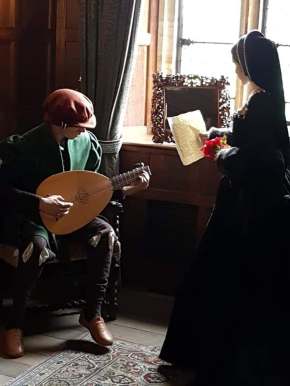
[Illustration #2 – Minstrels, Nikki Piggott, photographer, used w/permission]

[Illustration #3 – Greenwich Palace, Wikipedia]

Blurb

She has the voice of an angel…

But one false note could send her back to her old life of poverty.

After her father sells her to Henry VIII, ten-year-old Bess builds a new life as a royal minstrel, and earns the nickname “the king’s songbird.” 

She comes of age in the dangerous Tudor court, where the stakes are always high, and where politics, heartbreak, and disease threaten everyone from the king to the lowliest musician.

Her world has only one constant: Tom, her first and dearest friend. But when Bess intrigues with Anne Boleyn and strains against the restrictions of life at court, will she discover that the biggest risk of all is listening to her own stubborn heart?

Buy Links:

Amazon UKAmazon USAmazon CABarnes and NobleKobo

Audio Buy Links:

Narrated by Jennifer Summerfield

AudibleAuthors DirectNookHooplaApple BooksKoboScribdGoogle PlayAmazon

Author Bio

Karen Heenan

Karen Heenan was born and raised in Philadelphia, PA. She fell in love with books and stories before she could read, and has wanted to write for nearly as long. After far too many years in a cubicle, she set herself free to follow her dreams—which include gardening, sewing, traveling, and, of course, lots of writing.

She lives in Lansdowne, PA, not far from Philadelphia, with two cats and a very patient husband, and is always hard at work on her next book.

Connect with Karen:

WebsiteTwitterFacebookInstagramPinterestBook BubAmazonGoodreads

Guest Post: “A Matter of Conscience: Henry VIII, The Aragon Years” Excerpt by Judith Arnopp

I am pleased to welcome Judith Arnopp to my blog today to share an excerpt from her latest novel, “A Matter of Conscience: Henry VIII, The Aragon Years”. Thank you, The Coffee Pot Book Club and Judith Arnopp for allowing me to host a spot on this blog tour. 

Excerpt

1505 – Henry is informed by his father that he must withdraw from his betrothal to Catherine of Aragon

Most of my companions, the older ones at least, have tasted the pleasures of women but I have no desire to dally with whores. Instead, when the curtains are drawn about my bed at night, I think of Catalina and the delights we will one day enjoy. Since there are no tutors to instruct me on such matters, I listen to the tales my friends tell of their conquests. The prospect of bedding my future wife fills me with a mix of excitement and terror. 

And then, on the eve of my fourteenth birthday, the king informs me that I must make a formal protest against the union with Spain.

“Why?” I exclaim. “I have no wish to protest against it!”

Father rubs his nose, dabs it with his kerchief, rolls it into a ball, and glares at me.

“Your wishes are of no moment. This is politics. You will do as you are told.”

I am furious but I know better than to argue. It would do me no good. I can feel my ears growing red with resentment. I clench my teeth until I hear my jaw crack. Oblivious to my feelings, Father shuffles through the papers on his desk, picks one up, and reads aloud the instruction he has written there.

“You must declare, before witnesses, that the agreement was made when you were a minor and now you reach puberty you will not ratify the contract but denounce it as null and void. Your words will be set in writing and then signed and witnessed by six men.

Protestations tumble in my mind but I cannot voice them. When he dismisses me with a flick of his fingers, I bow perfunctorily, turn on my heel, and quit the room. I find Brandon on the tennis court, loudly protesting the score while his opponent, Guildford, stands with his hands on his hips.

“You are wrong, Brandon, the point is mine. Isn’t that so?” 

He turns to the others, who are lounging nearby. Having only been half attending, they shrug and shake their heads noncommittally.

“My Lord Prince,” Brandon, noticing my arrival, turns for my support. “You witnessed it, did you not? The point was mine. Back me up, Sir.”

I pick up a racket, idly test it in my hand, and emitting a string of curses, hurl it across the court. Silence falls upon the company.

“What ails you, Sir?”

Brandon is the only one brave enough to come forward. He reaches out, his hand heavy on my shoulder. There are few men I allow to touch me. At the back of my mind, I am aware that Brandon is merely proving to others how high he stands in my regard. 

I should shrug him off, but I don’t.

“Walk with me,” I mutter between my teeth and then turn away, almost falling over Beau who dogs my every footstep.

“Out of my way!” I scream and he cowers from me, tail between his legs.

Tossing his racket to Thomas Kyvet, Brandon follows me.

“Henry, wait,” he calls, and I slow my step until he has caught up.

“What has happened?”

“My accursed father.” 

I am so angry, I can hardly speak; my lips feel tight against my teeth, my head pounds with repressed fury. “He demands that I denounce my union with Catalina.”

I stop, rub my hands across my face, the blood thundering in my ears. 

“I don’t know if I am angry because I have lost her, or because I am so sick of being told what I must do. What will Catalina think? What will happen to her?”

He shrugs. “In all probability, she will be sent home to Spain.”

I think of her leaving, imagine her sad little figure boarding ship for the perilous journey to her homeland. For four years she has lived at the mercy of my father’s generosity which, as we all know, is greatly lacking, and now is to be sent home like a misdirected package.

“Sometimes I feel this … this limbo will never end, and I will spend my whole life under my father’s jurisdiction.”

He flings a brotherly arm about me and I am suddenly grateful to have a friend. He speaks quietly, with feeling and I struggle not to weep like a woman.

“We are all told what to do by our fathers, Henry, and we are much alike you and me. I am also the second son. Had my brother not died, I’d like as not be languishing in the country, wed too young to some red-cheeked matron yet here I am, your honoured servant. One day, you will be king, and I will still be at your side. The future will soon be ours, and the time for following orders will be done with.”

Blurb

‘A king must have sons: strong, healthy sons to rule after him.’

On the unexpected death of Arthur Tudor, Prince of Wales, his brother, Henry, becomes heir to the throne of England. The intensive education that follows offers Henry a model for future excellence; a model that he is doomed to fail.

On his accession, he chooses his brother’s widow, Catalina of Aragon, to be his queen. Together they plan to reinstate the glory of days of old and fill the royal nursery with boys. 

But when their first-born son dies at just a few months old, and subsequent babies are born dead or perish in the womb, the king’s golden dreams are tarnished.

Christendom mocks the virile prince. Catalina’s fertile years are ending yet all he has is one useless living daughter and a baseborn son.

He needs a solution but stubborn to the end, Catalina refuses to step aside.

As their relationship founders, his eye is caught by a woman newly arrived from the French court. Her name is Anne Boleyn.

A Matter of Conscience: the Aragon Years offers a unique first-person account of the ‘monster’ we love to hate and reveals a man on the edge; an amiable man-made dangerous by his own impossible expectation.

Buy Links:

Amazon UK: https://www.amazon.co.uk/gp/product/B08W48QQ9C

Amazon US: https://www.amazon.com/Matter-Conscience-Henry-Aragon-Years-ebook/dp/B08W48QQ9C

Author Bio:

Judith Arnopp

A lifelong history enthusiast and avid reader, Judith holds a BA in English/Creative writing and an MA in Medieval Studies.

She lives on the coast of West Wales where she writes both fiction and non-fiction based in the Medieval and Tudor period. Her main focus is on the perspective of historical women but more recently is writing from the perspective of Henry VIII himself.

Her novels include:

A Matter of Conscience: Henry VIII, the Aragon Years 

The Heretic Wind: the life of Mary Tudor, Queen of England

Sisters of Arden: on the Pilgrimage of Grace

The Beaufort Bride: Book one of The Beaufort Chronicle

The Beaufort Woman: Book two of The Beaufort Chronicle

The King’s Mother: Book Three of The Beaufort Chronicle

The Winchester Goose: at the Court of Henry VIII

A Song of Sixpence: the story of Elizabeth of York

Intractable Heart: the story of Katheryn Parr

The Kiss of the Concubine: a story of Anne Boleyn

The Song of Heledd

The Forest Dwellers

Peaceweaver

Judith is also a founder member of a re-enactment group called The Fyne Companye of Cambria and makes historical garments both for the group and others. She is not professionally trained but through trial, error and determination has learned how to make authentic-looking, if not strictly HA, clothing. You can find her group Tudor Handmaid on Facebook. You can also find her on Twitter and Instagram.

Social Media Links:

WebsiteBlogTwitterInstagramAmazon

Book Review: “Crown of Blood: The Deadly Inheritance of Lady Jane Grey” by Nicola Tallis

39330966._SY475_“Uneasy lies the head that wears the crown.” This famous quote from William Shakespeare’s play Henry IV, Part III has been used throughout the centuries to describe how difficult it is to rule a country for any duration of time. Most kings and queens of the past lasted for a few years, but there was one queen who lasted for a handful of days. She was the successor of Henry VIII’s only male son, King Edward VI, and was meant to replace his eldest half-sister, who would become Queen Mary I. It was a battle between Protestantism and Catholicism with a 17-year-old scholar caught in the middle. Her name was Lady Jane Grey, but many refer to her as the “Nine Day Queen of England”. Lady Jane Grey’s tragically short story, how she became queen, and the consequences of her reign are discussed thoroughly in Nicola Tallis’ beautifully written debut biography, “Crown of Blood: The Deadly Inheritance of Lady Jane Grey”.

I have been a fan of Nicola Tallis’ other biographies, “Uncrowned Queen: The Fateful Life of Margaret Beaufort, Tudor Monarch” and “Elizabeth’s Rival: The Tumultuous Life of the Countess of Leicester: The Romance and Conspiracy that Threatened Queen Elizabeth’s Court”. I had heard about this one through recommendations from other Tudor history fans, so naturally, I wanted to give it a try. Lady Jane Grey has been one of those historical figures that I have felt sympathy for in the past and I wanted to learn more about her life.

Lady Jane Grey was born into a royal family full of fighting for the throne of England and for the right to either be Protestant or Catholic. She was the eldest daughter of Henry and Frances Grey. It was through her mother Frances that Jane had a claim to the throne because Frances Grey was the daughter of Mary Tudor, the younger sister of Henry VIII, and Charles Brandon. If Frances and Henry Grey had sons, we would not have to talk about Jane’s claim to the throne, but Jane had two sisters, Katherine and Mary Grey. Jane was a rather unusual royal girl because she was not concerned about who she would one day marry. Lady Jane Grey has been known throughout history as a young scholar and a martyr for Protestantism. Her zeal for learning is so admirable and relatable. It makes you really wonder what her life might have been like if she had not been coerced to become Queen of England.

Unfortunately, on his deathbed Jane’s cousin King Edward VI declared that Lady Jane Grey would be his heir, not his eldest half-sister Mary, who his father had named as Edward’s heir if Edward had no children of his own. Jane never coveted the throne, but her father-in-law, John Dudley 1st Duke of Northumberland saw the opportunity to make his son Guildford king of England. It was not the role that Jane wanted in her life, but she was outspoken and courageous about things that mattered to her, even as she approached the scaffold that would seal her fate on earth.

Tallis’ writing style and her attention to detail brought Jane out of the shadows to uncover the truth behind the myths that surrounded her young life. This biography could have easily become a Mary vs. Jane book, but Tallis took the utmost care to make sure it was balanced for both women. It was dynamic and thoughtful, full of drama and revelations of the life of Lady Jane Grey. In short, it is a magnificent biography of one of the Tudor monarchs whose reign was quickly forgotten. Jane may have been a scholar, a lady, and a martyr, but she should also be remembered for another position she held in life. Jane was a Queen of England. If you want a stunning biography about Lady Jane Grey, I highly suggest you read, “Crown of Blood: The Deadly Inheritance of Lady Jane Grey” by Nicola Tallis.

Book Review: “Young and Damned and Fair: The Life and Tragedy of Catherine Howard at the Court of Henry VIII” by Gareth Russell

55728291._SY475_Divorced, beheaded, died. Divorced, beheaded, survived. For those who study Tudor history, we have heard this unimaginative rhyme to refer to the wives of Henry VIII for the longest time. We all know the stories of the queens, especially Anne Boleyn, but the fifth wife and the second one to be beheaded tend to be cast aside for some of the more intriguing tales. Her name was Catherine Howard, Henry’s youngest bride. Her story is full of rumors and myths, just like her cousin Anne Boleyn. Most know of her romantic dalliances that, in the end, led to her demise, but what was her reign like as queen? What was the court of Henry VIII like during his fifth marriage as his health was failing? In Gareth Russell’s brilliant biography, “Young and Damned and Fair: The Life and Tragedy of Catherine Howard at the Court of Henry VIII”, he dives deep into the archives to shine a light on the life of this tragic and young queen.

I would like to thank everyone who has recommended that I read this biography for years now. I have heard the praises about this book and I have enjoyed reading posts by Gareth Russell so I decided that it was about time that I read the book that put him on the map for so many Tudor history fans.

Russell begins his exploration into Catherine’s life with an execution and a wedding. The person being executed on July 28, 1540, was Henry VIII’s former right-hand man Thomas Cromwell and the bride is Catherine Howard. The duality of this first chapter is stunning, showing how favor in Henry VIII’s court was like a wheel constantly turning. A person’s fate was always in the hands of the king. To understand how Catherine caught the roving eye of the ailing king, Russell takes his readers on a journey into her past to show how this young lady made it into the glamorous Tudor court. We all have an idea of what life must have been like for Catherine in her grandmother’s, Agnes Tilney dowager Duchess of Norfolk, household. However, as Russell explains, Catherine’s life and her early romances with Henry Manox and Francis Dereham were not like how it has been portrayed in novels about her life.

Catherine’s life took a dramatic turn when she is chosen to be one of the ladies in waiting for Henry VIII’s fourth wife, Anne of Cleves. This relationship does not last long and Henry casts his eyes upon Catherine and she becomes his fifth wife. However, while at court, Catherine falls in love with the charming Thomas Culpepper. Russell goes further than any other author has in the past to explore the different aspects of Catherine’s reign as queen consort. He explores her household, how she viewed religious issues and political issues that impacted Tudor England during this time. Finally, Russell explores the downfall, the trial, and the execution of Catherine Howard and how her foolish decisions cost her everything.

The way Russell combined his easy to read style of writing with scrupulous attention to detail to create such a vivid account of Catherine Howard’s tragic life is magnificent. It felt as if you could visualize the events as they happened in the Henrician court. Before I read this account, I felt no sympathy for Catherine’s demise, but this beautiful biography changed my view on her life. If you want a hauntingly beautiful biography about the life of Henry VIII’s fifth wife Catherine Howard, you must read, “Young and Damned and Fair: The Life and Tragedy of Catherine Howard at the Court of Henry VIII” by Gareth Russell.