Guest Post: “Spotlight for ‘Trouble in Assisi’ by Heidi Eljarbo”

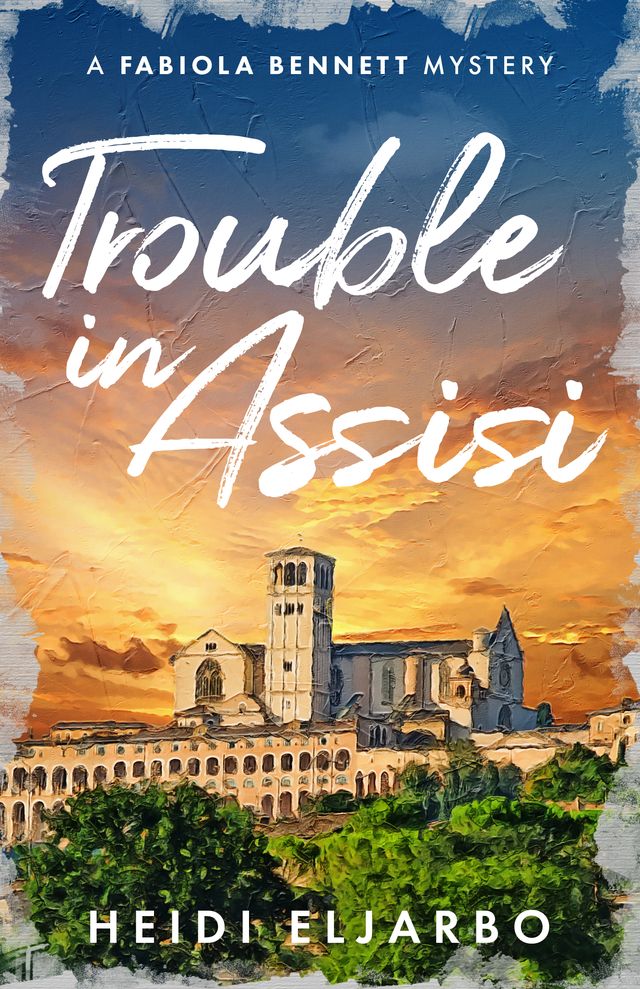
CJ1ceKcYI am pleased to welcome Heidi Eljarbo to my blog today to share a spotlight on her latest novel, “Trouble in Assisi.” I would like to thank The Coffee Pot Book Club and Heidi Eljarbo for allowing me to be part of this blog tour.

kCaxzjR0Blurb

Assisi, 1973

On art historian Fabiola Bennett’s first day in Assisi, a local gentleman takes her aside to ask for advice about a painting that has wondrously appeared in the basilica’s bell tower. 

So much for enjoying relaxing days filled with dining on pasta and gelato. 

Soon, Fabiola and her besties, Pippa and Cary, are thrown into a shrouded mystery and caught up in a whirlwind of intrigue, theft, lies, and attempted murder, all of which overshadows the postcard-like charm of the small, historic town. 

Rome, 1511

Life is going well for Teodoro Nicoletti. Since he was a young man in Florence, he has worked and learned alongside the most favored artist Raphael. 

When Pope Julius II commissions Raphael to paint several frescos in the reception rooms of the Vatican Palace, Teodoro follows his master to Rome and discovers firsthand the admiration and rivalry between Raphael and two other reigning artists: Michelangelo and Leonardo da Vinci. 

But the prickliest thorn in Teodoro’s side is his beloved Elisabetta’s father. The old man is determined to keep his youngest daughter from becoming Teodoro’s wife. 

Buy Links: 

This title is available to read on #KindleUnlimited. 

Universal Buy Link: https://books2read.com/u/4N5ZE6  

GyBUk4hoAuthor Bio: 

Heidi Eljarbo grew up in a home full of books, artwork, and happy creativity. She is the author of historical novels filled with courage, hope, mystery, adventure, and sweet romance during challenging times. She’s been named a master of dual timelines and often writes about strong-willed women of past centuries. 

Heidi now calls Norway home after living in Canada, six US states, Japan, Switzerland, and Austria. She lives with her husband on a charming island, enjoys walking in any weather, hugging her grandchildren, and has a passion for art and history. 

Her family’s chosen retreat is a mountain cabin, where they hike in the summer and ski the vast white terrain during winter. 


Heidi’s favorites are her family, God’s beautiful nature, and the word whimsical. 

Author Links: 

Website: https://www.heidieljarbo.com/ 

Twitter / X: https://x.com/HeidiEljarbo  

Facebook: https://www.facebook.com/authorheidieljarbo/ 

Instagram: https://www.instagram.com/authorheidieljarbo/ 

Pinterest: https://no.pinterest.com/heidieljarbo/ 

Book Bub: https://www.bookbub.com/profile/heidi-eljarbo 

Amazon Author Page: https://amazon.com/author/heidieljarbo 

Goodreads: https://www.goodreads.com/author/show/16984270.Heidi_Eljarbo 

Newsletter: https://www.heidieljarbo.com/newsletter 

Guest Post: “Researching Crime in Renaissance Venice” by Deborah Swift

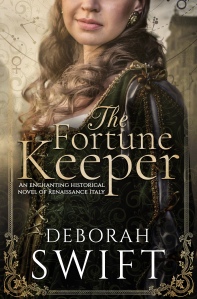
I am pleased to welcome Deborah Swift to my blog to share an article about researching crime in Renaissance Venice for her novel, The Fortune Keeper. I would like to thank Deborah Swift and The Coffee Pot Book Club for allowing me to be part of this blog tour.


One of the things I was aware of as soon as I started this novel, The Fortune Keeper, was that although not a crime novel, it would probably have several murders within its pages. This is because the whole series is about Giulia Tofana, who was renowned for poisoning men so that their wives could escape marital persecution.

Giulia Tofana became a legend and it is probable that she didn’t poison as many men as the rumors say, and that she was probably blamed for the crimes of others. One of the others suspected of her crimes was her stepdaughter Girolama. As she was to be featured in this book, it led me to look into the law in early modern Venice because I knew I would have to be aware of policing, punishment, and the mechanisms of the law.

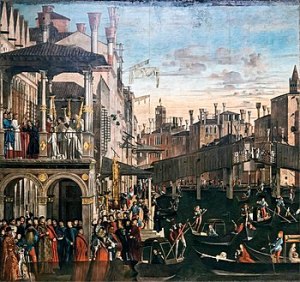
Accademia – Miracle of the Holy Cross at Rialto by Vittore Carpaccio

Renaissance Robbery
Venice was extremely wealthy in the Renaissance period, and vagabonds and thieves flooded into the city in search of easy pickings. In the picture above you can see the canal thronged with men dressed in rich clothing and ornament. The most common crimes in Venice were burglary and forgery, but it was by no means unusual for there to be murders over money and debts. The punishment for robbery was calculated based on the quantity of property taken. First offenders who stole goods worth less than one lira could get away with a whipping, but woe betide you if you stole something bigger. The penalty was the loss of an eye for goods valued between five to ten lire, and the noose awaited those brave enough to steal something worth more than forty lire.

Debt and Death
The law allowed anyone owed more than five lire de piccola to threaten and even kill the debtor to recoup their money, putting the onus firmly on the debtor, not the avenger. This tells us that money was the main driving force in Venetian society. But what about armed robbery or assault where no debt was owed? Most assaults were subject to a mere fine of twenty-five lire, or banishment from the city-state. If your crime was a crime that drew blood – sanguinem fecerit – then the punishment was up to the judging council. Venetian law had no such thing as ‘innocent until proven guilty’ at that time. The proof was largely circumstantial, and it relied on the judge and jury’s instinct regarding the guilt of the person involved.

Renaissance Lawkeepers
The Avogaria di Comun were a group equivalent to lawyers, though non-professional, drawn exclusively from the nobility. They acted as prosecutors for the state, giving evidence and arguing for punishments before the main judicial councils of Venice. Because of their status, their judgments were often influenced by their social position, and the personal axes they had to grind.

Execution and Mutilation
In this period it was still common for mutilations to take place, which had been traditional in medieval times. Cutting out the tongue for heresy, cutting off the thumb or fingers for pilfering. Courtesans regularly had their noses or faces cut. There was also the custom of cutting off the ‘offending’ part – this led to men who were convicted of dabbling in heresy or alchemy, or crimes against the Holy Roman Church having their hand cut off to remove the ‘devil’s instrument’. This kind of public ritual and humiliation was designed to bring public vengeance to the accused person and to reaffirm the values of the Church or state.

The ritual turned the execution into a purification of the city.
Few crimes brought down corporal or capital punishment. The types of corporal punishment used for the crimes of rape and assault were minor by today’s standards. As an example, for assault, out of 569 cases only fifteen involved mutilation of the criminal; and sixteen more involved some form of corporal discipline. For rape offenses, corporal punishment was even less significant, with twenty cases of discipline and only four of mutilation.


Maintaining law and order
On the streets, the main arbiters of law and order were the town guard, the vigili urbani, who acted as our police do now. Their job was to make sure masked men didn’t carry arms, that only noblemen wore swords, and to act as a preventative force as well as policing troublemakers.

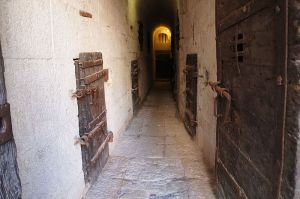
Further up the ladder was the Council of Ten, a kind of secret police force whose job was to maintain order within the city-state of Venice. There was not much space in the city gaols of Venice due to the whole nature of its construction. For crimes of fraud, marital dispute, and affray, these men sat in judgment. It was unfeasible to keep men incarcerated for long because otherwise, the gaols would be full of minor offenders. Small fines and short gaol sentences were the usual punishments for common violence in Venice. When the crime crossed the line into something that was considered ‘against God’ or ‘against the reputation of Venice’ then ritual punishment could be relied upon to warn the populace about sinning against these bigger, less personal edifices.

Documents I found helpful in my research:
Law and Punishment in Early Renaissance Venice
Violence in Early Renaissance Venice – Guido Ruggiero
Banditry and Social Identity in the Republic of Venice – Sergio Lavarda
Authority and the Law in Renaissance Venice — G. Cozzi

xr:d:DAEbig1CmJo:257,j:33693903820,t:22082511

Blurb:

Count your nights by stars, not shadows ~ Italian Proverb

Winter in Renaissance Venice

Mia Caiozzi is determined to discover her destiny by studying the science of astronomy. But her stepmother Giulia forbids her to engage in this occupation, fearing it will lead her into danger. The ideas of Galileo are banned by the Inquisition, so Mia must study in secret.

Giulia’s real name is Giulia Tofana, renowned for her poison Aqua Tofana, and she is in hiding from the Duke de Verdi’s family who are intent on revenge for the death of their brother. Giulia insists Mia should live quietly out of public view. If not, it could threaten them all. But Mia doesn’t understand this, and rebels against Giulia, determined to go her own way.

When the two secret lives collide, it has far-reaching and fatal consequences that will change Mia’s life forever.

Set amongst opulent palazzos and shimmering canals, The Fortune Keeper is the third novel of adventure and romance based on the life and legend of Giulia Tofana, the famous poisoner.

‘Her characters are so real they linger in the mind long after the book is back on the shelf’
~ Historical Novel Society

NB This is the third in a series but can stand alone as it features a new protagonist. The other two books are available if reviewers want them.

Trigger Warnings:
Murder and violence in keeping with the era.

Buy Links:

This title is available to read on #KindleUnlimited.

Universal Link: https://mybook.to/FortuneKeeper

Audiobook Buy Links:

Kobo: https://www.kobo.com/gb/en/audiobook/fortune-keeper-the
Audio: https://www.audible.co.uk/pd/The-Fortune-Keeper-Audiobook/B0C63R95WM

Author Bio:

Deborah Swift is a USA TODAY bestselling author who is passionate about the past. Deborah used to be a costume designer for the BBC, before becoming a writer. Now she lives in an old English school house in a village full of 17th Century houses, near the glorious Lake District. Deborah has an award-winning historical fiction blog on her website http://www.deborahswift.com.

Deborah loves to write about how extraordinary events in history have transformed the lives of ordinary people, and how the events of the past can live on in her books and still resonate today.

The first in her series about the Renaissance poisoner Giulia Tofana, The Poison Keeper, was a winner of the Wishing Shelf Book of the Decade, a Coffee Pot Book Club Gold Medal, and the latest in her WW2 Secret Agent series, Operation Tulip, is coming soon.

Author Links:

Website: http://www.deborahswift.com
Twitter: https://twitter.com/swiftstory
Facebook: https://www.facebook.com/authordeborahswift/
Pinterest: https://www.pinterest.co.uk/deborahswift1/
Bookbub: https://www.bookbub.com/authors/deborah-swift
Amazon: http://author.to/DeborahSwift

Book Review: “Sisters of Treason” by Elizabeth Fremantle

Sisters of TreasonThose born of royal blood are either blessed by being able to sit on the throne or cursed to be under intense scrutiny for fears of treason. That is the case for the Grey sisters. Jane, Katherine, and Mary were the daughters of Henry and Frances Grey and the granddaughters of Mary and Charles Brandon. Their bloodline made them cousins to Mary I and Elizabeth I, which meant they threatened the two queens, especially when Edward VI named Lady Jane Grey his heir. After Mary I executes Jane and their father Henry for treason, the remaining Grey sisters, Katherine and Mary, must survive the treacherous Tudor court or end up like their sister. Can Katherine and Mary survive in a court where their royal blood leaves a target on their backs? Elizabeth Fremantle tells the tale of the lesser-known Grey sisters in her novel, “Sisters of Treason.”

A few years ago, I read the first book in The Tudor Trilogy by Elizabeth Fremantle called, “Queen’s Gambit: A Novel of Katherine Parr,” and I adored it. I have always been fascinated with Tudor heroines that do not get enough attention. I feel like Katherine and Mary Grey fit that bill and another woman Fremantle included in this novel, Levina Teerlinc. When I read the description of this book, I knew I would enjoy it.

We begin with the tragic execution of Lady Jane Grey as her mother Frances and Levina Teerlinc, a family friend, watch in horror in the middle of the crowd. They know they cannot save her, but they can protect her sisters from the same grisly fate by keeping a close eye on them from themselves and the schemes of others. Mary Grey can keep herself from major scandals and close to her cousins because of her misshapen body. She knows that she cannot threaten the house of Tudor because she cannot have children. On the other hand, Katherine Grey only cares about love and having her own family; she does not care about the consequences that she may have to deal with if she marries without the queen’s permission.

While Mary Grey is a constant companion for Queen Mary and Queen Elizabeth, Katherine is on the outside looking in, wanting her own life and to marry Edward Seymour, Earl of Hertford. Eventually, they marry secretly, much to the chagrin of Queen Elizabeth I. Katherine and Hertford suffer the consequences of their love match by spending time in the Tower. Mary on the other hand knows her duty to the throne and how it is important to keep her family safe from the Tudor queens’ ire, even when she falls in love with Thomas Keyes. We also have the perspective of the artist Levina Teerlinc, a family friend of the Greys and a surrogate mother to Katherine and Mary after the death of Frances. The Greys and Teerlinc must also navigate the ever-changing religious world as they are reformers when Catholicism battles it out with Protestantism.

This is yet another sublime novel by Elizabeth Fremantle. It is full of tension, intrigue, romance, and love for one’s family, whether a friend as close as a mother or the bonds of blood. Even though I knew how the stories of Katherine and Mary Grey played out, it was still a thrilling read, especially with the addition of Levina Teerlinc. I have loved every novel that I have read by Fremantle so far and I look forward to reading more. If you want an excellent novel about the Grey sisters, I highly recommend you read “Sisters of Treason” by Elizabeth Fremantle.

Book Review: “The Passionate Tudor: A Novel of Queen Mary I” by Alison Weir

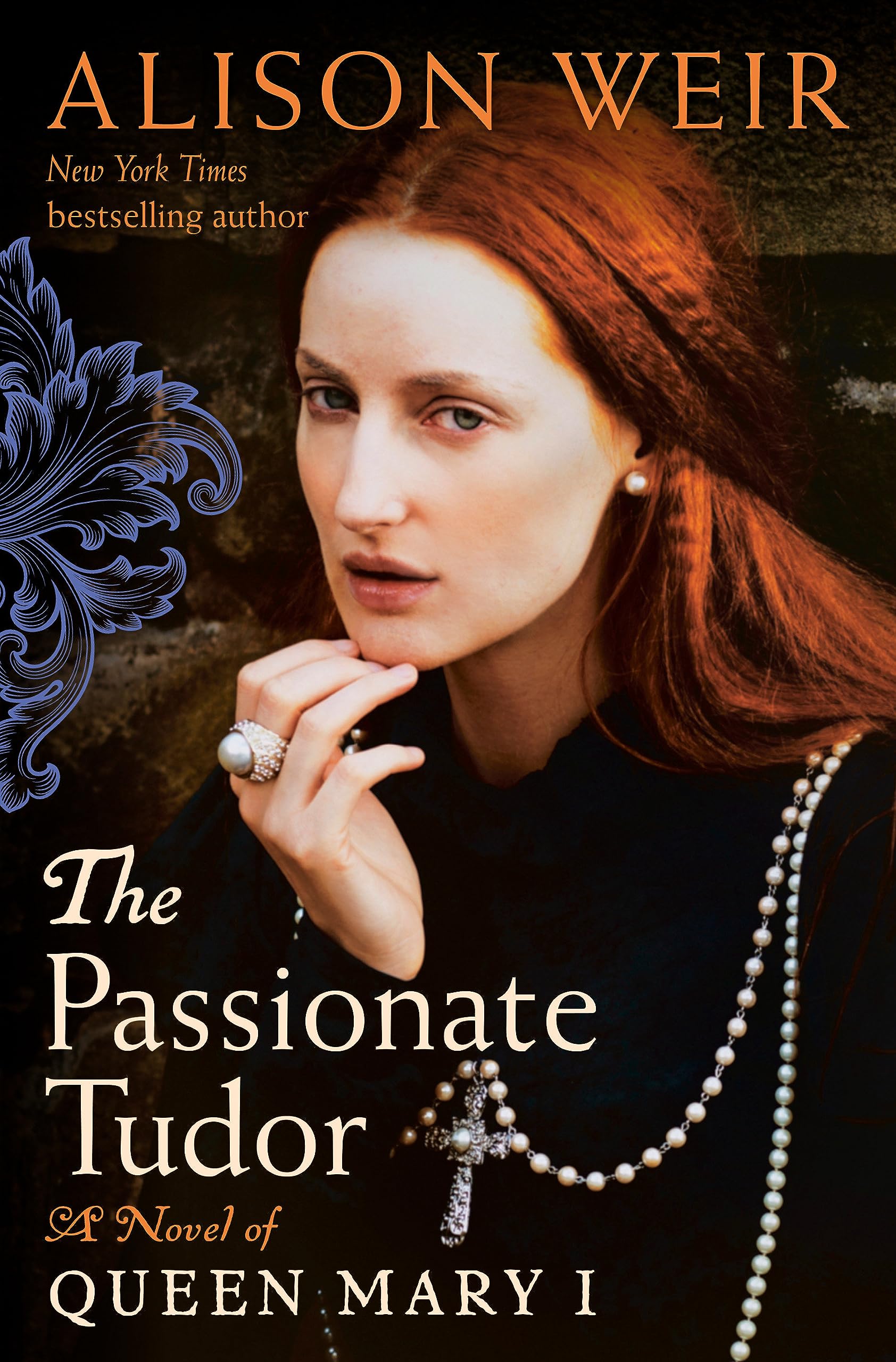
The Passionate TudorA king’s eldest child is usually the next in line to inherit the throne and become the next ruler. At least that is how the line of succession is supposed to work if the heir is male. Mary I knew this better than anyone. As the eldest daughter of King Henry VIII, she knew that once her mother Katherine of Aragon had a son, Mary would become a pawn in the marriage game. She was willing to accept this fate until her father fell in love with Anne Boleyn. Mary is declared a bastard and must fight for her inheritance and the crown of England while maintaining her Catholic faith. Alison Weir tells the tale of this remarkable woman, from her tumultuous childhood to her short reign that marked her legacy, in her latest novel, “The Passionate Tudor: A Novel of Queen Mary I.”

I would like to thank Ballantine Books and Net Galley for sending me a copy of this book. I have enjoyed the previous novels in The Tudor Rose trilogy by Alison Weir about Elizabeth of York and King Henry VIII, so when I heard she was writing a book about Mary I, I knew I wanted to read it. Mary I is one of those figures who shows how devastating it can be to be close to the throne and the hard decisions one makes when king or queen of a country.

Weir began her novel with Mary at the age of nine in 1525. She is her parent’s pride and joy as she is their only child. Her mother Katherine of Aragon is arranging an advantageous marriage for Mary that would create a strong alliance for England. Not even the birth of her half-brother Henry Fitzroy could dampen Mary Tudor’s spirits. However, that all changed when Anne Boleyn entered the picture and the Great Matter was made public. Katherine of Aragon is no longer queen, Anne Boleyn is Mary’s stepmother, and Mary is now declared a bastard in favor of her half-sister Elizabeth Tudor.

Mary’s life after the birth of Elizabeth Tudor begins to become even more tragic. Her mother Katherine of Aragon dies before she can see her daughter again and Anne Boleyn is executed for treason soon afterwards. Henry VIII marries Jane Seymour, has his desired male heir Edward VI, before Jane tragically dies quickly. As the Supreme Head of the Church of England, Henry wants his daughter Mary, a devout Catholic, to submit to his will, which she ultimately does. We also get to see how Mary interacted with her other stepmothers, Anna of Cleves, Katherine Howard, and Katherine Parr, until the death of her father Henry VIII. Before he died, Henry VIII revised his Act of Succession, making Mary Edward’s heir if he did not have children. However, Edward VI has his idea for who will succeed him after he dies and he names Lady Jane Grey as his heir, although that plan does not last long and Mary is proclaimed the first queen of England to rule on her own.

Weir shows Mary’s life and reign in a very sympathetic way. Even though she does still give her the nickname “Bloody Mary”, we can see a woman who is concerned about the faith of her kingdom and the well-being of her family, especially Edward, Prince Philip her husband, and Elizabeth, who she argues with on matters that matter to her. It is such a tragedy that Mary never had a child that she desperately wanted to have as she suffered through phantom pregnancies. At the end of the day, whether it was matters of faith or family, Mary was someone who was passionate and someone who desired to be loved.

This is a delightful novel about a woman who has often been vilified but maybe we should have sympathy for everything she had to endure starting at a young age. I enjoyed this novel very much and I look forward to the next novel by Weir. If you have enjoyed the previous books in the Tudor Rose trilogy or you just want a different take on Mary I’s story, I highly suggest you read, “The Passionate Tudor: A Novel of Queen Mary I” by Alison Weir.

Television Series Review: “Shardlake”

The year is 1536 and England is amid great religious change. King Henry VIII and his top advisor Thomas Cromwell wanted to close the top monasteries in the country so they initiated the dissolution of the monasteries. One such religious house is St. Donatus monastery in Scarnsea, so Cromwell sends one of his commissioners, Robin Singleton, to investigate the monastery and persuade the monks to leave their home. However, things do not go to plan and Singleton is brutally murdered. Now, Cromwell must rely on a lawyer named Matthew Shardlake and Jack Barak to solve the murder case and close the monastery once and for all. With a house full of secrets, suspicion, and monks fearful of the future, can Shardlake and Barak solve the case before they become the next victim?

This is the premise of the latest Tudor drama on Disney +, called Shardlake, based on the first book in the Matthew Shardlake series by C.J. Sansom, titled “Dissolution.” I remember falling in love with this book series when I first read it about four years ago and I did hope that one day, it would be turned into a television series because Sansom’s writing style was so vivid and his characters leaped off the pages. When it was first announced that Disney + was going to produce this show, it was exciting to know that it was finally going to be adapted for television, but it was also nerve-wracking because since it is one of my favorite Tudor book series, I was hoping that it would do the book justice.

I decided that before the show was due to release, I was going to reread “Dissolution” as I forgot the story and how it played out in the book. This was a joy as Sansom’s writing style is still vibrant and filled with many twists and turns. I was hoping that the show could capture the sense of excitement and danger and how he recreated the Tudor world that Sansom in his books for his readers, especially after it was announced that CJ Sansom passed away two days before the show premiered. I wanted the show to honor Sansom’s legacy and craft as a wonderful storyteller and extremely passionate about the Tudor dynasty.

As I have recently read “Dissolution” right before watching “Shardlake”, I feel like I cannot keep this review as spoiler-free as I would have liked, so this is your warning, I will be spoiling some things in the show and the book.

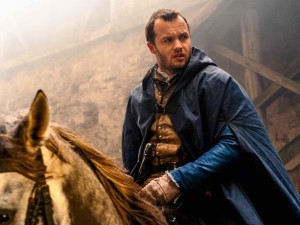
Before we dive into the story, we have to set out our cast of characters, starting with Matthew Shardlake, played brilliantly by Arthur Hughes. Hughes can present Shardlake in such a believable way that it feels like he jumped off the pages. We also have Jack Barak, the funny playboy who adds some light notes to the story, played by Anthony Boyle. I am not going to lie, I was shocked that they decided to replace Mark Poer with Jack Barak, but once I saw the interactions between Shardlake and Barak on set, it made sense. Wrapping up the main actors is Thomas Cromwell played masterfully by Sean Bean. When the casting was announced about Bean being Cromwell, it was hard to picture the historical figure, but when I saw him on the screen having his first scene with Shardlake about the relics, my doubts vanished. He does an excellent portrayal of Thomas Cromwell.

I must applaud the casting crew for creating such a diverse cast, just as diverse as the book that it is inspired by. Some of my standouts include Ruby Ashbourne Serkis as Alice, Irfan Shamji as Brother Guy, and Joe Barber as Simon Whelplay. Regarding the casting of Babou Ceesay as Abbot Fabian, I did not have a problem with it because I think he did a great job portraying a character in a fictional drama based on a historical fiction novel. The one character that I was a bit confused about was the inclusion of Norfolk played by Peter Firth, as he was not in the original story and didn’t add much to the story as a whole.

I think as a whole, the costumes did look relatively decent. However, a few, especially Dr. Goodhap’s outfit, looked synthetic and threw off the illusion of it being a Tudor period drama. I also wanted to see more head coverings for the male characters and for Alice, although the clothing colors were not as dark as I feared. I liked the addition of the relics, the parrot, and the manuscripts to add depth to the drama, and the use of candles instead of torches, always a major plus for history nerds when watching historical dramas.

One of my big issues was the monastery of St. Donatus itself. It has been reported that they filmed in Hungary, Romania, and Austria, primarily at Hunedoara Castle and Kruezenstein Castle. That is a big red flag for authenticity. They may be beautiful locations, but they were not an English monastery during the 16th century when monasteries were dissolved. You can tell that it was not filmed in England and it does take away from the illusion that is so important when it comes to historical dramas; you want to be transported to the location that the author had in mind, especially when Sansom included a map on the monastery in his book.

Now let’s address the elephant in the room, the story of the “Shardlake” series. For the most part, the Shardlake television series stays pretty close to the story, except for a few glaring exceptions. When they mentioned the holy relic went missing, they did not mention the beheaded bird on the altar, which is probably for the best because it is a rather disturbing image. We also have the scenes with Simon Whelplay, who is portrayed as a nervous youth who is constantly getting into trouble. His death plays out a little differently in the book, as he slips and falls in the bathhouse, whereas in the show, he plummets from a tower. In both cases, it is revealed that he was drugged with belladonna. I did feel a bit sad that they didn’t flesh out the relationship between Brother Guy and Shardlake as that was my favorite friendship in the book series. They could have easily had a scene where we could see the potential for their friendship to grow past the monastery.

The two major issues I had were inclusions to the plot of the story. I did not like the addition of Norfolk as a big-name villain for Shardlake because, in the book series, the major historical figures took a back seat to the original characters Sansom created. My biggest issue with this show was Barak’s character arc. At first, I thought it was an odd choice to include him over Mark Poer in the series, but then they decided to combine character traits, like Barak falling for Alice which felt so wrong, luckily he does not run away with her. And then Barak randomly killed Goodhap and got away with it. He admitted to Shardlake that he killed Goodhap and it felt like Shardlake ignored the entire issue, which feels completely off for Shardlake. If they do make another season and they have the actors playing Shardlake and Barak back, it is just going to feel a bit awkward between them.

Overall, I thought the “Shardlake” series was a decent adaptation of the Matthew Shardlake series by C.J. Sansom, but the books will always be superior. If you want to jump into the Tudor world with a murder mystery filled with twists and turns, you should check out “Shardlake” on Disney +, and if you want to read the book series, check out the Matthew Shardlake series by CJ Sansom.

What are your opinions about the “Shardlake” series on Disney + and what is your favorite book written by CJ Sansom?

If you are curious about my views about the Matthew Shardlake book series by CJ Sansom, you can find my review here: https://adventuresofatudornerd.com/2020/09/27/book-series-review-the-matthew-shardlake-series-by-c-j-sansom/

Sources for Images and Cast Information:

https://www.imdb.com/title/tt27390563/fullcredits/?ref_=tt_cl_sm

https://www.rottentomatoes.com/tv/shardlake

Guest Post: “Making Real People Work for You” by Anna Belfrage

Their Castilian Orphan Tour Banner 1I am pleased to welcome Anna Belfrage to my blog today to share a guest post to promote her novel, “Their Castilian Orphan.” I would like to thank Anna Belfrage and The Coffee Pot Book Club for allowing me to be part of this blog tour.

I write Historical Fiction. While my protagonists are entirely fictional, they now and then have to interact with “real” people who’ve existed, lived, and died for real. This can be a bummer – especially when your perfectly crafted timeline suddenly crashes headlong into the wall of historical facts. That conversation your protagonist was to have with the wife of the 14th-century Earl of Lancaster can no longer happen, seeing as the lady died some months before the planned meeting. The touching scene in which Philippe Augustus of France reconciles with his Danish wife, Ingeborg, must be scrapped – the king would no more reconcile with his wife than he would have a crocodile in his bed (which would not only be very weird but also anachronistic, as there were no crocodiles in medieval France. As an aside, no one knows just why Philippe Augustus stormed out of the chamber in which he’d just spent his wedding night said Ingeborg, determined to never, ever have her near him again). See? These real-life characters are hard to deal with. In actual fact, so are the invented characters, as all of a sudden they start developing opinions of their own and generally refuse to cooperate when they don’t agree with the overall plotline, but that is neither here nor there – not in this post.
Including real characters in the story adds a certain nerve. People can read the book, become intrigued, and spend some time googling the real characters. Hopefully, they come away with the impression that the author has done a good job adhering to the overall facts. If not, there may be a problem, as readers of historical fiction tend to be sensitive to incorrect information.

The further back in history you write, the more leeway you have when utilizing real-life characters. Also, I think it important to underline that Historical Fiction is precisely that: fiction. Even when writing about real historical people, we must keep in mind that we don’t know these shadowy ghosts from the past. What we have are fragments of their lives (at best), mentions in this roll or the other, acidic comments in one chronicler’s version of events, and praise in another’s. So what any good historical fiction author does is that he/she constructs a picture – fleshes out the spare bones we have left to create a living, breathing character (in as much as characters can breathe, of course). Every such representation is incorrect in that it does not – cannot – be a fair representation of the person who lived and died all those years ago.

This is why we get such varied depictions of historical people. Authors may start with the same bare facts, but then they’ll add biases and personal values, which is why Henry Tudor comes across as the villain in one book, as an earnest man with a mission in another. The thing is, we have no idea what he was really like. Was he passionate in bed? Did he have the enervating habit of sucking his teeth as he thought? Did he take reading matter with him to the garderobe? Did he eat the veggies first? Did he now and then curse that meddlesome mother of his to hell and back? We simply don’t know. What we do know is that he won at Bosworth – and that, according to some, is down to pure luck, while others will argue for divine intervention.

I guess the long and short of all this is that a historical fiction author must know his/her period, and must be familiar with customs and foods, clothes, and values. Of course, when writing about real people, the author needs to have read up on the facts that exist. But these are just the building blocks. A historical fiction author wants to tell a story, and sometimes those real-life characters have to be tweaked – a bit – to create the required tension. And so Henry Tudor is at times represented as diabolical, at others as an ambitious man who truly believes he deserves the English crown. A skilled author will have the reader accepting either or – for the sake of the story as such.

In my recent release, Their Castilian Orphan, I am writing about a very, very bad year for Edward I. 1294 is probably one of his least favourite years, even if nowhere close to that most awful year, 1290 (when his wife died. And see what I am doing here? I am imbuing Edward with romantic traits by indicating he never, ever got over the loss of Eleanor. While there seems to be plenty of evidence this was the case, we do not know. Not really. . .) In 1294, Philippe IV of France more or less tricked Edward into turning over parts of Gascony to him, and, as icing on the cake, the Welsh seized the opportunity offered by Edward’s conflict with France to rebel.

Obviously, Edward plays an important role in my novel. While he is not one of my protagonists, most of my invented peeps live in his shadow, some in closer proximity to him than others, but none untouched. As Edward was king, we know more about him than about other players in the period. We can, for example, track his itinerary through his rolls—and boy did the man move about a lot! But the documents offer little insight into his mind and innermost thoughts.

My Edward is a man determined to come across as powerful. Being humiliated by the much younger Philippe must hurt, as does, in all likelihood, his gouty toe. But Edward would refuse to show weakness in public—it suffices that some of his more vociferous nobles are insinuating he was tricked by Philippe because Philippe promised him his young sister, Marguerite as a new bride. Ugh, his nobles exclaim, a king ruled by his lusts! My Edward doesn’t want to wed again—but he knows he has no choice, not really, seeing as he only has one surviving son, and everyone knows a king needs at least one spare. My Edward is temperamental and at times he unfairly subjects those who serve him to his anger. I have no idea if the real Edward would ever throw a heavy candlestick at a boy, but my Edward does—and is incapable of bending his pride sufficiently to apologise for it afterwards.

Many would probably portray Edward as more demonic—especially those writing about his campaigns against the Scots. And yes, to them he probably was the devil in disguise, but like every other person in the world, Edward was a multifaceted person, even if he does seem to have had a propensity for ruthless violence when riled. On the other hand, he was a medieval king, and such kings ruled through the force of their swords.

In conclusion, as I said right at the beginning, I write fiction. I have the joy of constructing a plot that weaves its way through the tapestry of known history, my invented leads interacting freely with the people who populate the history books – as I see them. Lucky me, hey?
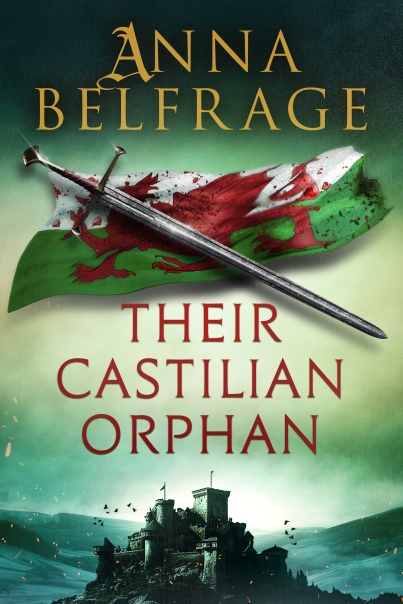
Their Castilian Orphan coverBlurb:

It is 1294 and Eustace de Lamont is back in England after five years in exile. He will stop at nothing to ruin Robert FitzStephan and his wife, Noor d’Outremer.

Robert’s half-brother, Eustace de Lamont, has not mellowed during his absence. He is more ruthless than ever, and this time he targets Robert’s and Noor’s foster son, Lionel.

Lionel is serving King Edward as a page when Eustace appears at court. Not only does Lionel become the horrified witness to Eustace’s violent streak, Eustace also starts voicing his suspicions about Lionel’s parentage. The truth about Lionel’s heritage is explosive—should King Edward find out, all would be lost for Robert and Noor.

In October of 1294, Wales rises in rebellion. Robert must leave his family unprotected to fight the Welsh rebels on the king’s behalf, comforted only by the fact that Eustace too is called to fight.

Except that Eustace has no intention of allowing his duty to his king—or a mere rebellion—come between him and his desire to destroy Robert FitzStephan . . .

Buy Links:

This title is available to read on #KindleUnlimited.
Universal buy link: https://mybook.to/TCO

Anna BelfrageAuthor Bio:

Had Anna been allowed to choose, she’d have become a time traveler. As this was impossible, she became a financial professional with three absorbing interests: history, romance, and writing. Anna has authored the acclaimed time travelling series The Graham Saga, set in 17th-century Scotland and Maryland, as well as the equally acclaimed medieval series The King’s Greatest Enemy which is set in 14th-century England. Anna has just released the final installment, Their Castilian Orphan, in her other medieval series, The Castilian Saga, which is set against the conquest of Wales. She has recently released Times of Turmoil, a sequel to her time travel romance, The Whirlpools of Time, and is now considering just how to wiggle out of setting the next book in that series in Peter the Great’s Russia, as her characters are demanding. . .

All of Anna’s books have been awarded the IndieBRAG Medallion, she has several Historical Novel Society Editor’s Choices, and one of her books won the HNS Indie Award in 2015. She is also the proud recipient of various Reader’s Favorite medals as well as having won various Gold, Silver, and Bronze Coffee Pot Book Club awards.

“A master storyteller”

“This is what all historical fiction should be like. Superb.”

Find out more about Anna, and her books and enjoy her eclectic historical blog on her website, http://www.annabelfrage.com

Sign up for Anna’s newsletter to keep up with new releases, giveaways, and other fun stuff: http://eepurl.com/cjgatT

Author Links:

Website: http://www.annabelfrage.com
Twitter: https://twitter.com/abelfrageauthor
Bluesky: https://bsky.app/profile/abelfrageauthor.bsky.social
Facebook: https://www.facebook.com/annabelfrageauthor
Instagram: https://instagram.com/annabelfrageauthor
Book Bub: https://www.bookbub.com/profile/anna-belfrage
Amazon Author Page: http://Author.to/ABG
Goodreads: https://www.goodreads.com/author/show/6449528.Anna_Belfrage


Book Review: “The Colour of Sin” by Toni Mount

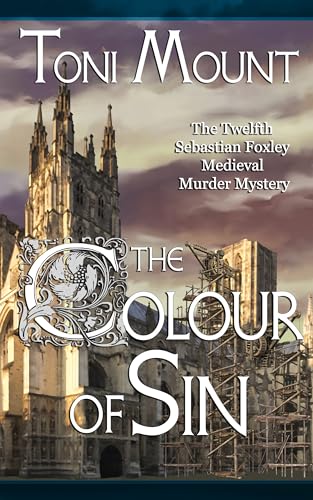
The Colour of SinThe year is 1480 and King Edward IV sits firmly on the throne, yet the Lancasterian threat lurks in the shadow. Things have taken a drastic turn for Sebastian Foxley’s workshop and his family. It has been months since a fire destroyed the Foxley home and workshop, which also left his brother Jude injured. Seb has decided now would be the perfect time to go on a pilgrimage to Canterbury to pray at the shrine of St Thomas Becket. The pilgrimage had its perils on paper before even setting out on the road. What terrors await Seb and his monty crew of pilgrims and can they survive the trip? Toni Mount’s twelfth Sebastian Foxley Medieval Murder, “The Colour of Sin,” takes our hero on a journey beyond the streets of his beloved London into a wider world full of intrigue.

I would like to thank Toni Mount for sending me a copy of her latest novel. I have enjoyed the previous Sebastian Foxley novels that I have read, so when I heard about the latest novel, I knew I wanted to read it, even though I did not read the novel, “The Colour of Bone” before jumping into this one.

Mount begins her latest Foxley mystery in the middle of October 1480. The Foxley home is being rebuilt while Seb and Jude are not on cordial terms after the accident a few months ago. Seb has decided that now would be the appropriate time to do the one thing that he promised God he would do if Jude was able to recover; to go on a pilgrimage to Canterbury and pray for Jude at the shrine of St Thomas Becket. When Seb’s beloved Rose finds out about his scheme, she accompanies her husband and their two young children, Dickon and Julia. It was going to be a simple family pilgrimage, until Father Christian, known as Kit, tags along and helps with the children.

Like every good pilgrimage, you need a group of people to make it a success, so Seb, Rose, and Kit are joined by the guide Tanner, the Warenne twins Troilus and Tristan, and Mother Thorogood and her black cat. Seb thought that this pilgrimage would be sort of a vacation and would go as smoothly as it is written in his book. However, the journey is more treacherous than what Seb had planned as there are natural disasters, rogues, kidnappings, and plenty of plots. Even on the road, Sebastian Foxley must battle intrigue and murder plots while dealing with family drama and keeping the ones he cares for alive far from home.

This was yet another fun and intriguing medieval murder mystery that follows Sebastian Foxley and his ever-expanding household. There were so many different story strings, but Mount tied them up neatly in a bow with a dose of political intrigue, religious piety, and drama filled with love and anger. I found this a pleasurable read and I look forward to the next novel in this series. If you are a fan of the Sebastian Foxley Medieval Murder Mystery series, I would suggest you read the latest installment, “The Colour of Sin” by Toni Mount.

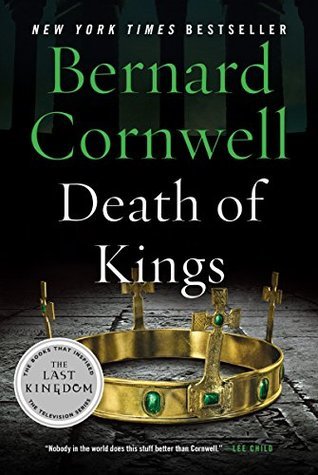
Book Review: “Death of Kings”(Book Six of the Saxon Stories series) by Bernard Cornwell

Death of KingsThe ninth century is coming to a close and England is at a major crossroads. King Alfred the Great is dying and England being unified is still a long-term goal. The only hope for a united England lies in the hands of his son and successor Edward. However, the road to the throne will be challenging as other Saxons and Viking warriors desire the throne. Only one man can help the young king, but which side will Uhtred of Bebbanburg choose? The fight for England’s future continues in book six of the Saxon Stories, “Death of Kings” by Bernard Cornwell.

We begin with Lord Uhtred as he works hard to maintain the lands he earned through fighting for Alfred. But let’s be honest, the quiet life is not for Uhtred of Bebbanburg. A horde of ruffians attack Uhtred at his home, which he can fend off, but he soon finds out that it was a Saxon lord who wishes for his death. At the same time, the dying King Alfred has sent a group to Uhtred to create an alliance with King Eohric to fend off the Danes who are beginning to amass armies against the Saxons.

However, Uhtred soon realizes that Eohric desires power over peace and aligns himself with Sigurd to kill Uhtred. While Uhtred is about to confront Sigurd, he is told about a woman named Aelfadell, who allegedly knows the future. She tells Uhtred of a prophecy that seven kings will die, the women he loves will die, the son of Alfred will not rule, and the Danes will rule all of England. Such a cheerful prophecy that will come into play later on.

As Uhtred deals with the aftermath of all of this, he finds out that Alfred is on death’s door and Edward, his son, and heir, is facing an affair scandal with a woman named Lady Ecgywynn and her children, all while he is betrothed to Aelflaed. With the death of King Alfred, Uhtred is free from his promises to the Saxon king and is given a choice. He can either swear loyalty to the young king and fight for the hope of a united England or he can put down Serpent-Breath and let Alfred’s dream die. I am not going to spoil what choice Uhtred made, but rest assured, his decision will change the course of history, at least this fictional version of Saxon England.

Overall, I found this an enjoyable middle book in a series. It is a solid setup book with a thrilling final battle which helps the readers to realize that the fight for England is not done and that there are many more adventures for Uhtred of Bebbanburg. If you have read the previous five novels in the Saxon Stories series, I would recommend you read, “Death of Kings” by Bernard Cornwell.

Guest Post: “Excerpt from ‘A Splendid Defiance’ by Stella Riley”

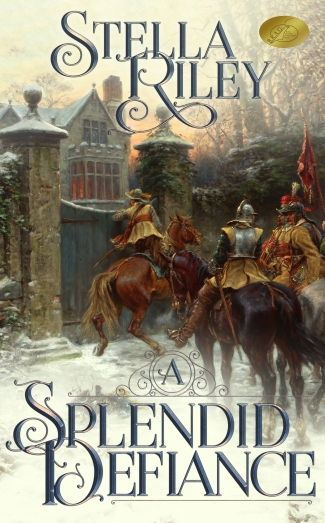
A Splendid Defiance Tour BannerI am pleased to welcome Stella Riley to my blog today to share an excerpt from her novel, “A Splendid Defiance.” I would like to thank Stella Riley and the Coffee Pot Book Club for allowing me to be part of this blog tour.
Abby storms the castle

Considering that he had left his bed to dress hurriedly and come straight downstairs, the Captain’s room was remarkably tidy. A lot tidier, thought Abigail, with a faintly shocked sideways glance, than he was himself. It was also larger than she had expected, being situated at the top of the south-east turret and reached by means of a narrow spiral stair.

I shouldn’t be here, thought Abigail, in sudden panic.  Jonas will kill me if he finds out.

Justin deposited his sword in a corner.  Then, turning to pull the bedclothes into some semblance of order, he told her to sit down and demanded again to be informed what she wanted of him.

Abigail hovered and hesitated.

‘For God’s sake!’ exclaimed Justin, dropping irritably upon the bed and regarding her with acute disfavour.  ‘Sit down and stop being coy.  I’m not in the mood for it.’

She obeyed him rather quickly.  ‘I’m sorry.’

‘Don’t be sorry.  Just come to the point.’

His tone made this difficult but she did her best.

‘It’s my brother.  He was arrested in the Market Place this afternoon – but he didn’t do anything.  I mean, he wasn’t involved in the fighting in the way that others were.  So I came to ask you to please let him come home.’

Comprehension dawned slowly and the blurred gaze registered astonishment.

‘You mean he was taken for rioting?  No, no.  It’s too good to be true.’

Abigail stiffened.  ‘I’m afraid I don’t find it funny.’

The dark brows soared and his reply was deliberately blighting. 

‘My dear child, I’d be amazed if the members of your household found anything funny.  Quite apart from your religious persuasion, your appalling brother and his sour-faced wife are enough to kill anyone’s sense of humour.  However, if you’ve hauled me out of bed just to ask a favour for Jonas, I can only say that your nerve outstrips your intelligence.  To put it bluntly, I don’t care if he rots.’

Abigail dissected this remarkable speech before brushing it aside.

‘What has Jonas to do with it?  It isn’t him you’ve got.’  And then, staring at him, ‘Is that what you thought?’

‘Not being on intimate terms with your entire family, what else was I to think?’ he asked acidly.  ‘Well?’

‘I’m sorry.  I thought you’d realise …’ She paused.  ‘If it was Jonas, I wouldn’t be here.’

‘And I am supposed to know that because …?’  Captain Ambrose leaned back, brooding on her overfolded arms. ‘Mistress Radford.  My patience, as you may have noticed, is extremely limited and diminishing by the second. Will you please tell me, in plain language, just who the hell it is you came to rescue?’

A Splendid Defiance cover 2Blurb:

For two years England has been in the grip of the Civil War.  In Banbury, Oxfordshire, the Cavaliers hold the Castle, the Roundheads want it back and the town is full of zealous Puritans.

Consequently, the gulf between Captain Justin Ambrose and Abigail Radford, the sister of a fanatically religious shopkeeper, ought to be unbridgeable.

The key to both the fate of the Castle and that of Justin and Abigail lies in defiance.  But will it be enough?

A Splendid Defiance is a dramatic and enchanting story of forbidden love, set against the turmoil and anguish of the English Civil War.

Buy Link: 

Universal Buy Link:  https://books2read.com/u/bPzVNd

Stella RileyAuthor Bio:

Winner of four gold medals for historical romance and sixteen Book Readers’ Appreciation Medallions, Stella Riley lives in the beautiful medieval town of Sandwich in Kent.

She is fascinated by the English Civil Wars and has written six books set in that period. These, like the 7-book Rockliffe series, the Brandon Brothers trilogy, and, most recently The Shadow Earl, are all available in audio, performed by Alex Wyndham.

Stella enjoys travel, reading, theatre, Baroque music, and playing the harpsichord.  She also has a fondness for men with long hair – hence her 17th and 18th-century heroes.

Author Links:

Website: https://stellarileybooks.co.uk

Twitter: https://twitter.com/RileyStella

Facebook: https://www.facebook.com/stellariley.books

Instagram: https://www.instagram.com/stellarileybooks/

Pinterest: https://www.pinterest.co.uk/riley9631/stella-riley-books/

Book Bub:  https://www.bookbub.com/authors/stella-riley

Amazon Author Page: https://www.amazon.co.uk/Stella-Riley/e/B0034PB7UU/ 

Goodreads:  https://www.goodreads.com/book/show/40487661-a-splendid-defiance

Guest Post: “Spotlight for ‘The Falconer’s Apprentice’ by Malve von Hassell

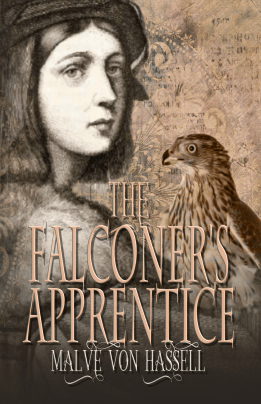
The Falconer's Apprentice Tour BannerI am pleased to welcome Malve von Hassell to my blog today to share a spotlight for her novel, “The Falconer’s Apprentice.” I want to thank The Coffee Pot Book Club and Malve von Hassell for allowing me to be part of this blog tour.
The Falconer's Apprentice CoverBlurb:

THE FALCONER’S APPRENTICE is a story of adventure and intrigue set in the intense social and political unrest of the Holy Roman Empire in the thirteenth century.

“That bird should be destroyed!” 

Andreas stared at Ethelbert in shock. Blood from an angry-looking gash on the young lord’s cheek dripped onto his embroidered tunic. Andreas clutched the handles of the basket containing the young peregrine. Perhaps this was a dream—

Andreas, an apprentice falconer at Castle Kragenberg, cannot bear the thought of killing the young female falcon and smuggles her out of the castle. Soon he realizes that his own time there has come to an end, and he stows away, with the bird, in the cart of an itinerant trader, Richard of Brugge. 

So begins a series of adventures that lead him from an obscure castle in northern Germany to the farthest reaches of Frederick von Hohenstaufen’s Holy Roman Empire, following a path dictated by the wily trader’s mysterious mission. Andreas continues to improve his falconry skills, but he also learns to pay attention to what is happening around him as he travels through areas fraught with political unrest. 

Eventually, Richard confides in Andreas, and they conspire to free Enzio, the eldest of the emperor’s illegitimate sons, from imprisonment in Bologna. 

Buy Links:

This title is available to read on #KindleUnlimited.

Universal Buy Link: https://books2read.com/u/31BMjD   

Barnes & Noble: https://www.barnesandnoble.com/w/the-falconers-apprentice-malve-von-hassell/1121105739?ean=9781737101185/   

Malve von Hassell Author photoAuthor Bio:

Malve von Hassell is a freelance writer, researcher, and translator. She holds a Ph.D. in anthropology from the New School for Social Research. Working as an independent scholar, she published The Struggle for Eden: Community Gardens in New York City (Bergin & Garvey 2002) and Homesteading in New York City 1978-1993: The Divided Heart of Loisaida (Bergin & Garvey 1996). She has also edited her grandfather Ulrich von Hassell’s memoirs written in prison in 1944, Der Kreis schließt sich – Aufzeichnungen aus der Haft 1944 (Propylaen Verlag 1994). 

She has taught at Queens College, Baruch College, Pace University, and Suffolk County Community College while continuing her work as a translator and writer. 

Malve has published two children’s picture books, Tooth Fairy (Amazon KDP 2012/2020), and Turtle Crossing (Amazon KDP 2023), and her translation and annotation of a German children’s classic by Tamara Ramsay, Rennefarre: Dott’s Wonderful Travels and Adventures (Two Harbors Press, 2012).

The Falconer’s Apprentice (2015/KDP 2024) was her first historical fiction novel for young adults. She has published Alina: A Song for the Telling (BHC Press, 2020), set in Jerusalem in the time of the Crusades, and The Amber Crane (Odyssey Books, 2021), set in Germany in 1645 and 1945, as well as a biographical work about a woman coming of age in Nazi Germany, Tapestry of My Mother’s Life: Stories, Fragments, and Silences (Next Chapter Publishing, 2021), also available in German, Bildteppich Eines Lebens: Erzählungen Meiner Mutter, Fragmente Und Schweigen (Next Chapter Publishing, 2022), and is working on a historical fiction trilogy featuring Adela of Blois. 

Author Links:

Website: https://www.malvevonhassell.com

Twitter: https://twitter.com/MvonHassell

Facebook author page: https://www.facebook.com/malvevonhassellauthor/

Linkedin: https://www.linkedin.com/in/malve-von-hassell-02b61517/ 

Instagram: https://www.instagram.com/mvonhassell/

Bluesky: https://bsky.app/profile/malvevonhassell.bsky.social

Goodreads: https://www.goodreads.com/author/show/471746.Malve_von_Hassell

Bookbub: https://www.bookbub.com/authors/malve-von-hassell

Amazon author link: https://www.amazon.com/stores/Malve-von-Hassell/author/B0CTGLDQ7P/