Guest Post: “Forsaking All Other” Excerpt by Catherine Meyrick

Forsaking All Other. Tour BannerpngToday, it is my pleasure to welcome Catherine Meyrick to my blog to share an excerpt from her novel, “Forsaking All Other”. I would like to thank Catherine Meyrick and The Coffee Pot Book Club for allowing me to take part in this blog tour. 

Excerpt

Wyard studied Lucy Torrington. Was this the manner of woman his mother thought would suit him best? She was well-dowered and, no doubt, malleable. But she was not to his taste, insipid was probably the best way to describe her. It had been a mistake to allow Eloise to talk him into coming here, he should have gone straight to Bucklings Hall.

He glanced at Bess Stoughton. Of all the women present she was the most appealing. Despite his initial misgivings, she seemed honest and sensible. She was not predatory or flirtatious, nothing like that bold piece who had tried to get him to dance last night. Perhaps Bess Stoughton’s relationship with that serving man was some sort of protection—life could be difficult for a widow. And she looked at him with neither pity nor revulsion.

‘You know Mistress Torrington well?’

‘As well as any. Lucy is a good and gentle girl who deserves to be treated with kindness and respect.’

‘Who does not?’

Her eyelashes fluttered as if surprised at his comment. ‘Lucy would bloom best married to someone who loved her.’

‘Few have that blessing. Kindness and respect are the best that most of us can hope for.’

She bit her lip, frowning. ‘Are you considering marrying Lucy?’

Wyard shrugged, ‘She is one of a number of young women my mother thinks would make a suitable bride.’ He gave a wry smile. ‘It may be more accurate to say would make a suitable good-daughter.’

‘Do you have a list of requirements—number of hands high, girth, teeth, temperament? A list such as you would take to a horse market.’

It sounded ridiculous the way she described it. He gave a sudden bark of laughter. ‘In truth, I have no list.’

‘Do you always do as your mother wishes?’

‘Rarely, but it is probably time I married and she fears that, left to my own devices, I will either never marry or choose someone highly unsuitable.’

‘Who would be unsuitable?’

‘From my mother’s position, someone without money or connections.’

‘And from your own?’

‘I have not thought so far.’ If you could not marry the best, the most loving woman you had ever met, it really did not matter.

‘Well you should. Can you imagine what it is like for a woman married to a man who is forcing himself to his duty, who does not like her company or her person, who married her simply because his mother or his father told him to?’

He had never thought of it from a woman’s point of view. ‘Was your own marriage like that?’

‘You lack courtesy, Master Wyard.’

‘But you sound as if you speak from experience.’

‘That is none of your business,’ she snapped, colour flooding her cheeks. ‘If I were a man, if I had your freedom, I would do exactly as I pleased. I would never accept a bride who had been bundled up for me by my mother.’ She glared at him, ‘Now, if you will excuse me.’ She swept away towards the group of singers, her back straight and her head held high.

Wyard wanted to stop her, to explain it was never so easy. He watched her go, wondering why he had never imagined he could truly do as he wished.

Forsaking All Other by Catherine Meyrick(Blurb)

England, 1585.

Bess Stoughton, waiting woman to the well-connected Lady Allingbourne, has discovered that her father is arranging for her to marry an elderly neighbour. Normally obedient Bess rebels and wrests from her father a year’s grace to find a husband more to her liking.

Edmund Wyard, a taciturn and scarred veteran of England’s campaign in Ireland, is attempting to ignore the pressure from his family to find a suitable wife as he prepares to join the Earl of Leicester’s army in the Netherlands.

Although Bess and Edmund are drawn to each other, they are aware that they can have nothing more than friendship. Bess knows that Edmund’s wealth and family connections place him beyond her reach. And Edmund, with his well-honed sense of duty, has never considered that he could follow his own wishes.

With England on the brink of war and fear of Catholic plots extending even into Lady Allingbourne’s household, time is running out for both of them.

Love is no game for women. The price is far too high.


Buy Links:

Amazon UKAmazon USAmazon CAAmazon AUBarnes and NobleKoboApple 

Books

Catherine MeyrickAuthor Bio:

Catherine Meyrick

Catherine Meyrick is a writer of historical fiction with a particular love of Elizabethan England. Her stories weave fictional characters into the gaps within the historical record – tales of ordinary people who are very much men and women of their time, yet in so many ways are like us today. These are people with the same hopes and longings as we have to find both love and their own place in a troubled world.

Catherine grew up in regional Victoria, but has lived all her adult life in Melbourne, Australia. Until recently she worked as a customer service librarian at her local library. She has a Master of Arts in history and is also an obsessive genealogist. When not writing, reading and researching, Catherine enjoys gardening, the cinema and music of all sorts from early music and classical to folk and country and western and, not least of all, taking photos of the family cat to post on Instagram.

Social Media Links:

WebsiteTwitterInstagramFacebookPinterest

Book Review: “Revelations” by Mary Sharratt

53968576._SY475_Margery Kempe, the only daughter of the mayor of Bishop’s Lynn, England has made a tough decision in 1413. She has decided to leave her home, her husband, and her fourteen children to go on a pilgrimage to the holy city of Jerusalem as a way to honor her late father’s dying wishes. As she begins her journey, she meets the famous anchoress Julian of Norwich, who entrusts Margery with an important mission. She gives Margery her book Revelations of Divine Love and tells her to spread her message throughout the world in secret. Margery’s pilgrimage, her connection to Julian of Norwich, and the aftermath of her journey are intricately woven together in Mary Sharratt’s stunning novel, “Revelations”.

I would like to thank Houghton Mifflin Harcourt and Net Galley for sending me a copy of this book. When I read the description of this novel, I was intrigued. I have heard the names Margery Kempe and Julian of Norwich floating around in recent years, but I sadly knew nothing about their life stories. I hoped that this novel would shed some light on both women and why they are remembered in such high regard today.

Sharratt’s novel is based on the research of historians, such as Dr. Janina Ramirez, who have argued that Margery Kempe knew Julian of Norwich and that Julian gave Margery her precious book Revelations of Divine Love. Margery is no ordinary woman as she has visions that will guide her to the path in which she believes God has chosen for her.

We begin with Margery as a young maiden, who has no desire to marry the man that her family has told her to marry. Reluctantly, she does marry John Kempe and they have fourteen children together. It is during the birth of her fourteenth child, Margery almost dies and so she decided to make a vow of celibacy, which her husband reluctantly agrees to. It was not until her father’s death that Margery chooses to fulfill his dream for her, to go on pilgrimage to Jerusalem. Since John chose not to go on pilgrimage with his wife, she decides to don the clothes of a bride of Christ, which means to dress all in white as a virgin.

Many believe that Margery’s visions, her sudden bursts of tears, and her choice to leave her family make her an evil woman. Except for Julian of Norwich, the famed anchoress, and someone who understood Margery’s struggles. Since Julian could not walk away from her duty as an anchoress to explore the world, she gave Margery the treacherous task of carrying her book throughout the world, giving it only those scholars who could be trusted with the knowledge of this scandalous text.

Margery’s journey to discover who she was meant to be is deep and riveting. It showed how even in the early 1400s, there was a struggle between different views of Christianity. From women accused of preaching in the streets to those accused of Lollardy, there was a real sense of danger and death for those who did not follow the status quo. Sharratt shows the dangers that a woman faced when she traveled on pilgrimage alone, but she also showed how deep Margery’s faith was and how willing she was to make sure that her message was heard. If I did have a small concern, it would be that I wish Sharratt delved into the writing of Margery Kempe’s autobiography, The Book of Margery Kempe.

As someone who has never read anything about Julian of Norwich or Margery Kempe, I found this novel enchanting. This was the first novel that I have read by Mary Sharratt and I thoroughly enjoyed it. It was a delightful escape into the past and the life of a friendship and a pilgrimage that would change the life of Margery Kempe forever. If this sounds intriguing to you, check out “Revelations” by Mary Sharratt.

Guest Post: “Life at the Tudor Court” by Karen Heenan

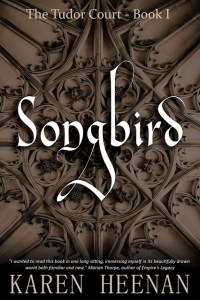
I am pleased to welcome Karen Heenan to my blog today to discuss life at the Tudor Court. This is part of the book tour to promote Karen Heenan’s book, “Songbird (The Tudor Court, book 1). Thank you The Coffee Pot Book Club and Karen Heenan for allowing me to participate in this tour. 
“Bess!”

The voice, close to my ear, startled me awake. I’m alone in the bed, and the small attic room shared by the female members of the music is empty but for Flora and one other girl. They are nearly dressed—I’m late. Bolting out of bed, I asked Flora, “Why didn’t you wake me?”

She shrugged. “The rest of us get up when Mistress Edith calls.” Relenting, she said, “Here, I’ll help you.”

I pulled my nightdress over my head and washed quickly at the basin. Flora handed me my shift, then helped lace my kirtle. My hair was braided for sleeping, so I pinned it into a hasty knot and settled a white linen coif over it, hoping I wouldn’t run into Nick Hawkins when I looked so untidy.

Breakfast was served in the great hall, which was filled with trestle tables and benches. Servants brought out great bowls of steaming pottage and pitchers of ale, and there were loaves of bread set along the length of the table, for us to cut with our knives.

When the trenchers have been cleared, and the remaining food was taken away for manners—to feed the beggars at the gate—we make out way to the chapel. I let my mind drift during mass until the choir begins to sing. It is impossible not to pay attention to every sound, every note—my dream, when I first arrived, had been to sing in the choir, but girls were not permitted to offer their voices to God. No one had still given me a good explanation as to why.

If we were at Greenwich—where we would travel in the morning, the king had decided to move from Westminster in London—we could also attend the local church, St. Nicholas. Their choir was inferior, but it was pleasing to get outside the palace. The king had less need of us at Greenwich than Westminster, where we were held constantly within call.

Once mass was done, I was free to do what I liked until dinner. Flora had gone off with friends, so I went up to the practice rooms. Someone might be willing to play for me, but if not, I would sing along. If I was fortunate, Tom would be there. He was my dearest friend, and a talented lutenist and composer, though he would blush and deny that his songs are any good.

Someday it would be known, and his songs would be sung all over the court, and perhaps all over England.

He was there, supervising the packing of the many musical instruments which would be transported to Greenwich, along with all the nobles and a good number of the court servants, and all their varied possessions.

 “Do you want me to play for you?” he asked, swaddling a lute in soft wrappings like a babe. His own instrument, I knew, would travel in his grasp; Tom would not trust it to the rough men who loaded the carts and barges for the trip between palaces.

“I can wait.” I leaned against the window, watching the flurry of activity below. In addition to the carts which would start this day so that things might be in place when King Henry stepped off his barge on the morrow, there were the usual clusters of men and horses, servants scurrying across the courtyard on some errand or another, and, to my delight, a certain gentleman atop a shining black horse. 

I let my eyes rest on him. A man such as Nick Hawkins would never pay any mind to a minstrel girl, no matter how lovely my voice. The fact that he had spoken to me on occasion proved nothing. He was handsome—beautiful, really—and powerful, a friend of the king. A man who could have any woman in the kingdom, save the queen. 

He would never look at me.

I turned to Tom, smiling. He would always look at me, always see me for who I was. But it wasn’t the same, and though I loved him as a friend and a brother, I did not think of him as I drifted off to sleep.

“What will you have me play?” Tom settled on a stool with his instrument on his lap, the light from the narrow window falling on his fair hair. “Bess?”

“Sorry.” I shook away my fancies. “We are to perform this evening for the French ambassador and his party.” 

“At least we will have time to eat.” He tuned the lute carefully. “And we will be in the gallery, so you can watch the gathering to your heart’s content.”

I ignored his words, knowing he was teasing. I did like singing from the gallery so I could watch the crowd, and not just because of Nick. It was more impressive, somehow, from above. Crowded in the narrow gallery with the other minstrels, with the horns and drums and shawms, and Tom’s lute singing a sure line beneath for me to follow, I was at peace and could watch the dancers and pretend I was one of them.

A gathering for the French ambassador was sure to run late; I should go back to the girls’ chamber and pack my things for the morning so that when we were done, I could just fall into bed. “Are you happy about going to Greenwich?”

“What does it matter?” he asked. Seeing my expression, he said, “I am if you must know. The stables are closer to the palace.”

Tom loved horses, and though our indoor lives gave us little contact with the beasts, when we were at Greenwich or visiting the cardinal at Hampton Court, he always found his way to the stables. I was glad he was happy, but prolonged time in the stables made me sneeze, and I preferred to walk in the gardens if I was to take my scant free time outdoors.

Other minstrels came in and we went over our evening’s program until the bells chimed eleven; then we all streamed downstairs to dinner. I stayed with Tom; even if the others left us after the meal, we would probably sing and play together until it was time to get ready for the evening’s entertainment. Despite my dreams of greater things, singing with him was when I was happiest, and when I knew that my father had done the right thing. 

I belonged in this place.

 Several hours later, changed into a green gown and clean coif, with my few things packed into a small chest for the morning, I reassembled with other members of the Music in the gallery overlooking the presence-chamber. The vast room was hung on all sides with vivid tapestries depicting scenes both secular and religious, interspersed with gold and silver plate that reflected the hundreds of candles lighting the space.

The king was all aglitter himself, clad head-to-toe in cloth of gold studded with diamonds and pearls. His queen, Katherine, was dressed more soberly, though her fabrics were equally rich. They sat on their thrones under the gold cloth of state, speaking quietly, until the music started. Then the king stopped, mid-sentence, his ear cocked toward the gallery. How fortunate that Tom had instructed the others to begin with one of Henry’s own songs. 

He leaned over to the French ambassador, who stood near the throne, and gestured toward us. I imagined he was telling the Frenchman that he’d written the song—though he praised us lavishly, it was much more likely that he was taking credit for the song.

I sang while the people below mingled and preened, showing off their finery for the king and each other. When the dancing started, I would step back; my voice did not lend itself to the stately pavanes which began the dancing each evening. Those were for the musicians—Tom, Harry, and Gilbert would play their instruments and the courtiers would parade slowly down the length of the room, bowing and circling, flirting with their eyes and their hands, the only parts of their bodies which touched during the dance.

King Henry began the dancing, leading Queen Katherine down from the dais and onto the floor. The jeweled crowd stepped back to give them room, and they traversed the floor alone, the focus of all eyes before the king raised his hand and called for everyone to join him. Then the courtiers paired off, men swiftly bowing before ladies and taking their chosen partner to join the king. 

Nick was there, I noticed almost immediately. He danced with the prettiest women, and once arrived before a woman at the same time as King Henry, bowing deeply and giving way to his monarch, who would dance until dawn if allowed. The queen would retire early, taking her women, though some of them crept back after Her Majesty had been settled for the night.

It was after midnight when the chamber finally began to empty. I sipped from the ale which had been set aside for us; my throat was dry from singing for hours in the stuffy gallery. Tom was yawning behind his hand, and several of the other looked as though they were asleep on their feet. I was still wide awake, but perhaps it was excitement: it was spring, and tomorrow we would journey to Greenwich, where I had begun my life with the Tudor court.

[Illustration #1 – Palace of Westminster, Wikipedia]

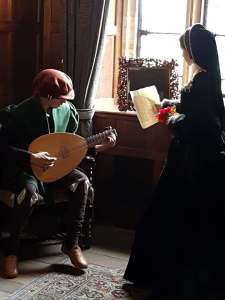
[Illustration #2 – Minstrels, Nikki Piggott, photographer, used w/permission]

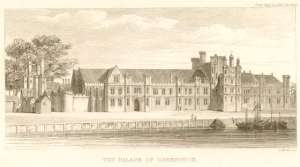
[Illustration #3 – Greenwich Palace, Wikipedia]

Blurb

She has the voice of an angel…

But one false note could send her back to her old life of poverty.

After her father sells her to Henry VIII, ten-year-old Bess builds a new life as a royal minstrel, and earns the nickname “the king’s songbird.” 

She comes of age in the dangerous Tudor court, where the stakes are always high, and where politics, heartbreak, and disease threaten everyone from the king to the lowliest musician.

Her world has only one constant: Tom, her first and dearest friend. But when Bess intrigues with Anne Boleyn and strains against the restrictions of life at court, will she discover that the biggest risk of all is listening to her own stubborn heart?

Buy Links:

Amazon UKAmazon USAmazon CABarnes and NobleKobo

Audio Buy Links:

Narrated by Jennifer Summerfield

AudibleAuthors DirectNookHooplaApple BooksKoboScribdGoogle PlayAmazon

Author Bio

Karen Heenan

Karen Heenan was born and raised in Philadelphia, PA. She fell in love with books and stories before she could read, and has wanted to write for nearly as long. After far too many years in a cubicle, she set herself free to follow her dreams—which include gardening, sewing, traveling, and, of course, lots of writing.

She lives in Lansdowne, PA, not far from Philadelphia, with two cats and a very patient husband, and is always hard at work on her next book.

Connect with Karen:

WebsiteTwitterFacebookInstagramPinterestBook BubAmazonGoodreads

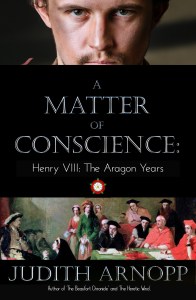
Guest Post: “A Matter of Conscience: Henry VIII, The Aragon Years” Excerpt by Judith Arnopp

I am pleased to welcome Judith Arnopp to my blog today to share an excerpt from her latest novel, “A Matter of Conscience: Henry VIII, The Aragon Years”. Thank you, The Coffee Pot Book Club and Judith Arnopp for allowing me to host a spot on this blog tour. 
Excerpt

1505 – Henry is informed by his father that he must withdraw from his betrothal to Catherine of Aragon

Most of my companions, the older ones at least, have tasted the pleasures of women but I have no desire to dally with whores. Instead, when the curtains are drawn about my bed at night, I think of Catalina and the delights we will one day enjoy. Since there are no tutors to instruct me on such matters, I listen to the tales my friends tell of their conquests. The prospect of bedding my future wife fills me with a mix of excitement and terror. 

And then, on the eve of my fourteenth birthday, the king informs me that I must make a formal protest against the union with Spain.

“Why?” I exclaim. “I have no wish to protest against it!”

Father rubs his nose, dabs it with his kerchief, rolls it into a ball, and glares at me.

“Your wishes are of no moment. This is politics. You will do as you are told.”

I am furious but I know better than to argue. It would do me no good. I can feel my ears growing red with resentment. I clench my teeth until I hear my jaw crack. Oblivious to my feelings, Father shuffles through the papers on his desk, picks one up, and reads aloud the instruction he has written there.

“You must declare, before witnesses, that the agreement was made when you were a minor and now you reach puberty you will not ratify the contract but denounce it as null and void. Your words will be set in writing and then signed and witnessed by six men.

Protestations tumble in my mind but I cannot voice them. When he dismisses me with a flick of his fingers, I bow perfunctorily, turn on my heel, and quit the room. I find Brandon on the tennis court, loudly protesting the score while his opponent, Guildford, stands with his hands on his hips.

“You are wrong, Brandon, the point is mine. Isn’t that so?” 

He turns to the others, who are lounging nearby. Having only been half attending, they shrug and shake their heads noncommittally.

“My Lord Prince,” Brandon, noticing my arrival, turns for my support. “You witnessed it, did you not? The point was mine. Back me up, Sir.”

I pick up a racket, idly test it in my hand, and emitting a string of curses, hurl it across the court. Silence falls upon the company.

“What ails you, Sir?”

Brandon is the only one brave enough to come forward. He reaches out, his hand heavy on my shoulder. There are few men I allow to touch me. At the back of my mind, I am aware that Brandon is merely proving to others how high he stands in my regard. 

I should shrug him off, but I don’t.

“Walk with me,” I mutter between my teeth and then turn away, almost falling over Beau who dogs my every footstep.

“Out of my way!” I scream and he cowers from me, tail between his legs.

Tossing his racket to Thomas Kyvet, Brandon follows me.

“Henry, wait,” he calls, and I slow my step until he has caught up.

“What has happened?”

“My accursed father.” 

I am so angry, I can hardly speak; my lips feel tight against my teeth, my head pounds with repressed fury. “He demands that I denounce my union with Catalina.”

I stop, rub my hands across my face, the blood thundering in my ears. 

“I don’t know if I am angry because I have lost her, or because I am so sick of being told what I must do. What will Catalina think? What will happen to her?”

He shrugs. “In all probability, she will be sent home to Spain.”

I think of her leaving, imagine her sad little figure boarding ship for the perilous journey to her homeland. For four years she has lived at the mercy of my father’s generosity which, as we all know, is greatly lacking, and now is to be sent home like a misdirected package.

“Sometimes I feel this … this limbo will never end, and I will spend my whole life under my father’s jurisdiction.”

He flings a brotherly arm about me and I am suddenly grateful to have a friend. He speaks quietly, with feeling and I struggle not to weep like a woman.

“We are all told what to do by our fathers, Henry, and we are much alike you and me. I am also the second son. Had my brother not died, I’d like as not be languishing in the country, wed too young to some red-cheeked matron yet here I am, your honoured servant. One day, you will be king, and I will still be at your side. The future will soon be ours, and the time for following orders will be done with.”

Blurb

‘A king must have sons: strong, healthy sons to rule after him.’

On the unexpected death of Arthur Tudor, Prince of Wales, his brother, Henry, becomes heir to the throne of England. The intensive education that follows offers Henry a model for future excellence; a model that he is doomed to fail.

On his accession, he chooses his brother’s widow, Catalina of Aragon, to be his queen. Together they plan to reinstate the glory of days of old and fill the royal nursery with boys. 

But when their first-born son dies at just a few months old, and subsequent babies are born dead or perish in the womb, the king’s golden dreams are tarnished.

Christendom mocks the virile prince. Catalina’s fertile years are ending yet all he has is one useless living daughter and a baseborn son.

He needs a solution but stubborn to the end, Catalina refuses to step aside.

As their relationship founders, his eye is caught by a woman newly arrived from the French court. Her name is Anne Boleyn.

A Matter of Conscience: the Aragon Years offers a unique first-person account of the ‘monster’ we love to hate and reveals a man on the edge; an amiable man-made dangerous by his own impossible expectation.

Buy Links:

Amazon UK: https://www.amazon.co.uk/gp/product/B08W48QQ9C

Amazon US: https://www.amazon.com/Matter-Conscience-Henry-Aragon-Years-ebook/dp/B08W48QQ9C

Author Bio:

Judith Arnopp

A lifelong history enthusiast and avid reader, Judith holds a BA in English/Creative writing and an MA in Medieval Studies.

She lives on the coast of West Wales where she writes both fiction and non-fiction based in the Medieval and Tudor period. Her main focus is on the perspective of historical women but more recently is writing from the perspective of Henry VIII himself.

Her novels include:

A Matter of Conscience: Henry VIII, the Aragon Years 

The Heretic Wind: the life of Mary Tudor, Queen of England

Sisters of Arden: on the Pilgrimage of Grace

The Beaufort Bride: Book one of The Beaufort Chronicle

The Beaufort Woman: Book two of The Beaufort Chronicle

The King’s Mother: Book Three of The Beaufort Chronicle

The Winchester Goose: at the Court of Henry VIII

A Song of Sixpence: the story of Elizabeth of York

Intractable Heart: the story of Katheryn Parr

The Kiss of the Concubine: a story of Anne Boleyn

The Song of Heledd

The Forest Dwellers

Peaceweaver

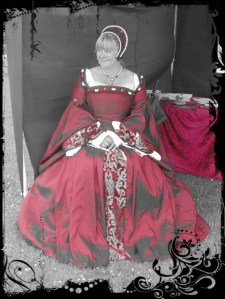
Judith is also a founder member of a re-enactment group called The Fyne Companye of Cambria and makes historical garments both for the group and others. She is not professionally trained but through trial, error and determination has learned how to make authentic-looking, if not strictly HA, clothing. You can find her group Tudor Handmaid on Facebook. You can also find her on Twitter and Instagram.

Social Media Links:

WebsiteBlogTwitterInstagramAmazon

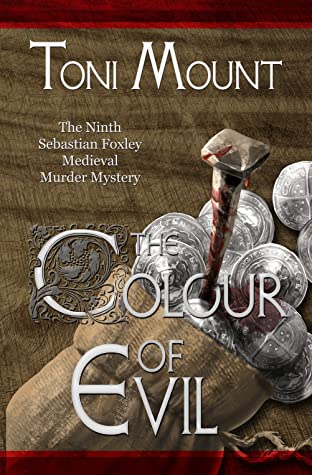
Book Review: “The Colour of Evil (Sebastian Foxley Book #9) by Toni Mount

57299292._SY475_ (1)Money problems litter the streets of London like debris. Those who have money have power. Yet, there are those who try to beat the system by making their own counterfeit currency to beat the system. When this counterfeit currency leaves to murder, only Seb Foxley and his merry band of friends and family members can bring justice to those who were killed. When unexpected complications arise, like Seb’s wayward brother Jude coming home with an Italian child bride and a commission from King Edward IV himself, can Seb solve the case before anyone else becomes the next victim in this vicious cycle of greed and exploitation? Toni Mount takes her readers on another thrilling adventure in, “The Colour of Evil”, the ninth installment of the Sebastian Foxley Medieval Murder Mystery series.

I would like to thank Toni Mount for sending me a copy of her latest mystery novel. When I was introduced to the colorful characters of Seb Foxley and his friends in the last novel, “The Colour of Shadows”, I became attached to them and I wanted to see what new adventures Toni Mount had for them.

We are reunited with Seb and his household two months after the conclusion of “The Colour of Shadows” as they adjust to a new normal. Life moves on and Seb receives a very tempting offer from King Edward IV to craft a luxurious book for an Italian nobleman. As he begins this arduous task, his friend Bailiff Thaddeus Turner needs his help to uncover the truth about a murder that has some very grisly circumstances along with coins that are found out to be fake. To top it all off, Seb is visited by not one but two people from his past. One is a former apprentice of his master who bullied Seb and now seeks his help. The other is his older brother Jude who has traveled around Europe. With all of these distractions, it is a wonder Seb and his household were able to get any work done during this novel.

Mount has created yet another vivid mystery for Seb to solve, full of dangers and intellectual puzzles. She has lovingly crafted each and every character to make their circumstances believable that you forget that they are fictional. The relationships are truly the backbone of this novel, especially the tempestuous relationship between Seb and Jude and the cautiously romantic relationship between Seb and Rose. Of course, we cannot forget that the series of murders must be solved and the way that Mount crafted the solution to this case was brilliant. You will be on the edge of your seat until the end, trying to figure out who committed the heinous deed and whether your favorite characters will succeed.

I have found myself totally immersed in the world of 15th century England and Seb’s continuous adventures. This is a true page-turner with so many secrets and scenes that can rival those crafted by C.J. Sansom. Mount again succeeds to transport her readers to another time in this delightful novel. If you have never read a Sebastian Foxley Medieval Murder Mystery, you really need to as they are a sheer delight for fans of historical fiction. “The Colour of Evil” is yet another brilliantly written and extremely well-researched novel by the talented Toni Mount. This is a must-read for anyone who is a fan of the Seb Foxley series or for anyone who wants to escape the modern-day for a little bit to explore the inner workings of 15th century England, full of greed and secrets.

Book Review: “Princess of Thorns” by Saga Hillbom

55613765 (1)The year 1483 proved to be a pinnacle point of change for the short-lived Yorkist dynasty. After finally defeating the Lancastrian army, King Edward IV and his family bring peace and order to England, but even their happiness cannot last as King Edward IV dies unexpectedly on April 9, 1483. A power struggle ensues between Richard Duke of Gloucester and Elizabeth Woodville over who should be King of England. Most of Elizabeth Woodville’s children side with her, but there is one child who is staunchly loyal to the Yorkist cause and her uncle Richard; Cecily of York. In her latest novel, “Princess of Thorns”, Saga Hillbom tells the heartbreaking tale of Cecily of York showing how deep her loyalty to her family was and how loyalty came with a cost.
I would like to thank Saga Hillbom for sending me a copy of her latest novel. This is the first novel by Saga Hillbom that I have read. When I heard that this novel was going to be about Cecily of York, I was intrigued since I have never read any novels where Cecily was the protagonist.

As the third daughter of King Edward IV and Elizabeth Woodville, Cecily of York can be the vivacious white rose of York, without the pressures that her brothers and her eldest sister have on their shoulders of one-day ruling a country. She can observe life at court while waiting for the day when she is married to a nobleman who shares her Yorkist views. However, that wish she has for her life comes crashing down when her father dies and her brothers, known in history as the Princes in the Tower, go missing. Cecily’s beloved uncle Richard becomes King Richard III, which causes Cecily’s mother Elizabeth Woodville to side with her once mortal enemy, Margaret Beaufort, and her son Henry Tudor.

After the Battle of Bosworth Field and Henry Tudor becomes King Henry VII, the remnants of the Yorkist cause slowly accept the Tudor dynasty. All except Cecily, who believes that Henry VII is a false king. We see Cecily go from a spoiled Yorkist princess to a woman who will fight for what she believes in and will never back down from an argument, even if she is arguing with the King of England himself. Along the way, she does marry and have her children, but even in her happiest moments, Cecily experiences tragic losses that will shape her future.

I usually don’t read many novels that side with the Yorkists, but this book was different. There was something about Cecily’s story that I found compelling. Her love and her loyalty to her family was her sword and shield as she waged war with life. Hillbom does repeat some of the old myths about the people that are central to this novel. I also wish Hillbom gave her readers more detailed descriptions of locations to give us a fully immersive experience.

I think this was a fine novel about the life of Cecily of York. Hillbom’s creative writing style allows the audience, whether Yorkist or Lancastrian in beliefs, to feel sympathy for Cecily and her life. This was an engaging and heartbreaking look at how the end of the Wars of the Roses was not the brilliant introduction of a period of peace that the Tudors often portrayed. There were still those who dealt with the pain of the end of a dynasty. If you are interested in a novel that focuses on one of the Yorkist princesses who does not get a lot of attention, Cecily of York, check out “Princess of Thorns” by Saga Hillbom.

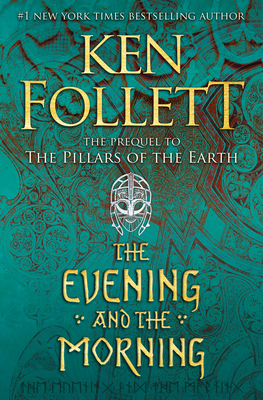
Book Review: “The Evening and the Morning” by Ken Follett

49239093The year is 997 and England is in a dire situation. Fears of invasions from the Welsh and the Vikings leave the Anglo- Saxon residents rattled while those in power take advantage of their citizens. Chaos reigns supreme as those who rule the towns are in constant power struggles between themselves and their king, Ethelred the Unready, with the average villagers caught in the middle, like the villagers of Dreng’s Ferry. It is in this small village where three characters find their lives intertwined with the political and social drama. A young boatbuilder named Edgar endures heartache and sorrow when the Vikings attack his home. A Norman noblewoman named Ragna follows her heart to marry the man she loves and travels to a faraway land but soon finds out how difficult that love can be. Finally, a monk named Aldred works hard for the people while dreaming of transforming his meek abbey into a lively center of learning. Their tales are masterfully woven together in the much-anticipated prequel to the Kingsbridge series by Ken Follett. This is “The Evening and the Morning”. 

When I heard that Ken Follett was writing a prequel to his Kingsbridge series, I was ecstatic. I read the Kingsbridge series a few years ago for the first time and I fell in love with the town of Kingsbridge. I wanted to know more about the origins of this town and I wanted another engrossing tale of strength and struggle, which Follett delivers in this brilliant novel. 

Follett introduces his audience to his colorful cast of characters with a Viking raid in the small village of Combe, the home of Edgar the boatbuilder. He lost everything that he cared about in one night, so he and his remaining family must pick themselves up and rebuild their lives in the town of Dreng’s Ferry. Edgar shows grit and determination as he realizes what is truly important in his life. Ragna is a vivacious Norman noblewoman who fell head over heels in love when she met a charming Englishman named Wilwulf. She decides to leave everything that she knows behind to marry a man she believes she knows very well. However, she soon realizes that Wilwulf and his family are not who she imagined. Ragna fights with vigor for what she believes is right for her immediate family and the people she has sworn to protect from her husband’s family. Her tenacity and courage to weather the storms that life throws her way are truly admirable. Finally, there is the academic monk Aldred who wants to pursue knowledge to better humanity. He believes that Dreng’s Ferry can become greater than what the people believe is possible, which often puts him on a political collision course with Wilwulf’s power-hungry family. 

The stories of these three dynamic protagonists are interwoven to create a sensational prequel to the fabulous Kingsbridge series. This novel is riveting with the gorgeous storytelling that readers have come to expect from Ken Follett. What I love is that Follett’s focus is not on the royal family, King Ethelred and Queen Emma, but the people who built England from the ground up. It is the nobles and the village people that had to endure every decision and mistake that the crown made. They were the ones who suffered when raiders like the Vikings pillaged towns and killed their loved ones. They were the ones who had to fight back time after time to make sure that their families survived. To focus on three people from three different walks of life gives the audience a complete picture of the fictitious town of Dreng’s Ferry. 

I applaud Follett for going back and giving his fans the prequel to the Kingsbridge series that they craved. To see how the town of Dreng’s Ferry became King’s Bridge was a delight. I had to slow down my reading pace to make sure I was fully immersed in the tale that Follett wrote. I loved every minute of reading this prequel and now I want to reread the Kingsbridge series. If you are a fan of Ken Follett’s Kingsbridge series or if you want to jump into a series that is a fabulous historical escape, “The Evening and the Morning” is a must-read. A sensational prequel to one of my all-time favorite historical fiction series. 

Book Review: “Katheryn Howard: The Scandalous Queen” by Alison Weir

52802802._SX318_SY475_The year is 1540 and King Henry VIII has grown tired of his fourth wife from Germany, Anne of Cleves. The aging king longs for another heir to make sure that his dynasty is secure, which means he is searching for his fifth wife. Henry’s wandering eye lands on a young girl who happens to be a cousin of his second wife of Anne Boleyn. The young woman’s name who caught the king’s attention is Katheryn Howard. Henry believes that his new bride is virtuous as well as being very beautiful, but what secrets does this young queen hide? In her latest installment of the Six Tudor Queens series “Katheryn Howard: The Scandalous Queen”, Alison Weir takes a look into the life of this young woman and the men who loved her.
As a fan of Alison Weir’s other books, I knew that I wanted to read this title. I have been enjoying the Six Tudor Queens series so far, even though I don’t necessarily agree with how she has characterized certain historical figures. I have not read any books with Katheryn Howard as the protagonist, so I was intrigued to see how it would go.

We begin our adventure with Katheryn Howard’s childhood and how she entered the household of her grandmother, the Dowager Duchess of Norfolk. This is where Katheryn fell in love with men like Henry Mannox and Francis Dereham. I enjoyed seeing how Weir fleshed out these two relationships and how drastically different they were in Katheryn’s eyes. We see Katheryn try to keep the secrets of her past relationships as she works hard to capture the heart of the aging king, Henry VIII. Katheryn’s relationship with Henry is a bit one-sided at first, but it develops into love on both sides, but not like the love that Katheryn has known before. I found myself feeling sorry for Henry and Katheryn as they suffered a few miscarriages. But none of her other relationships are like her connection with Thomas Culpeper.

I think one of my problems with this particular book is how she viewed certain characters, like Katheryn Howard and Jane Boleyn, the wife of the late George Boleyn. To me, it felt like Weir was repeating the traditional view about these two women. Katheryn Howard has been seen as a young and naïve girl who was used as a pawn by her family to manipulate the King. Jane Boleyn has been viewed as a manipulator who despised her husband and suffered from mental trauma in the end. I think that there is so much more to their stories than how they have been portrayed in fictional representations of their lives. We see Weir try to go a bit further into their personalities, but for the most part, she stays along these lines.

Just because I don’t agree with how these two characters were represented does not mean that I thought the book was bad. I think the story itself was intriguing and Weir’s writing style is engaging like her other books. I think it is a fine novel that shows Katheryn Howard’s rise and fall from power and how dangerous love can be, especially for a young queen. If you want a great escape with a novel about Henry VIII’s fifth wife, check out Alison Weir’s, “Katheryn Howard: The Scandalous Queen”.

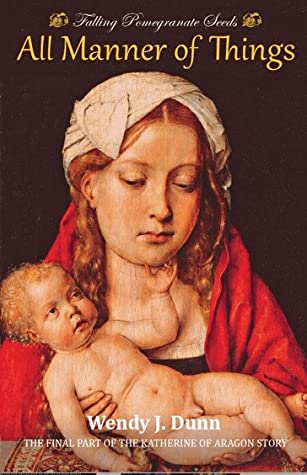
Book Review: “Falling Pomegranate Seeds: All Manner of Things” by Wendy J. Dunn

48815162._SY475_A journey to a foreign land for a long-promised marriage that will unite the royal families of Spain and England. Two friends caught in the middle far away from their beloved Spain. One is Princess Katherine of Aragon, who will marry Prince Arthur. The other is her cousin and close confidant, Maria de Salinas. Their journey like their friendship will last for decades, full of loyalty and love. Katherine’s story has been told many times in different ways, while Maria de Salinas has remained faithfully in the shadows. That is until now. In Wendy J. Dunn’s continuation of her Katherine of Aragon story, “Falling Pomegranate Seeds: All Manner of Things”, Maria de Salinas is the protagonist telling the tragic tale of love and heartache from her perspective.

I would like to thank Wendy J. Dunn for sending me a copy of her latest novel. I have heard wonderful things about Wendy’s novels from my friends. When I heard that Dunn was writing a novel about Maria de Salinas, I was intrigued by the concept. I only knew about Maria de Salinas through brief mentions of her in biographies and other novels about Katherine of Aragon, so I was excited to read her story.

Dunn’s novel begins as a letter that Maria de Salinas is writing to her only daughter. It is the story of her life with Katherine with the intention that her daughter understands the tough decisions that she made throughout her life and how unbelievably loyal she was to her queen, Katherine of Aragon. By having Maria recalling the story, Dunn adds another layer of depth to Katherine’s story. Maria knew Katherine her entire life so she knew how Katherine was feeling even when Katherine hid her emotions from the rest of the world. Her initial reactions to her new home, England. The love she had for Arthur and what happened on their wedding night. Katherine’s opinions of her father and her father-in-law. And of course, her tumultuous relationship with her second husband, Henry VIII.

Maria’s personal story is full of love and tragedy as well. Her love story with the man of her choice, who will be her husband, is gut-wrenching yet so beautiful. You will root for Maria to get her happily ever after. There were so many points in this book that I was on the brink of tears. I did not want this novel to end. Dunn created a protagonist with her own strength and a story that is nothing short of remarkable. The vivid descriptions that are in this work of art create a realistic Tudor world that you never want to leave.

This novel was a masterpiece in Tudor historical fiction. Maria’s story and how she helped Katherine of Aragon is riveting you will find yourself wanting to know more about Maria de Salinas. I wish we did have more of the relationship between Maria and her daughter, but that is because I wanted more of the tale. I have read many historical fiction novels about the Tudors and their world and I have to say this novel is one of the pinnacle Tudor novels that I have ever read. This is the first time that I have read a novel by Wendy Dunn, but now I want to read her other works. If you want a sensational novel centered around the astounding friendship of Maria de Salinas and Katherine of Aragon, “Falling Pomegranate Seeds: All Manner of Things” by Wendy J. Dunn is a must-read for any Tudor nerd.

Guest Post: “Between Two Kings: Book One in the Anne Boleyn Alternate History Trilogy” Q & A by Olivia Longueville

Today, I am pleased to welcome Olivia Longueville back to my blog to discuss her latest novel, “Between Two Kings: Book One in the Anne Boleyn Alternative History Trilogy”. 

B2K cover_page_jpgAuthor Q&A

Anne Boleyn has been featured in many books, movies, and television shows.  Her story has been told by writers many times.  How is your historical fiction series different?

In my first book, Between Two Kings, I re-imagined the life of Anne Boleyn, the second wife of King Henry VIII of England. When I think about Anne and her tragic fate, I want to rescue her from execution on trumped-up charges of adultery, high treason, and incest. Every time I visit the Tower of London, I see the place where she was executed, and I imagine that if I had been in the crowd watching her unjust death, I would have shouted, “Stop it! She is innocent!” 

As a result of my fascination with Anne and her tragic life, I decided to write an alternate history novel about her where she does not die on the 19th of May 1536.  Between Two Kings is part one of my exciting series that reimagines Anne Boleyn’s story in a unique way: having narrowly escaped her execution, she becomes the Queen of France.  In a sense, Anne follows in Eleanor of Aquitaine’s footsteps.  

My writing style is characterized by lush romanticism and passionate lyricism with beautiful and compact descriptions. In this series, I’m working to re-create the cultural atmosphere of the Renaissance and Tudor eras (my favorite periods!), giving my readers a strong sense of place to let them make the imaginative leap into these captivating times. 

This series will appeal to you because this story is about a one-of-a-kind medieval woman, who excelled in a man’s world, and whose fate has been transformed into something utterly spectacular.  Over the course of the novel, Anne emerges as a great Renaissance queen, whose indomitable nature refuses to surrender and enables her ascent to power again.  

Perfect for fans of Alison Weir, Philippa Gregory, Judith Arnopp, Laura Andersen, Tony Riches, and other Tudor authors, as well as fans of movies and shows of the Tudors. 

Are there sequels to Between Two Kings? 

In the second book, The Queen’s Revenge, Anne perseveres in her quest for justice and vengeance on the narcissistic, homicidal King Henry.  Her odyssey takes Anne from a world of gloom, across the barren landscape of ruin and the tempestuous waters of peril, to a realm of potential happiness in her marriage to the flamboyant, chivalrous King François.  Meanwhile, politics and disquieting intrigues abound… 

The later sequels explore deadly plots against Queen Anne and King François, including those of Anne’s Catholic enemies. The Valois couple struggle and intrigues against Emperor Charles V and King Henry VIII are woven into their story, for the English monarch will try to exact his own vengeance on his former wife. This culminates in a war of kings with unexpected participants. King Henry’s marriages to his historical wives have their own interpretation. Charles V’s union with Isabella of Portugal might not have an outcome as tragic as the one in history.

Beyond its theme of vengeance, The Queen’s Revenge is an optimistic tale of good triumphing over adversity and of Anne finding new love and building a life in France.  The third book, The Boleyn Queen of France, is the tale of Anne’s life in France after everyone in Europe learns the identity of the mysterious French queen. It also explores how she grows into her new role as a French queen. The political background of the story is organically embedded into the romantic and suspenseful storyline.   

Do any of the books in the series end in cliff-hangers? Are the books stand alone?  

I’ve structured the trilogy so that the books end with exciting, pivotal moments. I created a sense of completion in Between Two Kings. Although The Queen’s Revenge concludes the plotline of Anne’s vengeance, it includes a political cliff-hanger centering on themes that will be developed and resolved in the third book.  

Enough information is provided in every book, so a new reader will not be lost. 

What is important for writers to create a plausible alternate history reality? 

I love history because it shows how people lived in a completely different world. It reveals something new about the world, people, human evolution, traditions, and the way of life in different periods of time.  Nevertheless, I often wish to explore history from new angles and to re-imagine events or fates of my favorite historical figures. What if certain events had never happened or had occurred in a different way? 

It is a challenge to imagine and construct a plausible alternate history reality. You have to take real historical events and people, analyze them meticulously, and think how events could have unfolded differently, and how people would have responded to altered circumstances. If you like alternate history, you will definitely adore my alternate history universe. 

Many are aggrieved with the unjust end of Anne Boleyn’s life. She was most certainly innocent of all the accusations leveled against her, and our hearts weep at the thought of her last days in the Tower of London and how she lost everything, even her life. In my series, I’ve created an alternate universe for Anne that includes the Tudor, Valois, Habsburg, and even Medici storylines, combining them in a plausible way. 

I hope you will join me as we reimagine the fate of one of history’s most intriguing woman. 

Blurb

Anne Boleyn is imprisoned in the Tower of London on false charges of adultery, high treason, and incest on the orders of her husband, King Henry VIII of England. Providence intervenes – she escapes her destined tragedy and leaves England. Unexpectedly, she saves King François I of France, who offers her a foolhardy deal, and Anne secretly marries the French monarch.

With François’ aid, she seeks vengeance against the English king and all those who betrayed her and designed her downfall in England. Henry must face the deadly intrigues of his invisible enemies, while his marital happiness with his third queen, Jane Seymour, is lost and a dreadful tragedy also strikes the king. The course of English and French history hangs in the balance.

From the gloomy Tower of London to the opulent courts of England, France, and Italy, brimming with intrigue and danger – Anne Boleyn survives, becoming stronger and wiser, and fights to prove her innocence. Her hatred of Henry is inextricably woven into her existence.

If you are interested in “Between Two Kings”, you can purchase it either on Amazon or Amazon UK by clicking on the following links: 

https://bit.ly/Between2Kings

https://bit.ly/Between2Kings-UK

About the Author- Olivia Longueville

Olivia has always loved literature and fiction, and she is passionate about historical research, genealogy, and the arts.  She has several degrees in finance & general management from London Business School (LBS) and other universities.  At present, she helps her father run the family business.  

During her first trip to France at the age of ten, Olivia had a life-changing epiphany when she visited the magnificent Château de Fontainebleau and toured its library.  This truly transformed her life as she realized her passion for books and writing, foreshadowing her future career as a writer.  In childhood, she began writing stories and poems in different languages.  Loving writing more than anything else in her life, Olivia has resolved to devote her life to creating historical fiction novels.  She has a special interest in the history of France and England.  

Olivia’s social media profiles:

Personal website: http://www.olivialongueville.com/

Project website: http://www.angevinworld.com/

Twitter: @O_Longueville

Facebook: http://www.facebook.com/OliviaLongueville/

Tumblr: http://www.olivia-longueville.tumblr.com/