
 England is on the brink of civil war. Families with royal blood in their veins are fighting amongst each other as King Henry VI has fallen ill. Mistrust runs rampant and sacrifices are made in order to gain the throne. This is the England of 1454 and the beginning of the period in English history that we know today as the Wars of the Roses. Families like the Nevilles, the Percys, and the houses of York, Lancaster, and Tudor would gain fame and infamy during this time. Conn Iggulden decided to explore this tumultuous time after the Jack Cade rebellion, which he explored in his first book “Stormbird”, in the second book of his “Wars of the Roses” series called “Trinity”.
Many who study the Wars of the Roses believe that it started in 1455 with the First Battle of St. Albans. However, Conn Iggulden begins “Trinity” with a conflict between the Percys and the Nevilles, which is known as the Battle of Heworth Moor. Iggulden explains why he chose this point to begin his story in his Historical Note:
The ambush by some seven hundred Percy retainers and servants on the Neville wedding party took place a little earlier than I have it here, in August 1453- around the same time King Henry VI fell into his senseless state. It was a key event among years of low-level fighting between the families as they struggled to control the north and widen their holdings. That attack by Thomas Percy, Baron Egremont, was one of the most brutal actions in that private war, sparked by the marriage of Salisbury’s son to the niece of Ralph Cromwell, a union which placed estates claimed by the Percy family into Neville hands. The ‘Battle of Heworth Moor’ failed in its main aim of slaughtering Richard Neville, Earl of Salisbury. I have not included a dozen minor skirmishes, but that feud played a key part in deciding where the Nevilles and the Percys stood in the first battle of St. Albans in 1455- and its outcome. (Iggulden, 463).
The Battle of Heworth Moor is a unique place to start. We are thrust into the middle of the Percy family’s feud with the Nevilles. The plan is to attack the Nevilles during a wedding, but the Percys fail. It would not be a wedding that either family would forget for a long time. The Percy family decides to side with the Lancasters and the King, while the Nevilles side with the Yorkist cause. In the beginning, the Wars of the Roses was nothing but feuds between families to determine who should be taking care of the sick King Henry VI. Iggulden describes Henry VI in a way that shows the King as weak in body but his mind is sharp. When he wakes from his first bout of illness, he dismisses Richard Duke of York from being Lord Protector and reverses everything that Richard did.
Richard and the Yorkist cause are not upset with the king, but rather those who they believe are responsible for being in control of the king; Queen Margaret of Anjou, the Duke of Somerset and the Nevilles. Anger boils until it bursts at the First Battle of St. Albans in 1455. This battle was so pivotal in the evolution of the conflict that Iggulden goes into great detail to explain how the battle unfolded. The Yorkist cause may have one the “first” battle of the Wars of the Roses, but it ignited a flame inside of Margaret of Anjou to not only protect her son and her husband but to also completely destroy Richard Duke of York. As the story progresses, we see both sides working hard to gain control of the king in a more complex version of “capture the king”.
Conn Iggulden delivers a high action and extremely descriptive sequel to “Stormbird” with “Trinity”. He incorporates beloved characters from the previous novel, like Margaret of Anjou and the charismatic Derry Brewer, with new faces like the Tudors, Thomas Percy Baron Egremont, Warwick, Richard Duke of York and his eldest son Edmund Earl of Rutland. Iggulden transports the reader to this volatile time in English history. This book is so engaging and it keeps the reader wanting more, so he included a side story that is equally entertaining. Once again, Iggulden makes the Wars of the Roses and all of its intrigue come alive. If you were a fan of Conn Iggulden’s first book in the “Wars of the Roses” series “Stormbird”, I strongly encourage you to read “Trinity”.
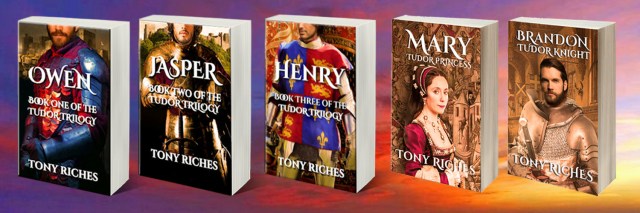

 Pembrokeshire, West Wales and is a specialist in the history of the Wars of the Roses and the lives of the early Tudors. For more information about Tony’s books please visit his website
 After the death of Henry VIII and Edward VI, there was an explosion of religious intolerance, not just in England, but in Europe as a whole. Many believe that it was Mary I “Bloody Mary” who really started this trend, however, the fires of hatred between Protestants and Catholics extended further into the reigns of Elizabeth I and James I of England. We often focus on the monarchs and their inner circles during this time and how the religious persecutions affected the decisions that they made. That tells only part of the story, but how did this religious fighting between Protestants and Catholics affect the normal person? What were their lives like? Ken Follett explores this topic in his third book in his historical fiction series, the Kingsbridge Series, “A Column of Fire”.
  Historical fiction has always been a genre that I have had a love/hate relationship with. I was a big fan of the genre for a while and I would read every book I could get my hands on about the Tudors, but then I realized that what the authors were writing was not always true to the historical facts. As I moved away from the fictional genre into the historically academic genre, I found myself looking at historical fiction with a more critical lens. Historical fiction became less entertaining for me the more I learned about the people behind the stories. I told myself that I was not going to read another historical fiction book because they were not historically accurate. That was until I read “ First of the Tudors” by Joanna Hickson.
  Adventures of a Tudor Nerd