Biography: Katherine Swynford

(Born November  25, 1350 – Died May 10, 1403). Daughter of Payne de Roet. Sister of Philippa Chaucer, the wife of Geoffrey Chaucer. Married to Hugh Swynford and John of Gaunt, 1st Duke of Lancaster. Mother of the Beauforts as well as 3 children with Hugh Swynford.

Katherine was probably born on or around November 25, 1350 to Payne de Roet, a herald and later a knight. We don’t know much about her early life.  Katherine was appointed governess to watch over the children of John of Gaunt and Blanche of Lancaster in 1365. In 1367, she married Hugh Swynford, a knight, and they had 3 children; Blanche, Thomas and Margaret Swynford.

Hugh Swynford and Blanche of Lancaster would both die in 1371, the same year that rumors began that Katherine and John were having an affair. John quickly silenced those rumors by marrying Constance of Castile later the same year. In 1372 Katherine’s position in John’s household got better and by 1373, their first child John, was born. They would have 4 children; John, Henry, Thomas and Joan.They would adopt the last name Beaufort in honor of their father’s lost of his lordship of Anjou.

During the 1380’s, Katherine left court so John could repair his reputation after the Peasants’ Revolt. When Constance died in 1394, everything changed for the couple. They were married in 1396 and their children became legitimate, however they were banned from the line of succession for the throne of England. John would die on February 3, 1399, leaving Katherine a widow yet again. Katherine would die on May 10, 1403.

Her children with John of Gaunt, the Beauforts and their children, would change English history forever.

Biography: John of Gaunt

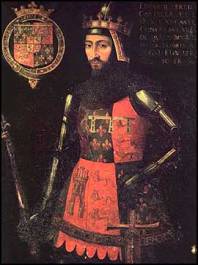
gaunt(Born March 6, 1340- Died March 15, 1399). Son of King Edward III and Philippa of Hainault.  He had three wives, Blanche of Lancaster, Constance of Castile, and Katherine Swynford. He was the 1st Duke of Lancaster, the Duke of Aquitaine, King of Castile, and one of the wealthiest men of his time. His children would become the House of Lancaster, the Beauforts, the monarchs of Portugal and Castile, and the Hapsburgs.


John of Gaunt was the third surviving son of Edward III. He wasn’t supposed to be as wealthy or influential as he became but he achieved prestige by marrying well. With his first marriage to Blanche of Lancaster, John of Gaunt was able to become the first Duke of Lancaster. Blanche of Lancaster would die in 1369 and John would marry Constance of Castile in 1371. She was next in line for the throne of Castile and for years John fought for her crown against the Spanish. The problem was that they were also fighting the French as the Hundred Years’ War was just starting.   After his brother Edward The Black Prince’s death in 1376, John took John Wycliffe under his protection as he now had more of a political influence.

When Edward III died, John of Gaunt’s nephew Richard II became king and John was his right hand man. There was a lot of mistrust with the nobility and the common folk which lead to the Peasants’ Revolt of 1381, which was quickly and brutally taken care of. John went  back to Castile try to take the throne, but as soon as he left, England almost fell into civil war because of how poorly Richard II ruled. John gave up his claim to the Castilian throne to help bring England back to some stability.


He would also help sponsor  Geoffrey Chaucer, who was his brother in law since Chaucer married the sister of John’s third wife and long time mistress, Katherine Swynford. John and Katherine met while he was married to Constance and had 4 children out of wedlock. After they were married in 1396, their children were made legitimate and given the name “Beaufort”. There was one catch, they were not allowed to inherit the throne, although their half- brother Henry IV allowed them to have some royal status. John of Gaunt died  of natural causes on March 15, 1399 with Katherine Swynford by her side. He would later be buried by his first wife, Blanche of Lancaster.

Biography: King Edward III

mw02027(Born November 13, 1312- died June 21, 1377. Reigned from January 1327 until June 21, 1377).Son of Edward II and Isabella of France.Married to Philippa of Hainault. They had 13 children including Edward “The Black Prince”, Edmund Duke of York, and John of Gaunt Duke of Lancaster.
Edward III was the king who started The Hundred Years’ War with France. His sons Edmund Duke of York and John of Gaunt Duke of Lancaster would be the founders of the Houses of York and Lancaster respectfully.

To say the early part of Edward III’s reign was turbulent would be an understatement. His mother Isabella of France and her lover Roger Mortimer had his father Edward II disposed and placed Edward III on the throne at the tender age of 14. A few years later after a terrible campaign in Scotland, Edward III had Mortimer executed.

Edward III had to deal with Scotland and France throughout his entire reign. He overthrew his brother in law David II King of Scotland for Edward Balliol, but it did not last long. Unfortunately before Edward III could really start a war with Scotland, he had to declare a truce with them as France was becoming a bigger headache. While the English were dealing with the Scots, the French had raided English coastal towns because Scotland and France had an alliance. Edward had a claim to the throne of France and so he decided to fight the French for what he believed was rightfully his, starting the Hundred Years’ War. Edward was able to capture Gascony, Calais, and other colonies in France for England.

Edward III modeled his court after that of King Arthur. It was a time that chivalry was becoming popular. Edward III established the Noble Order of the Garter, which is still active today, and his son Edward The Black Prince, was among the first members. However, the prosperous times would not last long as the Black Death of 1348 consumed all of Europe, including England, killing off a third of the population. In 1356, Edward The Black Prince won an important victory against the French at the Battle of Poitiers. The French king and his son were captured and it looked like England had won, but Edward III would sign the Treaty of Brétigny in 1360, which renounced his claim to the French throne, but allowed the English to keep its French territories.

Edward III relied on the military strength of his sons, especially Edward The Black Prince and John of Gaunt. In 1369, Philippa of Hainault died of what seems like dropsy. Edward was distraught and he decided to take a mistress Alice Perrers, who held too much power at court and was banished in 1376. Also in 1376, Edward The Black Prince passed away. Edward III would die the following year from an apparent stroke. He left the throne to his grandson Richard II.

Book Review: “The Wars of the Roses” by Alison Weir

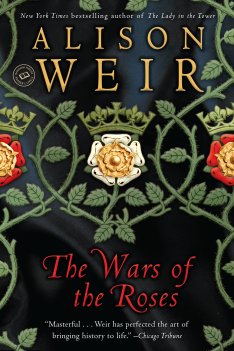
911GmwfEpdLThe Wars of the Roses was a series of wars from 1455 until 1487 for the throne of England. It is traditionally taught that it was between the houses of York and Lancaster, yet there were a lot more players involved than these two families. In fact the conflict started much earlier with the children of Edward III and Philippa of Hainault. The Lancasters were the descendants of John of Gaunt and his wife Blanche of Lancaster while the Yorks were descendants of Edmund of Langley Duke of York. This was a series over the question of who had the strongest claim to the throne. This question and the series of wars that would try to answer it is explored in depth in Alison Weir’s book “The Wars of the Roses”.

Alison Weir explains the struggle of studying this time period and what she is trying to accomplish in her book:

Sources for this period are meagre and often ambiguous, yet much research has been done over the last hundred years to illuminate a little for us what is often described as the twilight world of the fifteenth century. Many misconceptions have been swept away, yet even so the dynastic conflict still confuses many. My aim has been throughout to eliminate that confusion and try to present the story in chronological sequence, clarifying the problems of the royal succession in an age in which no certain rules of inheritance applied. I have also tried to bring the world of the fifteenth century to life by introducing as much contemporary detail as space permits, in order to make the subject relevant to any read, academic or otherwise. Chiefly, however, I have tried to re-tell an astonishing and often grim story of power struggles in high places that involved some of the most charismatic figures in English history. (Weir, xix).

Weir begins her book by explaining  what England in the fifteenth century was like before diving into the history of Edward III and the Plantagenets in the late 1300s. This may seem a little complex since there were many sons of Edward III, but the throne first went to Richard II, but when he was forced to abdicate, the throne went to Henry of Bolingbroke, who became Henry IV. He was the son of John of Gaunt and Blanche of Lancaster. John of Gaunt and his third wife Katherine Swynford had children who would become known as the Beauforts. They would become important later on.

Henry IV’s son would become Henry V who was married to Katherine of Valois. When Henry V died, their son Henry VI became king; he was a baby. His mother would remarry a Welsh man named Owen Tudor and they would have a few children, including Edmund and Jasper Tudor. Henry VI would marry Margaret of Anjou. Richard Earl of Cambridge, the son of Edmund of Langley, would have a son with his wife Anne Mortimer named Richard Plantagenet Duke of York. He would marry the “Rose of Raby” Cecily Neville and they would be the parents of Edward IV, George Duke of Clarence and Richard Duke of Gloucester, later Richard III.

This all may seem a bit complex, but it is important to understand how all of the players in the Wars of the Roses were connected. Henry VI was a weak king who was known for his madness and so someone had to lead the government. Richard Duke of York believed that he should have been Lord Protector, however Margaret of Anjou and her party at court had other ideas. The beginning of this conflict was a battle between court factions, but eventually it escalated rather quickly into a full on rebellion by Richard Duke of York. This was now a battle between the Yorks and the Lancasters. When Richard Duke of York died at the Battle of Wakefield on December 30, 1460, his son Edward took on the Yorkist cause and would become king after the battle of Towton on March 29, 1461, the bloodiest battle on English soil. After Towton, it was a battle between Edward IV and those who supported Henry VI, until 1471 when Edward IV ultimately won, thus ending the conflict between the Yorks and the Lancasters.

Weir chooses to end her book here at 1471 even though the Wars of the Roses will pick back up with the death of Edward IV in 1483 when his brother Richard becomes Richard III. Weir truly brought this time period to life. I have been studying the Wars of the Roses for a few years now and I have to say this book really simplified this complex family struggle in a way that makes sense. I love this book and I have read it several times. If you really want a great book that explains the causes of the Wars of the Roses, I highly recommend this book, “The Wars of the Roses” by Alison Weir. It is a fantastic introduction to this tumultuous time period.

Book Review: “The Last Knight” by Norman F. Cantor

the-last-knight-9781439137581_lgWhen we think of knights, we often think of shining armor, King Arthur and his fabulous court, fair maidens, and of course chivalry. These are considered to be literary ideals, almost too fantastic to be real. However, knights did live in the Middle Ages into the 14th century where some of the greatest knights lived. One is known as The Black Prince; the other was John of Gaunt. Both were brothers, sons of Edward III, the one who helped launch the Hundred Years’ War with France. The Black Prince might have a pretty cool nickname, but the one who really stole the show was John of Gaunt. The subject of Norman F. Cantor’s book “The Last Knight: The Twilight of the Middle Ages and the Birth of the Modern Era” is none other than the third son of Edward III, John of Gaunt.

Now I know what you are thinking, why do a book review for about someone who lived in the 1300s when this blog is focused on the Wars of the Roses and the Tudors. The answer is simple. It is because John of Gaunt and his children with his third wife and mistress Catherine Swynford would create the Beaufort line, the same family of Margaret Beaufort, mother of Henry Tudor, the founder of the Tudor Dynasty. It was also with John’s first wife Blanche of Lancaster, that the line of Lancaster was formed. He may have only been a third son but he became one of the wealthiest men in Europe and his family would shape the future of England forever.

Cantor, in this book, explores the world that John of Gaunt called home. What was it like in not just in England but in all of the medieval world? What about religion and literature? What was life like for women and knights in court? All of these aspects are explored throughout this book as well as elements in John of Gaunt’s life that made him unique, including his wealth and becoming King of Castile after he married his second wife Constance. Through wars and plagues, politics and rebellions, exploration and the beginning of the Renaissance, John of Gaunt navigated through it all.

It sounds like a very complex time, however, Cantor has a way of explaining it all in such a way that is both engaging and educational. Cantor through his writing style makes it easy to understand John of Gaunt’s legacy, not only is his time but how his legacy affected even our time. It was through his patronage that men like Chaucer and John Wyclif were able to complete their best works.

Shakespeare gave John of Gaunt a very patriotic speech, “this sceptre’d isle…This other Eden, demi-paradise”. Shakespeare was speaking as though John of Gaunt was an old man, reminiscing about the good times as the younger generation was taking over like Henry Bolingbroke and Henry the Navigator. Cantor brings to life the legend of John of Gaunt. Towards the end of his book, Cantor nicely sums up John of Gaunt’s life:

Above all, Gaunt’s taste for war, his frenetic energy, and his physical strength, as well as his love of women and his wealth and lifestyle, set the model for European aristocratic behavior, which went unchallenged until the nineteenth century and is still the pattern for all effective and durable social elites. (Cantor, 239).

John of Gaunt was a Renaissance man of his times. He wasn’t just some old man of Shakespearean lore. Cantor makes John of Gaunt and his world of the Middle Ages come alive. If you want to learn more about John of Gaunt, his family, and his world, Norman F. Cantor’s book “The Last Knight” is the book for you.


Sources

Cantor, Norman F. The Last Knight: The Twilight of the Middle Ages and the Birth of the Modern Era. New York: Harper Perennial, 2005.