
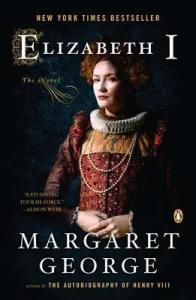
Book Review: “Elizabeth I” by Margaret George

The stories of queens have been told in numerous ways for centuries, but one of the most famous queens in human history is the Virgin Queen, Elizabeth I. The daughter of Anne Boleyn and Henry VIII who famously decided not to marry any man and instead devout her entire life to serve England’s people. That does not mean she was subservient to others she demanded respect and adoration from her subjects. Most stories of Elizabeth I begin in her golden years, but what could a novel about the queen’s silver years tell us about her personality, her reign, and the people who choose to follow or rebel against the famous queen? Margaret George gives her readers an innovative look at the titular queen in her novel, “Elizabeth I.”

This is only the second novel I have read written by Margaret George, the first being the brilliant “The Autobiography of Henry VIII.” I knew that she had written a novel about Elizabeth I, but I had not had the chance to read it until I saw it at a used bookstore. It was an instant buy for me even before I read the description, but the blurb made me even more intrigued.

George does not begin with Elizabeth’s coronation in 1558, like many novels about Elizabeth, but in the year 1588, which was arguably the queen’s most difficult challenge, fending off the Spanish Armada. To start at this most pivotal moment in Elizabeth’s reign is a bold choice that pays off because it sets the tone for the rest of the novel. Nothing is stable for the queen even after victory is won. Shortly after the Armada is defeated, the love of Elizabeth’s life, Robert Dudley Earl of Leicester dies. It is a huge loss for the queen, but she is not the only one who loves Leicester. He leaves behind his wife and cousin to the queen, Lettice Knollys, however, the two women cannot share their grief as the queen banished her cousin from court after she heard about the marriage.

The only one who can connect the two women at this point is Lettice’s son the Earl of Essex, who desires to be a great man, so he becomes a favorite of Queen Elizabeth. The arrogant young up-starter soon finds out that court is not all that he dreamed it would be and that to be a great man, he has to follow every rule of his monarch, which goes as well as you would imagine. What I appreciate about this novel is that George does not gloss over Elizabeth’s reign and instead chooses to show how muddy the political landscape was during the late Elizabethan age. We also get to see events that are not often featured in other novels about the Elizabethan age, such as Roanoke, Grace O’Malley, the return of the Armada, diplomats from farther countries, and the connection between Lettice Knollys and William Shakespeare. She fought every second of every day to keep her crown because she never knew who was the threat and when they would strike next until her dying breath.

I think this novel does an excellent job of showing George’s readers what Elizabeth I was like further into her reign. It balanced both the harsh reality of the Tudor court with plenty of intrigue with Elizabeth the person who had her heart broken on more than one occasion and had to be harsh to fight for what she loved, the English people. If you want an unforgettable portrayal of the Virgin Queen and her court towards the end of her reign, I highly recommend you read, “Elizabeth I” by Margaret George.

Book Review: “Henry VIII’s True Daughter: Catherine Carey, A Tudor Life” by Wendy J. Dunn

Henry VIII's True DaughterIllegitimate royal children have been known to make an impact on history. Take Henry Fitzroy, the illegitimate son of Henry VIII, and Bessie Blount, whom Henry VIII acknowledged as his son. There were discussions about Henry Fitzroy becoming the heir apparent if Henry VIII did not have a legitimate son. But what about the illegitimate children that a king did not acknowledge? What might their lives have been like? The story of Mary Boleyn and her affair with King Henry VIII has been told many times, but the story of her daughter born during that time is lesser known. In her first full-length nonfiction book, “Henry VIII’s True Daughter: Catherine Carey, A Tudor Life,” Wendy J Dunn has taken on the task of discovering the truth of Catherine Carey’s parentage and how it impacted her life.
I would like to thank Pen and Sword Books and Net Galley for sending me a copy of this book. I just finished reading Wendy J. Dunn’s novel, “The Light in the Labyrinth” about Catherine Carey, which is the book that inspired her to research and write this biography. I wanted to see if Dunn could write nonfiction as well as she writes historical fiction novels.

Dunn begins her biography by exploring what life was like in Tudor England before diving into the main point of her book, that Catherine Carey and her brother Henry Carey, were the illegitimate children of Mary Boleyn and Henry VIII. This was a point that she made in “The Light in the Labyrinth,” but it is in this biography that Dunn is able to expand on her theories even further, including the theory that Catherine was in the Tower and on the scaffold when her aunt, Anne Boleyn, was executed as a young woman. It is a sad theory, but it might explain why she was so close to her potential half-sister, Elizabeth Tudor.

Dunn shows how Catherine Carey grew up in the shadows of Henry VIII’s court. It is there where she met and fell in love with Francis Knollys, whom she married in April of 1540. As an audience, we get to see Catherine become a mother during the last years of the reign of Henry VIII and Edward VI’s tenure as king. It was during Mary I’s reign that life became dangerous for Catherine, Francis, and their family as they were Puritans, so they fled to Germany for three years. It was not until the reign of her potential half-sister Elizabeth that Catherine returned to court to serve her queen until Catherine died in 1569.

I think Dunn does a great job of combining her knowledge of Catherine Carey with her writing style as a historical fiction novelist. It creates a unique reading experience. I think for a first try at a full-length nonfiction book, it is pretty good. If you want a full-length biography of Catherine Carey that is informative with theories that will make you question what you think you know about the Tudors, I would suggest you read “Henry VIII’s True Daughter: Catherine Carey, A Tudor Life” by Wendy J Dunn.

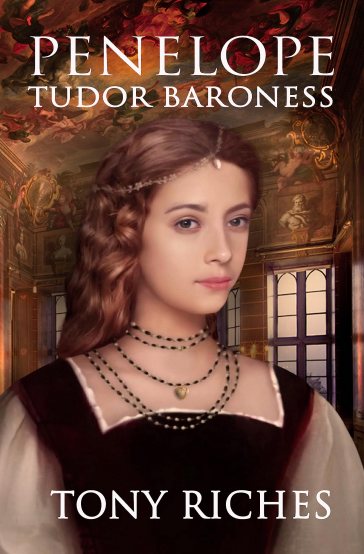
Book Review: “Penelope- Tudor Baroness” by Tony Riches

PenelopeIn a time when marrying for love was taboo, one woman took a stand to follow her heart no matter the consequences. Lady Penelope Devereux, the daughter of Lady Lettice Knollys and the step-daughter of Sir Robert Dudley understands how dangerous it is to defy the wishes of Queen Elizabeth I. Her mother and stepfather were banished from court for choosing to marry secretly, but this did not deter Penelope from pursuing love. A story spanning decades, full of love, intrigue, and plots galore, “Penelope- Tudor Baroness” by Tony Riches tells the tale of this remarkable woman and her family.
I would like to thank Tony Riches for sending me a copy of his latest novel. I have been a fan of Riches’ previous novels, which were written about male protagonists, so when I heard that he was writing a book about a Tudor woman, I was curious. I did not know much about Penelope’s life before this novel and I wanted to learn about her life.

Riches begins his novel with Penelope as a young woman going to work at court as a maid of honor for Queen Elizabeth I. It is a great honor as her parents were Lord Walter and Lady Lettice Devereux. To learn what it meant to be a maid of honor, she and her siblings went to the house of Catherine Hastings, Countess of Huntingdon. It seemed as if Penelope was destined for greatness, but it all came crashing down when her mother Lettice married the queen’s favorite, Sir Robert Dudley. A devastating blow for a young woman who wanted a role in the glittering Tudor court, but it did not deter her for long.

Penelope was a woman known for her beauty as she caught the attention of men like Anthony Bagot before she ever set foot in Elizabeth’s court. Her looks captured the attention of Sir Philip Sidney, who wrote the sonnet Astrophel and Stella in her honor. Sidney had her heart, but she would marry a man she did not love, Lord Rich. She is willing to risk everything for love, including her standing at court and the family she has with Lord Rich, but the man she risked it all for is not Sir Philip Sidney. The man who had Penelope’s heart for over 20 years was Charles Blount.

Penelope saw great change during her lifetime. She saw Elizabeth courting the Duke of Anjou and the attack of the Spanish Armada. She was in the middle of her brother’s failed rebellion against Queen Elizabeth, which was known as the Essex Rebellion. Penelope swore loyalty to King James I as Queen Elizabeth was approaching the end of her life and she was there as a lady of the bedchamber for Queen Anne of Denmark. Towards the end of her life, Lady Penelope Rich saw the impact of the Gunpowder Plot against King James I, her divorce from Lord Rich, and fighting for the rights of her children with Charles Blount.

Riches weaves a delightful tale of love, and loyalty to one’s family even amongst plots for power. Penelope was a strongly independent woman who fought for love and her family, even if that meant becoming enemies with the most powerful people in England. A remarkable woman who left her mark on both the Tudor and Stuart dynasties, Lady Penelope Rich took her life and legacy into her own hands. “Penelope- Tudor Baroness” by Tony Riches is a gorgeous novel that fans of Tudor and Stuart history will adore.

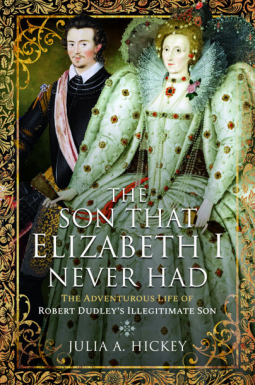
Book Review: “The Son that Elizabeth I Never Had: The Adventurous Life of Robert Dudley’s Illegitimate Son” by Julia A. Hickey

cover260109-mediumWhen we study the life of Queen Elizabeth I, the image of a virgin queen who never married tends to come to mind. Of course, she had a man who she favored above all others, Robert Dudley, but he married several times to Amy Robsart and Lettice Knollys. It was with Lettice Knollys that Robert Dudley was able to produce his heir, aptly named Robert Dudley Lord Denbigh, who unfortunately died at a young age. Robert Dudley was left without a legitimate heir, but he did have another son, albeit an illegitimate son, also named Robert Dudley. Julia A Hickey has decided to examine the life of the illegitimate Robert Dudley in her book, “The Son that Elizabeth I Never Had: The Adventurous Life of Robert Dudley’s Illegitimate Son.”

Thank you, Pen and Sword Books and Net Galley, for sending me a copy of this book. I am always in the mood to learn about someone from the Tudor period I have never heard about before. I did not know that Robert Dudley had an illegitimate son and that he might have been married before he married Lettice Knollys, so I was excited to learn more about this mysterious son.

Hickey begins her biography about this often forgotten Dudley by exploring the origins of the Dudley family and how his father was able to rise from the ashes to become Queen Elizabeth’s favorite. I think she did a decent job explaining Dudley’s history, but Hickey tends to jump around instead of staying in chronological order with specific issues, which is a pet peeve for me. I also felt like this background information went on for a bit too long, but that might have been because I had just recently read a biography about Dudley, so most of the background information was not new to me.

Robert Dudley had fallen in love and allegedly married one of Elizabeth I’s maids of honor, Douglas Sheffield, who was Robert “Robin” Dudley’s mother. Robert Dudley would later marry Lettice Knollys to the ire of Queen Elizabeth I and had a son named Robert Dudley to add to the confusion, known as Lord Denbigh or “the noble imp.” After Robert’s legitimate son, we see the rise of Robin Dudley, as he became an explorer and trader in the silk industry. We also see Robin Dudley dealing with romantic scandals, notably leaving England, his wife Alice Leigh, and their growing family to flee to France with his mistress and future wife, Elizabeth Southwell. Robin and Elizabeth were married even though Robin never divorced Alice, thus committing bigamy and making him an enemy of the Stuarts, especially King James I.

Robin was also allegedly involved in the Essex Rebellion but only stayed in prison for a short time. He tried to gain legitimacy through a court case arguing that his parents were indeed married, but it failed spectacularly. Besides the scandals, Robin was an adventurer and deeply fascinated with navigation; his most notable work, The Secrets of the Sea, was the 1st atlas of the sea ever published. It was interesting to see how Robin’s life transformed as he worked in Italy until the end of his life and how he dealt with living during the reigns of Elizabeth and the early Stuarts in different ways.

I wanted to learn more about the early Stuart kings and the different issues that Hickey included in this book that were unfamiliar to me. Robert “Robin” Dudley lived quite a fascinating life, and I think he would have made his father Robert Dudley proud with his adventures to new lands and the book The Secrets of the Seas. Suppose you are also interested in learning more about Robert Dudley and his illegitimate son. In that case, I recommend reading “The Son that Elizabeth I Never Had: The Adventurous Life of Robert Dudley’s Illegitimate Son” by Julia A. Hickey.

Book Review: “Elizabeth I’s Last Favourite: Robert Devereux, 2nd Earl of Essex” by Sarah-Beth Watkins

56283014A man who was young and had charisma would attract the attention of the Virgin Queen herself, yet that attention came with a price. The young man could not do what he desired and was buried in debt. His anger could not be quenched and he would end up rebelling against the very queen who brought him so much glory and honor. This rebellion would lead to his execution. The man’s name was Robert Devereux, 2nd Earl of Essex, and his story is told in Sarah-Beth Watkins’ latest bite-size biography, “Elizabeth I’s Last Favourite: Robert Devereux, 2nd Earl of Essex”.

I would like to thank Chronos Books for sending me a copy of this book. I had heard that Sarah-Beth Watkins was releasing this book around the same time that Tony Riches released his novel about Robert Devereux, so I thought it might be nice to read about this man through fiction and nonfiction.

The son of Walter Devereux and Lettice Knollys, Robert Devereux was destined to his father’s heir when he passed away. However, when Walter died, he left his young heir a mountain of debt. His mother would remarry, but her choice would cause her to be an enemy of the queen herself. Lettice Knollys married Elizabeth I’s most prized favorite at court, Robert Dudley. The legacies that Robert’s mother and father left him forced the penniless earl to think big and to strive to gain the queen’s favor.

His looks helped win the queen’s favor, but Robert wanted more. He wanted power, money, and military prestige, which was typical of an earl during the Tudor time. However, Robert was pretty terrible at being a military leader. No matter if it was in France, Spain, or Ireland, Devereux managed to fail on his missions and irritating the queen. Watkins included transcripts of poems and letters that Devereux and Elizabeth I exchanged and you can feel the anger and frustration centuries later. Devereux comes off as a spoiled brat who whined when he didn’t get his way and Elizabeth just continued to exasperate him.

Devereux would redeem himself slightly when he uncovered a plot by Elizabeth’s doctor Lopez to assassinate the queen with poison. Yet for the most part, the queen was almost always upset with the young man, which made him act recklessly. Although he did marry the daughter of Sir Francis Walsingham, he was known to have a few mistresses and illegitimate children on the side. When he was really upset with the queen, he would break into her chamber or he would sulk at home feigning illness until she would beg for him to come back to court. This was his routine until he was pushed over the edge and would stage a rebellion against the woman who raised him so high, ultimately leading to his own demise.

.Robert Devereux was the moody last favorite of Elizabeth I who depended too heavily on her influence to guide his life choices. Watkins does a very good job at portraying Devereux’s numerous attempts to change his fate and how he failed miserably. The length of this biography was reasonable and it did allow readers to get to know the truth about the young man who would be the final favorite. If you want a short biography about the man behind the Essex Rebellion, you should check out, “Elizabeth I’s Last Favourite: Robert Devereux, 2nd Earl of Essex” by Sarah-Beth Watkins.

Book Review: “Essex: Tudor Rebel (Elizabethan, Book 2) by Tony Riches

Essex Tudor Rebel Tour BannerToday, I am pleased to share my book review of the latest Elizabethan novel by Tony Riches as my contribution to his “Essex: Tudor Rebel” blog tour. Thank you to Tony Riches for sending me a copy of his latest novel, and to The Coffee Pot Book Club for allowing me to take part in this tour. 
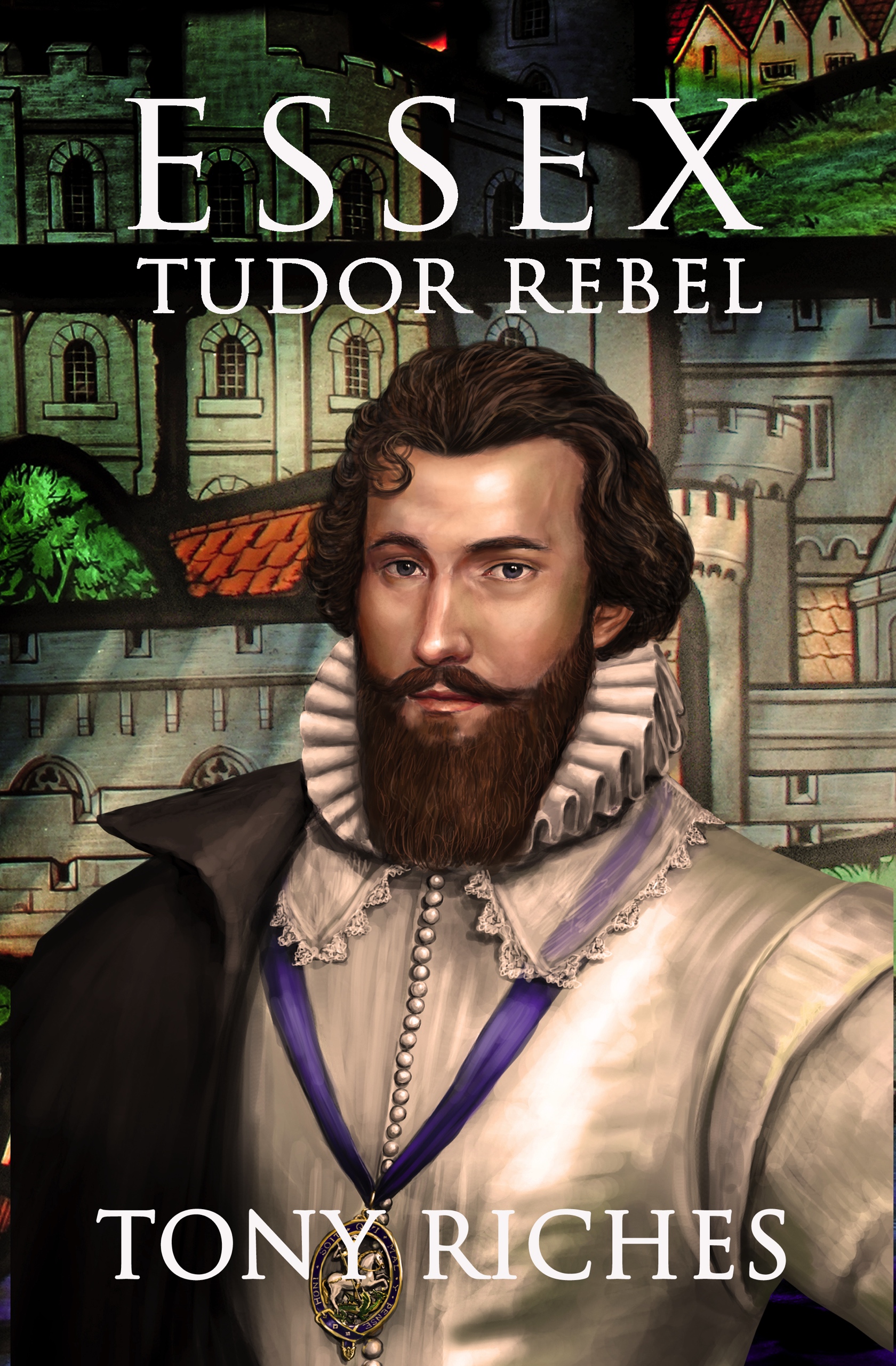
Being a favorite of a queen is not all glitter and fame. Take, for example, the men who were considered the favorites of Elizabeth I. They had to deal with a queen whose temper and praise were interchangeable. One of the most famous examples of a favorite enduring the wrath of the queen was Robert Devereux, Earl of Essex. A handsome rascal who had a mountain of debt to his name, Essex tries to follow his queen’s orders while staying true to his nature. His road from loyal man to Elizabeth I, his numerous adventures, and his ultimate rebellion are masterfully told in Tony Riches’ latest Elizabethan novel, “Essex: Tudor Rebel”.

I would like to thank Tony Riches for sending me a copy of his latest novel. I enjoyed his first venture into the Elizabethan era about Sir Francis Drake. When I heard about this novel, I was excited to dive in. Obviously, I knew about the Essex Rebellion and Essex’s fall from grace, but I really wanted to know about the man behind it all.

Robert Devereux was the son of Lettice Knollys and Walter Devereux, 1st Earl of Essex. Many recognize Robert’s rather remarkable mother Lettice Knollys as she would gain the ire of Queen Elizabeth when she married the Queen’s favorite, Robert Dudley. Essex’s father Walter would die with a mountain of debt when Essex was a boy. The fact that Essex grew up as a poor Earl does not make him stray away from the lavish lifestyle that he craves. In fact, he adds to his father’s debt with his own, making it nearly impossible to pay off.

What makes him so appealing to Queen Elizabeth I is his youthful bravado. Essex is like a son to Elizabeth I. They were so close that some assumed that they were lovers. Riches puts this myth to rest in this novel. That does not mean that Essex was single like his queen. In fact, he did marry the daughter of the famous spymaster Sir Francis Walsingham. His daughter, Frances, is extremely loyal to her children and is not afraid to speak her mind when she believes that Essex is in the wrong. Essex is not exactly the most loyal of husbands as he does have affairs and illegitimate children.

Essex did not shy away from battles. He was known for his ventures in France, Cadiz, and Ireland, but his reputation would be battered like the numerous storms he encountered. He wanted the glory to restore his reputation, but his naivete and anger towards the queen who treated him like a son would lead to his downfall.

There is something magical about a new novel by Tony Riches. He is able to capture the audience’s attention with realistic scenarios, characters that jump from the pages of the past, and dialogue that is entirely believable. Essex may seem like an outlandish character, but his desire to restore his honor and to pay back his debt is understandable. There were moments where I was getting frustrated with Essex because of his poor decision-making skills, but Riches really made me feel sympathetic for this naive young rogue by the end. If you want another brilliant escape into the late Tudor age, I highly recommend you read book two in Tony Riches’ enchanting Elizabethan series, “Essex: Tudor Rebel”.

Essex---Tudor-rebel-Kindle(Blurb)

Robert Devereux, Earl of Essex, is one of the most intriguing men of the Elizabethan period. Tall and handsome, he soon becomes a ‘favourite’ at court, so close to the queen many wonder if they are lovers.

The truth is far more complex, as each has what the other yearns for. Robert Devereux longs for recognition, wealth and influence. His flamboyant naïveté amuses the ageing Queen Elizabeth, like the son she never had, and his vitality makes her feel young.

Robert Devereux’s remarkable true story continues the epic tale of the rise of the Tudors, which began with the best-selling Tudor trilogy and concludes with the reign of Queen Elizabeth I.

Buy Links:

This novel is free to read with #KindleUnlimited subscription.

Universal Link: https://books2read.com/u/bwo16Y

Amazon UK: https://www.amazon.co.uk/dp/B09246T7ZT
Amazon US: https://www.amazon.com/dp/B09246T7ZT
Amazon CA: https://www.amazon.ca/dp/B09246T7ZT
Amazon AU: https://www.amazon.com.au/dp/B09246T7ZT


Tony Riches AuthorAuthor Bio

Tony Riches

Tony Riches is a full-time UK author of best-selling Tudor historical fiction. He lives in Pembrokeshire, West Wales and is a specialist in the history of the Wars of the Roses and the lives of the early Tudors. Tony’s other published historical fiction novels include: Owen – Book One Of The Tudor Trilogy, Jasper – Book Two Of The Tudor Trilogy, Henry – Book Three Of The Tudor Trilogy, Mary – Tudor Princess, Brandon – Tudor Knight and The Secret Diary Of Eleanor Cobham.

Social Media Links:

Website: https://www.tonyriches.com/
Twitter: https://twitter.com/tonyriches
Facebook: https://www.facebook.com/tonyriches.author/
LinkedIn: https://www.linkedin.com/in/tonyriches/
Instagram: https://www.instagram.com/tonyriches.author/
Amazon Author Page: https://www.amazon.com/Tony-Riches/e/B006UZWOXA
Goodreads: https://www.goodreads.com/author/show/5604088.Tony_Riches

Book Review: “Elizabeth I’s Secret Lover: Robert Dudley, Earl of Leicester” by Robert Stedall

52718070._SX318_The last Tudor monarch, Queen Elizabeth I, was known for many things, but her main legacy is that she never chose to marry anyone. She was the infamous “Virgin Queen”. However, there were those around her who manage to capture her attention and her admiration for a time. The most famous of these men was Robert Dudley, Earl of Leicester. He was a massive supporter of the arts and the Protestant faith, gaining prestige and praise from his highly exalted monarch. Yet, his life and his relationship with his wives, his enemies, and Elizabeth I was full of dangers and numerous scandals. Who was this man who wooed the heart of the most eligible woman in all of 16th century Europe? Robert Stedall investigates the relationship between these two lovers destined to never marry each other in, “Elizabeth I’s Secret Lover: Robert Dudley, Earl of Leicester”.

I would like to thank Pen and Sword Books for sending me a copy of this book. I am always interested in learning new aspects about the reign of Elizabeth I and her love life. When I saw the cover, I was instantly drawn to it and I wanted to know more about Elizabeth and Robert.

Stedall begins his biography by exploring the reigns of Edward VI, Lady Jane Grey, and Mary I to show how the Dudleys came to power and how they fell out of power. I noticed that Stedall included Lady Jane Grey and Guildford Dudley in the family trees that he provided at the beginning of the book, but their death years are different, even though they both died in 1554 on the same day. I think that it was interesting to see how the fall of the Dudleys affected Robert and how it was truly through Elizabeth’s favor that they gained back their honor. This friendship between Elizabeth and Robert gradually developed into love, although it was quite taboo. Robert was Elizabeth’s Master of the Horse and he was already married to Amy Robsart. Even after Amy’s untimely death, Elizabeth and Robert could never be together as a couple because her council, especially Cecil, wanted her to marry a great European power to create a strong alliance, which was a reasonable request.

Sadly, Robert Dudley could not wait forever for Elizabeth, so he chose to marry again, this time to Lettice Knollys. To say Elizabeth was upset about this marriage would be an understatement. Even though she could never marry Robert, it did not mean she wanted another woman to marry him. Robert remained faithful to his queen as a military officer and a patron of the arts and building projects. It is impossible to discuss the Elizabethan Age without mentioning the contributions of Lord Robert Dudley.

I think Stedall has done his research very well. However, this book is a tad too dry for my taste. I was hoping to learn some new swoon-worthy facts about this notorious romance, but Stedall’s book was a bit too analytical for this to happen. It was a struggle for me to read this book as it took me a few weeks to finish it. With a title such as the one he provided, I was hoping for new romantic facts, but it fell flat for me.

Overall, I felt like this was a well-researched biography, but it fell flat on the delivery. I think if you are being introduced to the relationship of Elizabeth I and Robert Dudley, this is a decent introduction, but if you know the story, it might not be the best book to read. If you want to learn more about Robert Dudley and his influence in the Elizabethan court, check out, “Elizabeth I’s Secret Lover: Robert Dudley, Earl of Leicester” by Robert Stedall.

Book Review: “Lady Katherine Knollys- The Unacknowledged Daughter of King Henry VIII” by Sarah-Beth Watkins

51M3PWFQLjLThe children of Henry VIII have been the center of historical studies for centuries. Edward VI, Mary I,  and Elizabeth I were all considered Henry’s “legitimate” children and were able to obtain the crown of England. Henry Fitzroy was the illegitimate son of the king, but he was still able to gain titles and a good marriage before he died. They all had something in common; they were all recognized by their father, Henry VIII. However, there was another child who many believed to have been the daughter of the king. The name of this intriguing lady was Lady Katherine Knollys and her story comes to life in Sarah-Beth Watkins’ book, “Lady Katherine Knollys- The Unacknowledged Daughter of King Henry VIII”.

I would like to thank Sarah-Beth Watkins and Chronos Books for sending me a copy of this great book. I have never read a biography on Lady Katherine Knollys and I found this a delight to read.

Katherine’s mother was the sister of Anne Boleyn, Mary Boleyn. For a time before Anne came into the picture, Mary was Henry VIII’s mistress. Henry VIII did have a child by another mistress, which he did declare as his own, so why did he not acknowledge Katherine as his child? Watkins offers an explanation on why Katherine was not acknowledged by the king and what her life was like:

Katherine would grow up never to be acknowledged as King Henry VIII’s daughter. Henry had every reason not to acknowledge her. He has his daughters, one already born when Katherine came into the world, and he needed no more. His denial of his affair with Katherine’s mother, Mary, would be something that would always position Katherine as a bastard. Yet Katherine joined the Tudor court as maid of honour to Queen Anne of Cleves and she went on to serve Catherine Howard as well as becoming one of Elizabeth I’s closest confidantes- cousins for definite, more likely half-sisters. Katherine lived through the reigns of Henry VIII, Edward VI, Mary I and on into Elizabeth I’s. Never far from court, she lived in a world where she would never be a princess but a lady she was born to be. (Watkins, 1).

Watkins begins her book by exploring Mary Boleyn’s life and her relationship with Henry VIII and the birth of Katherine. As Mary fell out of favor with the king, we see the rise and fall of her sister, Anne Boleyn. As Katherine grows up, we see her becoming a maid of honour for Anne of Cleves and Katherine Howard, until she marries Francis Knollys at the age of 16. Katherine and Francis went on to have quite a large family. Their children included Lettice Knollys, who scandalously married Elizabeth I’s favorite, Sir Robert Dudley. Katherine spent a lot of her life serving others, never flaunting who her father might have been. The only time that Katherine’s life was in danger was when Mary I came to the throne. Katherine and Francis decided to take their family and flee abroad since they were Protestants, but they did return when Elizabeth returned. Elizabeth came to rely on Katherine as a close confidante and when Katherine did die, Elizabeth gave her an elaborate funeral.

This was my first time reading a biography about Lady Katherine Knollys and I really enjoyed it. I go back and forth whether I believe she was the daughter of Henry VIII or not, but I found it interesting to learn more about this fascinating woman. Watkins does a superb job of balancing letters, facts and an easy to understand writing style to tell the story of Lady Katherine Knollys, her family, and the life inside the Tudor court. If you want to learn more about the life of the remarkable daughter of Mary Boleyn, I highly recommend you read, “Lady Katherine Knollys- The Unacknowledged Daughter of King Henry VIII” by Sarah-Beth Watkins.  

Book Review: “Cor Rotto: A Novel of Catherine Carey” by Adrienne Dillard

51LQDgS2-bLThe Boleyn family is one of the most notable families during the reign of the Tudors. When one thinks about this family, people like Anne Boleyn, Thomas Boleyn, and George Boleyn come to mind. However, another Boleyn and her family story have been emerging from the shadows of history in recent years. That is the story of Mary Boleyn, a mistress of King Henry VIII. Mary Boleyn had a daughter named Catherine Carey, who married Sir Francis Knollys and was the mother of 14 children, including Lettice Knollys. Since Catherine Carey was a direct relation to the Tudors, what might have her life have been like? Adrienne Dillard wanted to give readers a possible view of Catherine Carey’s life in her book, “Cor Rotto: A Novel of Catherine Carey”.

Adrienne Dillard chooses to start her fabulous novel in a unique dream sequence:

The dream was always the same. My feet were filthy. To most children my age this would be expected, something they dealt with every day of their lives as they toiled alongside their parents in the field, usually too poor to afford proper footwear. But to me it spelled disaster. I knew that soon my grandfather would be home and would be very displeased. Instead of swinging me in the air, plying me with affection as he usually did when he returned from Court, he would stare at my dirt-caked toes and say disdainfully, “You are a Boleyn and you should know your place. No Boleyn will ever live like a beggar child, I have worked hard my whole life to make sure of it.” With those scornful words, my heart would be cut in two. I knew I had to find my brother Henry, get back to the house and clean up before our grandfather arrived….I burst through the apple trees into a clearing and saw the scaffold before me. “No!” I shrieked, feet rooted to the ground, I stared on in horror as the sword sliced the head from my aunt’s swan-like neck. The executioner raised her severed head into the air by its long chestnut locks. Anne’s eyes were wide in shock, her lips still moving, the blood formed a river in the dirt. The last thing I remembered before my world turned black was my own scream. (Dillard, 2).

Catherine’s life was full of heartache, in fact, Princess Elizabeth was the one who signed a letter to Catherine with Cor Rotto, which is Latin for “broken-hearted”. With as many deaths that Catherine experienced in her lifetime, including the death of two of her children, she also found a lot of love. Although her marriage to Sir Francis Knollys was an arranged marriage, like so many were back in the time of the Tudors, Catherine and Francis fell in love with one another. It was that love that helped Catherine, Francis, and their family navigates the ever-changing political and religious environment of the royal court.

In this book, Catherine is portrayed as the illegitimate daughter of King Henry VIII. This has been a rumor ever since she was born since her mother was the mistress of Henry VIII, yet it has never been proven. It adds an interesting twist to her story since she was one of the ladies who served Elizabeth I, who if these rumors were true, was her half-sister. Catherine tends to be someone who enjoyed a normal, drama free life, and so she never tells anyone outside her immediate family the truth. Another unique aspect of this book is how Adrienne Dillard portrays when Catherine and Francis took part of their family to Germany during the reign of Mary I, to escape religious persecution. Not much is known about this time so it was rather interesting to read how different their lives could have been like while on the run.

Adrienne Dillard’s book is beautifully written and tells the story of such a remarkable woman. She stayed on the sideline and was able to have a good relationship with every Tudor monarch, which was actually quite a rarity. Dillard was able to portray the love that Catherine had as a mother and wife in a simple and humble way that it felt like Catherine could be a friend. This was my first time reading a book by Adrienne Dillard and I absolutely loved it. She was able to bring the life of a royal and a mother of 14 to life in such a respectful and dignified way. She made you believe that Catherine Carey could have been the illegitimate daughter of King Henry VIII. After reading this book, I want to learn even more about Catherine Carey and her extraordinary family.

If you want a gorgeous book about a wonderful woman who lived during the time of the Tudors, I highly recommend you read “Cor Rotto: A Novel of Catherine Carey” by Adrienne Dillard.

Biography: Catherine Carey

800px-Steven_van_der_Meulen_Catherine_Carey_Lady_KnollysAlso known as Catherine Knollys or Lady Knollys.
(Born around 1524- Died January 15, 1569)
Daughter of Mary Boleyn and William Carey.
Married to Sir Francis Knollys.
Mother of Mary Stalker, Sir Henry Knollys, Lettice Knollys, Countess of Essex, William Knollys, 1st Earl of Banbury, Edward Knollys, MP, Sir Robert Knollys, MP, Richard Knollys, MP, Elizabeth Leighton, Lady Leighton, Sir Thomas Knollys, Sir Francis Knollys, MP, Anne West, Lady De La Warr, Catherine, Baroness Offaly, Lady Butler, Maud Knollys and Dudley Knollys.

Catherine Carey was the daughter of Mary Boleyn, the sister of Anne Boleyn, and William Carey. She was the mother of Lettice Knollys and the Chief Lady of the Bedchamber to Queen Elizabeth I.

Catherine Carey was born around 1524 to Mary Boleyn and William Carey. William Carey was from Aldenham in Hertfordshire. He was a Gentleman of the Privy Chamber and Esquire of the Body to Henry VIII. Her parents were married in 1520 and soon after, it is believed that Mary Boleyn started her affair with Henry VIII. Contemporaries have claimed that Catherine Carey was in fact an illegitimate child of Henry VIII, but there is no evidence to support this claim and Henry VIII never acknowledged her as his own child. It is said that Catherine was a witness to Anne Boleyn’s execution, but that is simply not true.

Catherine would become a Maid of Honour for both Anne of Cleves and Katherine Howard. It is believed that Catherine met her future husband Francis Knollys when he was part of the group that welcomed Anne of Cleves to England in November 1539. We do not know if their families arranged the marriage or if the king had a hand in the match, but Catherine and Francis were married on April 26, 1540. The couple had fourteen children, including Lettice Knollys. Francis Knollys was knighted in 1547 and Catherine was called Lady Knollys. During the reign of Mary I, Francis and Catherine took part of their large family and fled to Germany because they were very staunt Protestants.

In January 1559, Catherine and Francis returned to England after the death of Mary I and the succession of Elizabeth I. Sir Francis Knollys was appointed Vice-Chamberlain of the Royal Household and Catherine was made Chief Lady of the Bedchamber. Elizabeth never supported the claim that Catherine was her half sister, but for the ten years that Catherine served Elizabeth, she was seen as one of Elizabeth’s favorites at court and her favorite first cousin. Catherine Carey would die on January 15, 1569 at Hampton Court Palace and she was buried in St. Edmund’s Chapel in Westminster Abbey.

Sources:
https://en.wikipedia.org/wiki/Catherine_Carey

26 April 1540 – The marriage of Catherine Carey and Francis Knollys