Book Review: “Edward IV & Elizabeth Woodville: A True Romance” by Amy Licence


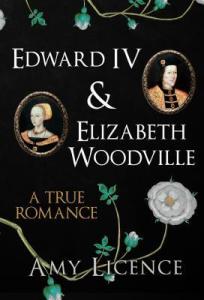
When we think of a fairy tale romance, we think about stories like Cinderella. A girl of lower status captures the heart of the handsome prince. They overcome the odds and live happily ever after. But that kind of romance only exists in books. The closest story we have to that in medieval English history might be the story of Edward IV and Elizabeth Woodville. A widow who begged the handsome and younger King of England for help, but ended up becoming his wife. It’s a story that any romance-loving history lover will swoon over, but how accurate is that story? What is the real story of Edward IV and Elizabeth Woodville? Amy Licence explores the nature of their relationship in her book, “Edward IV & Elizabeth Woodville: A True Romance.”

I have been reading books by Amy Licence for a few years now, so when I saw this title, I knew I wanted to read it. The Wars of the Roses is one of my favorite areas of history to study, but I have not read a joint biography of Edward IV and Elizabeth Woodville. When I saw this title, I knew that this was a must-read for me.

We begin in 1431 in Rouen, France, where the Maid of Orleans, who we know as Joan of Arc, is about to die on the pyre. In the same town, eleven years later, the future King Edward IV would be born to Cecily Neville and Richard, Duke of York. Edward’s future bride, Elizabeth Woodville, was born around six years after the death of Joan of Arc. Her mother, Jacquetta of Luxembourg, had married below her station after the death of her first husband, John Duke of Bedford passed away; Jacquetta would marry a knight, Sir Richard Woodville, Elizabeth’s father. Jacquetta was close to King Henry VI and Margaret of Anjou, the Lancastrian rulers of England, and Edward IV’s father, Richard, Duke of York, would fight against the Lancastrians for the right to rule England during the conflict that we know today as the Wars of the Roses. To top it all off, Elizabeth was married to Sir John Grey of Groby Old Hall, a man who fought and died for King Henry VI.

In other words, Edward and Elizabeth were on different sides of the Wars of the Roses, but somehow these two found each other after Edward IV became king. The obvious choice for Edward’s bride should have been a foreign princess to create an alliance, but there was something about Elizabeth that convinced Edward to forgo the wisdom of Warwick and marry her. Their court was based on the Burgundian court. They had a large family, but the fight for the crown with the Lancastrian cause and Edward’s own family continued. Just when the throne is secure, Edward passes away. Elizabeth had to fight for her children, fight against her brother-in-law, and join forces with her enemy Margaret Beaufort to help usher in the Tudor dynasty.

Licence was able to present the information not only about this period, but also about Edward and Elizabeth in such a comprehensive way that both novices and experts can understand. She can present theories that she either agrees with or disagrees with respectfully. I thoroughly enjoyed this joint biography as it gave me a better appreciation for the reign of Edward IV and Elizabeth Woodville. If you want to learn more about the Wars of the Roses, the first Yorkist king, and his wife, I highly recommend you read “Edward & Elizabeth Woodville: A True Romance” by Amy Licence.

Book Review: “The Stolen Crown: Treachery, Deceit and the Death of the Tudor Dynasty” by Tracy Borman

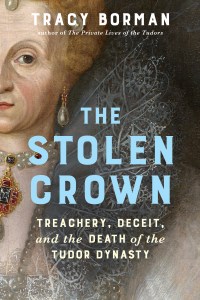
It is March 1603, and the Virgin Queen is dying. She has no children to inherit her throne directly, so she must choose a successor. She chooses the son of Mary Queen of Scots, the queen who had been executed a few years before. James VI of Scotland will become James I of England, but was it as easy as William Camden makes it in his account? What does a recent discovery about Camden’s original manuscript of Annales tell us about James’ succession to the throne of England? Tracy explores the messy conflict to find an heir to the English throne in her latest book, “The Stolen Crown: Treachery, Deceit and the Death of the Tudor Dynasty.”
I would like to thank Grove Atlantic and Net Galley for sending me a copy of this book. I have been a fan of Tracy Borman’s books for a few years now because of how she is able to present new information about stories from the past that I already know and give them a fresh look. When I heard that James might have stolen the crown from Elizabeth I, that thought intrigued me so much that I knew I wanted to read this book.

So how did the Stuarts come into power, and why did Elizabeth have James as her successor? To understand that question, we have to explore briefly the origins of the Tudor dynasty and how Elizabeth I came to the throne. After we are firmly established in the reign of Elizabeth I, Borman goes through why Elizabeth needed to elect a successor and the nominees. Those up for Elizabeth’s throne were: James VI, Arbella Stuart, Lady Katherine Grey, Mary Grey, and Henry Hastings, Earl of Huntingdon. We get to see how Elizabeth handled each of her potential choices as the next ruler of England, but the two that are highlighted significantly in this book are Arbella Stuart, the daughter of Charles Stuart, 5th Earl of Lennox, and Elizabeth Cavendish, and the man who would become King James VI of Scotland.

Borman shows her readers the complex relationship between Elizabeth and James, a tumultuous relationship, especially after the death of James’ mother, Mary Queen of Scots. It was not the most cordial relationship that has been shown in history, including the Annales written by William Camden. However, due to extraordinary research that was revealed in 2023, it was shown that Camden’s writing had serious revisions to paint James in a better light during the fight for succession. In fact, there were attempts on Elizabeth’s life that James knew about, including one incident where he might have been directly involved. Just because James became King of England after Elizabeth’s death does not mean that he had an easier time in England. In fact, the Stuarts lasted less than a hundred years before the monarchy was dissolved with the execution of James’s son Charles I in 1649.

This is another spectacular book by Borman, one that changed how I viewed the relationship between Elizabeth and James in the final years. It reads like a political thriller and offers a deeper appreciation for Elizabeth’s fight for the English throne, while also highlighting how the Stuarts employed similar tactics to the Tudors in securing their right to rule England. Suppose you want an extremely well-researched book that provides great insight into the end of Elizabeth’s reign and provides new information about this period. In that case, I highly recommend you read “The Stolen Crown: Treachery, Deceit and the Death of the Tudor Dynasty” by Tracy Borman.

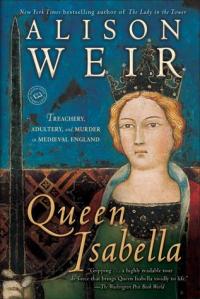
Book Review: “Queen Isabella: Treachery, Adultery, and Murder in Medieval England” by Alison Weir

Throughout medieval English history, there have been some famous queens who left their marks. Empress Matilda, Eleanor of Aquitaine, Eleanor of Castile, Philippa of Hainault, and Margaret of Anjou each left an impression on English history, either good or bad. However, there was one queen whose negative reputation came with the nickname “She-Wolf of France,” and her name was Queen Isabella of France. The wife of Edward II and mother of Edward III, she left her husband for Roger Mortimer and overthrew her husband in favor of her son. For centuries, she has been viewed as a horrible villainess, but is that a fair assessment of her life? Alison Weir dives into the archives to find the truth about Isabella of France, and she presents her findings in her biography, “Queen Isabella: Treachery, Adultery, and Murder in Medieval England.”
As a fan of Alison Weir, I am trying to read every book she has written so far, so when I saw this book in a used book store, I jumped at the chance to read it. I have read books that have featured Isabella of France, but I have never read a biography about her until now. I wanted to see if this book would change how I feel about her.

Isabella of France was the daughter of Philip IV, King of France, and Jeanne I, Queen of Navarre, born in 1295. As the only surviving daughter of Philip and Jeanne, she was expected to make a match that would create an alliance, which she did when she married Edward II of England. On paper, it should have been an ideal match, but Edward II had his favorites. The first was Piers Gaveston, whom Edward II knew before he married Isabella. Edward paid more attention to advancing Gaveston than governing, which led to the great men of England (known as the Ordainers) enacting the Ordinances of 1311 and Gaveston’s execution in 1312. Edward II swore revenge against those who killed Gaveston.

For a while, Edward and Isabella had a loving relationship. They had four surviving children: Edward III of England, John of Eltham, Earl of Cornwall, Eleanor Countess of Guelders, and Joan Queen of Scots. Unfortunately, Isabella’s happiness would not last long as Hugh Despenser the Younger would take the place as Edward’s new favorite. Things got so bad for Isabella that she decided to leave for France, stay there with her son Edward III, and start a relationship with Roger Mortimer. It would end with an invasion of England, the death of the Despensers, Edward II captured, and Edward III becoming King of England.

Isabella of France’s reputation may have been marred for centuries for her role in overthrowing her husband in favor of her son, and for what happened to Edward II afterward, but I think Weir does a decent job in rehabilitating her reputation. I don’t necessarily agree with her assessment of Edward II, but I felt like, when it came to Isabella herself, I appreciate her story and feel a bit sympathetic for what she had to deal with. If you want a biography about Isabella of France, I would recommend you read “Queen Isabella: Treachery, Adultery, and Murder in Medieval England” by Alison Weir.

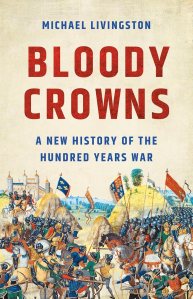
Book Review: “Bloody Crowns: A New History of the Hundred Years War” by Michael Livingston

Medieval Europe was a time of conflicts and change. While smaller disputes between countries or civil wars would define borders, the most prominent conflict during this period was the Hundred Years’ War. A conflict that has been traditionally taught to have lasted 116 years between England and France. It is often told from the English perspective, with battles such as Agincourt, Crecy, and Poitiers celebrated. But what if we look at the bigger picture and expand our lens to the whole of Europe while keeping a neutral approach to the France vs England conflict? What if the conflict did not last a mere hundred years, but in fact two hundred years? What type of story would this kind of approach tell when it comes to medieval European history? Michael Livingston takes on the mammoth challenge of telling the tale of how this war changed European history forever in his latest book, “Bloody Crowns: A New History of the Hundred Years War.”
I would like to thank Basic Books and Net Galley for sending me a copy of this book. I enjoyed the previous book that I read by Michael Livingston on the Battle of Crecy, so when I heard that he was writing a new book about the Hundred Years’ War, I was intrigued. I wanted to see what new information he could provide for a conflict that has been discussed heavily for centuries.

Livingston delivers with a plethora of information. He begins by explaining that the term Hundred Years’ War came from a French textbook in 1823. We often think that it began when King Philippe VI of France declared English lands forfeit on May 24, 1337, so King Edward III declared that he was the rightful king of France; and the end of the war was when the French seized the city of Bordeaux on October 19, 1453. However, Livingston argues that the war began in 1292 and ended in 1492, which means it was a two-hundred-year war. Livingston then goes into explaining the origins of France and England to explain how on earth they even got to a state of strife.

While the study of the conflict between France and England tends to focus on these countries, Livingston expands his view to include a pirate war between English and Norman merchants, wars in Portugal, the Burgundian Wars, fights between England, Scotland, and Wales, peasant revolts of all varieties, and wars with the Flemish. We also see a few civil wars in both France and England, including the Wars of the Roses. There are also colorful characters, including a couple of mad kings, the Black Prince, Henry V, Joan of Arc, William Wallace, earls and dukes of every variety, knights who were loyal to a fault, queens who fought for their families, heiresses fighting for their land rights, and a ton of family squabbles. And of course, Livingston focuses on the battles that defined the period, including Crecy, Poitiers, Agincourt, and Orleans, as well as lesser-known battles that helped shift the momentum for either side. Livingston can provide such vivid details that it feels like you are on the battlefield, even when it comes to the more obscure battles.

In my opinion, Livingston is one of the finest medieval military historians right now, and this is his magnum opus. I learned so much by reading this book that it kind of redefined what I think of the Hundred Years’ War. This is one of the best books I have read this year. If you want a book about medieval Europe that will challenge your way of thinking about one of the biggest conflicts of the age, I highly recommend you read “Bloody Crowns: A New History of the Hundred Years War” by Michael Livingston.

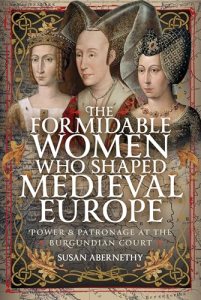
Book Review: “The Formidable Women Who Shaped Medieval Europe: Power and Patronage at the Burgundian Court” by Susan Abernethy

Throughout European history, we tend to think about the countries as a whole when it comes to the political sphere of influence. We think of the big countries like France, Spain, Italy, Germany, Austria, and England as having the most impact, but we have to consider that during the Middle Ages, duchies held immense power. Take, for example, the Duchy of Burgundy, also known as the Burgundian Empire. It was a part of France, but that does not mean that the dukes stayed on the side of the French. The Burgundians used their influence to expand and marry into the medieval European families, affecting European history as a whole. While we tend to focus on the Dukes of Burgundy, we should be paying attention to the women of this duchy. That is why Susan Abernethy chose to focus on these women in her latest book, “The Formidable Women Who Shaped Medieval Europe: Power and Patronage at the Burgundian Court.”

I would like to thank Pen and Sword Books and NetGalley for sending me a copy of this book. I enjoyed Susan Abernethy’s first book about Catherine of Braganza. When I heard that she was writing a book about medieval Burgundian women, I was intrigued. I know a little bit about historical figures connected to Burgundy, but I didn’t know much about the history of the duchy itself, so I was excited to learn more.

Abernethy begins by giving her readers a brief history of how Burgundy became a kingdom and a duchy of France. While the history of Burgundy is extensive, we are mainly focusing on the Valois Dukes of Burgundy and the women in their lives. The Valois Dukes of Burgundy were Philip the Bold, John the Fearless, Philip the Good, and Charles the Bold. While this is primarily about the women of Burgundy, it is important to understand the political and military landscape that these women had to deal with in Burgundy and other countries during this time.

The bulk of this book focuses on the women of the Burgundian empire, starting with Margaret of England, Duchess of Brabant, in the 13th century, and ending with Queen Juana of Castile, in the 16th century. We get to hear stories about duchesses and queens, countesses and diplomats, and even a saint. They had to deal with wars, international diplomacy, family drama, and husbands who were not faithful. There were some familiar figures like Mary of Guelders, Queen of Scots, Jacquetta of Luxembourg, Margaret of York, Duchess of Burgundy, and Margaret of Austria, but the majority of these women were new to me, which was very exciting.

It’s a lot of ground to cover, but Abernethy has a way of telling the stories of women comprehensively. I thoroughly enjoyed learning about Burgundy and these extraordinary women who made the duchy an empire. If you are someone who wants to learn about the Duchy of Burgundy, I would recommend you read “The Formidable Women Who Shaped Medieval Europe: Power and Patronage at the Burgundian Court” by Susan Abernethy.

Book Review: “Medieval Christmas: The Origins and Traditions of Christmas in the Middle Ages” by Toni Mount

The weather is getting colder, and life is getting a bit busier in preparation for winter and family gatherings. It’s time to get ready for the holiday season, and there is one that is universally loved. No, it’s not Halloween, even though it is October when I am writing this review. No, I am talking about Christmas. But one wonders what the origins of Christmas and how our traditions evolved? Toni Mount explores this most important holiday time in her latest book, “Medieval Christmas: The Origins and Traditions of Christmas in the Middle Ages.”
I would like to thank Toni Mount for sending me a copy of her latest book. I am always interested in learning the origins of holidays, especially Christmas, so when she sent me a copy of her book, I was excited to read it so that I can get into the holiday mood a bit early.

Since this book is relatively short, I will keep the review short. Mount explores the different aspects of Christmas and its origins in short sections. We begin with the origins of the holiday itself and how it went from Midwinter/ the Winter Solstice/ festival of Yule and Saturnalia to Christmas through the expansion of the Christian faith. In England, the first Christian Christmas was celebrated in 597 AD with Saint Augustine and King Aethelberht, but it was not until King Alfred that Christianity became the religion of England.

Christmas is not only a solemn day in the Christian calendar, but in the Middle Ages, it was an entire season full of feasting, music, and pageants. We also see how the concept of Santa Claus morphed overtime from Father Christmas and Old Man Winter to Saint Nicholas. We also learn the importance of gift giving and how politics would play a huge part in how Christmas was celebrated, or in the case of the Puritans, banned for many years.

I found this book enjoyable and extremely cozy in the vibes. I did wish it was a bit longer as I did enjoy learning about this topic and did not want it to end. Overall, I think “Medieval Christmas: The Origins and Traditions in the Middle Ages” by Toni Mount, was a delightful book and the perfect choice for medievalists who want to get into the holiday spirit.

Book Review: “Nemesis: Medieval England’s Greatest Enemy” by Catherine Hanley

The Plantagenets, one of England’s most dynamic dynasties, were always in the middle of some sort of conflict. Whether they were fighting foreign adversaries, their own people, or their own family, it felt like the Plantagenets were always getting into some sort of trouble. And there was one king who knew how to use the weaknesses of the kings of England to his advantage. He was King Philip II of France, also known as Philip Augustus. He had to deal with four different Plantagenet kings and had a strategy for each one of them. Just what were Philip II’s strategies, and how did his reign affect English/French relationships as a whole? These questions are answered in Catherine Hanley’s book, “Nemesis: Medieval England’s Greatest Enemy.”

I would like to thank Osprey Publishing and Net Galley for sending me a copy of this book. I enjoy reading about the Plantagenets and their impact on England and Europe as a whole. When I saw that this book took a French approach to the Plantagenets and focused on Philip Augustus, it was an intriguing premise to me.

As Hanley states in the introduction, this book is not your typical biography, as she focuses on the relationship between Philip Augustus and his Plantagenet opponents. That does not mean that we do not get biographical information for Philip, who was the son of Louis VII and Adela of Blois. Per tradition, as the heir to the French throne, Philip was crowned as Junior King of France on November 1, 1179, which meant that his father was still alive when he was crowned, and he trained to become the proper King of France.

While Philip knew that he had factions to deal with inside of France, his main concerns were overseas with the Plantagenets, primarily King Henry II and his sons. Over the course of his forty-year reign, Philip dealt with Henry II, Richard I the Lionheart, John, and Henry III. Each English king presented his own challenges for Philip, but Philip took them in stride and worked hard to make France stronger. At the same time, Philip had to deal with his own family dramas. He was married three times to Isabelle of Hainault, Ingeborg of Denmark, and Agnes of Merania. It was his marriage to Agnes of Merania that gave Philip his heir, the warrior King Louis VIII of France. However, it was Ingeborg of Denmark who gave Philip the biggest headache as she never gave up fighting for her marriage.

From military to political strategies, Hanley shows how Philip maneuvered against the English, and yet she shows that he was not a perfect person or a king. Philip was a flawed human who had to deal with the cards he was dealt like anyone else. Hanley presents a comprehensive book that explores the complex nature of medieval politics and how one man battled against an entire dynasty during his reign. If you are someone who wants to explore the early Plantagenets from the eyes of their enemy, King Philip II of France, I recommend you read “Nemesis: Medieval England’s Greatest Enemy” by Catherine Hanley.

Book Review: “Great Harry’s Navy: How Henry VIII Gave England Sea Power” by Geoffrey Moorhouse

One would assume that, since England is an island nation, its navy has been its strength since its foundation. That, however, was not always the case. While there were naval battles during the Middle Ages, it was not a navy like we know today. The concept of the Royal Navy was founded during the time of the Tudors, especially under the reign of Henry VIII. So, how did Henry VIII turn a navy from 7 ships to over fifty ships that could stand with other European navies? Geoffrey Moorhouse examines the creation of the English navy in his book, “Great Harry’s Navy: How Henry VIII Gave England Sea Power.”

This particular title was a used bookstore find for me. I saw that it was about the Tudors, and an aspect that I am not super familiar with. I don’t read a lot of nautically-based books, especially nonfiction, so I decided to go on a whim and try it out.

Moorhouse recognizes that this is a highly specialized book, so before delving into the history, he includes an extensive glossary at the beginning of the book to assist those unfamiliar with nautical terminology. He then dives into the origins of the English navy pre-Henry VII, and we can see that Henry VII did not leave his son, Henry VIII, many ships. However, Henry VIII had such a passion for ships that he got to work right away making shipbuilding centers and making sure that the right men were in the positions of power to make his navy superior to those in Europe. Moorhouse goes into minute detail to show how the Tudor navy rose, fell, and rose again to create a foundation that Henry’s children, Edward VI, Mary I, and Elizabeth I would build upon to create a sea superpower.

I am a fan of challenging books and discovering new topics in history. I wanted to learn more about naval history, presented in an easy-to-follow writing style. While Moorhouse does attempt to do this, his exuberant nerdy side for naval history comes out, and it felt like he was having a conversation with experts, not novices. It was one of those books that took me a long time to read because there was so much information that I was trying to digest as a novice.

I think this book is definitely written for a specific group of people, and they are those who love nautical history and learning about the Tudors. For novices, like myself, it may be quite a trial to read. If you are in the latter category and you want to read this, take your time and take notes if need be. I think this is a book that could be a great resource for historical fiction authors and just those who want a different approach to the Tudors. If that is you, “Great Harry’s Navy: How Henry VIII Gave England Sea Power” by Geoffrey Moorhouse might be a book to add to your collection.

Book Review: “Dark Renaissance: The Dangerous Times and Fatal Genius of Shakespeare’s Greatest Rival” by Stephen Greenblatt

Sixteenth-century England was a time of great change. There were religious changes as the crown passed from one member of the Tudor family to another. Wars and illnesses like the plague and the sweating sickness were rampant. However, this was also a time of an explosion of the arts, particularly of the theatre. We see men like William Shakespeare and Ben Jonson rise from obscurity to write plays that would propel them to become phenomena. There was a third playwright who should be included in this list. He was the son of a cobbler who was educated at Cambridge University. A brilliant man who wrote groundbreaking plays while he was a spy for her majesty Queen Elizabeth I, his cause of death when he was only in his twenties would remain a mystery for centuries. Christopher (Kit) Marlowe’s story is told in Stephen Greenblatt’s latest book, “Dark Renaissance: The Dangerous Times and Fatal Genius of Shakespeare’s Greatest Rival.”

I would like to thank W. W. Norton & Company and Net Galley for sending me a copy of this book. I will be honest. Although I do spend a lot of time studying the 16th century, I don’t read a lot of plays by Shakespeare or Marlowe. So, when I saw this book and its premise, it piqued my curiosity. I knew that Marlowe was a famous playwright, he was a spy, and that he died young, but that’s all I knew before reading this book. I wanted to know more about Kit Marlowe and his world.

Christopher Kit Marlowe was the son of John Marlowe, an immigrant shoemaker, and his wife, Katherine Arthur. As their only son, it was believed that Kit would become a cobbler, but he had different skills that were more academically inclined. The cobbler’s son would study the classical writers of Ancient Greece and Rome, while learning Latin and debating theology. Kit would find himself at Cambridge University, and he paid for his education on a scholarship. While the main focus of these chapters is Marlowe, Greenblatt does show the lives of the scholars and fellow students who would shape Marlowe’s writings and his path in life.

Just as Marlowe was about to complete his Master of the Arts degree, his attendance dropped, and he was seen in Rheims in France. He was beginning to establish connections to the Elizabethan spy network with William Cecil, Lord Burghley, and Sir Francis Walsingham. This is the stage of life where we not only see Marlowe get in trouble with the law, but we also get to see Marlowe become a playwright who would rival Shakespeare himself. Greenblatt takes his time to analyze Marlowe’s works, including Tamburlaine the Great, Edward II, The Jew of Malta, and Doctor Faustus. Finally, Greenblatt examines Marlowe’s death on May 30, 1593, and who might have been responsible for his murder.

I found this book extremely informative, not only when it comes to the life of Christopher Kit Marlowe, but also the worlds of Elizabethan higher education, the theatrical community, the divides on religious beliefs, and the spy world. Marlowe is one of those figures who challenged what it meant to be a playwright through his rather controversial works, which inspired others like William Shakespeare. If you want a book about a playwright with a tragic end who doesn’t get a lot of attention, I highly recommend you read “Dark Renaissance: The Dangerous Times and Fatal Genius of Shakespeare’s Greatest Rival” by Stephen Greenblatt.

Book Review: “The Many Faces of Anne Boleyn: Interpreting Image and Perception” by Helen Harrison

Anne Boleyn, a queen whose story has lived on for centuries. She was the woman who stood between Catherine of Aragon and King Henry VIII. Her daughter, Queen Elizabeth I, was her greatest legacy and her pride and joy. It was her untimely death due to charges that many believe were unfounded. We all have our image of the infamous queen, but how does that change when we switch the type of media we consume? Helen Harrison explores how our idea of Anne Boleyn changed over time in her latest book, “The Many Faces of Anne Boleyn: Interpreting Image and Perception.”

I would like to thank Pen & Sword Books and NetGalley for providing me with a copy of this book. I have enjoyed Helen Harrison’s previous books on Tudor Executions and Elizabethan Rebellions. When I heard that she was writing a book about Anne Boleyn, I was curious to see what new information she would add to Tudor studies, specifically Anne Boleyn.

So, how do you approach a book like this that is not a biography but tells how Anne Boleyn has been perceived throughout the centuries? Harrison has decided that the best way to show her readers how Anne has been portrayed throughout history is by breaking this book into sections, focusing on one source of media. We get to see Anne through portraiture/images, letters/poems, through foreign dignitaries, her views on religion, on stage and screen, both the movie and television screen, as well as historical fiction.

Harrison also includes a brief biography of Anne’s life so that we can refamiliarize ourselves with her tragic tale before taking the deep dive, which is important when it comes to understanding her legacy. My favorite part of this book is seeing the different takes historians and authors have taken towards it, including everyone’s favorite, the Victorians. It gives an overview of how different historians and authors interpret a single figure and gives us a unique take on the historiography of Anne Boleyn, including G.W. Bernard, who believed that Anne was guilty of some of the charges. The fact that Harrison decided to keep her feelings towards Anne relatively neutral allows the recent research about Anne to shine.

This book is unlike any other book about Anne Boleyn that I have read. It is a comprehensive deep dive into the research around the life of Anne Boleyn that any Tudor nerd will find a fascinating resource. If you are a Tudor nerd or a fan of Anne Boleyn, “The Many Faces of Anne Boleyn: Interpreting Image and Perception” by Helen Harrison is a must-read.