 I am pleased to welcome Jon Byrne to my blog today to share information about his research for the locations in his novel Sword Brethren. I would like to thank The Coffee Pot Book Club and Jon Byrne for allowing me to participate in this blog tour.
Detailed research is important for all writers – but for those writing historical fiction, it is vital. While much can be gained by researching information on the internet or reading books on the subject, one of the best things for me is the chance to visit the locations depicted in the book. Sometimes it is only by going to a place that you can really get a feel for how it might have been. Having said that, all of the places depicted in Sword Brethren have changed so much over the last 800 years that it is still difficult to imagine how a location would have looked so long ago, especially as there is so little remaining from this period.
The story begins in Cranham, a fictional village in East Anglia in England, located somewhere between Bury St Edmunds and Thetford. I traveled the area a few years ago, visiting the local castles like Framlingham and Orford, as well as the village of Lavenham – one of the best-preserved medieval villages in England. This helped to get an idea of what the area might have been like in the High Middle Ages, but even here most of the buildings date from the late medieval and Tudor periods.
One of the places that I found particularly helpful was Eye Castle – originally a motte and bailey fortress built during the reign of King William I. This is even earlier than the timeframe of the book, which made it far more relevant, but the castle is ruined, and a house was built on the motte in 1844, which has since decayed and collapsed. Nevertheless, the fictional village and castle of Cranham would not have been dissimilar.
Lübeck, in northern Germany, is now a UNESCO World Heritage Site and the location for approximately a third of the book. I spent a very satisfying weekend walking the cobbled streets and visiting the historical sites it has to offer – made considerably easier for me because at the time I lived in Berlin, which is only 280 km (approx. 170 miles) away.
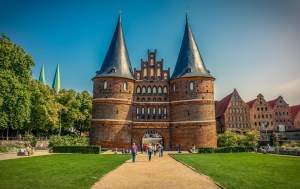
Caption: The Holsten Gate in Lübeck (built between 1464 to 1478). On the right can be seen some of the buildings of the Salzspeicher – a row of historic salt warehouses. On the left, the spires of St Mary’s Church (Marienkirche) pokes above the trees.
Founded in the mid-12th century, Lübeck became known as the Queen of the Hanseatic League (originally a powerful trading network of merchant communities in Northern Germany) and was the main point of departure for the Northern Crusades. Unfortunately, most of the late medieval buildings that the city is famous for – the Holsten Gate (Ger. Holstentor), St Mary’s Church (Ger. Marienkirche), St Peter’s Church (Ger. Petrikirche), the Salzspeicher (salt warehouses) and the famous brick-built gable houses – were not constructed at the time of this book. Only the cathedral that still stands (Ger. Dom zu Lübeck) existed in the early 13th century, and it was under construction, although it has been modified many times since and was almost completely destroyed in the Second World War. Much of the half-island that today makes up the old town was undeveloped and prone to flooding in the period of the book. The Holstenbrücke (Holsten Bridge) was first mentioned in 1216 but it is conceivable that a bridge existed beforehand. This would have been constructed from wood.
One of the highlights of researching Sword Brethren was a week-long trip I spent in Latvia with my family. We were based in Riga, which is a fascinating city that I would recommend anyone visit. Again, most of the architecture is later than the events in my book. In the early 13th century, Riga was made almost entirely of wood (including the churches), and despite being the largest city in the eastern Baltic at this time, it was little more than a village when compared to cities in Western and Central Europe.
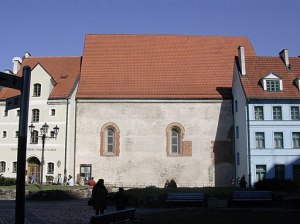
One of the first buildings made of stone in Riga was the original St George’s Castle, the first headquarters of the Livonian Brothers of the Sword, an order of warrior-monks, similar to the Knights Templar, who were formed to protect the fledgling German colony. It is the oldest surviving stone building in Riga. The only part still surviving is the chapel, now used by the Latvian Museum of Decorative Arts and Design.
 (Wikimedia Commons):
Caption: St George’s Chapel – the oldest stone building in Riga and the original headquarters of the Livonian Brothers of the Sword.
Outside of Riga, the only buildings that still remain from the period of the book are the stone castles built by the Brothers of the Sword and the Livonian Order of the Teutonic Knights that followed them. Most of these are either ruins or in various states of repair. Many of these castles were built on the banks of the River Daugava (Ger. Düna) by the German settlers and crusaders, using the river to improve their defenses. Sadly, today many are submerged beneath the waters of the Daugava that engulfed them when the Riga Hydroelectric Power Plant was built.
Nevertheless, two castles that remain in good condition lie northeast of Riga, only 23 miles or so from each other. The first is at Sigulda (Ger. Segewold), which was first constructed in 1207 and later rebuilt into a convent-type fortress. From its elevated position on a steep slope above the Gauja River, you can see another castle at Turaida across the water, built on the remains of an old pagan hillfort. It is a beautiful location, with the thick forest around it, and it gives a good flavor of how it might have felt to live here in the early 13th century.
 Turaida castle (Ger. Treiden) (taken by author):
Caption: The view from Sigulda castle.
The second castle, one of the best preserved in all of Latvia, is at Cēsis (Ger. Wenden). This is a huge castle, much of it still complete, with several relatively intact towers and walls. This is the castle that later became the main seat of the Brothers of the Sword and the Teutonic Order afterward. It is an impressive fortress that features more in the next book of the series, Soldier of Christ.
 (taken by author):
Caption: Cēsis castle – probably the best-preserved castle in Latvia from the early 13th century
However, it is only possible to learn a certain amount from visiting sites in the book personally. The bulk of research – for me at least, is reading some of the excellent books and research papers concerning the Northern Crusades.
The principal first-hand source is The Chronicle of Henry of Livonia, which was written by a priest, Henricus des Lettis, probably around 1229. The chronicle deals with events in the eastern Baltic between 1180 to 1226. Hardly surprisingly, it is written from the German point of view and describes the role of the Latin Church in colonizing and spreading Christianity to the local pagan tribes.
His chronicle is a highly detailed account, rich in human history, and he provides eye-witness testimony of the events at this time, depicting not only the military campaigns but interesting facts about the local people themselves. This is particularly valuable as there is practically no other first-hand evidence of the events of the early Christian settlement in what is now Latvia and Estonia.
 Blurb:
1242- After being wounded in the Battle on the Ice, Richard Fitz Simon becomes a prisoner of Prince Alexander Nevsky of Novgorod. Alexander, intrigued by his captive’s story, instructs his scholar to assist Richard in writing about his life.
Richard’s chronicle begins in 1203 when his training to be a knight is disrupted by treachery. He is forced to flee England for Lübeck, where he begins work for a greedy salt merchant. After an illicit love affair, his new life is thrown into turmoil, and he joins the Livonian Brothers of the Sword as they embark on imposing the will of God on the pagans of the eastern Baltic. Here, he must reconcile with his new life of prayer, danger, and duty – despite his own religious doubts, with as many enemies within the fortified commandery as the wilderness outside. However, when their small outpost in Riga is threatened by a large pagan army, Richard is compelled to make a crucial decision and fight like never before.
Buy Links:
Universal Ebook Buy Link: https://books2read.com/u/boVKlV
Barnes and Noble: https://www.barnesandnoble.com/w/sword-brethren-jon-byrne/1146519606?ean=2940184429601
Waterstones: https://www.waterstones.com/book/sword-brethren/jon-byrne/9781835740798
 Author Bio:
Jon Byrne, originally from London, now lives with his German family by a lake in Bavaria with stunning views of the Alps. As well as writing, he works as a translator for a local IT company and occasionally as a lumberjack.
He has always been fascinated by history and has studied the Medieval world for over twenty years, building up a comprehensive library of books. In his research, he has traveled to all of the locations mentioned in the book (East Anglia, Bremen, Lübeck, Latvia, etc).
Sword Brethren (formerly Brothers of the Sword) made it to the shortlist of the Yeovil Literary Prize 2022 and the longlist of the prestigious Grindstone International Novel Prize 2022. It is the first book in The Northern Crusader Chronicles.
Author Links:
Website: https://www.jonbyrnewriter.com/
Facebook: https://www.facebook.com/JonByrneAuthor
Amazon Author Page: https://www.amazon.co.uk/stores/Jon-Byrne/author/B0DJC6PL8D
Goodreads: https://www.goodreads.com/author/show/52458339.Jon_Byrne

 During the reign of King Henry VIII, the king would elevate well-qualified men to positions of power and prestige. We all know the story of Thomas Cromwell, but it is his mentor, Sir Thomas Wolsey, whose story shows how one can rise from humble beginnings, but whose fate is ultimately tied to the mood of the monarch. The son of a butcher turned scholar who became a priest, a lover, a father, and the closest advisor to the king. His life, his loves, his successes, and his struggles are told in Alison Weir’s latest novel, “The Cardinal.”
 The Wars of the Roses are ending, and with it comes uncertainty about who will lead the country. On one side is King Richard III, who many believe killed his nephews to become King of England; on the other is Breton Henry, Henry Tudor, who believes he is the rightful king due to his bloodline. However, there is a third player in this entire debacle. A young farm boy named John Collan may spend his days daydreaming and studying to his heart’s content, but he is destined for more. A path that will lead him to hobnob with nobility and become the enemy of a king who just sat on his throne. Just who is John Collan, and how did this boy go from the farm to a life of infamy? Jo Harkin tells the story of how John Collan became Lambert Simnel in her novel, “The Pretender.”
 Do you have a favorite historical figure whom you have wondered what would have happened if they survived their dark fate? Have you wondered what would happen if they had fantastical abilities, such as transforming into animals? Maybe the last piece sounds a bit too far-fetched, but it makes for an interesting concept for a novel. What if we took the story of Lady Jane Grey, the Nine-Day Queen of England, and turned the tale into a fantastical comedy full of romance and adventure? Then, you would get the premise of “My Lady Jane” by Cynthia Hand, Brodi Ashton, and Jodi Meadows.
 A princess born to a king and his second wife lost her title and legitimacy when her father decided that her mother, Anne Boleyn, needed to die. Elizabeth Tudor knows the meaning of resilience as she survived her childhood during her father King Henry VIII’s reign. Now that her father is dead Elizabeth is at the mercy of her half-siblings Edward and Mary, plus any scheming man who wants to marry her and get closer to the crown. Can Elizabeth survive her siblings’ reigns or is she destined to be locked in the Tower to await her ultimate fate like her mother? Janet Wertman explores the life of Elizabeth Tudor in her latest series
  Throughout history, the true defining feature of a good queen was whether or not she could give birth to a male heir and a spare to keep the dynasty going. No dynasty relied heavily on the pregnancy of a queen and a male heir than the Tudor dynasty of England. While we tend to focus on the women who wear the crown and give birth to the potential heir, another stands beside her during the entire process; the royal midwife. Not much attention has been given to the royal midwife until now. Brigitte Barnard explores the life of a royal midwife and her daughter who work to help Queen Katherine of Aragon in her novel, “The Tudor Queens’ Midwife.”
 Blurb:
 Author Bio
 When we think about live theater, we often think about big actors, elaborate sets, and glittery costumes. The world of the Tudor theater, especially during the reign of Elizabeth I, was similar in some ways, but there was an element of danger. Richard Shakespeare, an actor in the Lord Chamberlain’s Men company and a former thief, knew the dangers of Tudor theater life better than anyone. When a manuscript is stolen, suspicion lands squarely on Richard’s shoulders. Can Richard clear his name, or will it be his final curtain call? Bernard Cornwell tells the story of Richard Shakespeare and the debut of A Midsummer’s Night Dream in his novel, “Fools and Mortals.”
 Medieval wars were not just fought on the battlefield. They also fought in court through marriage alliances and politics. While we often think about wars and men, we should also consider the women who played their parts either in exile or glistening palaces. We often think about medieval queens like Margaret of Anjou as these strong women who fought in their ways, but we have to consider the wife of Richard Neville Earl of Warwick, known as the Kingmaker; her name was Anne Beauchamp Countess of Warwick. The relationship between Margaret of Anjou and Anne Beauchamp has not been discussed much until now. Anne O’Brien tells the stories of these two women and the wars that bound them together in her latest novel, “The Queen and the Countess.”
 Have you ever had a dream for your life that seemed so impossible that you would do anything to make sure it happened? Whether the matter of age or gender or even circumstances of one’s birth, there is always that one dream that keeps you going even during the most difficult times. Sander Cooke and his best friend Joan Buckler have dreams that seem impossible, especially living in Elizabethan England. Sander wants to stay young so he can continue to act in female roles in plays whereas Joan wants to be a natural philosopher even though she is a woman. Can they achieve their dreams or will they be doomed to fall to greater powers? The story of Sander and Joan is told in Nicole Galland’s latest novel, “Boy.”
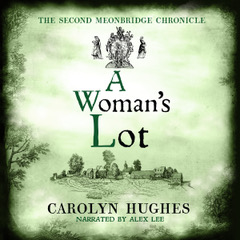
 I am pleased to welcome Carolyn Hughes back to my blog to share an audiobook extract from her novel, “A Woman’s Lot.” I want to thank The Coffee Pot Book Club and Carolyn Hughes for allowing me to be part of this blog tour.
 Blurb:
 Author Bio
 Adventures of a Tudor Nerd