
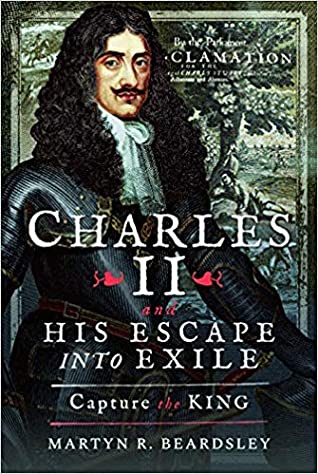
 On January 30, 1649, the Stuart monarchy took a major hit when Charles I was tried and executed by the Rump Parliament, making way for the Commonwealth of England to take control. His eldest son, Charles II, fled England leaving the control of the country in the hands of Oliver Cromwell. Two years later, in 1651, Charles tried to make his triumphant return to restore the monarchy. However, it failed miserably at the Battle of Worcester on September 3, 1651; Charles II was able to escape with the help of those loyal to the crown. The story of his escape from Cromwell’s men and his exile in Europe are told in Martyn R. Beardsley’s book, “Charles II and His Escape into Exile: Capture the King.”
I would like to thank Pen and Sword Books for sending me a copy of this book. I know that this book is not in the particular timeline that I normally read, but it looked intriguing to me for some reason. It is one of those subjects that I knew absolutely nothing about, so I was looking forward to learning something new.
Charles II was known as the “Merry Monarch” who restored the monarchy, his very extravagant lifestyle, and his numerous mistresses who produced quite a few illegitimate children. His wife, Catherine of Braganza, was unable to provide him with the desired heir that would be able to continue his legacy. He would also endure plots that would try to remove him from the throne and the quagmire of religious struggles between Catholics and Protestants, plus a small event known as the Great Fire of London of 1666. This legacy would come after he became king, but his struggle to achieve his father’s crown was just as dramatic as his actual reign.
Charles II had been in exile ever since his father, Charles I, was executed and replaced by the Commonwealth led by Oliver Cromwell. He returned to his native England with the support of the Scottish soldiers and decided to engage Cromwell’s men in battle at Worcester on September 3, 1651, which ended in a horrific defeat for the royalists. Charles II was able to miraculously escape the carnage with the help of those loyal to the crown, like the Penderel brothers and Jane Lane, Lady Fisher. His rescuers did everything they could to smuggle the young king out of the country, from hiding the king in a tree to disguising him as a Shropshire countryman.
Beardsley does an excellent job to take his readers along the same route that Charles II took to freedom. He uses the writings of Samuel Pepys to start each chapter, goes into depth about each stop, and includes a few fun notes at the end.
It is a relatively easy book to follow, but the problem for me is the fact that I did not the background behind the conflict between the Parliamentarians and the Royalists. Beardsley tries to explain the concepts behind the conflict, but it a bit too brief for my liking.
Overall, I think this was a very well written book about a king on the run for his life. It makes me wonder if other kings escaping their countries had a similar experience. It takes guts to return to a country that you called home after your own countrymen kick you out time after time to become king. The adventures of Charles II and the stories of those who helped him escape to fight another day are thrilling. If you are like me and want to read a daring story from a different dynasty full of action and danger, check out “Charles II and His Escape into Exile: Capture the King” by Martyn R. Beardsley.
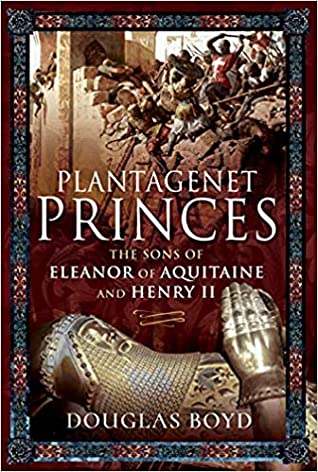 One of the most infamous families in the history of England lasted for over three hundred years and it was filled with numerous princes that fought for their right to rule, much to the chagrin of the Tudor dynasty. The Plantagenet Dynasty was full of scandals and bloodshed, testing the core values of what it meant to be a family and rulers of an emerging country like England. This dynastic clash for power that came to define this dynasty began with Henry II and his sons by his wife Eleanor of Aquitaine. When their father refused to give the boys any true power, which was to be excepted with all princes, his sons waged war against Henry II and their brothers. The stories of these bonds and what ultimately tore them asunder are told in Douglas Boyd’s latest collection of biographies aptly titled, “Plantagenet Princes: The Sons of Eleanor of Aquitaine and Henry II”.
 In 1483, King Edward IV’s family received a devastating announcement; the king in the prime of his life died, leaving the throne to his young son Edward V. However, neither Edward V nor his younger brother Richard of York would ever see the throne. Instead, they were taken to the Tower of London by their protector, Richard of Gloucester, for protection, never to be seen again. For over five hundred years, many theories have emerged about what happened to the princes in the tower and who might have possibly killed the boys. In MJ Trow’s latest book, “The Killer of the Princes in the Tower: A New Suspect Revealed”, he works hard to uncover the truth of what might have happened to the sons of King Edward IV.
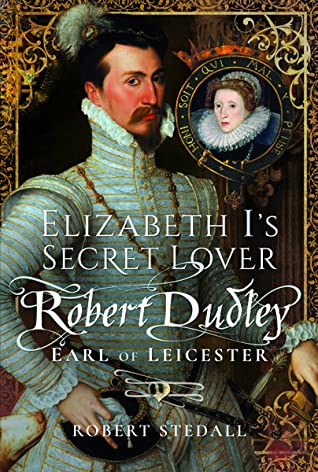 The last Tudor monarch, Queen Elizabeth I, was known for many things, but her main legacy is that she never chose to marry anyone. She was the infamous “Virgin Queen”. However, there were those around her who manage to capture her attention and her admiration for a time. The most famous of these men was Robert Dudley, Earl of Leicester. He was a massive supporter of the arts and the Protestant faith, gaining prestige and praise from his highly exalted monarch. Yet, his life and his relationship with his wives, his enemies, and Elizabeth I was full of dangers and numerous scandals. Who was this man who wooed the heart of the most eligible woman in all of 16th century Europe? Robert Stedall investigates the relationship between these two lovers destined to never marry each other in, “Elizabeth I’s Secret Lover: Robert Dudley, Earl of Leicester”.
 Action, adventure, drama, heartache, and love are what people crave when they read fictional stories. Yet, these elements are ever-present in the stories from the past. Each one of these topics could be explored in numerous ways when we are discussing history, but an area in history where romance and love were intermingled with politics was Elizabethan England. Queen Elizabeth I was obviously known as the “Virgin Queen” because she chose not to marry, but that did not mean that her subjects were banned from love and marriage. How did Elizabethans view the ideas of love, marriage, and sex? In this book, “Sex, Love, and Marriage in the Elizabethan Age”, R.E. Pritchard sets out to explore what love, marriage, and the intimate moments meant to Elizabethans of every class.
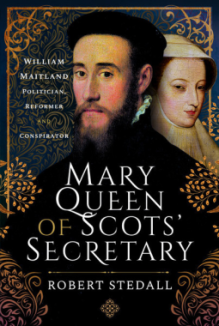 One of the most dynamic queens in 16th century Europe who spent most of her youth in a country that was not her homeland, but was fighting for the right to rule England. Her name was Mary Queen of Scots, the cousin of Queen Elizabeth I. Many know of her tragic tale, but there was a man who was behind the scenes trying to guide Scotland to a brighter future. He was not married to Mary Queen of Scots, but he was influential in her life and choosing who she might marry and who she would end up divorcing. He was a politician and a religious reformer whose decisions would alter history dramatically. His name was William Maitland and he served as Mary’s secretary. He is always mentioned as a footnote in history, until now. Robert Stedall’s latest biography, “Mary Queen of Scots’ Secretary: William Maitland- Politician, Reformer, and Conspirator”, explores the life and legacy of this rather extraordinary secretary.
 In the times of medieval kings, the power of the crown was dependent on the support that they maintained with noble families. One of the most notorious noble families in England was the baronial family known as the Despensers. Between the 13th and the 15th centuries, the Despensers were at the heart of royal politics and some of the biggest power plays during the reign of the Plantagenets. We know about the few members who truly made waves during this time, especially Hugh Despenser the Elder and Hugh Despenser the Younger, but this family’s story is much more than a few members. In Kathryn Warner’s latest book, “The Rise and Fall of a Medieval Family: The Despensers”, she takes on the challenge of explaining the entire family story of this infamous baron clan.
 Today, I am pleased to host the final stop in the “Cesare and Lucrezia Borgia” book blog tour. I would like to thank Pen and Sword Books and Samantha Morris for allowing me to finish this delightful tour with a Q and A discussion with Samantha Morris.
 Adventures of a Tudor Nerd