
 English royal history is filled with fantastic stories of triumphs and tribulations, grand romances, and divorces that shook the foundations of the monarchy. It is also filled with struggles over religion, wars both inside England and with foreign nations, and heartbreaking child losses. We often think about the spouses of the Plantagenets and the Tudors when we think about royal romances, but we shouldn’t forget about the dynasties that came after, like the Stuarts. So how did the Stuart dynasty come to be and how did the unions between monarchs and their significant others affect the dynasty and England? Heather R. Darsie explores this often-overlooked dynasty and the stories of their marriages and romances in her latest book, “Stuart Spouses: A Compendium of Consorts from James I of Scotland to Queen Anne of Great Britain.”
I want to thank Pen and Sword Books and Net Galley for sending me a copy of this book. I didn’t know much about the Stuarts before reading this book, except for those associated with the Plantagenets and the Tudors. I wanted to learn more about the Stuarts because I tend to stop after the death of Elizabeth I, so when I heard that Darsie was writing a book about the consorts of the Stuart dynasty, it was intriguing to me.
Darsie begins by explaining that she will be exploring the entirety of the Stuart dynasty, starting with its patriarch Walter Fitzalan, Stewart of Scotland for David I of Scotland in the 1100s. It is a fascinating story of how the family went from serving the monarchy to being the rulers of Scotland, all the way up to 1406 when James I became King of Scotland. The first royal consort that Darsie discusses might be familiar to anyone who knows about the origins of the Tudors, Joan Beaufort. We then track the Scottish story of the Stuarts through the death of Mary Queen of Scots through their significant others such as Mary of Guelders, Margaret of Denmark, Margaret Tudor, Madeleine of Valois, Marie de Guise, Francis II of France, Henry Stewart Lord Darnley, and James Hepburn 4th Earl of Bothwell.
It was under James VI of Scotland that things changed drastically for both England and Scotland as James became King James I of England with the death of Elizabeth I, and so James’ wife Anna of Denmark became the first Stuart Queen of England. This is the segment that I thoroughly enjoyed because they were new stories for me. We have Henriette Marie of France, a Catholic queen who married Charles I who was a Protestant, which did not have a happy ending as we get to see the English Civil War play out and the execution of Charles I on January 30, 1649. Darsie also includes the stories of the women who married Oliver Cromwell and his son Richard Cromwell, both Lord Protectors of England when the monarchy was not popular. Eventually, the Stuarts returned to their place on the English throne with Charles II and his queen Catherine of Braganza; followed by the women who married James Stewart Duke of York, Anne Hyde and Mary of Modena. James would become James II before the Glorious Revolution led by William of Orange, which led to the co-rulers William III and Mary II. Finally, we reach the tragic tale of Queen Anne of Great Britain and her Prince Consort George of Denmark.
I was so impressed with the amount of stories over centuries that Darsie was able to cover in this book. It was a fantastic introduction to Scottish Stuart history, how the dynasty survived, and created international relationships that allowed England to thrive. There were tales of tragedies, but there were also alliances that created stronger bonds, religious rifts, and romances. This was another triumph for Darsie and it is a book that made me interested in reading more about the Stuarts. If you are like me and you want a book that is a fantastic introduction to the Stuart monarchs and their consorts, I highly recommend you read, “Stuart Spouses: A Compendium of Consorts from James I of Scotland to Queen Anne of Great Britain” by Heather R. Darsie.
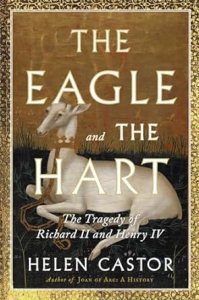 The story of the Plantagenets is filled with high triumphs and devastating tragedies. It is a story of families torn apart for a crown and the desire to either rule with an iron fist for the glory of England or live a life of luxury at the expense of their citizens. The story explored in this particular book is the tale of two cousins born months apart, Richard of Bordeaux and Henry Bolingbroke. Richard and Henry were not born to become King of England, but Fortune’s Wheel had a different plan for the cousins. So how did these cousins become kings and how did their tale turn to tragedy not only for their relationship but for all of England? Helen Castor tells the tale of these two Plantagenet kings in her latest book, “The Eagle and the Hart: The Tragedy of Richard II and Henry IV.”
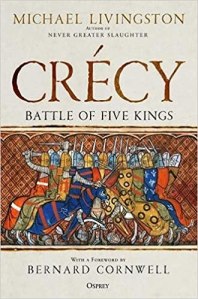 The year is 1346 and war has just begun between France and England. This conflict would be known as the Hundred Years War, which lasted over 116 years and ended in failure for the English. However, some glorious moments like Agincourt gave the English cause to celebrate, but none more so than the Battle of Crecy. It was a colossal battle between five European kings, leaving countless dead on the field without many long-term rewards. So how did the French and English armies meet on the field of Crecy and what truly happened? Michael Livingston dives deep into the archives and archaeological research to tell the truth of this famous battle in his book, “Crecy: Battle of Five Kings.”
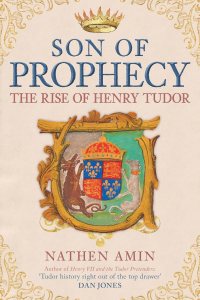 The date is August 22, 1485, and a young man stands in the middle of a battlefield. He has done what seemed nigh impossible, he defeated the last Plantagenet king Richard III to become the new King of England. His heritage makes this man unique and qualified to start a new dynasty. His mother’s family the Beauforts have been explored quite heavily by historians and authors alike. They see this victory as a change in English history whereas his father’s family sees it as a sign of something deeper. To the Tudors and Henry’s fellow Welshmen, it is the fulfillment of a centuries-old prophecy. So who were Henry Tudor’s ancestors and what did it mean for Henry to be the titular Son of Prophecy? Nathen Amin tells the remarkable story of the Tudors and how their struggles and triumphs led to Henry Tudor taking the throne in his latest book, “ Son of Prophecy: The Rise of Henry Tudor.”
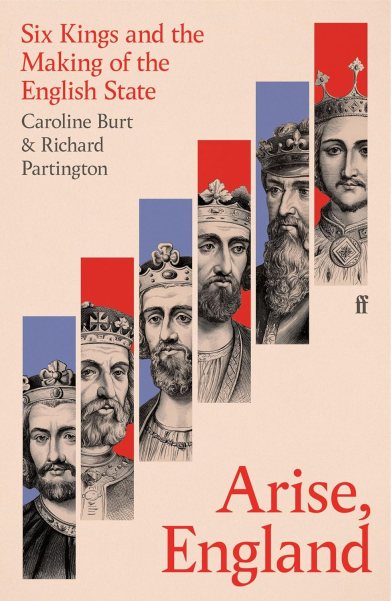 Like many other countries, England has been through growing pains when it comes to reforming its political, military, and judicial systems. None more so than the pains of the medieval period, specifically from 1199 to 1399. In those two centuries, there were six Plantagenet kings, each with a different style of being king and a different way of changing England with each reign. We often think that the biggest change to England’s political history during this time was the Magna Carta, but in fact, that was only just the beginning. Caroline Burt and Richard Partington have combed the archives to do a deep dive into each reign of these Plantagenet kings, examining the political and judicial changes that happened in a short period. Their comprehensive book is entitled, “Arise, England: Six Kings and the Making of the English State.”
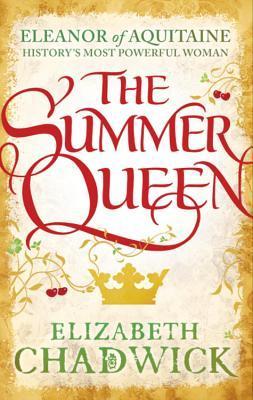 A legendary Queen of both France and England. A wife who went on the Crusades with her first husband and chose her second husband. A fierce mother who defended her Plantagenet children no matter the cost. Eleanor of Aquitaine has been revered and reviled for centuries, some saying she was a powerful woman ahead of her time while others considered her someone who could manipulate those around her by having affairs, including supposedly with her uncle in Antioch. Her story has been told in numerous ways through different mediums throughout the centuries, but now Elizabeth Chadwick has decided to write her interpretation of Eleanor of Aquitaine’s life in a trilogy of historical fiction novels. The first in the series, “The Summer Queen,” explores Eleanor’s early years, her marriage to a young French king, and the man destined to become King of England.
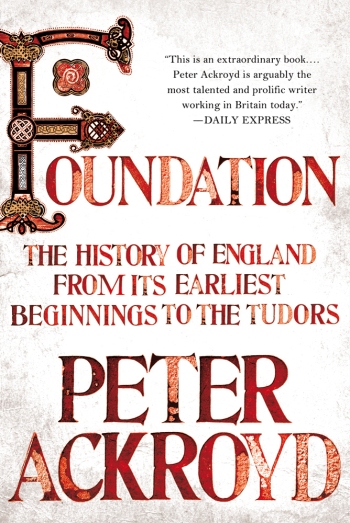 England is a nation that is rich in history and conflicts galore. Through the centuries, England has seen so much change. Many of us know the stories of the medieval and the Tudor kings and queens of England, covered in numerous books, but Peter Ackroyd has taken this concept a step forward. Ackroyd embarked on an epic quest to chronicle the history of England from its prehistoric origins to the modern age. In “Foundation: The History of England From Its Earliest Beginnings to the Tudors,” Peter Ackroyd begins his epic journey into the past to explore the origins of English history.
 A life of luxury from birth, destined to be crowned King or Queen of England. This is what we often think life must have been like for royal heirs who reached the ultimate destination of a crown and a throne. However, the stories of those who failed to reach the throne are mired in tragedy and heartache. The question of royal succession in England is a complex issue, especially when the heir to the throne dies unexpectedly, leaving doubts on whether a dynasty will survive through blood or dissolve in conflict. How did the deaths of these potential rulers radically transform the fabric of English history as a whole and what can their lives tell us about what kind of rulers they might have been? Ashley Mantle hopes to answer all of these questions and more in his latest book, “Uncrowned: Royal Heirs Who Didn’t Take the Throne.”
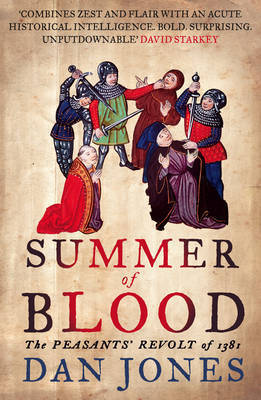 The year was 1381, and England was engulfed in chaos. A band of ruffians and revolters descended on London to achieve political change and a fair chance for the lower classes who suffered greatly from war and plague. The young King Richard II watched as men like Wat Tyler and the preacher John Ball led this ragtag army to his doorstep, fighting against his advisors, like John of Gaunt, to end a poll tax that was their last straw. Why did this ragtag army march on London? How did men like Ball and Tyler convince the masses to march against their sovereign and his government? How did this revolt end, and did the people get what they wanted due to their revolution? Dan Jones brings the bloody story of the first significant revolution by the English people to life in his book, “Summer of Blood: The Peasants’ Revolt of 1381.”
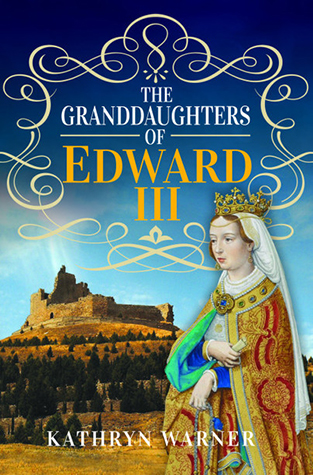 When we think about the legacy of Edward III, we often think about a warrior king who became king after his father, Edward II’s disastrous fall from grace. We know about his sons that he had with his beloved wife, Philippa of Hainault: Edward the Black Prince, Lionel of Antwerp, Duke of Clarence, John of Gaunt 1st Duke of Lancaster, Edmund of Langley, 1st Duke of York, and Thomas of Woodstock, Duke of Gloucester. Famously, we get the 15th-century conflict known as the Wars of the Roses through the descendants of Edward III. However, the male descendants only tell half the story of Edward III and Philippa of Hainault’s legacy in England and throughout Europe. In her latest book, “The Granddaughters of Edward III,” Kathryn Warner examines the lives of Edward III’s female descendants to better appreciate the strength of this group of branches of the Plantagenet family tree.
 Adventures of a Tudor Nerd