
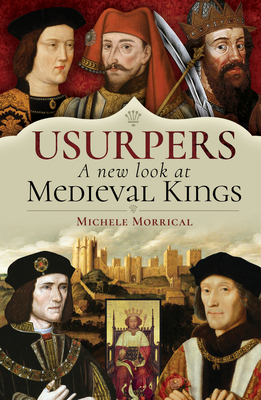
In medieval Europe, to be considered a strong king, you must keep a firm grasp on your crown, or those who see you as weak will take advantage. These men were known as usurpers throughout history who steal the throne through combat or by illegal means. Some of the most well-known kings in English history have been categorized as usurpers, but is this a fair assessment of their mark in history, or is it a case of propaganda changing their legacy? In her debut nonfiction book, “Usurpers, a New Look at Medieval Kings,” Michele Morrical explores the lives of six English kings who bear that title to see if it makes sense with the facts of how they came into power.
I would like to thank Net Galley and Pen and Sword Books for sending me a copy of this book. When I heard this book was published, I wanted to see how Morrical described a usurper and which king she considered usurpers. I have never heard of a book that focused solely on those who stole thrones in England, so I was excited to see how well it read.
Morrical breaks her book into six sections, with each part focusing on one specific king and his rise to power. She focuses on William the Conqueror, Stephen of Blois, Henry IV, Edward IV, Richard III, and Henry VII as examples of rulers in English history known to be usurpers. Morrical writes biography vignettes to give her readers an understanding of how they came to power and who they had to remove from the throne to become the next monarch. In some cases, it meant starting a new dynasty, and in others, it was just a continuation of the family’s lineage, but it was a different branch of the family tree. The biographies tend to get repetitive, especially with the sections dedicated to the Wars of the Roses. If you are new to these kings and the events of their lifetimes, the repetitive nature will help you understand how everything is connected.
I think Morrical can improve if she writes another nonfiction book by using quotes from primary sources and other historians to strengthen her arguments. I wish she had included discussions from chronicles or other primary sources from around the times that these men became rulers to see the consensus of the time towards the new king. It would have added an extra layer to the stories, and readers could see how our definition of a usurper king would have compared or contrasted to the views of the past. I would have also liked Morrical to have discussed whether being a usurper king had a positive or negative connotation. Many kings on this list were considered game-changers when ruling England and transformed how England was viewed in the grander scheme of European politics.
I think for her first book, Morrical does a decent job of presenting her viewpoints about certain kings and presenting the facts about their lives. One can tell that Morrical is passionate about usurpers and understanding why they took the English throne from their predecessors. Overall, I think it is not bad for a book that combines the lives of six kings of England into one text. If you want a good introductory book into the lives of usurper kings, you should give “Usurpers, a New Look at Medieval Kings” by Michele Morrical a try.

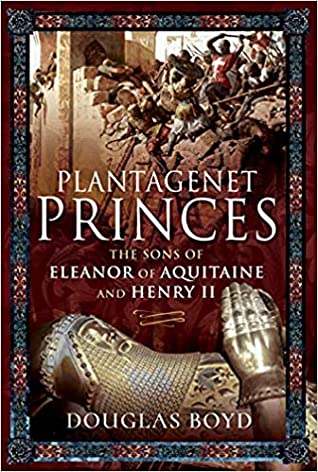 One of the most infamous families in the history of England lasted for over three hundred years and it was filled with numerous princes that fought for their right to rule, much to the chagrin of the Tudor dynasty. The Plantagenet Dynasty was full of scandals and bloodshed, testing the core values of what it meant to be a family and rulers of an emerging country like England. This dynastic clash for power that came to define this dynasty began with Henry II and his sons by his wife Eleanor of Aquitaine. When their father refused to give the boys any true power, which was to be excepted with all princes, his sons waged war against Henry II and their brothers. The stories of these bonds and what ultimately tore them asunder are told in Douglas Boyd’s latest collection of biographies aptly titled, “Plantagenet Princes: The Sons of Eleanor of Aquitaine and Henry II”.
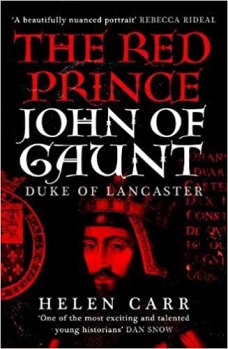 When one studies the history of the English monarchy, we tend to consider those who ruled and those who advised the ruler as significant characters. We rarely study the family members of the monarch who did not win the right to rule the kingdom. Yet, they are often either extremely loyal or they desire the crown with such ferocity that they rebel against their own family. It seems like a rather cruel world, but that was the life of a medieval monarch. True loyalty for one’s family was a rare feat. One man showed the depth of his loyalty to his family, even when the people despised him. He was the son of King Edward III, the brother of the famous Black Prince, the uncle of King Richard II, and the father of Henry Bolingbroke who would become King Henry IV. Gaunt’s reputation and legacy have been marred by his wealth and the role that he played with the Peasants’ Revolt, but was he such a bad person? In Helen Carr’s brilliant debut biography, “The Red Prince: The Life of John of Gaunt, the Duke of Lancaster”, she looks to uncover the truth about the man behind the throne and why he never desired the crown for himself.
 August 22, 1485, marked the end of the Plantagenet Dynasty with the death of King Richard III at the Battle of Bosworth Field. The man who succeeded him as King of England after his death was young Henry Tudor, whose dynasty would live in infamy in English history, thought that he was done fighting on the battlefield for his right to rule. This was only the beginning of a decades-long war against those who claimed to be lingering shadows of the past. They claimed to be the Princes in the Tower, whose disappearances in 1483 left to doubt and confusion on what happened to them and gave those who despised this new dynasty opportunity to exploit a young king’s fear of being overthrown. The young men who made this king who won his way to the throne on a battlefield quake in his boots are known today as “the Pretenders”, but who were they? In Nathen Amin’s much-anticipated book, “Henry VII and the Tudor Pretenders: Simnel, Warbeck, and Warwick”, he traces the origins of each pretender to show what type of threat that they posed to the first Tudor king.
 One of the most prominent royal families of English history was the Plantagenets, who reigned for over three hundred years. In the first one hundred years of this family’s infamous history, five kings ruled (the first two are considered kings of the Angevin dynasty): Henry II, Richard I, John, Henry III, and Edward I. These five kings saw England change drastically, but they also participated in the international political landscape of the day, which involved the series of wars that today we simply refer to as the Crusades. The early Plantagenet kings saw much bloodshed and war, but they were not alone in their struggle to keep the dynasty going. These men would not have gotten as far as they did without their wives who stood by their sides. In Alison Weir’s latest installment of England’s Medieval Queens series, “Queens of the Crusades”, she takes a deep dive into the lives of the first five Plantagenet queens to show how remarkable these women truly were to stand beside their husbands during the times of the Crusades in Europe.
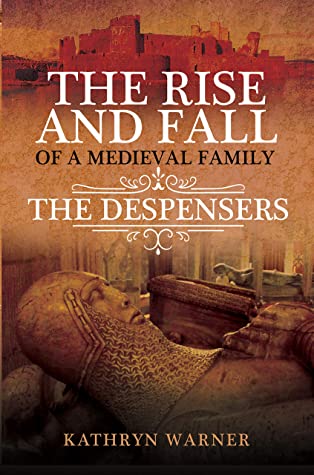 In the times of medieval kings, the power of the crown was dependent on the support that they maintained with noble families. One of the most notorious noble families in England was the baronial family known as the Despensers. Between the 13th and the 15th centuries, the Despensers were at the heart of royal politics and some of the biggest power plays during the reign of the Plantagenets. We know about the few members who truly made waves during this time, especially Hugh Despenser the Elder and Hugh Despenser the Younger, but this family’s story is much more than a few members. In Kathryn Warner’s latest book, “The Rise and Fall of a Medieval Family: The Despensers”, she takes on the challenge of explaining the entire family story of this infamous baron clan.
 In life, one of the hardest decisions that we must decide is who to trust. Who can we truly depend on to be by our side when times get rough or when they are going our way. Most of the time, we can rely on those who we put our trust in, but there are extraordinary times when our trust in someone is utterly shattered. Betrayal of one’s trust is like a knife in the back, it can be devastating no matter who is being betrayed. It is not a new concept in human nature to betray others. Whether for money, for power, or lust, betrayal can destroy the lives of everyone involved. Can there be redemption after betrayal? In this anthology of historical fiction tales, twelve authors explore every aspect of betrayal throughout history. This is “Betrayal” by the Historical Fictioneers.
 Adventures of a Tudor Nerd