 Today, I am pleased to welcome Anne O’Brien to my blog to discuss the inspiration for her latest novel, The Queen’s Rival. I would like to thank Anne O’Brien and The Coffee Pot Book Club for allowing me to be part of this blog tour.
In past years I have written about a variety of medieval women, either royal or attached to the Court. I enjoy investigating how these women played a role in the political manoeuvrings of their day. Although we so rarely hear the voices of these women, since they lived in a man’s world and the history was invariably written by men, their involvement was often considerable and they deserve our interest.
Cecily Neville, Duchess of York, is one of the most appealing women of English medieval history, worthy of celebration. Most medieval women verge towards the invisible, a two-dimensional entity without character or apparent influence; Cecily Neville is an exception. The Wars of the Roses were both vast in scope and complex in the range of family connections. So was Cecily’s own Neville family with its royal blood inherited through their mother Joan, Countess of Westmoreland, daughter of John of Gaunt. Cecily demanded in a regal fashion that she be allowed to speak for herself. It was a challenge that lured me to become involved; I accepted the challenge and wrote about her.
Without a doubt, Cecily was a remarkable woman, living for eighty years through five reigns, interacting with a vast dramatis personae of famous, infamous, and influential characters in these tumultuous years. She was the mother of two kings, Edward IV and Richard III, and grandmother to a Queen Consort, Elizabeth of York, who stepped across the divide between York and Lancaster and married King Henry VII.
On the surface, this would seem to be a life bringing Cecily immense satisfaction and personal achievement, but it was also a life of tragedy. Cecily outlived all but two of her twelve children, both daughters, some dying in infancy, others meeting terrible ends. George, Duke of Clarence, was executed for treason, on the orders of his brother King Edward, in the Tower of London. Richard III died on the battlefield at Bosworth; Edmund of Rutland met his end in an act of revenge after the Battle of Wakefield. What heartbreak this must have inflicted on her, added to the death of her husband, Richard, Duke of York, at Wakefield.
Cecily’s life also witnessed its share of scandal. The rumour of her liaison with the common archer Blaybourne, thus prompting the blot of illegitimacy against King Edward IV, was too valuable a rumour to ignore for those such as the Earl of Warwick and Duke of Clarence who would willingly depose King Edward. Was the scandal true? Unlikely, but the widespread gossip must be faced. How difficult for a woman of Cecily’s pride to accept that her own family would dishonour her reputation.
Would such tragedy obliterate the strength of Cecily’s character? Cecily worked tirelessly for the House of York. She stood by her children as far as it was possible, even George of Clarence, trying to bring him back into the Yorkist fold. In Ludlow, abandoned by her husband, Cecily faced a leaderless Lancastrian army and howling mob intent on plundering the town. She proved to be a woman of great courage. As old age approached, she devoted herself to a life of duty and formidable piety almost worthy of the life of a nun, a life of loyalty to the family she had always supported.
Cecily, Duchess of York, was the doyenne of late medieval history, the Queen who was never crowned. It would have been unforgivable of me to leave her out of my pantheon of medieval ‘heroines’.
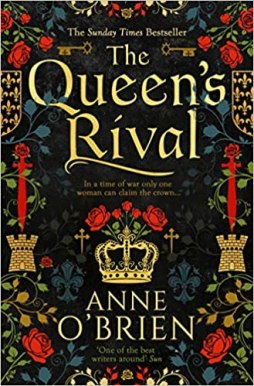 (Blurb)
England, 1459.
One family united by blood. Torn apart by war…
The Wars of the Roses storm through the country, and Cecily Neville, Duchess of York, plots to topple the weak-minded King Henry VI from the throne.
But when the Yorkists are defeated at the Battle of Ludford Bridge, Cecily’s family flee and abandons her to face a marauding Lancastrian army on her own.
Stripped of her lands and imprisoned in Tonbridge Castle, the Duchess begins to spin a web of deceit. One that will eventually lead to treason, to the fall of King Henry VI, and to her eldest son being crowned King Edward IV.
Buy Links
Amazon UK: https://www.amazon.co.uk/Queens-Rival-Anne-OBrien/dp/0008225532
Amazon US: https://www.amazon.com/Queens-Rival-Anne-OBrien/dp/0008225532
Amazon CA: https://www.amazon.ca/Queens-Rival-Anne-OBrien/dp/0008225532
Amazon AU: https://www.amazon.com.au/Queens-Rival-Anne-OBrien/dp/0008225508
Barnes and Noble: https://www.barnesandnoble.com/w/the-queens-rival-anne-obrien/1137842630
Waterstones: https://www.waterstones.com/book/the-queens-rival/anne-obrien/9780008225544
Kobo: https://www.kobo.com/gb/en/ebook/the-queen-s-rival-the-sunday-times-bestselling-author-returns-with-a-gripping-historical-romance
Audio: https://www.audible.co.uk/pd/The-Queens-Rival-Audiobook/0008225524
Blackwells: https://blackwells.co.uk/bookshop/product/The-Queens-Rival-by-Anne-OBrien-author/9780008225544
WHSmith: https://www.whsmith.co.uk/products/the-queens-rival/anne-obrien/hardback/9780008225544.html
 Author Bio
Anne O’Brien
Sunday Times Bestselling author Anne O’Brien was born in West Yorkshire. After gaining a BA Honours degree in History at Manchester University and a Master’s in Education at Hull, she lived in East Yorkshire for many years as a teacher of history.
Today she has sold over 700,000 copies of her books medieval history novels in the UK and internationally. She lives with her husband in an eighteenth-century timber-framed cottage in the depths of the Welsh Marches in Herefordshire. The area provides endless inspiration for her novels which breathe life into the forgotten women of medieval history.
Social Media Links:
Website: https://www.anneobrienbooks.com/
Twitter: https://twitter.com/anne_obrien
Facebook: https://www.facebook.com/anneobrienbooks/?ref=bookmarks
LinkedIn: https://www.linkedin.com/in/anne-o-brien-89668a45/
Pinterest: https://www.pinterest.co.uk/thisisanneobrie/_saved/
Amazon Author Page: https://www.amazon.co.uk/Anne-OBrien/e/B001HD1NHI
Goodreads: https://www.goodreads.com/book/show/51111864-the-queen-s-rival?from_search=true&from_srp=true&qid=MIYPBpVMFH&rank=1
News Letter sign up: https://www.anneobrienbooks.com/

 The glitzy, glamorous life of the Tudors portrayed in popular TV shows and novels mask the truth of this infamous dynasty. It is more bloody than what has been described. It is filled with grotesque executions, deadly diseases, bloody battles, and bloody battles. What happened to Richard III’s remains? What was Tudor torture like for those unfortunate victims? What were other devious tales at play in 16th-century Europe? Mickey Mayhew has worked hard to answer these questions by combining 45 of the most gruesome stories from this dynasty into one book, “The House of Tudor: A Grisly History.”
 One woman is torn between the loyalty to her birth family and the loyalty to her family by marriage. Now, this may sound like the story of Elizabeth of York, but alas, it is not. This story does take place in the fifteenth century, but it is the story of Elizabeth of York’s grandmother, “The Rose of Raby,” Cecily Neville. Born to the proud Neville family, who were proud Lancastrians, Cecily’s father, Ralph Neville, the Earl of Westmorland, arranged a marriage for his daughter to the young and ambitious Richard, Duke of York. She is now one of the most powerful women in England, but with power comes risks of ruin as Cecily has a secret that could be disastrous. War looms between the Red Roses of Lancaster and the White Roses of York, one that will transform English history forever, with Cecily caught in the middle. Her story is told in Joanna Hickson’s novel, “Red Rose, White Rose.”
 When we think of those who made an impact in history, we tend to think of those who have been born to a married couple and therefore were considered legitimate children, especially when it comes to royal children. However, we know that illegitimate royal children, like William the Conqueror, greatly impacted history. Illegitimate royal children may have been barred from becoming king or queen of their respective countries of birth, but that does not mean they didn’t impact how their home country was governed. One of these children who affected politics during the Tudor dynasty was Arthur Plantagenet, the illegitimate son of Edward IV. In her latest book, “Arthur Plantagenet: Henry VIII’s Illegitimate Uncle,” she explores the life of this man who gives us extraordinary insight into the running of Calais and how Henry VIII treated other family members.
 During medieval wars, one’s fate is often determined by the spin of the Wheel of Fortune, even for those who did not fight a single battle. One could be living a life of luxury, stability reigning supreme, and is destined to marry a foreign king or prince, but when the wheel begins to spin, all seems lost, and the things that once were as good as guaranteed fall by the wayside. This description could fit any number of stories from the past. Still, the one highlighted in this particular novel is the story of the eldest daughter of King Edward IV and Elizabeth Woodville and the first Tudor queen. In the first book of her latest book series, “The Last White Rose: A Novel of Elizabeth of York,” Alison Weir shows how one woman was able to ride the highs and lows of life to secure her family’s legacy and transform English history forever.
 In history, the stories of women closest to those who sat on the throne tend to shine a bit brighter than others. Their tales give us great insight into how their respective countries were run and how dangerous it could be to marry someone with royal blood in their veins. However, some of the tales get lost in the annals of the past, only to be discovered much later. One of those tales is the story of Cecily Bonville- Grey, the wife of Thomas Grey Marquis of Dorset. In her own right, an extremely wealthy woman, her marriage into the Grey family would help define the succession issue during the late Tudor dynasty. Her story is finally told in Sarah J. Hodder’s latest book, “Cecily Bonville-Grey- Marchioness of Dorset: From Riches to Royalty.”
 A banner decorated with three suns flaps in the wind on the field of battle. The young man behind this emblem is Edward, Earl of March, whose father Richard Duke of York and brother Edmund Earl of Rutland were tragically slain at the Battle of Wakefield. His younger brothers, George Duke of Clarence and Richard Duke of Gloucester, will help Edward carry their father’s cause for the family of York to rule England. When loyalty is questioned even among family members, only one man would truly stand behind Edward until the bitter end. That man would be Richard Duke of Gloucester, or as we know him today, the much-maligned King Richard III. He is often viewed as a treacherous child-killer who coveted the throne after Edward IV’s death, but is that accurately portraying the last Plantagenet king? Who was the real King Richard III? In her magnum opus, “The Sunne in Splendour,” Sharon Kay Penman presents her case for Richard III as a man betrayed, both in life and after his death.
 Loyalty to one’s king was imperative during times of war and strife. This statement was painfully true during periods of civil war when cousins fought against cousins. The Wars of the Roses was where we see families rise and fall like the tides, depending on which side they were loyal to and who was on the throne. One family who was able to navigate this political quagmire and end up on the side that would win in the end was the Brandons. Many recognize the name Brandon because of Charles Brandon and his rise in the court of Henry VIII, but how did they reach that point? What are the origins of the Brandon family? In her latest book, “The Brandon Men: In the Shadow of Kings”, Sarah Bryson takes her readers on a ride to find out what loyalty to the crown gave this family and why their legacy lives on today.
 Adventures of a Tudor Nerd